Slashdot Mirror
Domain: eeoc.gov
Stories and comments across the archive that link to eeoc.gov.
Stories · 5
-
Facebook Lets Advertisers Exclude Users By Race (propublica.org)
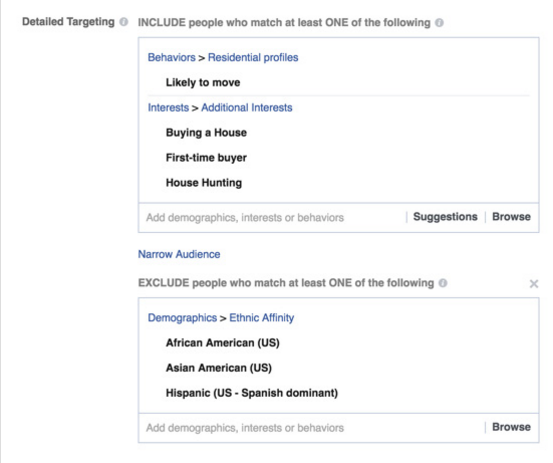
schwit1 quotes a report from ProPublica: Imagine if, during the Jim Crow era, a newspaper offered advertisers the option of placing ads only in copies that went to white readers. That's basically what Facebook is doing nowadays. The ubiquitous social network not only allows advertisers to target users by their interests or background, it also gives advertisers the ability to exclude specific groups it calls "Ethnic Affinities." Ads that exclude people based on race, gender and other sensitive factors are prohibited by federal law in housing and employment. You can view a screenshot of a housing advertisement that ProPublica's Julia Angwin and Terry Parris Jr. purchased from Facebook's self-service advertising portal here. The report adds: "The ad we purchased was targeted to Facebook members who were house hunting and excluded anyone with an "affinity" for African-American, Asian-American or Hispanic people. (Here's the ad itself.) The Fair Housing Act of 1968 makes it illegal "to make, print, or publish, or cause to be made, printed, or published any notice, statement, or advertisement, with respect to the sale or rental of a dwelling that indicates any preference, limitation, or discrimination based on race, color, religion, sex, handicap, familial status, or national origin." Violators can face tens of thousands of dollars in fines. The Civil Rights Act of 1964 also prohibits the "printing or publication of notices or advertisements indicating prohibited preference, limitation, specification or discrimination" in employment recruitment. Facebook's business model is based on allowing advertisers to target specific groups -- or, apparently to exclude specific groups -- using huge reams of personal data the company has collected about its users. Facebook's micro-targeting is particularly helpful for advertisers looking to reach niche audiences, such as swing-state voters concerned about climate change. Facebook says its policies prohibit advertisers from using the targeting options for discrimination, harassment, disparagement or predatory advertising practices. -
Silicon Valley Tech Workforce Is Vastly Different From US, Say Feds (computerworld.com)
Reader dcblogs shares an article on Computer World: In recent years, major high-tech firms have started releasing workforce diversity data, along with a promise to improve. And there is much room for improvement, according to federal officials. Among the top 75 Silicon Valley tech firms, whites make up 47% of the workforce, Asian Americans 41%, Hispanics, 6% and African Americans 3%, according to an analysis by the U.S. Equal Employment Opportunity Commission (EEOC). Women account for 30% of the workforce at these 75 firms. The diversity makeup of these Silicon Valley high-tech firms is very different from the national employment picture. When compared to overall private industry employment, the tech sector nationally -- not just Silicon Valley -- employed a larger share of whites (63% to 68%), as well as a larger share of Asian Americans (6% to 14%) and a smaller share of African Americans (14% to 7%) and Hispanics (14% to 8%). Employers with a workforce greater than 100 file reports to the EEOC about their employees' race, color, gender and national origin. Nationally, 64% of the employees in high-tech are men versus 52% in the broader workforce. Women account for 36% of the tech workforce, versus comprising 48% of the broader workforce. -
Google, Facebook, Microsoft Deliver K-12 CS Demands To Congress (politico.com)
theodp writes: Politico reports that just one day after Facebook launched TechPrep, a highly-publicized initiative to attract more minorities and women to coding, Google, Facebook, Microsoft, and Code.org quietly sent a letter to top education lawmakers in the House and Senate insisting that computer science "must" be added to the list of "core academic subjects" and states be given resources to improve STEM education programs. "Computer science is marginalized throughout K-12 education," reads the letter. "We need to improve access for all students, particularly groups who have traditionally been underrepresented." Echoing the last point at this month's Grace Hopper Women in Computer Celebration, YouTube CEO Susan Wojcicki called for mandatory computer science in schools, suggesting that boys — like her own son — are monopolizing the family computer across America, leaving girls — like her own daughter — out of the conversation when it comes to technology (video @38:33). The new round of hand-wringing comes as tech companies face the deadline for filing their 2015 EEO-1 surveys and seek more tech-friendly U.S. visa and OPT STEM policies, so it's probably worth remembering that Microsoft proposed tech could turn workforce diversity lemons into H-1B visa lemonade by connecting tech immigration to K-12 CS education. -
Lies, Damn Lies, and Tech Diversity Statistics
theodp writes Some of the world's leading Data Scientists are on the payrolls of Microsoft, Google, Facebook, Yahoo, and Apple. So, it'd be interesting to get their take on the infographics the tech giants have passed off as diversity data disclosures. Microsoft, for example, reported its workforce is 29% female, which isn't great, but if one takes the trouble to run the numbers on a linked EEO-1 filing snippet (PDF), some things look even worse. For example, only 23.35% of its reported white U.S. employee workforce is female (Microsoft, like Google, footnotes that "Gender data are global, ethnicity data are US only"). And while Google and Facebook blame their companies' lack of diversity on the demographics of U.S. computer science grads, CS grad and nationality breakouts were not provided as part of their diversity disclosures. Also, the EEOC notes that EEO-1 numbers reflect "any individual on the payroll of an employer who is an employee for purposes of the employers withholding of Social Security taxes," further muddying the disclosures of companies relying on imported talent, like H-1B visa dependent Facebook. So, were the diversity disclosure mea culpas less about providing meaningful data for analysis, and more about deflecting criticism and convincing lawmakers there's a need for education and immigration legislation (aka Microsoft's National Talent Strategy) that's in tech's interest? -
Is A "Well-Rounded" Education a Good One?
hendridm asks: "Universities seem to push being well-rounded, or knowing a little bit about everything but nothing about anything in particular. They attempt to teach courses that could help you succeed in your lifelong career, whatever it might be. It seems to me that it would be better to teach skills that would help us in the first 10 years of employment. As a senior Information Systems major in a state university in the Midwest, I can think of countless examples that support this idea." Of course, a well-rounded education can be a good one, it just depends on your definition of 'rounded'. It doesn't exactly do students a favor by exposing them to the forrest until they have a good grasp of the concept of the "tree", which is hedridm's main point. Do any of you know of curriculums that are good examples of a true well-rounded education?"In my Finance course, I learn how to balance a corporate stock portfolio, but I have no clue how to start a business or pay my employees.
In my System Analysis & Design course, I spend 3 hours constructing data-flow diagrams, entity-relationship diagrams, and Ghantt charts for programs that take around an hour to code!
In my Management course, my professor discusses techniques for being an effective CEO, but I don't even know how to manage a few subordinates, much less an entire company.
In my MIS course, we learn about client-server technology, but when I ask if my peers have tested their web pages on Macintosh, they reply, "Why would I have to do that?" Most of them don't even think of Linux as an operating system, but more as a hacker's toy. Forget about asking them to make it Mozilla or Lynx compatible. They don't want to waste their time. But the University will make sure it is ADA compliant, since any institution that receives federal funding must require this...
Don't most "big picture" lessons come with experience, through person's journey from entry-level employee to a skilled IT/business professional? Wouldn't it make more sense to teach things that will help students early in their careers, like technical skills and other trade/foundation skills that are often required of entry-level, non-management employees? Does the average entry-level IT person need to make the sort of decisions a CEO or CIO needs to make? Do companies really want me to spend more time diagramming a program than I need to program it in the first place? (What about just documenting the code?) Knowing the big picture is good, but how do you get to that level if you don't have any skills?My question for Slashdot readers is: Is this really what companies want of today's graduates?"