Slashdot Mirror
Domain: eesi.org
Stories and comments across the archive that link to eesi.org.
Comments · 8
-
Re:Disaster in the making
If you are really look here or or maybe here.
If reading information-dense articles are too much for you here is one money-quote pulled from the second link above:
All told, nearly 1 million Americans are working near- or full-time in the energy efficiency, solar, wind, and alternative vehicles sectors. This is almost five times the current employment in the fossil fuel electric industry, which includes coal, gas, and oil workers.
-
Re:Well crap
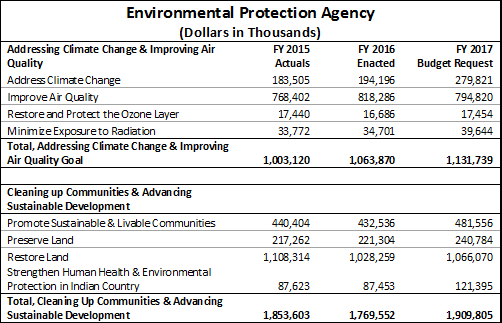
Do you have a breakdown anywhere I can reference showing how the EPA spends money? I've only been able to find documentation for budget requests that show 2 out of 5 high level goals:
http://www.eesi.org/images/con...
At least based on what's shown here, a large portion of the budget is spent on air quality and land restoration.
-
Re:and that would be a bad thing... because?
You're confusing cause and effect.
No I'm not.
A productive, active economy often creates corporate turnover and high employment.
Not wrong...
It doesn't follow that creating high corporate turnover and high employment is good for the economy.
No because I wasn't reaching that conclusion from that assumption.
The claim is that any government policy to reduce carbon emission will wreck the economy. But we already have examples of that not being the case I'm struggling to think of any examples of increased employment and new emerging industries being bad for the economy? Maybe you could help me out?I know: it's a common mistake made by devotees of left and right wing politics.
Only those that proceed on false assumptions.
-
Re: Without government...
here, a brief history: http://www.eesi.org/papers/vie...
B. Brief History of Building Codes
"Over the centuries, building codes have evolved from regulations stemming from tragic experiences to standards designed to prevent them." - The Insurance Institute for Business & Home Safety (IBHS)
The Code of Hammurabi (1800 B.C) is generally recognized as the world’s first building code, although this code was essentially a criminal statute that included capital punishment for shoddy workmanship that resulted in death. The great fires of history including Rome (64 AD), Boston (1631), London (1666), Chicago (1871), Baltimore (1904) and Cleveland Clinic (1929), led to soul-searching and new regulations.
The beginning of modern codes can be traced to the 1897 publication of the NFPA’s National Electrical Code® (NEC®). (Today, the 2014 NFPA 70®: NEC® covers the latest requirements on electrical wiring and equipment installation issues, including provisions for the use of connections, voltage markings, conductors and cables). Early attempts to prevent fires -- predecessors of today’s zoning laws and safety codes -- included requirements for wider streets, limitations on building spacing and height, and elimination of thatched roofs and wooden chimneys in cities. Sanitation concerns were the moving force behind some early codes and over the years, have led to plumbing standards, light and ventilation requirements, minimum room dimensions and other health and safety requirements we take for granted in today’s building codes. Tragic fires at the MGM Grand in 1980 and the Station Nightclub in 2003 led to more recent requirements for fire protection, including sprinkler systems, exit lighting and limits on explosives and pyrotechnics.
Natural disasters also lead to code improvements. Hurricane Andrew in 1992 resulted in the development of more stringent construction standards. The storm that destroyed South Florida revealed a serious deficiency and led to Florida’s first statewide code system. Seismic code provisions appeared first in Italy and Japan in the early 20th Century and in the United States as an appendix to the Uniform Building Code in 1927. Research programs have increased our understanding of earthquakes over the years, and serious research programs beginning in the 1970s led to code upgrades following the Northridge Earthquake in California in 1994. Specific provisions within the IBC, IRC and IEBC are intended to ensure structures can adequately resist seismic forces during earthquakes. These seismic provisions represent the best available guidance on how structures should be designed and constructed to limit seismic risk. FEMA officials, however, say some jurisdictions have been slow to adopt the latest code editions with seismic safety provisions. They warn new structures in these communities will "probably not provide the current minimum level of protection from earthquake hazards." FEMA also is concerned states and local jurisdictions with "high levels of seismic hazard" that have adopted model codes have weakened or excluded seismic provisions.
But then, Hammurabi was a crony capitalist too in your fantasy world I guess....
And look, more about fire and electrical. Like the great London fire, and several others, back when buildings were mostly wood and butted up right against each other, so a fire could destroy an entire city instead of just one home. and they solved it by....legally requiring them to be more spaced out...in a building code...
another important part of the code, sewage and sewage hookups. because who wants to repeat the great cholera epidemic, again in London, caused by a single dirty diaper being disposed of in a cistern that fed drinking water to half the city.
again: you're an idiot
-
Re:More for show than environment
According to this report by the EESI coal accounted for 65% of China's electricity production back in 2012, although it doesn't say what proportion of that is so-called "clean coal".
-
Re:Renewables Advantages Over Exhaustibles
The DOE table you linked to runs from 2003-2007, as shown below. Not sure where you got the '08 number. One surprise for me at least, is that from '06 to '07, the percentage actually decreased. Looking at the chart (http://en.wikipedia.org/wiki/File:USRenewableElectricity.jpg) that you provided, shows a continued downward swing in that percentage, which is likely due to our constantly increasing demand. One other thing that needs to be made clear is that hydroelectric currently makes up 5.74% of all the renewable energy in the U.S...and I suspect that won't be increasing since there's so much opposition to dams. So, if you take out hydro, the amount of energy that renewables are producing is much smaller.
Energy Source 2003 2004 2005 2006 2007
Renewable Energy 6.150 6.261 6.424 6.909 6.813I attempted to look further into the comments about CA, but some of the references on Wikipedia didn't work. http://www.eesi.org/publications/Fact%20Sheets/EC_Fact_Sheets/Factoid20.pdf for example.
-
Re:dodge! parry!
Sure, here's a lot of links for you to read over
Some links are by obviously biased parties (for example, NCGA is the National Corn Growers Association). Others are not. This is just a start, of course - I gathered these in about three minutes of searching. Again, if you can find a single "net negative" study done by anyone - university, corn-industry, government, environmental group, anyone really - that didn't have Pimental and his bad data involved, please let me know, because I've never found such a study. -
What about Canada?
Well, I live in Canada too, and I think the ridiculous costs of ratifying Kyoto estimated by the energy industry and Alberta are on at least as shaky ground as the estimated climactic effects of not ratifying that are often criticized. It's natural for Ralph Klein, the the Canadian Petroluem Producers Association & Chamber of Commerce, and George "Big-Oil" Bush to spread worst-case scenario estimates on the costs of Kyoto, but these scaremongering tactics just muddy an already difficult discussion. An economic meltdown certainly didn't happen when the state of California introduced stringent vehicle emissions standards and it's not in the cards with California's much greater planned controls, for example. Also, the jurisdictions that adopt such controls early will have a head start on building clean energy business and technologies that the rest of the world will inevitably have to adopt.
Two things nobody can deny: the climate is warming and further warming will have serious consequences. Further, the writing is on the wall that limits on carbon output is the way things are moving, whether we ratify Kyoto or not. We can either choose to join with the rest of the developed world and show some leadership, or not and point the finger to countries that cannot afford to adopt Kyoto as the reason we won't either. If Canada can't even take a (relatively) modest step now, how will we make the much larger necessary cuts in the future?