Slashdot Mirror
Domain: eoportal.org
Stories and comments across the archive that link to eoportal.org.
Comments · 7
-
Re:useless solution too
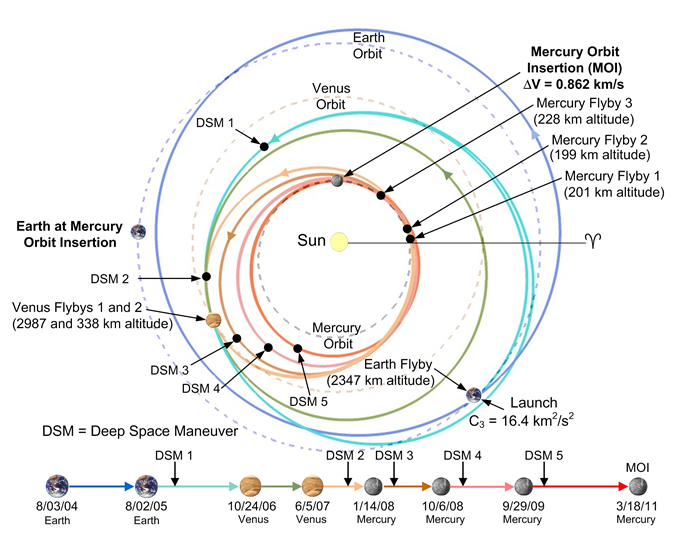
Actually, the closest approach doesn't necessarily matter, especially for the inner planets as the traveled path usually uses gravity assists. Here is an example of Parker's path to get close to the sun:
https://directory.eoportal.org...And one for Messenger going to Mercury:
http://messenger.jhuapl.edu/Ab...It's not like you can take a direct route without using a shitload of fuel.
-
Re:Too small to be tracked?
Objects about 10 cm and larger can be tracked in low orbit. That means the radar can follow an object long enough to derive orbital elements, allowing reliable predictions of where the object will be later. Objects about 2 mm and larger can be sampled by high-power radars. That means the radar helps build a statistical population based on whatever zips across a fixed beam.
I found a couple of figures (Fig. 1 and Fig. 24) showing the gap between tracking (Space Surveillance Network) and other sampling data sources. Also a recent presentation. -
Re:M2 is offline
WTF are you talking about? M-2 isn't offline. It just launched in 2014:
-
Re:Not good for long haul use
This band is not useful for long haul carriage due to atmospheric water vapor absorption. According to this chart, absorption between 200 and 280 GHz varies between 3 and 40 dB/km. That means at the low end only 50% of your signal is absorbed every km. At the high end, only 1/10,000th of your signal remains after each km.
this post speaks to similar issues including refraction.
That has not and will NEVER stop $TELCO from selling services across this with "UP TO" marketingspeak which means "we fuck you royally for a service which is online but effectively unuseable".
-
Not good for long haul use
This band is not useful for long haul carriage due to atmospheric water vapor absorption. According to this chart, absorption between 200 and 280 GHz varies between 3 and 40 dB/km. That means at the low end only 50% of your signal is absorbed every km. At the high end, only 1/10,000th of your signal remains after each km.
this post speaks to similar issues including refraction.
-
Re:Somewhat pointless, horse, barn, ...
There are no commercial European satellites with
For all those who ask 'how hard can it be?' (shades of Top Gear...) entry level into the commercial Very High Resolution satellite business starts at around half a billion -- don't forget the ground segment. Even future missions are not planning to go much below
The Man may well have bought 'all the coverage of Afghanistan' -- from a single operator. The Ikonos mission (1m pixel) was the only one operating at the time. The US Govt. does retain 'shutter control' rights of all the VHR missionslicensed by them - which is all the current VHR missions. That will change - especially with COSMO-SkyMed, a constellation of all-weather radar satellites with a max. resolution of >1m, coming soon.
There's a intro to VHR satellite imagery here. -
$10 million and 40kg? Why not $250k and 1kg?This is cool...but 'way out of my league. For those that have got $10 million to spare, have fun. What I'd like is a picosatelliteo coop.
These students got theirs into space for $120,000. Sure, that doesn't include "donated material, equipment and expertise", or the estimated $40,000 launch cost, but let's be optimistic and call it $250,000 all told. Well, get 50 people in and it's only $5000 each -- less than a good used car. Make it 500 people and you've got the cost down to less than a trip for two to Vegas. And for this I get to help send a satellite running Linux into space -- as close as I'm likely to come to making the trip myself.
I know that ham radio folks are already doing this sort of thing, but they've got their own goals. I admit, mine are a bit fuzzy beyond "put this L33+ satellite into space", but that's kind of appealing too. What could we cram on a picosatellite? What imaging can you do for cheap -- what resolution, what wavelengths? And of course, the question everyone wants answered: Can you host a webserver in space, and could it survive a Slashdotting?
I think something like this would be cool beyond measure. Who's in?