Slashdot Mirror
Domain: exploringcs.org
Stories and comments across the archive that link to exploringcs.org.
Stories · 5
-
Computational Thinking: AP Computer Science Vs AP Statistics?
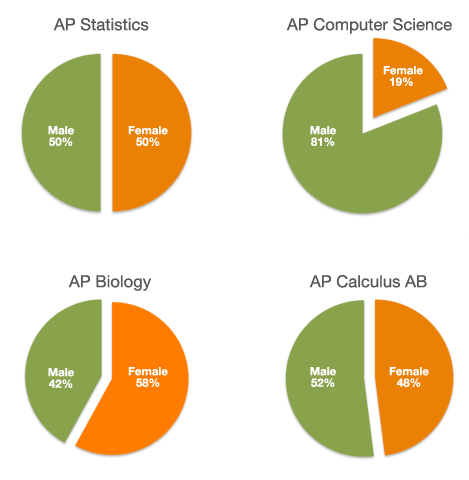
theodp writes: "What if learning to code weren't actually the most important thing?" asks Mother Jones' Tasneem Raja. "Rather than increasing the number of kids who can crank out thousands of lines of JavaScript, we first need to boost the number who understand what code can do." Computational thinking, Raja explains, is what really matters. So, while Google is spending another $50 million (on top of an earlier $40 million) and pulling out all the stops in an effort to convince girls that code and AP Computer Science is a big deal, could AP Statistics actually be a better way to teach computational thinking to college credit-seeking high school students? Not only did AP Statistics enrollment surge as AP CS flat-lined, it was embraced equally by girls and boys. Statistics also offers plenty of coding opportunities to boot. And it teaches one how to correctly analyze AP CS enrollment data! -
Computational Thinking: AP Computer Science Vs AP Statistics?
theodp writes: "What if learning to code weren't actually the most important thing?" asks Mother Jones' Tasneem Raja. "Rather than increasing the number of kids who can crank out thousands of lines of JavaScript, we first need to boost the number who understand what code can do." Computational thinking, Raja explains, is what really matters. So, while Google is spending another $50 million (on top of an earlier $40 million) and pulling out all the stops in an effort to convince girls that code and AP Computer Science is a big deal, could AP Statistics actually be a better way to teach computational thinking to college credit-seeking high school students? Not only did AP Statistics enrollment surge as AP CS flat-lined, it was embraced equally by girls and boys. Statistics also offers plenty of coding opportunities to boot. And it teaches one how to correctly analyze AP CS enrollment data! -
Is Computer Science Education Racist and Sexist?
theodp writes "What's wrong with this picture?" asked Code.org at its launch earlier this year, lamenting the lack of Computer Science students in a race and gender reference-free infographic. But as the organization has grown via public/private partnerships and inked agreements to drive the CS curriculum for the Chicago and NYC school systems, the same stats webpage has adopted a new gender and racial equity focus, positioning Computer Science education as "a chance to level the playing field" for women, Hispanic and African American students. The new message is consistent with the recently-forged Code.org partnership with the NSF-funded Exploring Computer Science (ECS, "a K-12/university partnership committed to democratizing computer science") and Computer Science Principles (CSP, "a new course under development that seeks to broaden participation in computing and computer science"). According to The Research Behind ECS, an "insidious 'virtual segregation' that maintains inequality" is to blame for keeping the number of African Americans and Latino/as CS students disproportionately low. So, what might the future of Code.org's proposed equity-based U.S. K-12 CS education look like? "Including culturally relevant instructional materials represented a driving focus of our course development," explained ECS Team members who now advise Code.org. "Cultural design tools encourage students to artistically express computing design concepts from Latino/a, African American, or Native American history as well as cultural activities in dance, skateboarding, graffiti art, and more. These types of lessons are important for students to build personal relationships with computer science concepts and applications – an important process for discovering the relevance of computer science for their own life." And — ironically for Code.org — it could mean less coding." -
Is Computer Science Education Racist and Sexist?
theodp writes "What's wrong with this picture?" asked Code.org at its launch earlier this year, lamenting the lack of Computer Science students in a race and gender reference-free infographic. But as the organization has grown via public/private partnerships and inked agreements to drive the CS curriculum for the Chicago and NYC school systems, the same stats webpage has adopted a new gender and racial equity focus, positioning Computer Science education as "a chance to level the playing field" for women, Hispanic and African American students. The new message is consistent with the recently-forged Code.org partnership with the NSF-funded Exploring Computer Science (ECS, "a K-12/university partnership committed to democratizing computer science") and Computer Science Principles (CSP, "a new course under development that seeks to broaden participation in computing and computer science"). According to The Research Behind ECS, an "insidious 'virtual segregation' that maintains inequality" is to blame for keeping the number of African Americans and Latino/as CS students disproportionately low. So, what might the future of Code.org's proposed equity-based U.S. K-12 CS education look like? "Including culturally relevant instructional materials represented a driving focus of our course development," explained ECS Team members who now advise Code.org. "Cultural design tools encourage students to artistically express computing design concepts from Latino/a, African American, or Native American history as well as cultural activities in dance, skateboarding, graffiti art, and more. These types of lessons are important for students to build personal relationships with computer science concepts and applications – an important process for discovering the relevance of computer science for their own life." And — ironically for Code.org — it could mean less coding." -
Is Computer Science Education Racist and Sexist?
theodp writes "What's wrong with this picture?" asked Code.org at its launch earlier this year, lamenting the lack of Computer Science students in a race and gender reference-free infographic. But as the organization has grown via public/private partnerships and inked agreements to drive the CS curriculum for the Chicago and NYC school systems, the same stats webpage has adopted a new gender and racial equity focus, positioning Computer Science education as "a chance to level the playing field" for women, Hispanic and African American students. The new message is consistent with the recently-forged Code.org partnership with the NSF-funded Exploring Computer Science (ECS, "a K-12/university partnership committed to democratizing computer science") and Computer Science Principles (CSP, "a new course under development that seeks to broaden participation in computing and computer science"). According to The Research Behind ECS, an "insidious 'virtual segregation' that maintains inequality" is to blame for keeping the number of African Americans and Latino/as CS students disproportionately low. So, what might the future of Code.org's proposed equity-based U.S. K-12 CS education look like? "Including culturally relevant instructional materials represented a driving focus of our course development," explained ECS Team members who now advise Code.org. "Cultural design tools encourage students to artistically express computing design concepts from Latino/a, African American, or Native American history as well as cultural activities in dance, skateboarding, graffiti art, and more. These types of lessons are important for students to build personal relationships with computer science concepts and applications – an important process for discovering the relevance of computer science for their own life." And — ironically for Code.org — it could mean less coding."