Slashdot Mirror


Computational Thinking: AP Computer Science Vs AP Statistics?

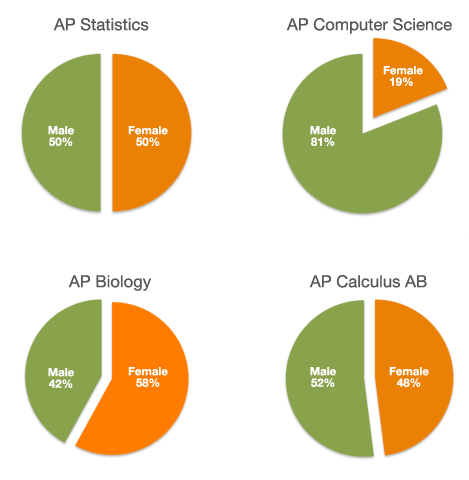
theodp writes: "What if learning to code weren't actually the most important thing?" asks Mother Jones' Tasneem Raja. "Rather than increasing the number of kids who can crank out thousands of lines of JavaScript, we first need to boost the number who understand what code can do." Computational thinking, Raja explains, is what really matters. So, while Google is spending another $50 million (on top of an earlier $40 million) and pulling out all the stops in an effort to convince girls that code and AP Computer Science is a big deal, could AP Statistics actually be a better way to teach computational thinking to college credit-seeking high school students? Not only did AP Statistics enrollment surge as AP CS flat-lined, it was embraced equally by girls and boys. Statistics also offers plenty of coding opportunities to boot. And it teaches one how to correctly analyze AP CS enrollment data!
155 comments

  1. AP Statistics isn't really computational thinking by Trepidity · · Score: 5, Insightful

    Statistics is indeed quite important, and whether AP CS or AP Statistics is a more useful use of a high-school student's time is a useful question (assuming they have to choose, which maybe they don't?). But AP Statistics is not teaching computational thinking; it's teaching statistical thinking, which is not the same!

    Computational thinking, or to use an older term, procedural literacy, is the idea that people should understand how to think in terms of processes, procedures, etc. Rather than teaching programming, which often (especially at introductory levels) focuses a lot on the mechanics of a programming language's syntax and other idiosyncracies, the idea is to teach people how to even think about the basic idea of a machine that can execute programs. Many people can't do that: even leaving aside that they don't know C or Java or Lisp, they also don't really understand what an algorithm or a computer program is conceptually, and have absolute no idea what kinds of things can be computed and what kinds can't, or which are easy or harder to compute. They lack the ability to interact meaningfully with non-code representations of computation and algorithms as well, like flow charts or (natural-language) instruction sequences.

    Statistical thinking is quite a bit different, more about proper use of data, quantification of evidence and uncertainty, etc. It can be complementary to computational thinking, but it isn't the same skill.

  2. Broken priorities by Shadow+of+Eternity · · Score: 3, Interesting

    We throw tens if not hundreds of millions of dollars at girls and women to get them to choose technology or engineering as a major, but completely ignore that they're already a majority to an overwhelming majority of graduates in literally every other major and dominate every level of education. Evidently it's more important that women not be a mere ~5% less of a program that's already only 10% of the degrees conferred in the US than it is to do something about the fact men are barely 1/3rd of college graduates in the first place.

    Because, yknow, that's not going to be unhealthy for society at all.

    --
    A bullet may have your name on it but splash damage is addressed "To whom it may concern."
    1. Re:Broken priorities by buddyglass · · Score: 1

      For the 2009-2010 school year men received 42.6% of bachelor's degrees awarded. Rates were higher for associate's and master's degrees, but lower for doctorates. Data here.

    2. Re:Broken priorities by Shadow+of+Eternity · · Score: 1

      1/3rd is 33.33333%, 42.6% is less than 10% higher than that, and that was five school years ago with the trend continuing (if not accelerating) since then.

      --
      A bullet may have your name on it but splash damage is addressed "To whom it may concern."
    3. Re:Broken priorities by DexterIsADog · · Score: 1

      So in other words, you were wrong, didn't show anything real to prove you're not wrong, but you are confident that you are right.

      That's actually a bigger problem in the U.S. these days. People are not actually good at things, but they're very confident that they are.

    4. Re:Broken priorities by Ol+Olsoc · · Score: 1

      So in other words, you were wrong, didn't show anything real to prove you're not wrong, but you are confident that you are right. That's actually a bigger problem in the U.S. these days. People are not actually good at things, but they're very confident that they are.

      Yes. I wouldn't say you are immune to it either.

      But here's an issue. What if we do all this, what if we add gender sensitivity to the qualifications for men, and start making programming a mandatory class for women, and not allow men to take the classes, and we still don't have gender equity?

      Just based upon my experience in a University environment, and involvement with programs to get young women inviolved with STEM careers, I don't think we're taking the right approach. At some point, at some time, at some level, it has to stop being one or another version of "Men are Pigs". All problems cannot be laid at the feet of men

      Let us go through a little listing of male STEM workers malfeasance, and some comments on my part

      Men and their testosterone fueled environment. We hear of the evil males making jokes about "dongles".

      Okay, let me tell you about the business world, with it's ego and testosterone fueled raging. The evil of dongle jokes, pales in comparison to the demands for sex typical of the business workplace. My better half has first hand experience in this matter.

      And yet, Women go for MBA's.

      Women need to be exposed to STEM

      Here is something. In a world where there is a plethora of information on the internet about science, one only lacks information by not looking for it. I was not encouraged to do anything as a child, except my parents wanted me to become a priest. (cue the jokes here) but with no internet at the time, I learned a lot at the public library. All the Radio and chemistry books I brought home were scoffed at a bit. Tough. I knew what I wanted to do. So I did it.

      I have difficulties with the entire idea that a young lady just needs the exposure to STEM. So here's what I think we need to do. Take a intelligent approach to the matter

      Investigate why there are some fields that have a disparity in the other direction. Why do the Vet sciences now consist of 80 percent women? 20 years ago, male applications to universities in the field were about 44 percent. Now it's around 23 percent and dropping.

      Certainly that is the case at my local vet's office. 20 some females in all the positions, and 1 male.

      Investigate if there is some things that the young ladies need to change. I know this flies in the face of all allowed opinion, but given some of the feedback I've received, the young ladies do not particularly like the idea of the late hours, the living on takeout food, and the lack of a regular schedule.I do not know ifwe can change the schedule to accommodate that, because people who don't have a problem with living at work might have an inherent advantage. I'ts just possible that young ladies might need to make a personal change. That could be a hard sell "Yeah, I just got off working 36 hours straight - it's kind of fun???" Many is the week I had 40 hours in by Wednesday morning. Lived on takeout pizza for weeks.

      Anyhow, after all those years of trying, and actually seeing less female participation, while the workplace had been scrubbed of sex, and the only people talking about sex were the women, I have to say that despite the willingness of some to point out dongle jokes, this one might not be all men's fault. And when you don't get to the real problems, you don't fix them.

      --
      The shepherds did so well protecting the flock that the sheep no longer believed that wolves existed.
    5. Re:Broken priorities by russotto · · Score: 1

      But here's an issue. What if we do all this, what if we add gender sensitivity to the qualifications for men, and start making programming a mandatory class for women, and not allow men to take the classes, and we still don't have gender equity?

      My guess: If you were looking for a course of action to make programming even less attractive to women, you'd be hard-pressed to beat that one. But then, as I said on the other thread, I've been seeing women-only sections of such courses fail for a long time; the women who actually take the sections find them useful, but they can't get enough women to fill them.

      I know this flies in the face of all allowed opinion, but given some of the feedback I've received, the young ladies do not particularly like the idea of the late hours, the living on takeout food, and the lack of a regular schedule.

      I think this one may be spurious; few people, men or women, like that sort of thing. Yet as you point out, women go into veterinary science, and nurses are overwhelmingly women. Both fields involve late and irregular hours (much worse than software in many cases). In other words, it might be more informative to ask why women go into other difficult fields rather than software, instead of asking why they don't go into software -- any signal in the latter question might be drowned out by the noise of people who just want an easy job.

      Anyhow, after all those years of trying, and actually seeing less female participation, while the workplace had been scrubbed of sex, and the only people talking about sex were the women, I have to say that despite the willingness of some to point out dongle jokes, this one might not be all men's fault. And when you don't get to the real problems, you don't fix them.

      Indeed. I suspect the current "men in tech are pigs and that's the issue" doctrine is actually driving more women away from the field than any actual man-pigs in tech. If the #1 message young women hear about tech, from other women, is that it's filled with misogynistic pigs (whether this is true or not), why would they even consider the field?

    6. Re:Broken priorities by buddyglass · · Score: 1

      Consider the time demands on medical residents. Or attorneys trying to make partner. And yet women go into those fields. Btw, on another note, it has not been my experience in 15 years as a developer that the time demands are out of whack with other relatively high paying professions. If I ever had a job that matched up with the stereotype (frequent all-nighters, etc.) I would quit. My personal opinion for women's disproportionately low interest in software is the cultural baggage. For whatever reason they're more averse than men to associating themselves with the computer programmer stereotype, even if they themselves don't fit that stereotype. Women seem to be, at an aggregate level, less willing to pursue "geeky" professions. Medicine, despite requiring science classes and long hours, doesn't carry the same stigma as CS and EE.

    7. Re:Broken priorities by Ol+Olsoc · · Score: 1

      Consider the time demands on medical residents. Or attorneys trying to make partner. And yet women go into those fields.

      Sure. But I'd put my hours up against any of them.

      Btw, on another note, it has not been my experience in 15 years as a developer that the time demands are out of whack with other relatively high paying professions. If I ever had a job that matched up with the stereotype (frequent all-nighters, etc.) I would quit.

      And so would a lot of people. Can't say I'd blame them. Then again, I was the highest paid person in my department, was immune to layoffs, and was able to retire at 55. Part of that was my willingness to take on the hard work that others were "too good" for or were worried that they were being taken advantage of if they had to work extra.

      My personal opinion for women's disproportionately low interest in software is the cultural baggage. For whatever reason they're more averse than men to associating themselves with the computer programmer stereotype, even if they themselves don't fit that stereotype. Women seem to be, at an aggregate level, less willing to pursue "geeky" professions. Medicine, despite requiring science classes and long hours, doesn't carry the same stigma as CS and EE.

      I certainly wouldn't deny that - it is a rational argument, and likwise a part of the problem such as it is. And part of why these programs are doomed to failure. How are you going to ungeekify programming, or even science?

      We can try to show that not all female STEM workers are uncool. You can show Kari Byron, or Amy Mainzer, or Danica McKellar, as women of science,(yeah, Byron is more of a Techy) but I would bet that some would complain because they are "too pretty", and just conform to men's desire to see "hot babes". So that might be a non-starter. More along the lines of a "Normal" Science type woman might be Mayim Bialik. But she isn't using her PhD in neuroscience, she's acting on a TV sitcom. Laura Danly perhaps? Seems like a good balance, and strikes me as a smart, competent, and nice person. Then again, she doesn't radiate coolness, that might turn off a lot of girls. In that vein, I'd challenge slashdot people to make programming look remotely glamorous and cool. Pizza at 1:00 at night trying to finish up that rendering engine - not so much wow factor.

      But notice what I did. I offered something, but I then thought twice about it. The reason? In trying to achive the mythical gender balance, there are people who will bring out their own pet theories. But sad to say, most of them I've heard lately all say one thing. Men are pigs.

      And I've seen enough of life to know that line of reasoning. That's the line of reasoning of people who think men are pigs, no matter what. Listening to the practitioners of misandry will not dure the problem.

      --
      The shepherds did so well protecting the flock that the sheep no longer believed that wolves existed.
    8. Re:Broken priorities by DexterIsADog · · Score: 1

      So in other words, you were wrong, didn't show anything real to prove you're not wrong, but you are confident that you are right. That's actually a bigger problem in the U.S. these days. People are not actually good at things, but they're very confident that they are.

      Yes. I wouldn't say you are immune to it either.

      But here's an issue.. (blah, blah, blah, lots of hyperbole and strawmen galore, refutations of opinions not offered, etc., etc.).

      Nonsense. I correctly pointed out that the GP claimed something to be true, was refuted, and offered nothing in response, except the opinion that he was *still* right.

      You, on the other hand, made a snide remark at me with no basis whatsoever, and then proceeded on a long tangent that had nothing to do with my point. I surmise that you missed my point, and read a lot into my post based on your prejudices, which was not there.

      So, congrats. Now there are two of you up on the stage accepting awards for high confidence.

    9. Re:Broken priorities by DexterIsADog · · Score: 1

      Consider the time demands on medical residents. ... Medicine, despite requiring science classes and long hours, doesn't carry the same stigma as CS and EE.

      I'm not arguing with you, just noting that my wife is a physician, and she carried the load in school and training just fine. And she did manage to overlook the stain of my CS degree. :-)

    10. Re:Broken priorities by buddyglass · · Score: 1

      I'm certainly not saying women can't handle the workload. I mentioned medical residency as a counterpoint to the argument that women don't go into tech professions because of the long hours.

    11. Re:Broken priorities by buddyglass · · Score: 1

      Sure. But I'd put my hours up against any of them.

      Okay. But you're an outlier in your profession. Medical residents and partner-seeking attorneys are all expected to work long hours. Regardless, even if the avg. hours worked by software dev's were on par with the avg. hours worked by partner-track attorneys that wouldn't detract from my point, which was that women go into those two fields despite the long hours. Ergo "the long hours" isn't a great explanation for women not going into software dev.

      Part of that was my willingness to take on the hard work that others were "too good" for or were worried that they were being taken advantage of if they had to work extra.

      I was mostly responding to what seems to be the prevailing view on slashdot that working "crazy hours" is part and parcel with software dev. In my experience that's not the case.

      How are you going to ungeekify programming, or even science?

      Good question. It's interesting that computer science (and math, and electrical engineering, and physics) have the geek stigma while other STEM-y disciplines (biological research, chemistry, civil engineering) don't. If I had to guess, I think it might stem from the former being seen as "arcane" and "inaccessible", regardless of whether that's actually true. The former also tend to have subcultures build up around them that might be a turnoff for some women.

      We can try to show that not all female STEM workers are uncool.

      I don't think that would be enough. Mainly because even if not all female STEM workers are uncool, they still have to work around a bunch of uncool male STEM workers and who wants that? The whole field is tainted with the stigma of geek culture.

      But notice what I did. I offered something, but I then thought twice about it. The reason? In trying to achive the mythical gender balance, there are people who will bring out their own pet theories. But sad to say, most of them I've heard lately all say one thing. Men are pigs.

      In general, men are pigs. And I say that as a man. But I don't think "men are pigs" by itself is a good explanation for women not choosing STEM careers.

    12. Re:Broken priorities by Ol+Olsoc · · Score: 1

      (blah, blah, blah, lots of hyperbole and strawmen galore, refutations of opinions not offered, etc., etc.).

      You, on the other hand, made a snide remark at me with no basis whatsoever,

      I'm sorry, I see, you are quite easily offended, by me saying you might be part of the problem too. Consider that your response might be proving the point.

      "Blah blahs", "strawmen", "snide remark" "long tangent"

      You do not control the conversations here. Neither do I. This is how threads evolve. If you don't like what I write, you can ignore it, refute it, or go all offense on me. Attacking me rather than the argument seldom wins the argument

      Do you care to respond to what I originally wrote?

      Point out the strawmen if you will.

      --
      The shepherds did so well protecting the flock that the sheep no longer believed that wolves existed.
    13. Re:Broken priorities by civilizedINTENSITY · · Score: 1

      Really would have been nice to have women in the Physics programs. We are talking almost no women at all in undergrad classes, and literally none in graduate classes. The fact that there are more women getting degrees isn't really relevant to the skew in some disciplines.

    14. Re:Broken priorities by Rakarra · · Score: 1

      1/3rd is 33.33333%, 42.6% is less than 10% higher than that, and that was five school years ago with the trend continuing (if not accelerating) since then.

      42.6% is closer to "fifty-fifty" than it is to a third.

    15. Re:Broken priorities by Shadow+of+Eternity · · Score: 1

      1/3rd is 33.33333%, 42.6% is less than 10% higher than that, and that was five school years ago with the trend continuing (if not accelerating) since then.

      42.6% is closer to "fifty-fifty" than it is to a third.

      It's also an out of date figure that mischaracterizes how bad the gender gap is by using the lag of higher level post-graduate degrees among wealthy white students to cover up everything else.

      --
      A bullet may have your name on it but splash damage is addressed "To whom it may concern."
    16. Re:Broken priorities by Shadow+of+Eternity · · Score: 1

      It's not that men are pigs, it's that women aren't pigs. The double standard is strong enough that even some feminist websites like Good Men Project openly refer to it as problematic.

      --
      A bullet may have your name on it but splash damage is addressed "To whom it may concern."
  3. AP Stats is the easy AP math by pjhenley · · Score: 2

    The role of AP Statistics is to offer an AP 'math' to students who don't stand a chance in AP Calculus, but who demand an AP math class on their transcript. Most do not consider AP Computer Science 'math' enough for it to play that role, hence the surge in AP Statistics. On top of that, AP Computer Science is perceived as being much harder than AP Statistics. For a Junior or Senior looking for a reliably easy AP, Computer Science is not the way to go.

    1. Re:AP Stats is the easy AP math by K.+S.+Kyosuke · · Score: 2

      I wouldn't call statistics a part of math, but the idea that it's somehow easier is ridiculous. If it's so "easy", why have so many people so many problems with actually using it? Even those who're supposed to be masters of it, like researchers and scientists?

      --
      Ezekiel 23:20
    2. Re:AP Stats is the easy AP math by pjhenley · · Score: 1

      I think you are speaking of statistics generally. I am speaking of the AP Statistics course. It doesn't matter what statistics is. It only matters what college admissions officers will think when they read the list of AP courses on your transcripts. Or, rather, it matters what parents and students think colleges will think when colleges read their transcripts. For most parents and students, AP Stats is a math course and they've heard it's easier than AP Calculus. Choosing AP courses is a game, with the goal being to get into a good college. Learning something is a secondary objective.

    3. Re:AP Stats is the easy AP math by KPU · · Score: 1

      Statistics isn't easy. AP Statistics is easy. It's basically how to turn a story problem into numbers you plug into your calculator.

    4. Re:AP Stats is the easy AP math by K.+S.+Kyosuke · · Score: 2

      OK, that's possible. We don't have the American AP system around here, so I won't pretend I know the exact curricula, but one still wonders why the need to dumb it down for high-schoolers even more than in the case of function analysis (and why are those colleges being dumb).

      --
      Ezekiel 23:20
    5. Re:AP Stats is the easy AP math by Anonymous Coward · · Score: 0

      I think that may be too general of a statement and depend strongly on the high school. My daughter just completed AP Stats at her (private) HS.

      Her teacher was a stats fanatic and it showed. I followed her progress and can attest that the curricula was every bit as comprehensive and difficult as the equivalent course I took at my fancy ivy-league university years ago. He also put a lot of emphasis on making trial design interesting having worked in the pharma industry prior to teaching. She loved every minute of the class, pulled off a cumulative A+ and most importantly actually knows the stuff (really!).

      AP Calc 1+2 is next year, I'll be following that one closely too to see if AP Stats was just an aberration.

    6. Re:AP Stats is the easy AP math by qwak23 · · Score: 1

      Anecdotal, but most people I know who've signed up for a stats class as a math based elective (working adults pursuing a college degree in their free time) have no clue what statistics actually is. The last one told me almost verbatim "It's just a bunch of percentages, how hard could that be?".

    7. Re:AP Stats is the easy AP math by TechyImmigrant · · Score: 1

      I took a refresher college stats course at around age 40. It certainly was not a bunch of percentages. It was a bunch a tests and distributions (t-test, poission, chi-square, anova etc) and how to apply them. Useful, but it didn't get as far as covering what I'd consider is required to be able to think critically about statistical inference and correct trial design. It worked for me, I had plenty of the latter and I'd forgotten much of the former. But for someone coming through the system the fist time, they don't come out of a generic US stats 1+2 course with the tools necessary to do statistics.

      --
      I should use this sig to advertise my book ISBN-13 : 978-1501515132.
    8. Re:AP Stats is the easy AP math by qwak23 · · Score: 1

      I don't think it's necessary for everyone to be able to do statistics, but having enough of an understanding to evaluate testing methodologies, sample sizes, data collection methods and conclusions, at least a rudimentary level is extremely valuable and a college level stats course should be able to do at least that. In regards to intro college level stats courses I've taken my n = 1, so not the greatest data set, but I felt I got the above out of the class.

  4. AP? by evenmoreconfused · · Score: 2

    As Slashdot caters to an international audience, could someone please explain what AP means?

    --
    No. Well...maybe. Actually, yes. It really just depends.
    1. Re:AP? by oldhack · · Score: 2

      "Advanced Placement". They are high school courses designated to prepare the students for subject-specific AP tests. Colleges can give the students course work credit for good AP grades.

      --
      Fuck systemd. Fuck Redhat. Fuck Soylent, too. Wait, scratch the last one.
    2. Re:AP? by Anonymous Coward · · Score: 0

      Think of it like a U.S. program for high school honors students, similar somewhat to the old International Baccalaureate (IB) program.

    3. Re:AP? by kwbauer · · Score: 1

      According to all the complaining, /. doesn't really "cater to" an international audience as much as it just has one.

    4. Re:AP? by kwbauer · · Score: 1

      I'm not sure how "old" the IB program is as my nephew graduated High School 3 or 4 years ago after having gone through such a program.

    5. Re:AP? by Anonymous Coward · · Score: 0

      AP: Amour Piercing?

      You want an AP shell to knock out enemy tanks!

  5. Don't like AP by oldhack · · Score: 1

    I don't know what they teach in high school AP CS, but most such courses only lick the surface and are incomparable to proper college courses. Taking AP credit is only advisable for elective courses that does not require much rigor.

    Especially for something as subtle and delicate as statistics, it would be better for the kids to learn the subject properly with the necessary rigor in college. The damage due to half-assed stat learning is all too prevalent in much of academia, especially softer sciences and social studies.

    --
    Fuck systemd. Fuck Redhat. Fuck Soylent, too. Wait, scratch the last one.
    1. Re:Don't like AP by TemperedAlchemist · · Score: 2

      AP is such BS. It only exists to make parents feel like their kid is smart.

      Find me the kids reading through and doing problem sets that aren't assigned. Those are the smart kids.

    2. Re:Don't like AP by Anonymous Coward · · Score: 0

      At my high school the AP courses were comparable to college courses (although I'm sure that varies by school). I scored a 5 on the AP Calculus AB test which allowed me to skip the first 2 of 6 calculus classes that I was required to take for computer engineering. I didn't have any trouble in my college calculus classes. I scored a 5 on the AP Physics test which allowed me to skip 1 of the 6 physics classes I had to take. Physics 1 was in winter quarter and I forgot to try to skip it and took the class. It was all review of what I had learned in AP Physics and I coasted through that class.

    3. Re:Don't like AP by Anonymous Coward · · Score: 0

      I never did extra problem sets that weren't assigned and I'm a smart kid. Smart enough to take 4 AP classes while being in sports and band.

    4. Re:Don't like AP by pla · · Score: 1

      AP is such BS. It only exists to make parents feel like their kid is smart.

      I agree with you in spirit, but not quite for the same reasons.

      A student doing well in AP calculus really will do better when they take "real" calculus. And they will still have to take calculus in college, because colleges don't consider AP credits as actually satisfying any requirements, they consider them nothing more than an elective.

      Congrats, kid, you busted your ass for the last year of Highschool and it got you out of one semester of Basket Weaving 101 with that cute girl you see hanging out on the quad every day at lunch. :)

      More to the topic at hand, though, you'll notice this involves taking AP stats vs CS, not calculus. AP stats has become popular because for non-mathphobes, it counts as an easy "A". By comparison, kids see both CS and calculus as really really hard. So we end up back at the fundamental motivation of the typical American student: Take the easiest courses that will satisfy the requirement.

    5. Re:Don't like AP by Anonymous Coward · · Score: 1

      I don't know what colleges you have gone to but as several of my friends and I started college as 2nd years as we had accumulated so many AP credits. So I would say at least for some % of colleges what you said is complete BS.

      Here would be a link to a state college: http://creditevaluation.unl.edu/credit-types/ap
      Or if you have money to waste you might waste a bit less with Harvard if you are good on the AP tests: http://oue.fas.harvard.edu/icb/icb.do?keyword=k18059&pageid=icb.page498253&pageContentId=icb.pagecontent1065010&view=view.do&viewParam_name=asgeninfo.html#a_icb_pagecontent1065010_a_icb_pagecontent825552_apexams

      Better yet, kill 1 year on AP and do your second year low cost (1/10 the price) at a Community College making sure to stay in the transferable classes. Pull the last two years at where you want your degree from (of course make sure they have the appropriate transfer agreements). Put in 20-60 hours a week on a job (I would suggest night clerk at a gas-station or small postal delivery driver) and you could graduate in 3-4 years with no debt and a degree that will hopefully help you out in life.

      Here is a Community College link: http://www.mccneb.edu/articulation/

    6. Re:Don't like AP by pla · · Score: 1

      Here would be a link to a state college: http://creditevaluation.unl.ed...

      Wow... I have to admit, that looks a HELL of a lot more appealing than what it got you at my uni!

      I wonder if that more reflects the school itself, or just the passage of time since my school days.

    7. Re:Don't like AP by jeIlomizer · · Score: 1

      A student doing well in AP calculus really will do better when they take "real" calculus.

      Yes, when they take calculus... as a course. What is ignored is that most don't even understand why any of the math works; they can use the formulas and recognize patterns, but all they did was memorize facts. Doing *real* calculus and solving *real* problems is far, far different.

      --
      If something is so important that you feel the need to post it on the internet... It probably isn't that important.
    8. Re:Don't like AP by Anonymous Coward · · Score: 0

      Smart enough to take 4 AP classes while being in sports and band.

      How does taking AP classes mean you're smart? I think the smart people innovate in such a way that our understanding of the universe is increased. Einstein is an obvious example. Go solve a millennium prize problem or something.

    9. Re:Don't like AP by Rakarra · · Score: 1

      Smart enough to take 4 AP classes while being in sports and band.

      How does taking AP classes mean you're smart?

      1) He's taking a harder course than the regular math course. That's smart.
      2) In most systems, an 'A' in an AP course counts for more than an 'A' in a regular class. It will increase your GPA. That's smart.
      3) AP courses will increase your odds of getting into the college you want and landing the scholarship you need. That's smart.
      4) Some AP courses can be used for college credit, allowing you to skip some entry-level classes. That's smart.
      5) Most of the dumb-fucks who like to make your life miserable in your regular classes aren't smart enough to get into the AP classes. That's hella smart.

      So yeah, a student who is passing his AP courses might be smarter, not just because he's learning more, but because he's thinking more strategically.

    10. Re:Don't like AP by david_thornley · · Score: 1

      FWIW, my son wound up taking physics three years in a row: high-school physics (no AP offered that year), AP high school physics (beat taking Earth Sciences), and then when he got into a STEM college. The AP classes were more useful in areas less related to his major.

      --
      "When you have eliminated the unacceptable, whatever is left, however improbable, must be the truthiness" - Holmes
  6. coding is the blue collar job of the future by alen · · Score: 2, Insightful

    when everyone knows how to code expect it to be the factory work of this century. find some pictures of early 20th century offices where everyone sits at a desk in a huge room with no dividers. it's already here again

    the value is going to be figuring out algorithms to make sense of the huge amounts of data being collected. the code to implement the algorithm will be your average low wage job

    1. Re:coding is the blue collar job of the future by DexterIsADog · · Score: 1

      find some pictures of early 20th century offices where everyone sits at a desk in a huge room with no dividers.

      No, no, that's not a factory, that's an "open plan workspace", which facilitates communication among teams.

      When I leave my office to wander the floor doing my exemplary "management by walking around", don't let me catch you posting on /. during working hours.

    2. Re:coding is the blue collar job of the future by Anonymous Coward · · Score: 1

      No its not. You know why? Not everyone can code. Not everyone has the logical thought processes to do it correctly or well. I suggest you read The Mythical Man Month, if you think that throwing more people at the problem is going to solve anything. In the words of George Santayana, "Those who cannot remember the past are condemned to repeat it"

    3. Re:coding is the blue collar job of the future by Anonymous Coward · · Score: 0

      Anyone who can type can 'code' if the specifications are tight enough. I think the flaw in his argument is that when you get to a place where the language and the specifications are so close that it just becomes the menial task of typing the human will just be replace with a computerized conversion process.

    4. Re:coding is the blue collar job of the future by Anonymous Coward · · Score: 0

      No,this is not true. I attended a couple community colleges and an expensive private university. It seemed it was full of people with some sort of learning disorder. Well, it looked like that to me. There are people, no matter how difficult it is to accept, that have intellectual limits. Since you have been an engineer, you may not see them, as they can not get that far - but they are out there. They wash your car, do your dry cleaning, and take care of your lawn. (if you have a yard) The next level are the people that can barely code - and it takes them too much time to do it and they use all their brain power to figure out hot to get their recursive function to work when they shouldn't be using it in the first place.

    5. Re:coding is the blue collar job of the future by Anonymous Coward · · Score: 0

      Everyone assembling parts on a line does the work at an equivalent level.
      The same is not true for coders. My work is demonstrably better than most, and some is better yet than mine. Coding is not factory work.

  7. AP? by pjhenley · · Score: 5, Informative

    AP stands for Advanced Placement. The program intends to offer college-level courses to high school students. Each course culminates in a standard exam in the spring which is graded on a 1-5 scale. Some colleges award college credit to their students for AP courses they took in high school, depending on the score and the exam.

  8. Statistics by wisnoskij · · Score: 1

    Is a very specialised branch of mathematics. Yes, the basics are important to know, and they can help your understanding of things in general but knowledge of Statistics will not make other subjects easier. Knowing Statists, unlike all other mathematics, does not help with programming. I am not going to make broad generalizations about most students, but university Statistics was the hardest course I ever took. University Calculous was just more of the same, But Statists start out counter intuitive and weird in high school and just get worse the further you go.

    --
    Troll is not a replacement for I disagree.
    1. Re:Statistics by cryptizard · · Score: 2

      Statistics is incredibly important for understanding algorithms and complexity theory. Many modern algorithms are randomized, and not understanding the statistics involved in using them can be a huge problem.

    2. Re:Statistics by Rockoon · · Score: 1

      Knowing Statists, unlike all other mathematics, does not help with programming.

      uhhh.. what?

      Sure, it wont help with HelloWorld.c, ... but lets be real here... unless you definition of "programming" is gluing 3rd party libraries (written by people that know math) together, you clearly havent thought it through. While statistics doesnt encompass all the more-than-simple math knowledge required to be a good programmer, its a start.

      If you want any sort of proof of this, open up any volume of the Programmer Bible, aka Donald Knuths "The Art of Computer Programming" - very little code and what code there is is purposely in a fictitious assembly language. Thats because Programming is Math.

      --
      "His name was James Damore."
    3. Re:Statistics by Anonymous Coward · · Score: 0

      Or even Introduction to Algorithms. It is conceptual mathematics. If you dig into those libraries that do GUI rendering - it is all mathematics. Any type of data mining - stats. Faster data mining - more math. The nuts and bolts are math. They have to be. The language syntax is a way to organize the mathematical functions and to reuse them. But it is all math. As soon as you start looking at it like that, it will make more sense and you will become better.

    4. Re:Statistics by TechyImmigrant · · Score: 1

      Knowing Statists, unlike all other mathematics, does not help with programming.

      Knowing statistics is essential for the programming I do.
      Your statement is too general and doesn't reflect the state of the universe as it is today.

      --
      I should use this sig to advertise my book ISBN-13 : 978-1501515132.
  9. CS grad, took both, and working as a programmer by watermark · · Score: 2

    I'm a CS grad and I took AP Stat and AP CS in high school, and I'm currently working as a programmer. In relation to programming, stat is very nearly worthless. There are certainly things I learned in stat that I use every so often, but nothing in relation to a programming task. In my high school, I had to choose between AP stat and calc and calc would have helped a lot more in college. Granted, for my line of programming, calc doesn't help either, but it would have helped more in obtaining the degree.

    1. Re:CS grad, took both, and working as a programmer by Anonymous Coward · · Score: 0

      I'm currently working as a programmer. In relation to programming, stat is very nearly worthless.

      Agreed. But in relation to computer science, stat is very nearly priceless.

    2. Re:CS grad, took both, and working as a programmer by civilizedINTENSITY · · Score: 3, Insightful

      Agreed. But I'd say that in relation to not just any, but indeed to all branches of Science, Statistics are very nearly priceless.

    3. Re:CS grad, took both, and working as a programmer by twistedcubic · · Score: 1


      ...In relation to programming, stat is very nearly worthless...

      Have you ever needed to make an informed choice of pseudo- (or quasi-) random number generator? The first 200 pages of Knuth volume 2 (Seminumerical Algorithms) is highly enlightening for programmers, in my opinion, and reads better if you know the standard statistical distributions. Also, the more you know, the more likely it is for you to establish important relationships between concepts which are seemingly unrelated. People seem to miss this as the dumbing down of education continues...

    4. Re:CS grad, took both, and working as a programmer by Anonymous Coward · · Score: 1

      You can't compute the average runtime of quick-sort without statistics. Amortized runtimes of things like self resizing hash tables and vectors also require basic statistics. Doing failure probability analysis and the related system design also require statistics (whats the chance of bit errors? crashes? hardware failing? Do you need error correction? How much error correction? You need to size and partition your clusters somehow). Sizing queues properly requires statistics.

      Even bench marking properly requires statistics (Is your change statistically significant? Whats the distribution of run-times? Can you think of any confounding factors such as caching effecting your results?).

      Having a good intuitive sense of statistics lends itself to thinking of some interesting deigns as well. You can guarantee n*log(n) average time on untrusted inputs to quicksort if you randomly shuffle the data before sorting. If you can't afford to write every action, you can do probabilistic logging. You can compute the risks of hash collisions and build neat things like content addressable storage by keeping them negligible.

      I use things covered in my AP statistics class daily. Personally I learned all those things in several other places as well, but not everyone takes engineering focused statistics classes in college, or lots of desecrate math, game-theory or all the other stuff I study for fun.

      Personally though, I'd argue that a decent coverage of statistics should be required for everyone. I don't want people voting who can't do a significance test or tell correlation from causation. That is way more important than what ever benefits CS might get from it.

      Personally I use linear algebra pretty heavily in my CS work too, but also in general life (high dimensional spaces are super useful for thinking about parameterized things like cooking recipes or plant growing environments), and the same applies for calculus (its so much easier to think about things like global warming, or your driving style effecting gas mileage in terms of differential calculus). A lot of the rather paradoxical outcomes from basic gametheory explain a lot of group behavior issues (collections of rational people doing dumb shit as a whole). These things are useful, and we would be better off if people knew them.

      So sure I'm not typical, maybe I'm even totally insane (well I know I am, but hopefully we can agree about this part), but it seems like my study in these areas makes me a much more rational and capable individual at general life, and a much better voter. Making sure everyone has easy access to such things would be cheaper than the military, and do a lot more for our countries future than some more shitty fighter jets that are already out classes by the Chinese, or those tanks we don't want that just get parked in Arizona...

    5. Re:CS grad, took both, and working as a programmer by david_thornley · · Score: 1

      Odds are you aren't using that much calculus in your job. Possibly some form of discrete math would have been better. You know, combinatorics, graph theory, that sort of thing.

      --
      "When you have eliminated the unacceptable, whatever is left, however improbable, must be the truthiness" - Holmes
    6. Re:CS grad, took both, and working as a programmer by watermark · · Score: 1

      Universities feel the need to teach you much more than is required for your field (to be well rounded). I suppose I was saying many more classes depended on calc than stat, so calc in highschool would have helped more.

      Several discrete math classes came in college and I do find parts of those useful, but I'm not sure they have a place at the high school level. Perhaps a class where you had to build/design turing machines would be interesting enough to be useful.

  10. A real statistics course by Lawrence_Bird · · Score: 1

    is a good starting point but probably needs to be combined with some type of 'critical thinking' class. I also think the question may be better off inverted - it would be far better for students to understand what code cannot and/or should not do.

  11. Re:AP Statistics isn't really computational thinki by Registered+Coward+v2 · · Score: 4, Interesting

    Statistics is indeed quite important, and whether AP CS or AP Statistics is a more useful use of a high-school student's time is a useful question (assuming they have to choose, which maybe they don't?). But AP Statistics is not teaching computational thinking; it's teaching statistical thinking, which is not the same!

    While I agree statistical think is different than computational thinking, to answer your question I think it is a better use of a students time to teach statistics. Properly taught, it teaches you to think about how to formulate a question, what data you need and how to analyze it. In short, it is as much about the problem as the answer.

    Computational thinking, or to use an older term, procedural literacy, is the idea that people should understand how to think in terms of processes, procedures, etc..

    SNIP

    Many people can't do that: even leaving aside that they don't know C or Java or Lisp, they also don't really understand what an algorithm or a computer program is conceptually, and have absolute no idea what kinds of things can be computed and what kinds can't, or which are easy or harder to compute. They lack the ability to interact meaningfully with non-code representations of computation and algorithms as well, like flow charts or (natural-language) instruction sequences.

    Again, I concur with you comments. That's why code monkeys are cheap and those who can actually develop a solution valuable; and the skills you mention don't become obsolete when a new language comes along. Unfortunately, far to many people equate the ability to code with being a computer scientist or engineer. That's not to say we don't need good coders but focusing on coding and forgetting the how and why behind it is doing them a disservice. I've also found the ones who can really write elegant code generally also think conceptually as well. Maybe I was lucky but when I took CS in high school the teacher made us explain and diagram what we are trying to do before coding, and rewarded accomplishing tasks in as few lines of code as possible. A she put it, "anybody can write a program with 100 lines to accomplish what can be done in 2."

    Statistical thinking is quite a bit different, more about proper use of data, quantification of evidence and uncertainty, etc. It can be complementary to computational thinking, but it isn't the same skill.

    True, but faced with learning statical thinking or how to write code I think the former is more valuable.

    --
    I'm a consultant - I convert gibberish into cash-flow.
  12. How to lie with statistics by Anonymous Coward · · Score: 2, Insightful

    I think stats SHOULD be taught at least at an intuitive level and have a good portion of it being how one can lie with stats.

    That way, we can start having an electorate that doesn't get so suckered by the stats in politics, advertising, and shitty articles.

  13. Not a coding opportunity by damienl451 · · Score: 1

    I spend a lot of time writing R code, with occasional forays into SAS-land. But I don't really consider it a coding opportunity, nor would I want people like me to do the actual lower-level coding that is needed to make these software packages work adequately (yes, I know that lots of function in R are written in R, but there's still a majority of C/Fortran code under the hood. Because I'm not a computer scientist or a software engineer. I can write ok code in that it runs, does what it needs to do, and is not grotesquely inefficient. But I have no interest in writing production-quality, well-optimized code since I only want to get statistical results as easily as possible. I enjoy writing the code, but it's a purely utilitarian endeavor and definitely not something that would make me employable in the software industry. Which is okay since my comparative advantage is analyzing and interpreting data, but means that there's room for CS graduates and 'code monkeys'.

  14. Quality of Teaching by Anonymous Coward · · Score: 0

    I took every available AP Course during high school, including AP Computer Science and AP Statistics. Roughly factoring in "normal" high school courses, worked out to taking equivalent of 12 credit hours per college semester - i.e ~48 credit hours total.

    I double majored in Computer Science and Statistics in college, finishing both in 4 years thanks to the AP credit. My perspective on things:
    - I was far ahead my peers in the second level Statistics course.
    - I was far behind my peers in the second level Computer Science course.

    Why? It came down to the quality of teaching for the courses my high school offered. I personally do not care which courses one organization vs. another is promoting. The problem has (and will always be) the quality of teachers available to teach said courses. Fix that before you attempt to fix anything else.

    P.S. And for those wondering, no I'm not THAT smart. I know how to work hard and it didn't take a genius to figure out how to save on a year's worth of college expenses through AP credit.

  15. What about statistics vs calculus by langelgjm · · Score: 4, Insightful

    It's not really a new debate, but the assumption that high school students will on average be better served by taking calculus instead of statistics could use some scrutiny.

    Practically speaking, basic familiarity with statistics is also a form of civics - teaching kids when to call BS on bogus claims, helping them to understand what statistical significance means and doesn't mean, etc.

    --
    "Anyone who [rips a CD] is probably engaging in copyright infringement." - David O. Carson
    1. Re:What about statistics vs calculus by ShanghaiBill · · Score: 4, Interesting

      It's not really a new debate, but the assumption that high school students will on average be better served by taking calculus instead of statistics could use some scrutiny.

      Students should learn calculus, but it could be compressed, and maybe even merged with physics. My class spent a lot of time learning how to do things like integrate the square root of the reciprocal of the co-secant. That is not useful. Students already get quite a bit of exposure to statistics and probability in math classes, although there is usually not a class solely focused on that topic.

      Practically speaking, basic familiarity with statistics is also a form of civics - teaching kids when to call BS on bogus claims

      Indeed. I have long felt that we should be teaching "bullshit math" where rather than getting a problem and finding a solution, the students are presented with a political advocacy statement, and tasked with identifying the logical and mathematical flaws, unstated assumptions, and missing information. This sort of critical thinking skill, along with learning basic economics, could lead to a better functioning democracy.

    2. Re:What about statistics vs calculus by Anonymous Coward · · Score: 0

      My class spent a lot of time learning how to do things like integrate the square root of the reciprocal of the co-secant. That is not useful.

      I just spat coffee all over my MacBook.. thanks.

      As somebody who didn't take calc until his mid-30s, I kept telling myself when we were doing techniques of integration "okay, this is going to be useful later on.. it will.. srsly.. ".. no such luck.

    3. Re:What about statistics vs calculus by ahoffer0 · · Score: 2

      I took trigonometry, calculus, and (later) differential equations and vector calculus. Integrating sin(2x) did not contribute enough to by education to be worth the effort.

      As a computer programmer, I need discrete math for my job. (The only computer people I know using continuous math for their day jobs are in HPC /scientific computing). As a citizen, voter, and member of society, I need probability, statistics, and a good understanding of logical fallacies.

      I'm just another jerk with an opinion, but I'd drop the trig and calculus curriculum in favor of discrete math and stats in secondary education. In post-secondary education, I like another poster's idea to teach calculus in the context of other disciplines (i.e. physics)... at the undergrad level for non-math majors. Or better, I'd run a controlled experiment with random sampling to determine the effects of a curriculum change.

    4. Re:What about statistics vs calculus by Anonymous Coward · · Score: 0

      And we have a winner.

    5. Re: What about statistics vs calculus by Glonoinha · · Score: 2

      Perhaps learning calculus is about learning to think in abstract and increasingly difficult (although mathematically provable and correct) realms of intangible worlds.

      And software engineering is nothing, if not that.

      --
      Glonoinha the MebiByte Slayer
    6. Re:What about statistics vs calculus by russotto · · Score: 1

      But you do need some calculus for computer science. Not all those integration techniques (thankfully I've never had to do an integration by parts in my professional career), but things like limits and rates of change and logarithms and the relation between polynomial powers.

      BTW, integral of sqrt(1/csc(x)) = integral of sqrt(sin x), which isn't expressible in terms of elementary functions.

    7. Re:What about statistics vs calculus by Anonymous Coward · · Score: 0

      I'm a new calculus professor. Good god, is it hard to find relevant examples of, say, rational functions. In fact, if you have any beyond filters in EE, I would really appreciate seeing them before lecture on monday.

    8. Re:What about statistics vs calculus by Shoten · · Score: 1

      Practically speaking, basic familiarity with statistics is also a form of civics - teaching kids when to call BS on bogus claims

      Indeed. I have long felt that we should be teaching "bullshit math" where rather than getting a problem and finding a solution, the students are presented with a political advocacy statement, and tasked with identifying the logical and mathematical flaws, unstated assumptions, and missing information. This sort of critical thinking skill, along with learning basic economics, could lead to a better functioning democracy.

      The "bullshit math" you refer to is known as Symbolic Logic. It provides a mechanism for reducing statements and concepts into operands, effectively...and by doing so you can more easily detect things like non-sequiturs, circular logic, self-contradiction, empty statements with no real meaning and the "post hoc ergo propter hoc" bullshit that is the basis of many knee-jerk legislative actions. The real beauty is that by sticking to the symbolic operands of a statement rather than the contextual content, you can strip away information that triggers an emotional response (terrorism, child porn, etc.) and recognize when someone is just plain full of shit.

      And I agree greatly; teaching this is an excellent idea. It's a cornerstone of critical thinking, which in turn is a cornerstone of good citizenship in a democratic society. But if you don't seek it out as a college course, you'll probably never hear about it. That should change.

      --

      For your security, this post has been encrypted with ROT-13, twice.
    9. Re:What about statistics vs calculus by TheLink · · Score: 2

      Yeah. Teaching people to detect bullshit and think scientifically would be good.

      As for getting a problem and finding a solution, it's still good to teach students to think and solve problems, rather than be an inferior "Google" and regurgitate memorized solutions or follow very specific memorized processes. Because I actually know adults who can't do basic problem solving- say there's a problem with something, their default is getting stuck. They don't go - it could be caused by A, B, C, D and perhaps other stuff I don't know yet. If it's A and we do X, Y should happen. OK lets try doing X. OK Y didn't happen, so it's not A. Let's see if 's B now, and so on. Or let me use Google to get a list of possible causes and then figure out one by one which it might be. Being able to finding possible answers that way is more important than being able to memorize and retrieve answers.

      --
    10. Re:What about statistics vs calculus by Anonymous Coward · · Score: 0

      I went on to do EE so I always thought it was very useful that I got most of the required math in high school.

    11. Re:What about statistics vs calculus by ShanghaiBill · · Score: 1

      Good god, is it hard to find relevant examples of, say, rational functions.

      If they have no practical application, then maybe you should take them out of the curriculum and devote the time more useful topics.

    12. Re:What about statistics vs calculus by Anonymous Coward · · Score: 0

      Standard lessons in philosophy, civic issues and rhetoric could be of help in thinking and expressing oneself. This can be augmented by course in statistics as these are a tool used in many different subjects - decision making, organization and some such. Coding is just a tool but these days any meaningful job will require some coding, mostly scripting. Basics in coding of some most likely to be used language plus some info on different levels of complexity - it is different to write a program that does something (possibly even quite complicated) and ends and a system that is supposed to run forever, security issues, privacy concerns, data storage and management etc etc. Some ethics would do too so that NSA and other criminals have more problems with getting slaves. But philosophy and rhetoric would get you a long way. This of course excludes vast majority of 'ricans who are born with inherited or induced brain malfunction.

      For kids with asperger like character problems - it would be good to show that there are other humans and the world is more complex than simple model of it in their brains, this including realization that different but conflicting perceptions of reality may actually have to coexist. For other kids - a lessons in recognition and dealing with the first group would go a long way in avoiding problems. This can be expanded to dealing with other humans in respectful way including recognition of potentially dangerous conditions which is especially important in societies where well organized militias are vital from preventing SWAT teams overtaking the world. I think you can also learn English and some basic calculus. But where you are supposed to get teachers doing all this stuff???

    13. Re: What about statistics vs calculus by civilizedINTENSITY · · Score: 1

      Math classes (my minor) and Software Engineering (my profession) have little of the same flavor at all. Math classes feel closer, perhaps, to Physics (my other degree), but even still, it isn't the same. Applied math is incredibly useful. Abstract math isn't useful, and those involved are unabashed proud of the fact. Very sad for Mathematics. The idea of teaching applied math (science and engineering based,) is a great idea that won't fly, due to the culture of mathematical academics. If you want to really learn Vector Calculus (which I've had) you'd do better to take the Physics E&M courses. Likewise, there is a lot more application to be found in Statistical Thermodynamics than Probability or Statistics classes. As a tutor I saw that Math majors could prove theorems, but Business majors could talk to someone about what the applications mean, which the Math majors thought was not relevant (in part, because they didn't know, and didn't need to know.)

    14. Re: What about statistics vs calculus by russotto · · Score: 1

      Abstract math isn't useful, and those involved are unabashed proud of the fact.

      Yeah, that's what the number theory weenies thought, until Diffie and Helman went and invented their key exchange.

    15. Re:What about statistics vs calculus by TechyImmigrant · · Score: 1

      I'm a new calculus professor. Good god, is it hard to find relevant examples of, say, rational functions. In fact, if you have any beyond filters in EE, I would really appreciate seeing them before lecture on monday.

      In EE, harder calculus does not follow the easier calculus. In EE, you go from calculus to statistical calculus. You don't integrate over smooth equations, you integrate over noise. Then comes the number theory, because you you need to grok error detection, correction and some crypto.

      The biggest failure of school math is to present calculus as being the 'college path' of mathematics, when in reality it's a back water and the engineering action is happing in finite fields which schools simply don't admit exist.

      --
      I should use this sig to advertise my book ISBN-13 : 978-1501515132.
    16. Re:What about statistics vs calculus by TechyImmigrant · · Score: 1

      But you do need some calculus for computer science. Not all those integration techniques (thankfully I've never had to do an integration by parts in my professional career), but things like limits and rates of change and logarithms and the relation between polynomial powers.

      BTW, integral of sqrt(1/csc(x)) = integral of sqrt(sin x), which isn't expressible in terms of elementary functions.

      You just did.

      --
      I should use this sig to advertise my book ISBN-13 : 978-1501515132.
    17. Re:What about statistics vs calculus by Anonymous Coward · · Score: 1

      http://en.wikipedia.org/wiki/Rational_function#Applications

      "Rational functions are used in numerical analysis for interpolation and approximation of functions,..."

      "Rational functions are used to approximate or model more complex equations in science and engineering including (i) fields and forces in physics, (ii) spectroscopy in analytical chemistry, (iii) enzyme kinetics in biochemistry, (iv) electronic circuitry, (v) aerodynamics, (vi) medicine concentrations in vivo, (vii) wave functions for atoms and molecules, (viii) optics and photography to improve image resolution, and (ix) acoustics and sound."

      http://en.wikipedia.org/wiki/Rational_function_modeling

      "Rational function models can take on an extremely wide range of shapes, accommodating a much wider range of shapes than does the polynomial family.
      Rational function models have better interpolatory properties than polynomial models. Rational functions are typically smoother and less oscillatory than polynomial models.
      Rational functions have excellent extrapolatory powers. Rational functions can typically be tailored to model the function not only within the domain of the data, but also so as to be in agreement with theoretical/asymptotic behavior outside the domain of interest.
      Rational function models have excellent asymptotic properties. Rational functions can be either finite or infinite for finite values, or finite or infinite for infinite x values. Thus, rational functions can easily be incorporated into a rational function model.
      Rational function models can often be used to model complicated structure with a fairly low degree in both the numerator and denominator. This in turn means that fewer coefficients will be required compared to the polynomial model.
      Rational function models are moderately easy to handle computationally. Although they are nonlinear models, rational function models are particularly easy nonlinear models to fit."

      http://www.itl.nist.gov/div898/handbook/pmd/section6/pmd642.htm

      http://academics.utep.edu/Portals/1788/CALCULUS%20MATERIAL/2_6%20RATIONAL%20FNS.pdf (pages 29-30)

      http://www.algebra.com/algebra/homework/Polynomials-and-rational-expressions/Polynomials-and-rational-expressions.faq.question.184284.html

      http://www.montereyinstitute.org/courses/Algebra1/U11L2T2_RESOURCE/text.html

      http://www.dlt.ncssm.edu/algebra/15_applications_of_rationals/Applications_of_Rational_Functions.doc

      http://math.tutorcircle.com/precalculus/real-world-application-of-rational-functions.html

      http://www.freebookez.net/rational-function-real-life-example/

    18. Re: What about statistics vs calculus by civilizedINTENSITY · · Score: 1

      Number Theory has application today, oh yes. Hellman (two 'l's, not one) had a BS, MS, and PhD in Electrical Engineering. Diffie had a bachelor's degree in Mathematics. My question is this: after Number Theory was shown to have applications how many Mathematicians lost interest due solely to the fact that it was no longer "pure" math? I knew a topologist who grew embarrassed and closed his office door before discussing relativity. It just wouldn't do to be interested in applications. Perhaps I should have drawn the distinction less about abstract vs concrete, and more about pure vs applied.

    19. Re:What about statistics vs calculus by david_thornley · · Score: 1

      There's a fair amount of graphics stuff based on NURBS (Non-Uniform Rational B-Splines). In my current job, we rely very heavily on a commercial NURBS library. I don't think you want to teach NURBS directly, but you could base some problems on them.

      --
      "When you have eliminated the unacceptable, whatever is left, however improbable, must be the truthiness" - Holmes
  16. Re:AP Statistics isn't really computational thinki by beelsebob · · Score: 4, Insightful

    This whole article is based on a fallacy - that Computer Science is teaching people to code.

    This isn't what a Computer Science degree teaches you.

  17. Computer Science all the way by Murdoch5 · · Score: 1

    Statistics is how you lie to yourself about understanding the world.

  18. Re:AP Statistics isn't really computational thinki by Anonymous Coward · · Score: 2, Insightful

    What the fuck is "AP"?

  19. Re:AP Statistics isn't really computational thinki by Trepidity · · Score: 1

    It is, however, what AP Computer Science teaches you. Maybe it's massively improved since I took it, but when I took it we spent an inordinate amount of time learning really stupid detailed things about C++, like the idiosyncracies of iostreams.

  20. WWDZD? (What would Derek Zoolander do?) by ItsJustAPseudonym · · Score: 2

    "Welcome to the Derek Zoolander Center for kids who can't Statistics good, and who want to learn to do other stuff good too."

  21. not having cs undegraduate degree is an advantage by alex4747 · · Score: 1

    I can attest to that based on almost 30 years of my own career in software development. The only and very slight problem is that management does not understand this matter.
     

  22. Re:AP Statistics isn't really computational thinki by Anonymous Coward · · Score: 0

    You use "use" rather a lot in that first sentence, consider using use more sparingly in your use of the word use. It would make the sentence scan better, which is useful in getting your point across to readers.

  23. What about Discrete Math? by Anonymous Coward · · Score: 1

    While I know there isn't currently a AP course for Discrete Math, if we are talking about courses to help how you think about computational thinking, there really isn't a better course than Discrete Math. I don't think there was any course in my college curriculum that helped shape my thinking more than Discrete Math I & II. Its got everything, logic, sets, graphs, combinatorics, probability, etc, etc, as well as building a foundation in formal proofs. IMHO, done right early exposure to Discrete Math would be far more beneficial to the computational thinking process of high school kids than AP Stat or AP CS.

    1. Re:What about Discrete Math? by pcolaman · · Score: 1

      +50 this. If you want a real foundation that can make you a really damn good programmer in college and beyond, try to get an intro into Discrete Math. I'm sure that through iTunes U and other places online there are likely videos and instruction on Discrete Math if there are not any courses available to a HS student.

  24. Re:AP Statistics isn't really computational thinki by Anonymous Coward · · Score: 0

    Advanced Mother Fucking Placement Computer Science

  25. Computational thinking? by excelsior_gr · · Score: 1

    Cool, another phrase to add to buzzword bingo.

    In fact, the whole blog-post is full of similar bullshit. Here's an example: "Computational thinking for scientists, engineers, and other professionals further means being able to: [ ] Discover new science through analysis of large data". What is that even supposed to mean? Science doesn't get "discovered", it develops. It's a methodology. The analysis of the data (large and small) is the science. Never mind the fact that the "definition" itself of "computational thinking" quite pompously restricts its application to the upper white-collar class "of scientists, engineers and other professionals" as if science is not for the unprivileged plebs.

  26. IF you end up in MIS/Business coding? by Anonymous Coward · · Score: 0

    For Information Systems work, what this article tends to allude to in part does massively HELP!

    Just to understand all the departments you will be coding for (the processes always vary, @ least SOME, since no 2 companies do business the EXACT same, but, they do have to report the same things (from receipts all the way to governmental reports)) and perhaps, more importantly, the people involved in it along with their end-goals.

    So - How can I state this?

    Well, 1st - I have my Business Administration Bachelor's degree (& along with that came our subject-matter, STAT I/II) with an MIS concentration... @ 1st, I didn't think it was very useful (in middle mgt. roles @ least for me) & secondly, I've been @ that as my "day job" for the better part of, oh... around 20 yrs. now.

    However, when I "shifted gears" SOLELY into coding from mgt. roles which I didn't find 1/2 as interesting or fulfilling personally?

    (With the advent of the PC, I knew it was the future, so I went on for another degree, Associates in CS, & changed to Programmer-Analyst, then Software Engineer as titles/roles over time)

    Well - THEN, it did... & for the very reasons I noted above!

    E.G./I.E. - I could "geek speak" + understand WHAT the desired goals were of the departments in various companies very easily (moreso than coders minus the business backgrounds in Accounting, Finance, Marketing, & yes, even mathematics (shortest route/path is HIGHLY critical in logistics companies for example for routing goods to their destinations as efficiently as possible)).

    So I tend to agree with a good deal of what this article alludes to... because you can't CODE for something, or as well & without a LOT of "turn-around time" to understand the business processes involved, without thoroughly understanding it, and the people involved + their goals, minus it... it helps MOST in the analyst analysis stages + for good design architecture of the information systems you build to empower employees.

    APK

    P.S.=> I'm only speaking from experience professionally (1994-present day curently) in BOTH arenas (business + computing)...

    ... apk

  27. VERY GOOD (samplesets are everything) by Anonymous Coward · · Score: 0

    For example (dating myself here): "4/5 dentists chew trident" - yea, "ok" - perhaps WHEN YOU PAID THEM TO, or sent them 100 crates of it AND only used THEM as your target demographic / sampleset.

    * MOD THE AC I REPLIED TO UP...

    (He's right & merits it...)

    APK

    P.S.=> It's one of the 1st things I was taught in STAT I/II per my other post here regarding this -> http://developers.slashdot.org...

    ... apk

    1. Re:VERY GOOD (samplesets are everything) by Anonymous Coward · · Score: 0

      '96%of statics are made up' ... see what I did there

    2. Re:VERY GOOD (samplesets are everything) by TechyImmigrant · · Score: 1

      You should try using words rather than symbols when writing English.

      --
      I should use this sig to advertise my book ISBN-13 : 978-1501515132.
    3. Re:VERY GOOD (samplesets are everything) by Anonymous Coward · · Score: 0

      I don't see what you mean. What he wrote's easily understood. Do you have your glasses on?

    4. Re:VERY GOOD (samplesets are everything) by TechyImmigrant · · Score: 1

      Look at the linked comment:

      Well, 1st - I have my Business Administration Bachelor's degree (& along with that came our subject-matter, STAT I/II) with an MIS concentration... @ 1st, I didn't think it was very useful (in middle mgt. roles @ least for me) & secondly, I've been @ that as my "day job" for the better part of, oh... around 20 yrs. now"

      Could have been:

      Well first I have my Business Administration Bachelor's degree and along with that came our subject matter statistics I/II with an MIS concentration. At first I didn't think it was very useful in middle management roles, at least for me and secondly, I've been at that as my day job for the better part of, oh around 20 years now

      Much less messy.

      --
      I should use this sig to advertise my book ISBN-13 : 978-1501515132.
  28. Re:AP Statistics isn't really computational thinki by Greyfox · · Score: 2

    And CS isn't learning how to crank out thousands of lines of Javascript code. The only people who think it is are ones who don't really understand CS (or computers) very well.

    --

    I'm trying to teach myself to set people on fire with my mind... Is it hot in here?

  29. Instead of programmers, why not PGMs? by wrook · · Score: 1

    In over 20 years as a professional programmer, I have met many, many good programmers. In the same time period, I have met maybe 3 competent program managers (or business analysts, or whatever they call them in your neck of the woods). I'm lucky to be working with a great program manager right now and it is amazing what a difference it makes. I would easily trade half my team for that one person. There will be a lot of people here who have *never* worked with a competent PGM.

    If you have people skills, organizational skills, can find a way to not go crazy listening to programmers complain about minutia, and can grasp technical concepts you can be a good PGM. Which probably explains why there aren't very many... Rather than push people who are not interested in techie things to become programmers, why not look for people who are interested in talking to people, listening to problems and organizing things. Train them as PGMs.

    1. Re:Instead of programmers, why not PGMs? by Collective+0-0009 · · Score: 1

      What you describe is a Program/Project Manager. But the same principles apply to a Business Analyst. In fact in my time in IT I have found that I end up doing more Business Analyst work because I understand the business, know SQL and programming so I can get the data I need, and I can process the data into something employees and managers can make decisions on. Often this is presented either as a web page or in Excel depending on needs.

      I think the most important skills for my success in both IT and business roles has been my understanding of data, data sets, basic statistics, and SQL. If there is one language/skill that will make you a valuable employee to any business/department/project... I think it is the ability to query data with SQL. But to do that you need to understand the underlying details of how data is stored and retrieved. That requires database, SQL, software-specific and business-specific knowledge.

      See, you can't outsource the last two of those requirements as they are not generic skills (and sometimes very hard to obtain depending on the software and business). If you know data, databases, and SQL; know a specific industry such as marketing or manufacturing; and can quickly learn the specifics of new software systems, you are nearly guaranteed employment.

      So what should we be teaching... I think it's all about CRUA. Create, Retrieve, Update, Analyze data. Hard drives are cheap.. don't worry about delete.

      --
      I finally updated my sig, but now it's lame.
  30. Re:AP Statistics isn't really computational thinki by TapeCutter · · Score: 1

    A mechanic is not an engineer, they are different skill sets. By analogy, you won't get far trying to apply CS if you don't know what CS is in the first place, what you can do however is tinker with the machine and make it do something interesting, perhaps even useful. CS is a branch of mathematics, it's closely related to Operations Research (or logistics as it is often called in the US), it makes heavy use of statistics, calculus, and other mathematical tools to solve computationally expensive optimization problems. CS is fundamentally linked to OR, which is fundamentally linked to Turing and others who solved real world problems presented by WW2.

    Above all CS is about creating mathematical models. At the end of the day Science is a mathematical model of reality, which is why every scientists and engineer on the planet knows something about AP CS. I've attended lectures like the ones you describe, where they simply went over the syntax of some language. Yes they are boring and ultimately pointless if you can RTFM but fortunately I found them to be the exception rather than the rule. The guy teaching the class simply wasn't interested, he was preoccupied with some pet project in China and teaching was taking time away from that. But more often than not I went to lectures and found myself struggling with mathematical concepts that were at the time just beyond my level of understanding. I'm certainly no math genius, but if you want to hear what geniuses like Turing and Godel have to say then you first need to learn the language in which they speak - maths.

    --
    And did you exchange a walk on part in the war for a lead role in a cage? - Pink Floyd.
  31. If you build stats from a practical standpoint, by jpellino · · Score: 3, Interesting

    then it's a lot more like computational thinking. A team of us - 3 college math profs (goals) , 6 HS math teachers (reality check) and 2 scientists (applications) were asked to craft a HS math series from scratch. We were able to condense most of traditional HS math into three years, then allow for a year of electives. What we came up with as the start of the three years was to "force the card" onto the students with some evocative event, like the teacher walks into the room and declares "boys are taller than girls". And that's when the battle starts. "I'm taller than him!" "Yeah, but look at these four tall boys and those five short girls." Etc. So the socratic stuff starts, and they go through the developmental history of statistics in order to find the tools needed to solve problems (i.e., arguments about numbers). It leverages all the arithmetic they learned K-8 and some of the geometry, they need to think hard about why a stdev can be more sensible than a variance, why diagrams and structures are important in dealing with numbers, why arrays and variables and sorting and the procedures involved in mean/median/mode etc. have to be thought out thoroughly. Add in testing, logic, thresholds, and you pretty much have the basis of many of the skills you want a programmer to have when they're tackling an actual problem in context. Put a Ti-83-ish in their hands, and have them use it all along. Far less whining about "like will we ever use this" and a glimpse of what a career can be doing this sort of thing.

    --
    "Win treats sysadmins better than users. Mac treats users better than sysadmins. Linux treats everyone like sysadmins."
  32. It could, but does it? by RR · · Score: 2

    The main purpose of AP Statistics (and AP Calculus) seems to be to teach limited subsets of the functionality of the TI-89 calculator series. The programmability features of that calculator are never taught in American schools.

    Not that AP Computer Science is much better. Its main purpose seems to be to teach the Serious Programming Language du Jour, currently Java. Any algorithmic learning has to happen in between the struggles with that language.

    I'm not pleased with the College Board's position in American society.

    --
    Have a nice time.
    1. Re:It could, but does it? by civilizedINTENSITY · · Score: 1

      Finally. When I was in High School, calculators where not allowed. In HS Chem and Physics we could at least use slide rules. In Math, it was just pencil and paper. Most people need to learn to calculate in order to solve specific problems. Math as its known and taught today isn't the way to teach the general population to do either. I'd suggest that buying HS students a laptop and a copy of Mathematica, and then teaching them to use it, would pay for itself in terms of how swiftly both the general concepts as well as actual calculating ability would be instilled. Many, many more people would be capable of using advanced maths if only they could leverage these rather inexpensive tools. Is it more important to memorize multiplication tables, or to understand intuitively what Div, Grad, and Curl are, and how to use them? Why not let even people with 400 Math SAT scores understand and be able to apply the concepts of Calc and DiffEq (and Probability and Statistics) without having to work so hard at it?

  33. Useful why.... by brunes69 · · Score: 1

    As someone with a BCS who has worked in the industry for over 10 years in an environment highly focused on algorithmic efficiency and performance, AND got a near failing grade in stats in university, I fail to see how being proficient at statistics would help one in computer science. What is important is computation theory and algorithm theory, which are not things you learn in statistics. Unless you are trying to write code that does everything using Monte Carlo simulations that is.

    1. Re:Useful why.... by Anonymous Coward · · Score: 0

      I dont see what they're getting at.

      There is statistics in CS and doing that subject is part of the degree. Its a component which is needed but isnt 'everything' in statistics. Herein lies the issue: they are saying choose between CS or Statistics. Well isnt that the whole point someone who wants to look at lagnuages, coding, computational complexity etc will choose CS.

      I dont think any one is 'better' because they both have a subset of common tools and then branch in different directions anyway.

      Not being American this sounds like a bit of a stuff up even choosing as if one is superior.

      Its like choosing to be a sign writer or a painter then saying 'look you chose painting' but youdont know anything about making a sign stand out. Well obviously

    2. Re:Useful why.... by Collective+0-0009 · · Score: 1

      This is about whether AP Stats classes in high school might get more girls interested in, and headed down the path of CS. Not about Stats being the be-all, end-all of CS education.

      BTW, how do you determine if your algorithm is performing more or less efficient if not through the use of statistics?

      --
      I finally updated my sig, but now it's lame.
    3. Re:Useful why.... by brunes69 · · Score: 1

      A comment like this shows a fundamental misunderstanding of algorithmic theory. You don't have to determine if an algorithm is performing more or less efficient through sampling or statistics, you can PROVE it using math.

    4. Re:Useful why.... by brunes69 · · Score: 1

      I disagree that it is a component that is needed in computer science. I mean.. one should UNDERSTAND basic statistics just to operate in modern life, but this has nothing to do with CS at all. One should understand what a sample is, what standard deviation is, what mean vs median is, what the normal curve looks like, etc.. everyone should know this graduating from high school nowadays. If they don't then the school system is failing. None of this has anything to do with computer science though unless you are writing a program for or using statistical analysis. Like I said before, I have been working in the industry for over 10 years now doing very complex stuff and I have never used statistics to do it. I don't understand at all what this article is talking about, it seems to confuse the idea that statistical analysis of large data sets is the only thing computer science is about.

  34. Re:AP Statistics isn't really computational thinki by Trepidity · · Score: 3, Insightful

    Are you sure we're both talking about high-school CS courses, here? I'm not talking about a university CS degree. I have one of those, from a very theory/math-focused school, and yes, there was virtually no programming in it. But the AP Computer Science courses in high school are not like that, and should probably be renamed to AP Programming. That's also how Google and others are promoting them (as part of these "learn to code" initiatives), which was the jumping-off point for this article.

  35. "Honors" in concept but not in actuality - by jpellino · · Score: 3, Insightful

    as governmental education agencies have pretty much said that anyone can now take an AP course and exam, whether they have demonstrated the needed aptitude or not. Pushing students not yet ready for these courses into them is the wrong way around. Building a system that can get them there has been pushed off to commercial pre companies, which is tough if your actual goal is to give traditionally disadvantaged students the needed guidance to get there (cost is the issue). In fact most of this is in order to promote a honorable but currently undeliverable system of egalitarianism. In my state, this solution was created in response to a lawsuit instead of by - oh, I dunno - actually implementing a sensible educational system and having local non-educational government agencies work on the life-in-hell part of urban living. Students spend 6 hours per day in school, 18 back in whatever else is going on in their lives, none of which the policy makers would put up with on their property for more than 5 minutes. It's like holding someone's head underwater for three minutes out of four, then being surprised that they spend that other minute gasping for air and clawing at your face.

    --
    "Win treats sysadmins better than users. Mac treats users better than sysadmins. Linux treats everyone like sysadmins."
  36. Formal Logic by Anonymous Coward · · Score: 1

    I am a software engineer with 30+ years experience. I was an engineering major in college. The most important class I ever took that has helped me in my software career was the required philosophy course - which I selected formal (boolean) logic. For software engineering students, it should be a requirement!

    1. Re:Formal Logic by Anonymous Coward · · Score: 0

      I completely agree. I was a CS major in college (PhD later, prof of CS later on, specialized in malware/self-reproducing programs) . The most useful course I took was my sophomore year phil logic course. Most useful skill of all is being able to see through invalid arguments (pet peeve: fallacy of the consequent).

      Do yourself a favour, listen to the six lectures on critical reasoning for beginners by M. Talbot from Oxford http://podcasts.ox.ac.uk/people/marianne-talbot .. even as a seasoned prof I learned from those six lectures

  37. Bebop Bytes Back by 7bit · · Score: 1

    Computational thinking, or to use an older term, procedural literacy, is the idea that people should understand how to think in terms of processes, procedures, etc. Rather than teaching programming, which often (especially at introductory levels) focuses a lot on the mechanics of a programming language's syntax and other idiosyncracies, the idea is to teach people how to even think about the basic idea of a machine that can execute programs.

    Many people can't do that: even leaving aside that they don't know C or Java or Lisp, they also don't really understand what an algorithm or a computer program is conceptually, and have absolute no idea what kinds of things can be computed and what kinds can't, or which are easy or harder to compute. They lack the ability to interact meaningfully with non-code representations of computation and algorithms as well, like flow charts or (natural-language) instruction sequences.

    Google might do better to just buy a bunch of kids/people copies of the brilliant book:

    Bebop Bytes Back: An Unconventional Guide to Computers '.

    I highly recommend it for anyone wanting to actually understand exactly what interactions occur in a cpu etc and how they result in what you experience. The book actually makes it fun! At least for people like me. ;)

  38. Re:AP Statistics isn't really computational thinki by plopez · · Score: 3, Insightful

    If you do not understand statistics you do not understand Science and empiricism. The programmers I meet are great at Discrete Mathematics, but if you beyond that, on to some thing that requires more of an exploratory mind set and data gathering, they are way out of their depth. They do not seem to understand the difference in how you approach things. Since, IMO, most of the universe is better investigated imperically they are out of their depth with real world data. They do not know how to collect, analyze, QA, or interpret it. With the emphasis on data analytics and and "Big Data" I consider that to be dangerous.

    --
    putting the 'B' in LGBTQ+
  39. Misunderstanding of what CS really is by pcolaman · · Score: 1

    Computer Science != chugging out code. Anyone who has actually gone through a Computer Science degree (I'm nearly done with mine) will tell you that it's not purely writing code. Analyzing algorithms and computational complexity, doing Math up to or beyond Linear Algebra, Set Theory, and Theory of Computation, and possibly (depending on chosen electives) learning about Cryptography, Database Design, and Artificial Intelligence indicates that learning about how computers work, what code does, how important it is to have efficient algorithms, and the real life applications of coding all is encompassed in Computer Science.

    I think there is a gross misunderstanding in society of what skills a CS Grad takes from their degree. To be honest, when I was in High School (96-00) there was no such thing as an AP Computer Science class or test (at least not at my HS) so I don't know how much the class focuses on stuff other than coding, but I can tell you that if someone goes from HS to College expecting a CS Degree program to essentially be a bunch of classes about chugging out a bunch of lines of javascript, they'll get a nice swift kick in the ass the first time they take an Algorithm Analysis class and realize all of the math and proofs involved.

  40. Re:AP Statistics isn't really computational thinki by John+Bokma · · Score: 1

    A 3 year old can build a LEGO car following instructions in a booklet. An older child can cook something using a recipe. Both are examples of non-code representations of algorithms.

  41. Actual Math + AP CS teacher here by reiscw · · Score: 4, Informative

    I am a teacher who has taught math and electronics in a high-performing public suburban school and currently teach math and computer science in a comparably performing urban preparatory school.

    There are several reasons why AP CS enrollment has flat-lined as AP Statistics has surged (here are three that came to mind immediately):

    1) There are a lot more kids taking Algebra as 8th graders. These kids (assuming success through the American four year Algebra, Geometry, Algebra 2, Precalculus sequence) need a course to take senior year. Most high school teachers will suggest AP Calculus or AP Statistics as an option. My previous employer went from 1 section of AP Calculus when I started to 7 sections of AP Calculus and AP Statistics by the time I had left (enrollment declined slightly during that time). Yes, the average AP scores went down a little during that time --- but I still think it's a good thing that more kids are taking the classes.

    2) Lots of math teachers are willing and able to teach AP Statistics, but few can teach AP CS. In most states you need a separate license to teach it. I teach at a private school, so no such license is necessary (my undergrad is in electrical engineering, most of my work experience was software, and thus I feel comfortable teaching the course). The topics covered on the A exam (the AB, or harder, exam that I took in high school no longer exists) are not trivial. Inheritance, interfaces, polymorphism, and sorting/searching algorithms are all presented. Data structures topics (linked lists, stacks, queues, etc.) are not taught but could easily be taught in a follow up course, since most students taking AP CS at my school are juniors. Some of my teaching colleagues who know how to program would struggle with the object-oriented focus of the exam given that they came up during the Pascal era.

    3) In the era of budget cuts, if you can only get 15 students to register for AP CS, it will not run in many schools. Sometimes it's feasible to run it every other year, but often that doesn't work. Many kids who are interested in programming cannot fit two semesters into their high school schedules. AP Statistics, however, fulfills the fourth year of mathematics that many schools require and thus is easier to fit into the schedule.

    Let me say that I very much enjoy teaching the course. The examination in CS is challenging and well written. There are some topics that I'd like to see added (file input / output is not typically covered). I am confident in my students' ability to take Data Structures as a freshman if they pass the exam with a 4 or 5.

    1. Re:Actual Math + AP CS teacher here by Arker · · Score: 1

      IMOP the two subjects that are critical here and get neglected are logic and number theory. Logic typically gets covered as a first or second year course in college - after many years of courses that depend on it. Teaching it much earlier would make more sense and result in better comprehension of other subjects.

      Number theory is, in my experience, the branch of mathematics most relevant to programming. Far more relevant than either calculus or statistics, and (for me at least) much easier as well. Like logic it's really foundational for a lot of other stuff. Yet it's essentially unheard of. No?

      --
      =-=-=-=-=-=-=-=-=-=-=-=-=-=-
      Friends don't let friends enable ecmascript.
    2. Re:Actual Math + AP CS teacher here by civilizedINTENSITY · · Score: 1

      I agree in regard to logic. Critical thinking needs to be taught as early as the human mind can comprehend it. This is essential, and it isn't being done. I disagree that number theory is appropriate. Some of the applications of number theory are useful, certainly, but I couldn't apply number theory theory to either my CS or my Physics degree. I think Information Theory would be more useful, or Operations Research, even, for that matter.

    3. Re:Actual Math + AP CS teacher here by TechyImmigrant · · Score: 1

      It's my favorite trick at work, to crack out a bit of number theory and then show a two line algorithm to solve the problem people have been failing at for weeks.

      Number theory should be taught in elementary schools.

      --
      I should use this sig to advertise my book ISBN-13 : 978-1501515132.
  42. Re:AP Statistics isn't really computational thinki by Trepidity · · Score: 2

    The "learn to code" initiatives, however, are precisely about teaching people to learn how to churn out code. They're not called "learn CS" initiatives for a reason. (And AP CS, despite the name, is more of a learn-to-code than a CS course.)

  43. "Teaching" programming by paulxnuke · · Score: 1

    is an oxymoron. CS degrees (don't have one myself) are useful: DaVinci and Hendrix were born with talent, but not developed ability. No amount of training by itself could create a DaVinci or Hendrix, though it might help one develop faster.

    It is obvious anyone who interviews that programming is a born in ability, and if it's not there no amount of training makes the slightest difference. If it is there, school makes things faster, but the end result is the same. I started in high school in the '70's with a single BASIC book and a teletype/300 baud modem. College gave me experience and some handy facts, but nothing fundamental that I wouldn't have figured out when I needed it.

    What we really need is a one semester or less high school class to determine who has the "gift." Those who do don't require much more if they choose to become programmers, and they can get that in AP classes or in college; the rest (and their colleges) would know not to waste time and resources on CS classes. Yeah, yeah, everyone has a "right" to be whatever they want, but if they're going to fail, get it over with early.

    1. Re:"Teaching" programming by russotto · · Score: 1

      Unfortunately, I believe that current educational "thinking" is much closer to the "talent is a myth" theory than yours.

    2. Re:"Teaching" programming by Anonymous Coward · · Score: 0

      Maybe... maybe not. I received my training in a 3 month, 40 hour per week, hands-on training lab type of thing. You had to be able to pass a two part test to even get into the class (IQ and aptitude tests). I was the least experienced programmer in the class. All the others had done much more programming, and of course much more D&D. It was seriously like the Big Bang Theory. At any rate, I graduated top of the class. With, quite honestly, pretty little effort and tons of distractions in my personal life. The others were all shocked... still claimed I didn't "know programming" as well as they did.

      So while I bet you think you have the gift... you may find out that in that short class, there are others, those not as l33t, that are subjectively a better programmer than you are.

    3. Re:"Teaching" programming by jeIlomizer · · Score: 1

      So while I bet you think you have the gift... you may find out that in that short class, there are others, those not as l33t, that are subjectively a better programmer than you are.

      "subjectively" in the sense that they got a 'better' grade, which is meaningless. Also, do people take IQ tests seriously? Really?

      --
      If something is so important that you feel the need to post it on the internet... It probably isn't that important.
    4. Re:"Teaching" programming by paulxnuke · · Score: 1

      Unfortunately, I believe that current educational "thinking" is much closer to the "talent is a myth" theory than yours.

      "Current educational theory" verges on flamebait.

      My theory has tons of anecdotal evidence. Theirs is based mostly on what someone in charge wants to be right, and mostly fails everywhere it's tried. There's a reason my kid is home schooled.

    5. Re:"Teaching" programming by paulxnuke · · Score: 1

      Can't comment on Big Bang, don't have a TV. This makes perfect sense, though. Most Gifts are a matter of degree: you'd have risen to the top of that group with or without the class, it would just have taken longer to acquire experience and pick up all the little facts a programmer needs from day to day, none of which has any relation to ability. There are no end of entry level programmers who rise past colleagues without going into management; there are lots of graduates of good schools (in many fields) who can't do the work. I've known several in the shareware biz (VB), as long as it could be done almost entirely with ActiveX.

    6. Re:"Teaching" programming by wrook · · Score: 1

      Your view is common. I held it myself for a long time. I have since changed my mind. The real problem is that programming is taught very badly pretty much everywhere.

      I spent 20 years as a programmer and then taught English as a foreign language for 5 years. I am now back programming, but I have started to apply what I learned as a teacher to programming. Just like programming, foreign languages are usually taught badly: the idea is to teach grammar and drill vocabulary. The students jam words together using the grammar and eventually learn how to speak. The problem is that most people are not very good at this technique, leading everyone to the conclusion that you need to have some sort of talent for learning languages in order to become fluent at a second language. I have found (like a lot of other teachers) that this is a poor way to teach. It is better to use "comprehensible input" to build fluency. The idea is that if you furnish students with a large amount of input that they can understand, they will acquire language. So instead of breaking up language by category and teaching rules that students apply, you give them language in context that they can understand and have a high amount of repetition. My experience (at high school level) is that the vast majority of my students could reach a surprisingly high level of fluency.

      When I went back to programming a couple of years ago, I started mentoring some of the guys on the team who were under performing. Their main problem was that they would not understand what was going on in the code and would resort to "programming by google" (i.e. just cut and paste whatever crap from stack overflow that seemed relevant into the code). I talked with these team members and asked them, "When you read the code, how much of it do you understand perfectly". The answer was "70-80%". I explained the input hypothesis and told them that in order to reach fluency with the code, they would have to understand 95% of everything they read. Or, since it is hard to tell if you understand 95%, they should aim for 100% comprehension. After a few times where they fell back and claimed that it was "impossible" to understand all of the code (and I demonstrated that it was not impossible), they started taking more time to comprehend what was in the code base. Within a few months, their level improved dramatically.

      I'm not saying that anyone can be a great programmer. But, most people who are diligent enough to graduate from college can become a half decent programmer. Our team is rather special in that we provide a lot of time and support to allow people to improve. I think the reason most teams can only get good productivity with talented programmers is that they essentially abandon them once they join the team. If you don't have the chops, then you don't deserve to be here. I've actually said that before, to my shame. I now think that most people who are interested in programming can be a programmer if they are taught properly.

    7. Re:"Teaching" programming by TechyImmigrant · · Score: 1

      What makes you think school teaching methods have anything to do with "current educational theory"?
      They don't.
      My kid is* home schooled to, but my wife is one of those educational theorists. She has a PhD in it and when you know the data, you can see how badly schools are practicing teaching.

      is* == was, but technically is now attending a public online school from home, which is neat. Best of both worlds.

      --
      I should use this sig to advertise my book ISBN-13 : 978-1501515132.
  44. Code Monkey Island by Kensai7 · · Score: 1

    What about Code Monkey Island? This board game should be in every elementary school in the world!

    --
    "Sum Ergo Cogito"
  45. CS is not IT and some cases not programming by Joe_Dragon · · Score: 2

    CS is not IT and some cases not programming.

    Some of CS is programming at very low levels doing stuff that for the most part is done by API's and the OS. Now some theory is good but an overkill of it while lacking other more needed / hands on skills is bad and leads to poor code / people who think that this will work but it does not work that well.

    And on the other side you have people with the more hands on skills and some theory who can put out good code and can fix up the poor code.

  46. There's a range of schools of thought on this by Anonymous Coward · · Score: 0

    Mine simply is the observation that the more mathematics you take, the more Computer Science (and for that matter Engineering) schools like you as an incoming student. They really care less about AP Computer Science, treating Mathematics and Physics as the essential pre-requisites.

  47. Re:AP Statistics isn't really computational thinki by Eunuchswear · · Score: 1

    Mod these motherfuckers up.

    Fucking Americans and their fucking assumption that we fucking understand their fucked educational system.

    FUCK!

    --
    Watch this Heartland Institute video
  48. You are so right by Anonymous Coward · · Score: 0

    Why the AP exams are the de facto gatekeepers for university entrance is a heaping helping of condemnation for K12 education AND the universities that let it happen, although to be fair they are treating the AP with far less importance these days.

  49. Different careers by Anonymous Coward · · Score: 0

    CS grads usually go to application or systems development, debugging all the possible errors in a form or process.

    Stat grads usually go to analyst positions, scrubbing the data and tracing report calculations for accuracy.

  50. ALL WASTE. by bussdriver · · Score: 1

    The few AP courses available to me in high school were CRAP. They taught to the test; I got out of 2 semesters of Calc. I took Calc in college anyway and it was almost a different world.

    All people care about are simplistic certifications - which is what the AP stuff is. It will gravitate an education into a certification training course and there is a big difference between the two of those. Forget actual understanding or building up skill level (aka IQ) in the area.

    I would recommend AP Statistics not because I know anything about it but because statistics are so important today so any increased understanding (even if it is just at a shallow certification level) is better than NOTHING which is what most people have. Perhaps a better understanding will help to undermine the meritocracy we continually try to prop up using a poor understanding statistics (and that is just part of the problem... the other is the idea that all aspects of life can be quantified and ranked as well as being programmed by laws/policies we blindly adhere to like good little authoritarians we are raised to be.)

    I don't know about AP CS. I have taught a programming course in a high school and I'm confident I went way beyond whatever AP covers in terms of practical skills. I teach in a university now and it is similar because it's me but also differs greatly because I can extract many hours outside of class from my students which was never possible in high school.

    As others (quietly) say all the time-- if you put college into the high schools then that reflects BADLY upon high schools and colleges!!!!

  51. None of it by UrsaMajor987 · · Score: 1

    Basic schooling (up to high school) should be about preparing kids for life; not jamming in some jobs training gratis for business. Instead of statistics, how about financial literacy? So that later on the kids won't be stunned when they find out what a $100,000 college loan really means. And maybe they can keep their parents away from the pay day loan vendors. Instead of computer science, how about critical thinking? The next time they hear some bloviating politician they will be able to see the arguments for the hogwash they are. If a kid graduates high school with good reading skills (and with that the ability to teach themselves anything they want to learn), good math skills (enough for financial literacy), a good grasp of history (at least of their own country) and the ability to think critically and analyze arguments, the schools can pat themselves on the back for a job well done.

  52. Losing the point? by Anonymous Coward · · Score: 0

    What is the point of AP? I understand for kids that want to 'get a jump on' their classmates, but in general its useless. What is the point of having it in college if you take it in High School? If its a college course, then take it there. Usually college courses provide better meaning and comprehension when you take them with other courses that fit the material. "Why am I learning this?" is often answered by other course material in other courses. You don't get that when you take a course as a one off. I took a second year "Cognitive Psychology" course along with a third year "Artificial Intelligence" course at the same time in university. There is a massive overlap between these courses and of the approximately (combined) 150 people who were taking the courses at that same time, there was one other person besides me who was also taking both at the same time. I talked to him briefly when I was cramming for one of the finals and we both very quickly concluded: "Studying for one is like studying for the other, except for a few terms that you have to keep separated, and remember which term fits to which course". That, and some problems that you could try at home but not to hand in for the psych. course were "write three programs and turn them in by Tuesday, and provide a mathematical proof describing your solution" for the CS course.

  53. Re:AP Statistics isn't really computational thinki by drinkypoo · · Score: 1

    Many people can't do that: even leaving aside that they don't know C or Java or Lisp, they also don't really understand what an algorithm or a computer program is conceptually, and have absolute no idea what kinds of things can be computed and what kinds can't, or which are easy or harder to compute.

    Is there in fact a better way to teach that than by sitting down with a teaching language and actually doing some programming? Writing a LOGO program to draw fractal trees was something a whole class of kids (some of whom had never used a computer before the class) managed to accomplish. Then we understood recursion, limits, loops, functions, operands...

    --
    "You're right," Fisheye says. "I should have set it on 'whip' or 'chop.'"
  54. Re:AP Statistics isn't really computational thinki by MacTO · · Score: 1

    The AP curriculum has probably changed over the years, but my AP computer science courses were computer science course. Yes, we learned a language. Yet we went beyond that to learn how languages (in general work), how particular algorithms work, as well as how to design and implement various algorithms. While the projects may have been boring by modern standards (i.e. we didn't frame the course in the context of games), the actual content and instruction was exciting.

  55. What do we need so many more programmers for? by morgauxo · · Score: 1

    What do we need so many more programmers for anyway?

    The internet was world-changing. I have no doubt that in 1990-something more getting more programmers in the world was a very laudable goal. What do we need a world population filled with coders for now though? Endless UI permutations? Is there really a whole new, currently un-thought of world changing application just waiting to be written for the benefit of humanity? What is it, an iPhone game? Come on!

    We need more scientists working on clean energy solutions. They are going to need to study things like physics and chemistry. Somehow I don't think learning to type things like "$polution=0;" and "$efficiency=100;" are going to cut it. How about some more medical researchers? I would really really love to see many or any of the diseases and/or bad effects of time that eventually kill us all cured before the day that they do me in myself.

    How about some engineers to invent more and better labor saving devices to make our lives more enjoyable. While they are at it they can always come up with some new manufacturing methods allowing us to produce more stuff for less time and money. Of course, with that kind of thing it would be nice if we had some philosophers or politicians or whatever come up with some ways we can all benefit from this saving of labor rather than just a few. You know.. ways that work, not like the things which have been actually tried. I can't wait for my 20 hour work week!

    Of course.. while we are making life here on Earth better there is still the fact that Earth is only a small part of a very large universe. Surely there are great things waiting out there somewhere! How about an actual space program, one with an actual goal of spreading humanity out there? Of course that will require rocket scientists, engineers and all sorts of support people.

    Meanwhile life does go on. We will still need people doing all the ordinary things, growing food, preparing it, running stores, building things, fixing things, teaching our children and everything else. Yes, some will even be needed to write code. But surely not everyone! I don't see how programming has somehow become more important than everything else that we need to encourage all children to become programmers rather than whatever they otherwise would have been.

  56. Re:AP Statistics isn't really computational thinki by the+phantom · · Score: 1

    The only people who think it is are ones who don't really understand CS (or computers) very well.

    Including at least half of the sophomore level wannabe CS majors that show up in my calculus classes...

  57. First handheld tools, now programmed tools by vanOorschot · · Score: 1

    We, as humans, got the lead on the other monkeys in the tree by using (handheld) tools. This does not scale to well since we only have two hands. So now we make tools that we can tell what to do and then walk away. However, like learning how to use a tool, we also need to learn how to tell tools what to do. Enter Computational Thinking. The best way to teach children Computational Thinking is to present them with an inspirational simulated world where they can pester toys until they get the hang of it. I guess Statistics is a simulated world, but i myself have never found it inspirational. Worlds like Scratch (scratch.mit.edu) and Robomind (www.robomind.com) are more to my liking (disclaimer, i am one of the culprits who made the latter).

  58. Instead of being embarrassed... by Anonymous Coward · · Score: 0

    We get proposals like this.

    AP Statistics is a nice class, but most majors have you relearning any stats you utilize, tailored for your major, anyways. It's a good foundation for other science majors let's say, but it's sure not a better CS course than AP CS.

  59. umm, teach both? by Anonymous Coward · · Score: 0

    >> could AP Statistics actually be a better way to teach computational thinking to college credit-seeking high school students

    No. Evident to anyone that hires in this area. Stats courses in no way make it a priority to teach how their stats programs can be enhanced by the ability to code well.

    But a mixture should definitely be taught.

  60. Trying to solve a problem that doesn't exist. by leereyno · · Score: 1

    What does it matter how many girls are doing what?

    Young women are going to do precisely what they want. No one is stopping them from pursuing computer science or engineering careers. These fields pay well. There are many clear and obvious incentives to pursue these careers. If young women tend to choose other careers more often than young men, this does not represent a problem in need of a solution.

    Promoting a class based on its female participation rate is absurd.

    --
    Muslim community leaders warn of backlash from tomorrow morning's terrorist attack.