Slashdot Mirror
Domain: gemini.edu
Stories and comments across the archive that link to gemini.edu.
Stories · 13
-
Exoplanet Camera Now Online
The Bad Astronomer writes with news that the Gemini Planet Imager is officially online "The Gemini Planet Imager is a camera that is designed to take direct photos of exoplanets, alien worlds orbiting other stars. In a test run last November it spotted the exoplanet Beta Pictoris b, a dusty ring around a nearby star, and even snapped a portrait of Jupiter's moon Europa. Up to now, only about a dozen exoplanets have been directly imaged; GPI is expected to find dozens more in the next few years." From the Gemini project: "'Even these early first-light images are almost a factor of 10 better than the previous generation of instruments. In one minute, we are seeing planets that used to take us an hour to detect,' says Bruce Macintosh of the Lawrence Livermore National Laboratory who led the team that built the instrument." The announcement has pictures. -
Exoplanet Camera Now Online
The Bad Astronomer writes with news that the Gemini Planet Imager is officially online "The Gemini Planet Imager is a camera that is designed to take direct photos of exoplanets, alien worlds orbiting other stars. In a test run last November it spotted the exoplanet Beta Pictoris b, a dusty ring around a nearby star, and even snapped a portrait of Jupiter's moon Europa. Up to now, only about a dozen exoplanets have been directly imaged; GPI is expected to find dozens more in the next few years." From the Gemini project: "'Even these early first-light images are almost a factor of 10 better than the previous generation of instruments. In one minute, we are seeing planets that used to take us an hour to detect,' says Bruce Macintosh of the Lawrence Livermore National Laboratory who led the team that built the instrument." The announcement has pictures. -
Hubble's Exoplanet Pics Outshined by Keck's
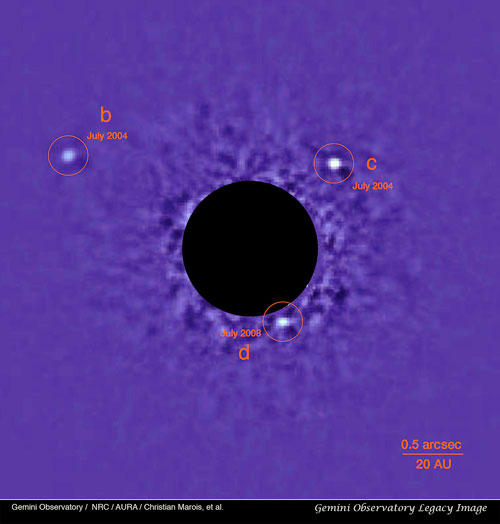
dtolman writes "Scientists at the Keck and Gemini telescopes stole the thunder of Hubble scientists announcing the first picture of an extrasolar world orbiting a star. Hubble scientists announced today that they were able to discover an extrasolar world for the first time by taking an actual image of the newly discovered exoplanet orbiting Fomalhaut — previous discoveries have always been made by detecting changes in the parent star's movement, or by watching the planet momentarily eclipse the star — not by detecting them in images. Hubble's time to shine was overshadowed though by the Keck and Gemini observatories announcing that they had taken pictures of not just one planet, but an entire alien solar system. The images show multiple planets orbiting the star HR 8799 — 3 have been imaged so far." -
Hubble's Exoplanet Pics Outshined by Keck's
dtolman writes "Scientists at the Keck and Gemini telescopes stole the thunder of Hubble scientists announcing the first picture of an extrasolar world orbiting a star. Hubble scientists announced today that they were able to discover an extrasolar world for the first time by taking an actual image of the newly discovered exoplanet orbiting Fomalhaut — previous discoveries have always been made by detecting changes in the parent star's movement, or by watching the planet momentarily eclipse the star — not by detecting them in images. Hubble's time to shine was overshadowed though by the Keck and Gemini observatories announcing that they had taken pictures of not just one planet, but an entire alien solar system. The images show multiple planets orbiting the star HR 8799 — 3 have been imaged so far." -
Binary Star EF Eridanus Baffles Astronomers
baldinux writes "Reuters is reporting the finding of a new stellar object in the Eridanus constellation that may require the astronomical community to create a new category of stellar entities -- that is, dead ones. In the binary system, one of the stars 'gave too much' (Reuters) of its own resources to its partner white dwarf star, resulting in a breakdown of nuclear fusion, thus producing this 'dead' entity. Researchers at Gemini North (click here for images) and Keck II observatories at Mauna Kea, Hawaii, have been analyzing this unique system." -
Binary Star EF Eridanus Baffles Astronomers
baldinux writes "Reuters is reporting the finding of a new stellar object in the Eridanus constellation that may require the astronomical community to create a new category of stellar entities -- that is, dead ones. In the binary system, one of the stars 'gave too much' (Reuters) of its own resources to its partner white dwarf star, resulting in a breakdown of nuclear fusion, thus producing this 'dead' entity. Researchers at Gemini North (click here for images) and Keck II observatories at Mauna Kea, Hawaii, have been analyzing this unique system." -
Distributed Astronomy
prostoalex writes "Scientists at Gemini Observatory are using Internet2 to link telescopes worldwide and receive images that they say are sharper than those coming from Hubble." -
Gemini Observatory Probes Galaxy NGC 1068 Churning Core
Mr. Intel writes: "Using the Gemini Telescope at Mauna Kea, scientists have created a 3D movie of a distant galaxy. How you ask? By using a new instrument, the Integral Field Unitor or IFU, they can collect vast amounts of light and scan the beams using 1500 special optical fibers. This allows the researchers to track stars and interstellar gas motion in the galaxy. There is a press release and an images page. SciAm also has an article." -
Gemini Observatory Probes Galaxy NGC 1068 Churning Core
Mr. Intel writes: "Using the Gemini Telescope at Mauna Kea, scientists have created a 3D movie of a distant galaxy. How you ask? By using a new instrument, the Integral Field Unitor or IFU, they can collect vast amounts of light and scan the beams using 1500 special optical fibers. This allows the researchers to track stars and interstellar gas motion in the galaxy. There is a press release and an images page. SciAm also has an article." -
Gemini Observatory Probes Galaxy NGC 1068 Churning Core
Mr. Intel writes: "Using the Gemini Telescope at Mauna Kea, scientists have created a 3D movie of a distant galaxy. How you ask? By using a new instrument, the Integral Field Unitor or IFU, they can collect vast amounts of light and scan the beams using 1500 special optical fibers. This allows the researchers to track stars and interstellar gas motion in the galaxy. There is a press release and an images page. SciAm also has an article." -
Gemini's Twin Lights Up in Chile
pyrrho writes: "The southern twin Gemini Observatory in Chile, Gemini South, was dedicated today. This is an exact duplicate of the Gemini North Observatory which recently directly imaged a brown dwarf. These Observatories not only bring in a new era of amazing astronomy, including the possibility of direct imaging of planets, but also represent a step forward in the automation of observatories, being highly remote controllable from around the world if desired, and also highly automated, supporting observation queuing that helps to match particular observations to the best fit seeing conditions. Gemini is an international project, bringing together an unprecidented number of nations for joint research in astronomy. By supplying identical observatories in both the Northern and Southern Hemisphere, Gemini Observatory truly ushers in an era of big telescopes." -
First Image Of Planet-Like Body Orbiting A Star
deglr6328 writes "The Gemini North Telescope has, for the first time, directly imaged a planet like body orbiting a star. The object is a brown dwarf, 55 to 78 times the mass of planet Jupiter and 14 AU distant from its parent star 15 Sge. It was imaged using adaptive optics(see also here) that correct for the blurring effect of the atmosphere using deformable mirrors. Cool!" -
First Image Of Planet-Like Body Orbiting A Star
deglr6328 writes "The Gemini North Telescope has, for the first time, directly imaged a planet like body orbiting a star. The object is a brown dwarf, 55 to 78 times the mass of planet Jupiter and 14 AU distant from its parent star 15 Sge. It was imaged using adaptive optics(see also here) that correct for the blurring effect of the atmosphere using deformable mirrors. Cool!"