Slashdot Mirror


Hubble's Exoplanet Pics Outshined by Keck's

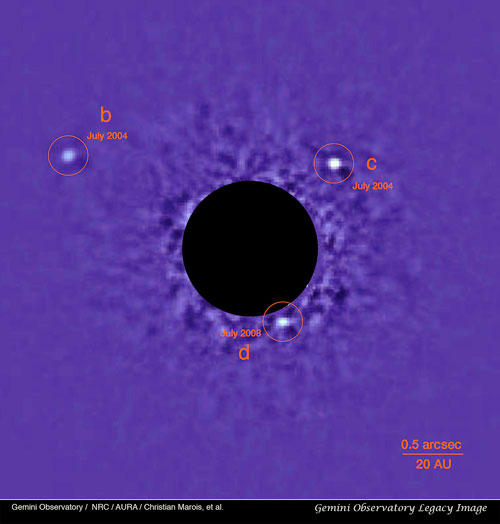
dtolman writes "Scientists at the Keck and Gemini telescopes stole the thunder of Hubble scientists announcing the first picture of an extrasolar world orbiting a star. Hubble scientists announced today that they were able to discover an extrasolar world for the first time by taking an actual image of the newly discovered exoplanet orbiting Fomalhaut — previous discoveries have always been made by detecting changes in the parent star's movement, or by watching the planet momentarily eclipse the star — not by detecting them in images. Hubble's time to shine was overshadowed though by the Keck and Gemini observatories announcing that they had taken pictures of not just one planet, but an entire alien solar system. The images show multiple planets orbiting the star HR 8799 — 3 have been imaged so far."
140 comments

  1. Gene Wolfe fans rejoice by CRCulver · · Score: 3, Interesting

    A planet orbiting Fomalhaut? Well, it seems Gene Wolfe was prescient in his work The Book of the New Sun when one of his characters contacts a wise civilization there on, as Wolfe uses the Arabic name, "the Fishes' Mouth".

    1. Re:Gene Wolfe fans rejoice by Anonymous Coward · · Score: 0

      It's not likely there are any civilizations existing on Fomalhault b. It's too young, big, and far away from its parent. Even the moons are unlikely given its distance from its star relative to the star's temperature.

    2. Re:Gene Wolfe fans rejoice by FiloEleven · · Score: 2, Interesting

      I did'nt catch that reference while reading New Sun - good eye. I was thinking of mentioning Fomalhaut system's role in the Hyperion Cantos by Dan Simmons, even though it's just a minor setting IIRC. Then I was going to tell people to check out the series because it's a fine one, but since you've mentioned The Book Of The New Sun, I'm just going to shut up and hope that more folks put it at the top of their reading lists, and then insert it again halfway down to catch what they missed before.

    3. Re:Gene Wolfe fans rejoice by Anonymous Coward · · Score: 1, Interesting

      It's not likely there are any civilizations existing on Fomalhault b. It's too young, big, and far away from its parent. Even the moons are unlikely given its distance from its star relative to the star's temperature.

      Very true. However, recall that Jupiter's presence (along with the other gas giants) gives wayward asteroids much larger targets than the small lumps of rock in the warmer zone. The discovery of Fomalhaut b just adds another promising similarity between that system and ours.

    4. Re:Gene Wolfe fans rejoice by Grishnakh · · Score: 5, Informative

      It's unlikely there's any civilizations on ANY exoplanets we've discovered, since they're all gas giants. Civilizations like ours are only likely on small, rocky, warm planets, which are currently undetectable to us as they're too small, and too close to their stars.

      Of course, Fomalhault "b" is only a temporary designation; if smaller planets are detected closer to the star, then one of those would become "b" I imagine. But even so, it still isn't likely there'd be a civilization on one of those, since this star is so young, and so would any planets orbiting it. If the age of this star is correct, it didn't even exist when our world had dinosaurs on it, which wasn't really that long ago considering the age of our planet.

      As for moons, however, I wouldn't be surprised to find that Fomalhault's gas giant planets had some moons. Our own gas giants have tons of moons, many of them just tiny asteroids really. Surely at least a few stray asteroids have been captured by these gas giants over the past 60 million years.

    5. Re:Gene Wolfe fans rejoice by Number14 · · Score: 1

      The Book of the New Sun is one of those very few stories that I finished and then immediately turned back to page 1 to reread to see what I had missed. Genius.

      Of course, the Hyperion Cantos is also a favorite, so people should go read both!

    6. Re:Gene Wolfe fans rejoice by techno-vampire · · Score: 2, Insightful
      Of course, Fomalhault "b" is only a temporary designation; if smaller planets are detected closer to the star, then one of those would become "b" I imagine.

      Maybe not. It might be easier to name them in the order of discovery. If nothing else, that eliminates any possible confusion down the road.

      --
      Good, inexpensive web hosting
    7. Re:Gene Wolfe fans rejoice by Anonymous Coward · · Score: 0

      I really don't understand this mentality.

      Where does the notion that for intelligent alien life, alien civilizations even, need to have earth like qualities to even exist? Evolution isn't bound to just our planet's standards.

      Imagine a molten hot planet where intelligent life evolved on it, while it may deadly to humans to even touch the planet's surface, the alien life goes on about it's day swimming in streams of lava.

      It just seems so close minded to think otherwise.

    8. Re:Gene Wolfe fans rejoice by VShael · · Score: 1

      Of course, Fomalhault "b" is only a temporary designation; if smaller planets are detected closer to the star, then one of those would become "b" I imagine.

      Oblig Khan reference :

      "THIS is Fomalhault B!!!"

    9. Re:Gene Wolfe fans rejoice by Grishnakh · · Score: 1

      On a molten hot planet, even if intelligent life somehow managed to evolve, how would it build a civilization or technology with just streams of lava to work with?

      It's like dolphins. They appear to be pretty intelligent, perhaps second only to us on this planet. But they have no way of manipulating their environment (e.g., opposable thumbs), and are stuck living in the oceans, so even if they wanted to, their ability to create technology is quite limited compared to us. So, they just swim around and have orgies.

      There's nothing closed-minded about it; it's just pragmatic to assume alien life is likely to resemble us in many ways: developing on a rocky planet within the Habitable Zone of its star, where it won't be too hot or too cold for carbon-based organic life to develop. It would certainly be easier to recognize such life too, rather than looking for Hortas.

    10. Re:Gene Wolfe fans rejoice by avgjoe62 · · Score: 1
      So, they just swim around and have orgies.

      Actually sounds a lot like the parties down here in Miami, except that those opposable thumbs are usually using a Blackbeyy or iPhone while swimming around and having orgies.

      Not that I ever get invited to those parties, mind you. I'm usually at home, trying to build a Finite Improbablility Machine using a hot cup of tea.

      --

      How come Slashdot never gets Slashdotted?

  2. Wish I could discovery something by ItsColdOverHere · · Score: 0, Troll

    From your friendly neighborhood grammar nazi

    1. Re:Wish I could discovery something by ItsColdOverHere · · Score: 1

      Oh look, fixed

    2. Re:Wish I could discovery something by Farmer+Tim · · Score: 5, Funny

      To "Discovery" something is easy: you just make a documentary about it that's too dumbed-down for people who like documentaries but still too boring for those who don't, and add lots of unnecessary and repetitive CG animation.

      --
      Blank until /. makes another boneheaded UI decision.
    3. Re:Wish I could discovery something by fastest+fascist · · Score: 1

      Bonus point for hiring that guy that does voice-overs for action movie and thriller trailers.

    4. Re:Wish I could discovery something by davester666 · · Score: 0, Flamebait

      FAKE! Those pictures totally look Photoshopped!

      --
      Sleep your way to a whiter smile...date a dentist!
    5. Re:Wish I could discovery something by Farmer+Tim · · Score: 1

      Sorry to be the bearer of bad tidings, but he died recently. Sadly this means Hollywood will only be releasing romantic comedies and musicals from now on.

      In other news, Gillette's share price has skyrocketed...

      --
      Blank until /. makes another boneheaded UI decision.
    6. Re:Wish I could discovery something by Xcruciate · · Score: 0, Redundant

      Too late, he just died recently.

      http://www.imdb.com/news/ni0559736/

      --
      It's like "looking busy" at your employment - it's actually easier to do real work than to fake it. - bmo
    7. Re:Wish I could discovery something by Patchw0rk+F0g · · Score: 1

      [sigh] Mod points, and not an Idiot category in sight...

      --
      When the going gets weird, the weird turn pro. ~~ Hunter S. Thompson
    8. Re:Wish I could discovery something by ItsColdOverHere · · Score: 1

      The fact remains that after I posted the comment the typo was fixed, troll mod or not.

  3. Amazing by mfh · · Score: 1, Insightful

    This is exhilarating news, that we are most likely not alone in the universe (and beyond). Our solar system is not unique!!

    This whole galactic mess has some more meaning, today. We are like infants, opening our eyes for the first time -- how far we have to go (if we don't destroy ourselves soon).

    --
    The dangers of knowledge trigger emotional distress in human beings.
    1. Re:Amazing by EraserMouseMan · · Score: 2, Insightful

      We already knew there were planets orbiting other stars.

    2. Re:Amazing by Anonymous Coward · · Score: 0

      we're not going to destroy ourselves. because that's not profitable.

    3. Re:Amazing by dedazo · · Score: 1

      We hardly needed these to tell us there are other solar systems with planets in them. I mean they're nice and probably good for creationists or whatever, but other non-visual data proved a long time ago that our star-planet orbit configuration is far from unique.

      --
      Web2.0: I love when people Flickr my cuil and digg my boingboing until my google is reddit and I start to yahoo
    4. Re:Amazing by jfengel · · Score: 1

      Take a deep breath. The discovery of exoplanets isn't news. Even taking pictures of them isn't news.

      It's news that we're finding them on stars kinda like our own, but these aren't earth-style planets.

      So, it's pretty interesting, but you can push "pause" on the CD player with "Also Sprach Zarathustra" queued up.

    5. Re:Amazing by Anonymous Coward · · Score: 5, Insightful

      Taking pictures of them *is* news. In fact, that's the point of these releases. These are the first direct images ever released. Before this, all evidence was indirect (oscillating plots of star brightness as the planet periodically eclipsed the host star, for instance).

    6. Re:Amazing by RiotingPacifist · · Score: 2, Insightful

      planets != habitable != life != intelligent life

      Hell there is no reason to assume that intelligence is even the natural outcome of evolution, it didn't work during the era of the dinosaurs. When you take into account so many unknown factors, the existence of planets that we already knew would exist hardly makes it likely that we are not alone in the AU (we are ofcourse not alone in the universe, but what does it matter if we can never make contact with them). How many species are there in the AU well Drake came up with an equation for this i believe the answer was something like 31 +/- 3,000,000.

      --
      IranAir Flight 655 never forget!
    7. Re:Amazing by MMatessa · · Score: 4, Interesting

      These are the first direct images ever released. Before this, all evidence was indirect (oscillating plots of star brightness as the planet periodically eclipsed the host star, for instance).

      Well, except for HD 189733b, 2M1207 b and GQ Lup b.

    8. Re:Amazing by Alan+Partridge · · Score: 1

      Tell that to the weapons manufacturers. War is HIGHLY profitable.

      --
      That was classic intercourse!
    9. Re:Amazing by Anonymous Coward · · Score: 0

      You assign sight primacy over humanities other methods of 'perception'. Is that where truth emerges these days?

    10. Re:Amazing by Trapezium+Artist · · Score: 5, Informative

      HD189733b: not directly imaged, but has had a temperature map of it reconstructed from very careful analysis of the change in the light from the parent star as the planet transits in front of and behind it.

      2M1207b: this orbits a brown dwarf, not a star.

      GQ Lup b: not a planet by any reasonable stretch of the scientific imagination, unless you happen to have been a co-author of the original paper. Believe me: this one is dead, Jim, and was known by most of us to be so on arrival.

    11. Re:Amazing by Beezlebub33 · · Score: 2, Insightful

      Why on earth (or whatever planet you live on) would this be good for creationists? It's good science, and indicates significant progress in astronomy. Of course, they don't count any data as against them but I can't imagine how that would help them.

      --
      The more people I meet, the better I like my dog.
    12. Re:Amazing by Specter · · Score: 1

      Especially for Vault-Tec! Have you reserved you slot? Do it today!

    13. Re:Amazing by dedazo · · Score: 2, Insightful

      Good as in "there you go, you ignorant idiot" :)

      --
      Web2.0: I love when people Flickr my cuil and digg my boingboing until my google is reddit and I start to yahoo
    14. Re:Amazing by Grishnakh · · Score: 2, Insightful

      Intelligence isn't a binary, yes-or-no trait. Dinosaurs were intelligent, just like lizards and birds and cats. They weren't very intelligent compared to us, but compared to an amoeba they certainly were. While you're sitting there thinking that you're so intelligent, there's probably some super-advanced alien race observing us, the way we observe mice or ants, and laughing at us for thinking we're intelligent.

      Because of our limited technology for detecting exoplanets, the only ones discovered so far are gas giants, mostly larger even than our own solar system's gas giants (which are already gigantic compared to Earth). There's no telling how many earth-sized rocky planets (or moons) exist, even around the stars we've already found gas giants around. ETs may even exist on some of these, but short of detecting radio transmissions from them, there's no way to tell.

    15. Re:Amazing by Cassius+Corodes · · Score: 3, Funny

      Plus they might all go there to try and convert the heathens.

      --
      Control is an illusion, order our comforting lie. From chaos, through chaos, into chaos we fly
    16. Re:Amazing by Anonymous Coward · · Score: 0

      So, i'm guessing you are one of those humans who think only humans have intelligence?

      Why do people always do this?
      Is it because humans can speak the way they do?
      How do we know that birds aren't just randomly making noises? Or that dogs barks aren't some form of communication? (simple at that)
      Or is it because we build things?
      I'm pretty sure there are other animals who build all the time, including birds.

      And speaking of communication, do all these people searching think outside of the box much?
      Alien races could easily be using entire suns to communicate, by altering its surface state, or covering it in a massive bubble that could encode information by removing certain frequencies.
      Hell, for all we know, Pulsars could be communicators.

      We have already created some form of cross-species communication with dolphins, simple just now (pictographic for now), but with more research and funding, could go much further.
      Could be useful, if out of some freak chance, we actually do manage to find an alien race nearby...

    17. Re:Amazing by actionbastard · · Score: 1

      "Our solar system is not unique!!"

      Actually, from current observations, it is -especially when it comes to punctuation.

      --
      Sig this!
    18. Re:Amazing by David+Gould · · Score: 1

      Marklar!

      --
      David Gould
      main(i){putchar(340056100>>(i-1)*5&31|!!(i<6)<< 6)&&main(++i);}
    19. Re:Amazing by totally+bogus+dude · · Score: 1

      I think the interesting / meaningful distinction is that humans design and create things, rather than simply "building" them. While some animals do make use of very basic tools, humans take it to a whole new level. The process for creating a microcomputer, for example, is far removed from actually performing the tasks we use them as tools to accomplish.

      Definitely agree with the post above yours though -- intelligence (as we think of it) -- is not necessarily going to be the "final product" of evolution, or even a product at all. This question was posed to Richard Dawkins (in a video series on YouTube, "A conversation with Richard Dawkins"), I think it was essentially "if humans didn't exist or became extinct, would another species evolve our level of intelligence?" and his answer was "almost certainly not", simply based on the slim likelihood of intelligence evolving in the first place.

      Also, your suggestion that we should take "communicating with other species on our own planet" as a serious goal is an interesting, and I think, very compelling idea.

    20. Re:Amazing by eleuthero · · Score: 1

      As I recall, it did work with the dinosaurs, and then they left in giant starships and created a religion that made heresy of the "great migration" theory that all their archaeology proposed. It was only after being confronted with the truth that they tried to eat it... err, something along those lines anyway. Star Trek is great fun sometimes.

    21. Re:Amazing by coastwalker · · Score: 1

      It has to be said that you can only go so far with metaphor. Looking at a plot of oscillating light curves is great for those of us who understand what they mean. There is something visceral that hits you in the gut when you can see the things with your own eyes in a photograph that could have been taken in your back garden.

      Its why we do stupid things like send people into space instead of machines - it gets the thing into the brains of mainstream mortgage defaulters and their tax dollars are diverted into more of the same instead of mediating religious wars in oil filled deserts or building creationist edutainment museums.

      I for one welcome our new methane breathing overlords even if they are 25 or 129 lightyears away.

      --
      Facts are history now plebs have politics for religion on social media.
    22. Re:Amazing by Terminus32 · · Score: 0

      Yeap, agreed this is some BIG news...amazing discovery.

      --
      http://nathanlindsell.blogspot.com/
    23. Re:Amazing by mfh · · Score: 1

      Your story from 2004 was trumped by the discovery of a solar system that is very much like our own, as reported in the Slashdot article this is comment attached to. This is probably the reason I titled this thread "Amazing" -- because I'm totally amazed by this discovery!!

      --
      The dangers of knowledge trigger emotional distress in human beings.
    24. Re:Amazing by ObiWanKenblowme · · Score: 1

      And they did so without leaving any traces of any technology, primitive or advanced, on the entire planet - god, I hated that episode.

      --
      Obvious exits are NORTH, SOUTH, and DENNIS.
  4. Rings around the planet by Anonymous Coward · · Score: 0

    Planet b looks like it might have a dark set of saturns rings ?!?!?!?!

  5. The Author by cuby · · Score: 5, Informative

    Hello,
    I think the discovery was made by the team led by Paul Kalas:
    http://astro.berkeley.edu/~kalas/index.html

    --
    Math is beautiful... e^(pi*i)+1=0
    1. Re:The Author by dtolman · · Score: 1

      You are correct. I pretty much guessed what the gist of the announcement would be, thanks to his presence in the pre-announcement last week . After all - his big extrasolar claim to fame is figuring out that the dust ring at that star had a sharp inner edge that had to be caused by a planet.

  6. obligatory... by advocate_one · · Score: 3, Funny

    that's not a planet...

    --
    Donald 'Duck' Dunn: We had a band powerful enough to turn goat piss into gasoline.
    1. Re:obligatory... by truthsearch · · Score: 4, Funny

      It would be "That's no planet..."

      I wish I could mod myself (-1: Pedantic)

    2. Re:obligatory... by metamatic · · Score: 2, Informative

      On the contrary, if it's in Kecks, it might be Uranus.

      --
      GCHQ Quantum Insert installed. If only our tongues were made of glass, how much more careful we would be when we speak
    3. Re:obligatory... by RiotingPacifist · · Score: 4, Funny

      That's no mod choice!

      --
      IranAir Flight 655 never forget!
    4. Re:obligatory... by Anonymous Coward · · Score: 0

      That's no joke!

    5. Re:obligatory... by iluvcapra · · Score: 1, Informative

      Ahem. It would be "That's no moon..."

      --
      Don't blame me, I voted for Baltar.
    6. Re:obligatory... by Anonymous Coward · · Score: 0

      I see you've played Planety-Moony before.

  7. Are we sure it's a planet? by NiceGeek · · Score: 1
  8. Direct link to Hubble Press Release and pix by dtolman · · Score: 5, Informative

    This came out after I posted the article... Hubble presents - Fomalhaut B! This graphic is particularly nice!

  9. Colonization by Scutter · · Score: 4, Funny

    I wanna live on the left dot.

    --

    "Tell me doctor, with all of your defenses, are there any provisions for an attack by killer bees?"
    1. Re:Colonization by EraserMouseMan · · Score: 1

      It looks like Saturn. So it's probably a gas giant. Bring plenty of GasX with you to neutralize the atmosphere.

    2. Re:Colonization by dkleinsc · · Score: 5, Funny

      If you can get there, it's yours.

      --
      I am officially gone from /. Long live http://www.soylentnews.com/
    3. Re:Colonization by Scutter · · Score: 1

      If you can get there, it's yours.

      Sweet. I'm going to paint it pink and stock it with hippies.

      --

      "Tell me doctor, with all of your defenses, are there any provisions for an attack by killer bees?"
    4. Re:Colonization by Afforess · · Score: 0, Redundant

      That's no moon...

      --
      If our elected representatives no longer represent us, do we still live in a Democracy?
    5. Re:Colonization by Fluffeh · · Score: 1

      Colonel Sandurz: Prepare ship for ludicrous speed! Fasten all seatbelts, seal all entrances and exits, close all shops in the mall, cancel the three ring circus, secure all animals in the zoo!

      --
      Moved to http://soylentnews.org/. You are invited to join us too!
  10. Alien vs Predator by avandesande · · Score: 2

    Alien vs Predator made even more sense than the comparison in the headline...

    --
    love is just extroverted narcissism
  11. I'm sending them a email right now! by Anonymous Coward · · Score: 0

    It's only 26 light years away. That just enough time for LOLCATS to stop being lame and starting being ironically retro.

  12. Planets look like... by infalliable · · Score: 1

    So planets look a lot like noise. They really aren't all that much different than the expected noise levels on the images. Especially on the first one from Fomalhaut.

    1. Re:Planets look like... by msbmsb · · Score: 5, Informative

      You have to see the orbital progression to get over the thought that it's just another speck of light noise. Here is a larger image showing the position of the planet from 2004 and 2006. Also, here is the url for the release showing the image of HR 8799 with its 3 planets.

    2. Re:Planets look like... by Stephen+Ma · · Score: 4, Insightful
      So planets look a lot like noise.

      If the "noise" obeys Kepler's laws, it's probably an image of something real.

  13. Ummm... that's the Eye of Sauron by Nyktos · · Score: 1

    This ain't no solar system... it's the all seeing Eye of Sauron! Creepy.

    1. Re:Ummm... that's the Eye of Sauron by VagaStorm · · Score: 1

      lol, yeah, thats what I was seeing to :)

  14. Ah... so this is... by alexborges · · Score: 0, Flamebait

    What a big ass telescope pissing contest looks like...

    And here I thought the headline would read: we can now see planets and stars beyond.

    --
    NO SIG
  15. more like by Digitus1337 · · Score: 1

    Speck and Gemini telescopes stole the thunder of Hubble scientists announcing the first picture of an extrasolar world orbiting a star.

    Seriously though, it is a shame that this will not get wider news coverage. Slashdot has had some interesting articles in the past few days, first the 11,000 temple and now this. This is slashdot after all, let us not dwell on the cosmic or profound. Queue the speck puns in 3... 2... 1...

  16. The similarities are stunning! by need4mospd · · Score: 5, Funny

    they are massive, young, hot planets that are probably mostly gaseous and completely inhospitable. They'd get along great with my ex!

  17. In the hubble picture by SnarfQuest · · Score: 4, Informative

    In the hubble picture, does anyone else see the shadow of the Enterprise?

    --
    Who would win this election: Andrew Weiner vs Andrew Weiner's weiner.
    1. Re:In the hubble picture by JesseMcDonald · · Score: 1

      That was my first thought as well. Glad to see I wasn't the only one.

      --
      "The state is that great fiction by which everyone tries to live at the expense of everyone else." - Bastiat
    2. Re:In the hubble picture by Anonymous Coward · · Score: 0

      I just love .... Scanning for lifeforms.
      Where ist SETI when you need them?

  18. Yeah, some picture by dukeofurl01 · · Score: 0

    It's a regular pulitzer.

  19. Zoom In by HeyBob! · · Score: 1

    "Computer, Zoom in"

  20. Mote in God's Eye by MikeMo · · Score: 4, Funny

    no, not Sauron. That is clearly the Mote in God's Eye.

    1. Re:Mote in God's Eye by El+Micko · · Score: 1

      On the other hand, the gripping hand, what it looks like probably depends on where you stand.. looks like a coalsack from somewhere I'm sure.

      The diagrams are clearly missing the Alderson Point.

      http://antwrp.gsfc.nasa.gov/apod/ap081114.html

  21. Sorry by istartedi · · Score: 4, Funny

    As deed holder via the International Star Registry, that includes a deed on any planets in orbit, I forbid it. Why, there might even be rich deposits of diamelles and/or Ginsu steak knives on that planet. I'm not giving it up without a fight.

    --
    For all intensive purposes, "whom" is no longer a word. That begs the question, "who cares"?
    1. Re:Sorry by Scutter · · Score: 4, Funny

      As deed holder via the International Star Registry, that includes a deed on any planets in orbit, I forbid it. Why, there might even be rich deposits of diamelles and/or Ginsu steak knives on that planet. I'm not giving it up without a fight.

      If it's interstellar war you want, sir, it's interstellar war you shall have! Have at you!

      --

      "Tell me doctor, with all of your defenses, are there any provisions for an attack by killer bees?"
    2. Re:Sorry by AkkarAnadyr · · Score: 2, Funny

      Gesundheit!

      --

      I bought this house and you know I'm boss
      Ain't no h'aint gonna run me off

  22. Outshined? Outshone! by Anonymous Coward · · Score: 0

    From the "My English is goodly" department, more like.

    At least you managed to use the apostrophes correctly, Timothy.

    1. Re:Outshined? Outshone! by 4D6963 · · Score: 1

      Irregular verbs are binded to slowly disappear, that's how it haved always beed.

      --
      You just got troll'd!
    2. Re:Outshined? Outshone! by 4D6963 · · Score: 1

      Crap, I mean "that be how". Seriously though, it's a trend that dates back to the middle ages or something.

      --
      You just got troll'd!
  23. Great explanation from Gemini directors by G3CK0 · · Score: 3, Interesting

    On Thursday 13th November 2008, Gemini Observatory in coordination with several institutions released the first images of an exo multi-planet system around star HR 8799 in the constellation of Pegasus. The discovery was made at Gemini North using the adaptive optics system ALTAIR and NIRI as the infrared imager on October 17, 2007. Follow up and confirming observations were made on the Keck II Telescope and Gemini North. Adaptive optics played a crucial role in obtaining these historic images of a young extra-solar multiple-planet system. The estimated age of the system implies planetary masses between 5 and 13 times that of Jupiter. These giant planets orbit at roughly 25, 40 and 70 times the Earth-Sun separation around their host star which is about 128 light-years from our sun. For more details see www.gemini.edu.

    --
    A clear conscience is usually the sign of a bad memory.
  24. Finally! by sneakyimp · · Score: 1

    I was an astrophysics major in college for about 2 years but gave up on it because it seemed so speculative. To infer the existence of a planet around a star from the 'wobble' we see in the position or spectrum of the star may be sound science but it hardly grabs the imagination.

    THIS, on the other hand is truly awesome. Seeing is believing I guess. Unless some kid is dicking around with Photoshop -- or more likely GIMP.

    1. Re:Finally! by eabrek · · Score: 1

      I'm sure there is a lot of processing/filtering required to make these images, but still! Very cool!

    2. Re:Finally! by eabrek · · Score: 3, Interesting

      Some description of the technique. Under ADI.

    3. Re:Finally! by mangu · · Score: 2, Insightful

      To infer the existence of a planet around a star from the 'wobble' we see in the position or spectrum of the star may be sound science but it hardly grabs the imagination.

      Funny thing is, it grabs *my* imagination! To see something, we have been doing this since eyes evolved on animals. But to perform careful calculations and realize that the results imply the existence of a planet, well, that's what I call awesome.

  25. overshadowed? by MLCT · · Score: 4, Insightful

    Not entirely sure why the summary touches on one being overshadowed by the other.

    On the contrary, the two works are complimentary, and it is thus no coincidence that they have been released at the same time. Hubble shows an old cold planet on the edge of a solar system, while Keck shows some very young hot infra-red emitting planets close to their star. The two discoveries help elucidate the workings of other solar systems - and each is just as valuable as the other.

    1. Re:overshadowed? by dtolman · · Score: 1

      How about the fact that the Keck/Gemini team just happened to release the news a few hours before a press conference by the Hubble team. A press conference that was announced a week ago. They could have waited until tomorrow. Or next week. Looked to me like they figured out that Hubble had a similar announcement, and tried to beat them to the punch.

    2. Re:overshadowed? by Anonymous Coward · · Score: 0

      Both papers are appearing in the same issue of ScienceExpress, and presumably had identical press embargo restrictions. If an embargo was broken, it's not clear that it was an attempt of one team to scoop another; could just be a journalist trying to get a scoop, or someone accidentally overlooking the embargo.

    3. Re:overshadowed? by dtolman · · Score: 1
      hmmm... good counter argument. Still have no idea what the truth behind this is.

      Either way, its a good day for armchair astronomers (and professional ones too).

    4. Re:overshadowed? by Trapezium+Artist · · Score: 5, Informative
      Rest assured, these were strongly coordinated: both teams knew full well of each others results well in advance, both were scheduled for simultaneous release via Science at 2pm EDT today, and indeed, both papers share one co-author. (I work in the same group as another co-author of the HR8799 paper, so believe me that this is first-hand knowledge). The HST press conference was scheduled (well in advance) for shortly after the Science embargo expired.

      Of course, this hasn't stopped both groups trying to spin up their results in a perfectly understandable fashion. The downside is that many online press stories are showing very signs of confusion as to what's what, not at all helped by the blizzard of parallel press releases from various institutions on the HR8799 3-planet system result.

      Indeed, the Gemini Observatory release shows images taken with their telescope showing just two of the planets, presumably because they don't want to cede any ground to the Keck, their rivals on Mauna Kea, where the third planet was found. Again, potentially very confusing indeed to the public.

      As for the complementary aspect of the two discoveries, that's mostly the case and both discoveries are very important. But it's not true to say that one's (Fomalhaut) an old planet seen in reflected visible light while the others (HR8799) are young and shining in their own heat: both stars are roughly equally young and the Fomalhaut planet seems also to be shining in some mix of its own heat even in the visible (it's at 400K, possibly), plus perhaps some additional reflected light from a dusty disk around the planet (as opposed to the obvious disk around the star itself).

      Also, I wouldn't say the HR8799 planets are close to their star: nothing like. They're out at the equivalent of Neptune's orbit and beyond, even though the Fomalhaut planet's a bit further out still.

      Hope this helps allay your (understandable) scepticism.

    5. Re:overshadowed? by Tablizer · · Score: 2, Informative

      Not entirely sure why the summary touches on one being overshadowed by the other...the two works are complimentary...Hubble shows an old cold planet on the edge of a solar system, while Keck shows some very young hot infra-red emitting planets close to their star.

      More specifically, comparing the two is like comparing apples and oranges. The infrared image shows the planets because they are still glowing bright in infrared because they were very recently formed, and thus "hot out of the oven". The article said that the Hubble image was based on visible light reflected from the parent star, not from the planet's own heat. It's thus a dimmer target. (Hubble is not designed/optimized for infrared.)

      It is true that Earth-based scopes have better resolution than Hubble in very *specific* circumstances with careful "tricks"; but in general, Hubble is still The King. (Although processing tricks to counter the atmosphere "wiggle" for Earth scopes are making incremental improvements and may catch up someday.)
             

    6. Re:overshadowed? by Anonymous Coward · · Score: 0

      Conspiracy theories are always more fun than the boring truth.

      The boring truth is that it was a coincidence.

    7. Re:overshadowed? by Trapezium+Artist · · Score: 2, Informative

      See my post elsewhere in this thread, but this isn't true: if you read the Fomalhaut paper (as opposed to the PR), they're unsure quite what mix of reflected starlight, thermal self-emission, and additional reflected light from a circumplanetary disk makes up the light seen from Fomalhaut b, at both visible and IR wavelengths.

      These objects are actually more similar than they are different, in my opinion.

      As for HST still being king, well, yes and no: depends on what you're after. Ground-based AO has caught up and exceeded HST in some domains already, while HST still wins in others. Ultimately we need ground- and space-based telescopes to get the most complete view: today it's HST and the 8-10m telescopes, tomorrow it's JWST and the 30-40m extremely large telescopes.

    8. Re:overshadowed? by Tablizer · · Score: 1

      if you read the Fomalhaut paper (as opposed to the PR), they're unsure quite what mix of reflected starlight, thermal self-emission, and additional reflected light from a circumplanetary disk makes up the light seen from Fomalhaut b, at both visible and IR wavelengths. These objects are actually more similar than they are different, in my opinion.

      The referenced article says this: "Fomalhaut b, in the Hubble image, is much older (200 million years) [implying cooler], and glows only by reflected light from Fomalhaut."

      If what you say is true, then the article is wrong.

      As far as which telescope is "best", my understanding is that atmosphere "cancellation" techniques require a nearby bright "guide star", greatly limiting the targets. There is technology to use a laser beam(s) instead of a guide star, but it was still in the testing stages the last I read. Maybe it's gotten better since I last read up on it.


    9. Re:overshadowed? by dtolman · · Score: 1
      That makes sense. It was a little confusing this morning seeing the Keck/Gemini announcements out, covering the same ground as the expected (and previously announced) Hubble. Then the Keck got pulled for a few hours leaving just the Gemini. Guess those press/web guys at the observatories need more practice following embargoes :)

      Anyway - its quiet exciting to see not just 1 but 4 objects that we can get spectra on (hopefully soon).

    10. Re:overshadowed? by tyrione · · Score: 1

      See my post elsewhere in this thread, but this isn't true: if you read the Fomalhaut paper (as opposed to the PR), they're unsure quite what mix of reflected starlight, thermal self-emission, and additional reflected light from a circumplanetary disk makes up the light seen from Fomalhaut b, at both visible and IR wavelengths.

      These objects are actually more similar than they are different, in my opinion.

      As for HST still being king, well, yes and no: depends on what you're after. Ground-based AO has caught up and exceeded HST in some domains already, while HST still wins in others. Ultimately we need ground- and space-based telescopes to get the most complete view: today it's HST and the 8-10m telescopes, tomorrow it's JWST and the 30-40m extremely large telescopes.

      I somehow imagine that if they replaced Hubble with a current cousin in technological advances the King's cousin would reign supreme, across all fields of imagery.

      Too bad we had to put so much into Iraq when just one month of cost could do wonders for earth orbiting telescopic research.

    11. Re:overshadowed? by Anonymous Coward · · Score: 0

      You only helped? You either *find* a new planet or you *don't* you arrogant prick.

    12. Re:overshadowed? by RockDoctor · · Score: 1

      (Although processing tricks to counter the atmosphere "wiggle" for Earth scopes are making incremental improvements and may catch up someday.)

      I'm unclear of what you mean by "processing tricks". Describing adaptive optics (AO) as "processing tricks" is strange - a better description would be "getting a better mirror". The AO systems that I've seen details of work by manipulating a mirror in the light path so that a near-axis guide star (natural or artificial) maintains as small an image as possible ; since the mirror is at a point where the whole wavefront is involved in the whole mirror, then correcting the size/ shape of the guide star by adjusting the shape of the AO mirror will also apply the same corrections to the on-axis target image. Several nanoseconds later (ummm, 10m at 300000000 m/s = 33ns, to a first approximation ; assuming the AO mirror is at one end of the scope and the detector is at the other end) the light comes to a focus on the detector, which works exactly as in non-AO modes. To my mind, if that's a processing trick, then I want to get a 500mm Ritchey-Chrétien processing trick, with a good dark processing trick above it.

      There are other "processing tricks" that are used - speckle interferometry springs to mind - which are done off-line, after you've had your telescope time, but the AO that you've described happens before image capture.

      Hubble hasn't been king since ... some years before it was launched. It never has been a light bucket - it's 2.4m diameter mirror is around 1/4 of a modern national-grade light bucket, and so approximately 1/16 of the light gathering power of a light bucket ; that's around 3 orders of magnitude which is non-trivial. Also it's a LOT easier to put a new detector onto a ground telescope, so the improvements in seeing, lack of vibration, and exposure time that come from being in space have steadily been eroded.
      Don't get me wrong - Hubble is a great piece of telescope ; but it's not the only telescope in the world.

      --
      Birds are not dinosaur descendants;birds are dinosaurs, for all useful meanings of "birds", "are" and "dinosaurs"
    13. Re:overshadowed? by Tablizer · · Score: 1

      I'm unclear of what you mean by "processing tricks". Describing adaptive optics (AO) as "processing tricks" is strange

      Okay, I agree it was a poor way to summarize it.

      Hubble hasn't been king since ... some years before it was launched. It never has been a light bucket - it's 2.4m diameter mirror is around 1/4 of a modern national-grade light bucket, and so approximately 1/16 of the light gathering power of a light bucket

      It's not really a matter of collecting light the fastest: resolution is the big issue, and the Earth's atmosphere is resolution's biggest enemy at this stage.
           

    14. Re:overshadowed? by Anonymous Coward · · Score: 0

      What do you usually find in kecks? Dicks and assholes.

    15. Re:overshadowed? by RockDoctor · · Score: 1

      Hubble hasn't been king since ... some years before it was launched. It never has been a light bucket - it's 2.4m diameter mirror is around 1/4 of a modern national-grade light bucket, and so approximately 1/16 of the light gathering power of a light bucket

      It's not really a matter of collecting light the fastest: resolution is the big issue, and the Earth's atmosphere is resolution's biggest enemy at this stage.

      Resolution is, as you say, the issue. And, aS YOU SAY (bloody CapsLock!), the atmosphere is one of the major constraints to achieving high resolution. Which requires a combination of altitude (Mount Wilson gave way to Mauna Loa which is giving way to the Atacama), and Adaptive Optics, and then the diffraction limit (Rayleigh limt IIRC) imposed by interference between light from opposite edges of the mirror. So, while the popular designation of large mirrors is "light bucket", one of the major reasons for building large mirrors is to drive down the diffraction limit on resolution.

      A modern, well sited (would anyone build a national-grade observatory at a non-optimal site?), AO-equipped system is hitting it's diffraction limit when the seeing is good. So the only ways to better resolution involve less atmosphere (higher altitude), or bigger mirrors.

      For IR observations specifically, one of the other constraints is that water vapour in the atmosphere is a killer for some bands of observation. That's another reason for siting telescopes at high altitudes in deserts.

      But IR has another problem - because diffraction is related to the wavelength, then using a (say) 3.5m telescope at optical wavelengths will return resolution comparable to an IR observation on a 4+m telescope.

      Another issue - distant objects are at high red shifts and so the large majority of their light output arrives at Earth as IR, and their dim. Which pushes for big mirrors, operating in IR, sited in high-altitude deserts.

      Or a space-based IR-operating light-bucket.

      [Enter, stage right, JWST]

      --
      Birds are not dinosaur descendants;birds are dinosaurs, for all useful meanings of "birds", "are" and "dinosaurs"
  26. Traffic routing by Anne_Nonymous · · Score: 2, Funny

    Nice pictures. That looks like an excellent spot for a hyperspace express bypass.

  27. Alien Solar System? by Anonymous Coward · · Score: 1, Insightful

    "pictures of not just one planet, but an entire alien solar system"

    Isn't there just 1 Solar system? The one with the star Sol. All the rest are just planetary systems.

  28. How is this outshined? by patiwat · · Score: 1

    Wouldn't it be harder to take a photo of a single planet than an entire solar system? And if so, then the Hubble team's accomplishment still means a lot more.

    1. Re:How is this outshined? by Anonymous Coward · · Score: 0

      Actually, it's not outshined. It should be "outshone."

  29. Duck Dodgers... by argent · · Score: 1

    You know, I bet if we follow THESE planets, we can't help but reach Planet X!

    I don't know how you do it Dodgers.

  30. Re:Yawn by Tablizer · · Score: 1

    I thought it said there were actual detailed pictures of these planets like the pictures we have of planets in our system.

    How the [bleep] did you read it that way?

    Wake me up when there's a pic of what the weather (atmosphere) looks like on an extrasolar planet.

    If you want to sleep until 2085, be my guest. I can help knock....I mean put you out that long, but I'll have to leave the waking part to the future experts.
                 

  31. Atmosphere is in the spectrum by mangu · · Score: 4, Insightful

    Wake me up when there's a pic of what the weather (atmosphere) looks like on an extrasolar planet.

    What they have right now can give a pretty accurate idea of the atmosphere on that planet. Pass the light from that dot through a diffraction grating and the spectrum will tell you which gases are present in what proportion in the atmosphere, and what is their temperature.

  32. Yes they do. by interactive_civilian · · Score: 5, Interesting

    So planets look a lot like noise. They really aren't all that much different than the expected noise levels on the images. Especially on the first one from Fomalhaut.

    From far enough away, yes. Yes they do. For example, here's Earth from just outside the solar system, and the basis for Sagan's Pale Blue Dot.

    http://veimages.gsfc.nasa.gov/601/PIA00452.tif (TIFF image)

    That light blue pixel on the right is us. All of us. Taken from 6.4 billion kilometers away.

    Deadpixel, indeed.

    --
    "Empathise with stupidity, and you're halfway to thinking like an idiot." - Iain M. Banks
    1. Re:Yes they do. by Patrik_AKA_RedX · · Score: 2, Funny

      Great! They make a picture of Earth from 6.4 billion kilometers away and it happens to be from the other side of the planet. I wanted to be in it!

  33. Redo by Tablizer · · Score: 2, Funny

    Nifliik blinked, please retake it.

  34. these discoveries by SETY · · Score: 1

    I really love these discoveries, because it means someday a game like Spore or Elite will have the actual stars, with the actual planets, with the actual atmospheres. These planets will all be named, etc. etc.

    When I was playing Elite/Frontier years ago, I (and I believe scientist too) weren't even 100% sure extra-solar planets existed.

  35. focus the camera on the moon landings by wandlerer · · Score: 0, Troll

    How is it that pictures can be taken of a planet 26 light years away, yet the moon landing site cannot be photographed?

    One of the worn out excuses is that the pixel angle is too small to see things that small.

    Well, I would like to counter with the argument that seeing a 3m object 250,000 miles away is just as easy, if not easier, than seeing a planet many light years away.

    And they did this optically?

    Let's see if my math is wrong:

    3m/400km = 7.45e-9 radians. This is what "can't" be done

    x/26 light years = 7.45e-9 radians: x = 1,840,000 km. That KM, not meters.

    So, if the camera can't take a picture of a 3m object on the moon [the size of the rover], it also shouldn't be able to take a picture of anything less than 1.84e9 meters in diameter 26 light years away.

    What am I missing?

    1. Re:focus the camera on the moon landings by ashfields · · Score: 1

      The moon is too bright.

      Try it at night, when it's not lit.

      It's still too bright.

      Use less sensitive optics.

      Good idea!

      And to make it interesting to slashdot:

      To photograph the Moon landing sites in high detail, with cheap home made equipment, the bunch of moon-landing-deniers could each buy a small telescope, coordinate them across the net in real time, and use adaptive optics techniques to combine and sharpen the images, the same way the Keck team photographed those exo-planets.

      I think, with a million home telescopes linked up, all pointed at the landing sites, with adaptive optics, they could count the stars on the flags (at least).

    2. Re:focus the camera on the moon landings by Anonymous Coward · · Score: 0

      Your brain.

  36. Re:Yawn by Beezlebub33 · · Score: 1

    Dude, we don't have that for all the planets in our own Solar System.

    --
    The more people I meet, the better I like my dog.
  37. Kind of a tautology by Weaselmancer · · Score: 1

    these aren't earth-style planets.

    The reason we're able to see them is because of that fact - these are young planets. Still hot. We're photographing them in the near-infrared. Once they cool down (and become possible earth candidates) we won't be able to see them with current techniques.

    But! We can see them now. Now it's a known skill, not a theoretical. From here on out it's refinement of that skill. Trying to see colder and colder planets. Getting better estimates of mass, rotation and composition. Eventually, we will be able to make those determinations and see earth like planets.

    Can't wait! Very exciting stuff.

    --
    Weaselmancer
    rediculous.
  38. grammer gammer by Farcalled · · Score: 1

    "outshone" rather than "outshined" which does not yet exist even in Wesbsterland.

  39. Official names: Daganeth, Nonalon, and Graftifomal by Anonymous Coward · · Score: 0

    After much deliberation, the newly discovered planets finally have names: orbiting the star HR 8799 are the planets Daganeth and Nonalon. In the Gemini picture, these are "b" and "c", respectively.

    Orbiting Fomalhaut is the planet Graftifomal (previously named Fomalhaut b).

  40. Second Sci-fi favourite planet by physburn · · Score: 0
    Thats the second sci-fi favourtie star, to be found, to actually have a planet in real life. Slashdot post about Epsilon Erdani less than a month ago.

    Its less than fifteen years ago we first found an Extra Solar Planet. But there starting to turn up regularly now. Can't be long before we find our 1st earth like planet. Maybe will build a colony ship before the end of the century.

  41. You're missing the science case. by NixieBunny · · Score: 2, Insightful

    Go ahead and write a proposal for telescope time on Keck II for an Apollo landing site observation run. You'd better have some funding from the moon conspiracy theorists in hand to pay for that expensive time, since it's not likely to lead to a paper in the ApJ.

    --
    The determined Real Programmer can write Fortran programs in any language.
    1. Re:You're missing the science case. by wandlerer · · Score: 1

      That would be the most valid excuse I have heard so far. At least the conspiracy theorists could then have a unified goal.

      Look at these reasons though:

      July 2008 - http://blogs.discovery.com/cosmic_ray/2008/07/the-top-reasons.html

      6. Direct Observational Evidence
      The six lunar lander descent stages left on the moon are about 15 feet across. Even the eagle-eyed Hubble Space Telescope can only see down to the width of a football field.

      [just a comment from a poster, but still good info] - http://www.popularmechanics.com/science/air_space/4279691.html

      "As was mentioned below, you would need a telescope with a 100m mirror just to get 1m resolution on the moon."

      The Hubble doesn't have a 100m mirror, and can get greater than 1m resolution? strange.

      Wikipedia: http://en.wikipedia.org/wiki/Apollo_Moon_Landing_hoax_accusations#Large_telescopes_and_the_Moon_hoax

      Large telescopes and the Moon hoax

      Another component of the moon hoax theory is based on the argument that professional observatories and the Hubble Space Telescope should be able to take pictures of the lunar landing sites. The argument runs that if telescopes can "see to the edge of the universe" then they ought to be able to take pictures of the lunar landing sites. This implies that the world's major observatories (as well as the Hubble Program) are complicit in the moon landing hoax by refusing to take pictures of the landing sites.

              * However, to see the 1.2 meter long flag left on the Moon, an Earth-based telescope would have to be 200 meters wide, whereas the largest telescope on Earth is only about 10 meters across. Furthermore, such a telescope would have to mitigate against the effects of seeing, beyond what is currently possible with adaptive optics. The Hubble Space Telescope can only see objects on the Moon as small as 60 meters across.[89][90]

      So, 60m doesn't quite put the angular resolution of the Hubble quite good enough to capture a planet "3 to 5 times the mass of Jupiter" 26 light years away, does it?

      I do like your explanation - but why hasn't it been offered before?

  42. Makes me proud by Anonymous Coward · · Score: 0

    Look it's a selfish post but:

    There 3 canadians on that that astronomy team... with microscopic research budgets and they still get good science done and a once in a while.. a flashy discovery... Now that is cool....

    And I was just considering ditching my engineering degree after 3 years of not using it.....

  43. Did anyone else notice... by idigitallDotCom · · Score: 1

    ... how the galaxy itself looks like an eye? And, two gigantic chunks of rock going round a star? isn't that just a glorified comet? What is the correlation between something orbiting a star and that something being able to support life?

    --
    blog.idigitall.com
    1. Re:Did anyone else notice... by RockDoctor · · Score: 1

      What is the correlation between something orbiting a star and that something being able to support life?

      The correlation is 1 (otherwise expressed as "100%", "complete", "unblemished"). All known natural occurrences of life occur on "somethings orbiting a star". More, of the postulated locations of naturally-occurring life in our vicinity, all are either themselves in orbit around a star, or in orbit around an object itself in orbit around a star. I am not aware of any seriously proposed locale for the development of life which does not occur in orbit around a star.

      NOTE - this does not include the Hoyle-Wickramasinghe postulations about panspermia ; the objects they propose transiting between stars (and therefore not in orbit around a star, or in orbit around an object that itself is in orbit around a star) are locales for dormant life forms, not actively growing, developing or reproducing lifeforms. Even were the Hoyle-Wickramasinghe proposal shown to be true (not an event I consider a significantly important probability, while I do consider myself dieing in a plane crash as a significantly important probability), it would not constitute supporting life on objects not in orbit around a star.

      Executive summary : life is only expected to exist in (fairly close) orbit of stars.

      --
      Birds are not dinosaur descendants;birds are dinosaurs, for all useful meanings of "birds", "are" and "dinosaurs"
  44. Papers available at ... by RockDoctor · · Score: 2, Informative

    Go to the exoplanets.EU site ; follow the news links to publications about HR 8799 and also see Science for the abstract on Formalhaut (if you're working through a location which pays for access to Science, which I'm not, you should be able to get the paper from there ; there's also Supporting Online Material available, which isn't terribly informative. Now, contrary to SlashDot procedure, I'm going to shut my flap while I RTF-Papers. Shocking, isn't it?

    --
    Birds are not dinosaur descendants;birds are dinosaurs, for all useful meanings of "birds", "are" and "dinosaurs"
  45. Will there ever be better pictures? by Anonymous Coward · · Score: 0

    Has someone here a clue about:

    With the 30, 40 or whatever meter telescopes currently in planning or being build. Is it (or will it ever be) possible to make pictures which show atmospheric features, some real color patterns on those extrasolar planets? Like a picture from a space probe, just smaller and blurrier.

    Or will it always be some blurry dot or pixelated false color stuff?

    Because personally, I woud really like to see some actual image (even blurry and quite small) of an extrasolar world within my lifetime.

  46. Cthugha by nicomede · · Score: 1

    Nobody gets the horror of this news ! Obviously it's Cthugha, the evil deity from Fomalhaut, akin to Cthulhu ! He's coming for us ! We are doomed to be engulfed in flames in less than 4,5 Bn years !

  47. French TV only citing Hubble, no mention of Keck by Anonymous Coward · · Score: 0

    Two french TV channels news just mentionned the "first picture of an exoplanet", giving the Hubble pic and mentionning it, and no single word of the other one! This seems highly unfair to say the least.

  48. Re:Direct link to Hubble Press Release and pix by VeNoM0619 · · Score: 1

    Very nice looking eye.

    --
    Disclaimer: I am not god.
    We may not be created equal
    But we can be treated equal.
  49. List of fiction references by jbeaupre · · Score: 1
    --
    The world is made by those who show up for the job.
  50. I get the joke "all intensive purposes" - heh heh by Krioni · · Score: 1

    If you don't get the joke in parent's sig, google the phrase. There's more goodness in that sig, too.

    --
    Lose essential liberties to get temporary safety = get only hassles and security theater.