Slashdot Mirror
Domain: gravitation3d.com
Stories and comments across the archive that link to gravitation3d.com.
Comments · 9
-
Re:Classic 100 years from now?
In terms of replay value and intricacy, 'computer games' are arguably several largely different things that all just happen to be amenable to running on computers and being sold in software boxes:
The trivial analog to simple games is (of course) those games implemented on a computer. Being the trivial case, this is mostly a wiseass cop-out; but it's worth mentioning because computer implementations have made a substantial difference in what games are considered 'solved' and how strongly. Some games are so simple that children can solve them by hand (tic-tac-toe, most notably, since people do actually play it; but it's simple enough that most players eventually solve it and lose interest); but solving checkers, or the partial solutions for chess and go, are exercises that require ingenuity and cunning; but a lot of brute force.
The slightly less trivial analog is extensions of classic games that would be impossible or impractical to fabricate as board games. Mostly 2d games adapted to 3 or more dimensions(or 3d puzzles, like Rubik's cubes adapted to 4 or more dimensions). These usually have some improvised implementation that doesn't need a computer (multiple chess/checkers boards with rules for pieces moving between them in the extra dimension, that sort of thing); but computers make them easier and less knock-over-and-abandon-in-frustration prone.
Then there are computer games that are really, in terms of playability and intricacy, basically team sports, rather than anything analogous to deterministic games of perfect information like chess, checkers, go, etc. Something like Counter-Strike is replayable much like soccer or football are (ignoring the fact that operating systems and Glide/OpenGL/DirectX tend to break backward compatibility more often than 'grass' does, so a single, specific, implementation may not remain playable in the long term without porting, though games with robust port support are in decent shape). There is strategy and teamwork; along with individual expertise in implementation, so most of the 'churn' in these games is either abandonment of older engines in favor of nicer ones, or iterative tweaking of weapons and balance. Specific 'games' in the sense of 'Program X sold under name Y' tend to come and go; but the overall dynamic is similar to regional variations, changes in equipment, occasional rule tweaks, and the like in traditional sports, except that traditional sports tend to treat variants as all being flavors of A Sport, while the trademark and SKU-focused game market tends to treat each variant as a separate game.
Then there are the 'games' that really shade into choose-your-own-adventure books with pictures, or movies with reflex tests: I enjoy these myself, and they are a perfectly valid form of entertainment; but they are about as dissimilar from classic 'games' as something called a 'game' can be. Single-player FPSes, relatively 'closed world' RPGs, that sort of thing. Hardly identical to a film(in all but the worst excesses of the early days of "Wow, we have a whole CD to fill with shitty, overcompressed FMV!" era), the tests of reflexes, RPG party management, or whatever are genuinely part of the experience; but they aren't terribly replayable because, sooner or later, you run up against the fact that there is only so much manually-generated, written, and voice-acted plot to uncover. Likely good for more than one playthrough, unless brutally linear; but each 'branch' costs so much dev and artist time that there aren't going to be too many of them.
There may also be a category for the games (the Civilization series being the most prominent example that comes to mind) that could have been implemented as board games; but would be near insanity if you had to keep track of teeny plastic wheat counters for every single square. If these are single player, they often wear out their welcome sooner or later because the AI opponents just aren' -
Re:If you're bored with Rubik's Cube
I'm on this page!
There is also a 5D version of the puzzle that I will probably never take the time to solve.
-
Re:Why, yes, I do.
Refining the above consists mainly of heating them enough to drive off the oxygen. [not sure about Al]
I'm not a chemist, but from whatever I remember oxygen bonds are very strong (and oxygen oxidizes many things.) Aluminum can't be extracted from an oxide just by melting it - we do that already on Earth, but molten oxide is just that. Electrolysis is required, and you need power of a nearby hydro power plant, not mere smattering of solar panels.
In general terms indeed, "the moon dust" has oxygen (40%), silicon (20%) and iron (12%). This means little because oxygen is bound. Your common river sand, SiO(2) also has oxygen and silicon. Now go and try to break oxygen free. Melt the sand if you wish, the world can always use another sheet of glass
Building solar furnaces consists of: - inflating a balloon of the correct shape.
The shape needs to be parabolic, and the balloon needs to be oriented properly (with focus at the metal, not on a neighboring building.) The size of that dish will have to be enormous, and towers to hold it upright must be produced first. I'm afraid it also must track the Sun, which makes the whole project all but impossible even if there is a location on the Moon (on a pole?) where Sun can be always seen. That issue also applies to solar panels; I think as a backup they are great, but the primary power source should be [thermo]nuclear, with all that talk about free He(3) there.
Oxygen is for burning out carbon from pig iron - not an issue when you've got iron ore with no carbon in it that is vacuum-refined.
Iron ore Fe(2)O(3) has no carbon; carbon is actually an essential part of the smelting process; it is used to remove oxygen, and then excess carbon is removed itself:
Iron ores consists of oxygen and iron atoms bonded together into molecules. To convert it to metallic iron it must be smelted or sent through a direct reduction process to remove the oxygen. Oxygen-iron bonds are strong, and to remove the iron from the oxygen, a stronger elemental bond must be presented to attach to the oxygen. Carbon is used because the strength of a carbon-oxygen bond is greater than that of the iron-oxygen bond, at high temperatures. Thus, the iron ore must be powdered and mixed with coke, to be burnt in the smelting process.
You ship a few critical parts for a starter mill and bootstrap from there.
I fully agree with that. This is why I am so skeptical that today's primitive rockets can do the job. But once you have, say, antigravity you can easily make big things on one planet, ship them to another until an industry is set up there, and repeat from there. Bootstrapping it from your backpacks will cost large number of lives, several waves will probably fail, and it will take forever.
Do it by remote control using operators ON THE MOON
This requires one operator per machine (as you say, Just because the on-site personnel are pricey so you want as much done automatically as possible.) Can't have so many people on the Moon before an infrastructure is built. Many proposals that were floating around focus on semi-automatic machinery that requires not an operator but an overseer. Then a 10-20 men colony can control a few hundred machines, and then those machines can gather enough resources. IMO, if we can't put together a few stupid excavation robots (but can build robots that drive on public roads for hundreds of miles!) then we have no business being on the Moon - we just aren't serious.
-
Re:Let's not put the cart before the horse
11th dimension? hell, have you even tried working in 5D?
-
4D? Pfft.
If you wanna post on my site, you better be prepared to solve the 5D hyper-hyper-cube!
-
Re:Get off my lawn!I'm always happy when somebody comes out with a puzzle that nobody can solve (yet, I suppose). Makes me feel less stupid than not being able to solve the ones that tons of people can solve, like the Rubik's Cube. I'm sorry to inform you that several people already have.
-
Wait, wait...
http://www.gravitation3d.com/magiccube5d/
Five dimensional rubix cube. That has actually been completed. -
Re:Psh~Props for hilarity!
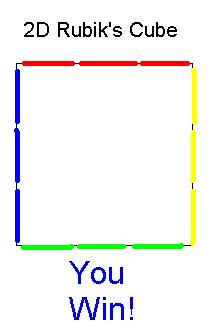
Sorry to be the annoying stickler. That is not a 2D Rubik's cube, but rather 1 face of a 3D Rubik's cube. To correctly make the analogy, you need to reduce all parts of the puzzle by a dimension. So for a 2D Rubik's cube, the 2D faces of the 3D version become 1D, and the 2D stickers of the 3D version also become 1D.
But you were right that it can't be scrambled and is always solved.
Here you go:
http://www.gravitation3d.com/magiccube5d/2d_rubik
' s_cube.jpg -
Really 4D/5D?
Is there anyone reading with the brains/training to confidently/accurately answer some questions please?
"These are Rubik's cubes of the form 3d, with the original popular puzzle being 33. We label the puzzles like this because they are a d-dimensional cube broken into 3d smaller pieces or "cubies" of the same dimension. For example, the 3D cube has 33 or 27 total 3-dimensional cubies."
Does adding cubies really mean adding a dimension, or does it mean simply making a more complicated 3D puzzle and giving it a fancy name? (Behold: the Fifth Dimension! Amaze Your Friends!)
I noticed in the 4D model that elements disappear and reappear with each move. What's up with that? What do the green cubes represent? Where are the pieces which disappear supposed to be going, and why can't we see the changes being made to this set of cubies? Is the invisible set a cheat on the part of the designers?
I have not played with the 5D version, and so have no questions about that one.