Slashdot Mirror
Domain: hackeducation.com
Stories and comments across the archive that link to hackeducation.com.
Stories · 7
-
Is Tech Billionaires' Educational Philanthropy a Bug Or a Feature?
Long-time reader theodp writes: Some education watchers have adopted a wait-and-see response to Jeff Bezos' two-pronged $2B pledge to aid the homeless and to establish preschools for low-income children (Mark Zuckerberg's The Primary School interestingly prefers 'em even younger, noting "we admit students at or before birth"). Not so Audrey Watters, who presents her misgivings in a blog post, titled, "It's Like Amazon, But for Preschool" (tl;dr: read her URL), wondering what a chain of preschools that "use the same set of principles that have driven Amazon" might look like, considering Amazon's own labor practices. She asks, "Are private preschool chains really the path we want to pursue, particularly if we believe that access to excellent early childhood education is so incredibly crucial? Can the gig economy and the algorithm ever provide high quality preschool? For all the flaws in the public school system, it's important to remember: there is no accountability in billionaires' educational philanthropy." Sharing Watters' concerns is author Anand Giridharadas, who argues in his new book Winners Take All that the wealthy pursue social change without uprooting the systems that produce inequality. Bezos has a "a stark opportunity to be a traitor to his class, to actually think about giving in ways that transform the system atop which he stands," Giridharadas said. "It is great to be a winner who gives back. It is even better to be a winner who thinks about how winners can take less." -
A Book Recommendation for Bill Gates: The Story of PLATO
Long-time Slashdot reader theodp writes: This holiday season, many Slashdot readers are likely to find gifts under the tree because of Bill Gates' book picks. Not that there's anything wrong with that, but it seems that turnabout is fair play -- what book recommendations do you have for Bill?
At the top of my pick list for personalized learning advocate Gates would be Brian Dear's remarkable The Friendly Orange Glow: The Untold Story of the PLATO System and the Dawn of Cyberculture, with its tale of how a group of visionary engineers and designers -- some of them only high school students -- created a shockingly little-known computer system called PLATO in the late 1960s and 1970s that was decades ahead of its time in experimenting with how people could learn, engage, communicate, and play through connected terminals and computers. After all, "we can't move forward," as Audrey Watters argued in The Hidden History of Ed-Tech, "til we reconcile where we've been before." -
Four Code Bootcamps Are Now Eligible For Government Financial Aid (hackeducation.com)
Long-time Slashdot reader theodp notes a pilot program for improving computer science education which includes financial aid for students at four code bootcamps: In this week's Hack Education Weekly News, Audrey Watters writes, "The US Department of Education has selected eight higher ed institutions and eight 'non-traditional providers' that will work as partners to pilot the DoE's new EQUIP experiment, meaning that students will be able to receive federal financial aid for coding bootcamps, MOOCs, and the like...
"Good thing there haven't been any problems with for-profit higher ed and exploitation of financial aid, otherwise this would all seem like a terrible idea."
The original submission has more details on the participants (including the four code bootcamps). Ultimately the program involves pairing "non-traditional" providers with higher education institutions -- and then monitoring their results with a third-party "quality assurance entity" -- to improve the ways we measure a school's performance, but also testing new ways to fund training for computer careers. (I'm curious how Slashdot's readers feel about government loans for attendees at code bootcamps...) -
Drag-and-Drop "CS" Tutorials: the Emperor's New Code?
theodp writes: Teaching kids computer science is a great movement," writes HS senior David Yue, "however, to overly dilute the magnitude of the difficulty in regards to the subject area of coding and to create the illusion of mastering a 'superpower' (Code.org) is a huge mistake. There are many videos and articles on the Internet these days that have demonstrated positive support towards computer science education. Below these articles, one can find many comments, left mostly by parents and supporters. These people usually express how proud they are that their children have an opportunity to learn computer science or how proud they are that computer science is being integrated at a more substantial level into the education system." But Drag and Drop Doesn't = Coding, argues Yue. "Parents and teachers today who aren't technical need to be aware that the drag and drop code or the candy-coated learning process does not effectively teach children programming but eventually causes a huge amount of shock once they are immersed in real code." Yue's Emperor's-New-Code warning comes days before President Obama — a graduate of Code.org's drag-and-drop Disney Princess coding tutorial — asks Congress for $4-billion-and-change in the upcoming budget to fund his "Computer Science for All" K-12 initiative. -
Is There an Ed-Tech Critic In the House?
theodp writes: Educational technology has been stuck for awhile, laments Hack Education's Audrey Watters in And So, Without Ed-Tech Criticism... (an accompanying 1984 photo of Watters making a LOGO turtle draw a square looks little different than President Obama 'learning to code' 30+ years later by making a Disney Princess draw a square). "We might consider why we're still at the point of having to make a case for ed-tech criticism," writes Watters. "It's particularly necessary as we see funding flood into ed-tech, as we see policies about testing dictate the rationale for adopting devices, as we see the technology industry shape a conversation about 'code' — a conversation that focuses on money and prestige but not on thinking, learning. Computer criticism can — and must — be about analysis and action." -
Education Chief Should Know About PLATO and the History of Online CS Education
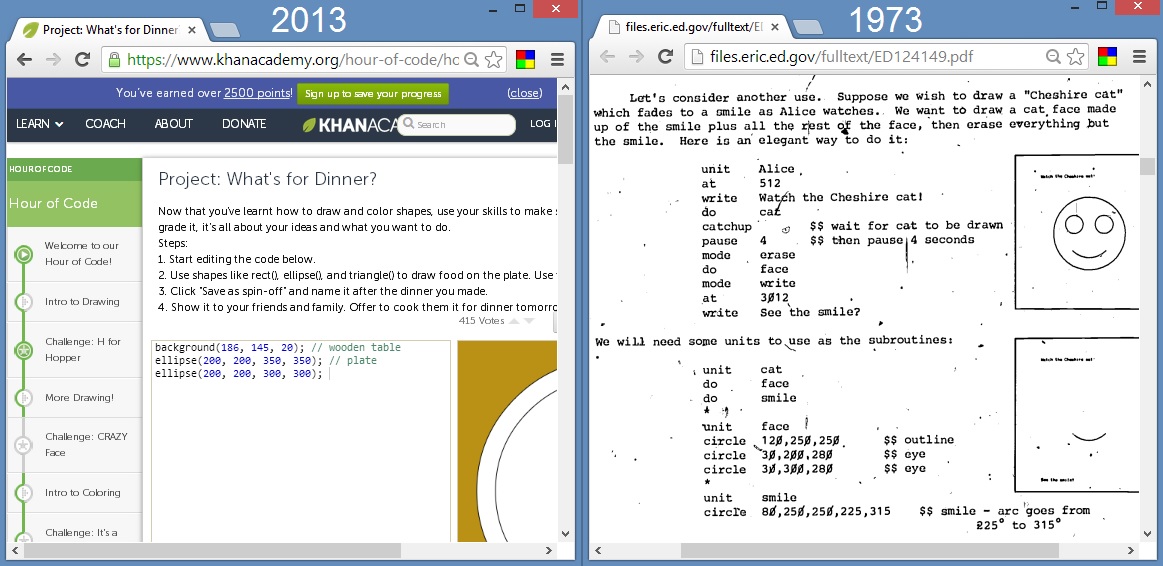
theodp writes Writing in Vanity Fair, U.S. Secretary of Education Arne Duncan marvels that his kids can learn to code online at their own pace thanks to "free" lessons from Khan Academy, which Duncan credits for "changing the way my kids learn" (Duncan calls out his kids' grade school for not offering coding). The 50-year-old Duncan, who complained last December that he "didn't have the opportunity to learn computer skills" while growing up attending the Univ. of Chicago Lab Schools and Yale, may be surprised to learn that the University of Illinois was teaching kids how to program online in the '70s with its PLATO system, and it didn't look all that different from what Khan Academy came up with for his kids 40 years later (Roger Ebert remarked in his 2011 TED Talk that seeing Khan Academy gave him a flashback to the PLATO system he reported on in the '60s). So, does it matter if the nation's education chief — who presides over a budget that includes $69 billion in discretionary spending — is clueless about The Hidden History of Ed-Tech? Some think so. "We can't move forward," Hack Education's Audrey Watters writes, "til we reconcile where we've been before." So, if Duncan doesn't want to shell out $200 to read a 40-year-old academic paper on the subject (that's a different problem!) to bring himself up to speed, he presumably can check out the free offerings at Ed.gov. A 1975 paper on Interactive Systems for Education, for instance, notes that 650 students were learning programming on PLATO during the Spring '75 semester, not bad considering that Khan Academy is boasting that it "helped over 2000 girls learn to code" in 2014 (after luring their teachers with funding from a $1,000,000 Google Award). Even young techies might be impressed by the extent of PLATO's circa-1975 online CS offerings, from lessons on data structures and numerical analysis to compilers, including BASIC, PL/I, SNOBOL, APL, and even good-old COBOL. -
Grant To Allow Khan Academy To Expand, Build a Physical School
mayberry42 writes with this news snipped from Hack Education: "Khan Academy announced this morning that it has raised $5 million from the O'Sullivan Foundation (a foundation created by Irish engineer and investor Sean O'Sullivan). The money is earmarked for several initiatives: expanding the Khan Academy faculty, creating a content management system so that others can use the program's learning analytics system, and building an actual brick-and-mortar school, beginning with a summer camp program."