Slashdot Mirror


Education Chief Should Know About PLATO and the History of Online CS Education

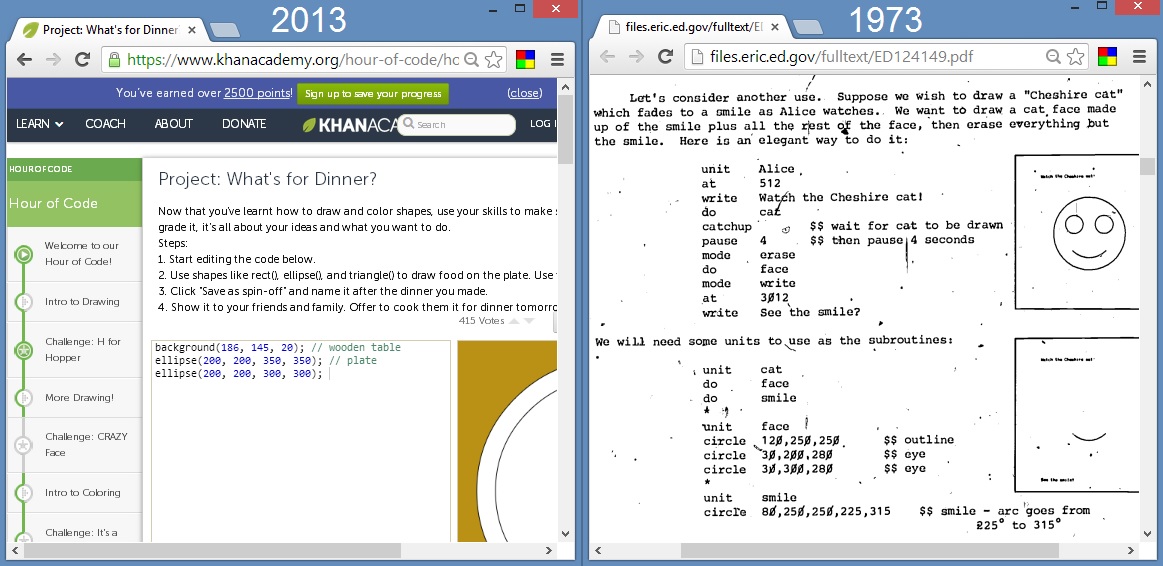
theodp writes Writing in Vanity Fair, U.S. Secretary of Education Arne Duncan marvels that his kids can learn to code online at their own pace thanks to "free" lessons from Khan Academy, which Duncan credits for "changing the way my kids learn" (Duncan calls out his kids' grade school for not offering coding). The 50-year-old Duncan, who complained last December that he "didn't have the opportunity to learn computer skills" while growing up attending the Univ. of Chicago Lab Schools and Yale, may be surprised to learn that the University of Illinois was teaching kids how to program online in the '70s with its PLATO system, and it didn't look all that different from what Khan Academy came up with for his kids 40 years later (Roger Ebert remarked in his 2011 TED Talk that seeing Khan Academy gave him a flashback to the PLATO system he reported on in the '60s). So, does it matter if the nation's education chief — who presides over a budget that includes $69 billion in discretionary spending — is clueless about The Hidden History of Ed-Tech? Some think so. "We can't move forward," Hack Education's Audrey Watters writes, "til we reconcile where we've been before." So, if Duncan doesn't want to shell out $200 to read a 40-year-old academic paper on the subject (that's a different problem!) to bring himself up to speed, he presumably can check out the free offerings at Ed.gov. A 1975 paper on Interactive Systems for Education, for instance, notes that 650 students were learning programming on PLATO during the Spring '75 semester, not bad considering that Khan Academy is boasting that it "helped over 2000 girls learn to code" in 2014 (after luring their teachers with funding from a $1,000,000 Google Award). Even young techies might be impressed by the extent of PLATO's circa-1975 online CS offerings, from lessons on data structures and numerical analysis to compilers, including BASIC, PL/I, SNOBOL, APL, and even good-old COBOL.
134 comments

  1. Not news by operagost · · Score: 4, Interesting

    A presidential appointee who is ignorant and unqualified? Horrors!

    --

    Gamingmuseum.com: Give your 3D accelerator a rest.
    1. Re:Not news by Anonymous Coward · · Score: 1

      But he is known as being a very good basketball player. Doesn't that count for something?

    2. Re:Not news by Anonymous Coward · · Score: 1, Insightful

      Except he's not. He knows about the Khan academy, and modern systems. He just doesn't know about some niche system from 40 years ago. Not knowing irrelevant details in the history of a subject doesn't make one ignorant of the subject. The entire premise of this story is completely false. It's the kind of intellectual masturbation that makes reasonable debate as to the guy's actual qualifications impossible.

    3. Re:Not news by oh_my_080980980 · · Score: 1

      On-line education systems are irrelevant to someone who is pushing on-line education systems? Nice job ass-hole.

    4. Re:Not news by sycodon · · Score: 4, Informative

      The Plato system was not a niche system. It was a complete automated learning system with content in all areas, reading , writing ,math, history. They were the first to have the curriculum adapt to the students progress and allow, theoretically at least, a student to follow a course of study independently.

      They did not close their doors until 2006.

      Anyone involved in the educational software market knew and respected Plato.

      --
      When Fascism comes to America, it will call itself Anti-Fascism, and tell you to give up your guns.
    5. Re:Not news by nabsltd · · Score: 2, Informative

      He just doesn't know about some niche system from 40 years ago.

      PLATO was many things, but not "niche".

      I'm the same age as the SecEd, didn't go to "prestige" schools like he did, and still had access to systems running PLATO.

    6. Re:Not news by rnturn · · Score: 5, Informative

      I think the point of the story is that Duncan has never shown any curiosity once he got out of college. His degree is in Sociology and not Education so I think there are some valid questions as to his qualifications. I think it's rather telling that he doesn't even know what's been done in the past in the field in which he's employed. You have to wonder just that the heck he does all day. He's never done anything in education other than be an administrator. And he's never been much good at doing that. Chicago's pubic schools were a mess when he started running them and they were a mess when he left. Actual educators can't stand the guy.

      BTW, PLATO was hardly a "niche" system and it was certainly never considered "irrelevant" by anyone who knows what the heck they're talking about. I first encountered it while on a two week high school trip (JETS) to UofI but didn't have as much time to access it as I would have liked. There were PLATO terminals in many colleges back in the '70s; I know there was at least a couple of them where I did my undergraduate work. The PLATO terminals were heavily used and getting time on them required signing up for a time slot well in advance. It's may be "cool" nowadays to consider the PLATO system "niche" but people need to remember that the world of computing and computer-aided education didn't begin with the Internet. PLATO was in use while Duncan was going to college at Harvard; maybe they just didn't have a terminal in the Sociology Department.

      --
      CUR ALLOC 20195.....5804M
    7. Re:Not news by ShanghaiBill · · Score: 1, Insightful

      On-line education systems are irrelevant to someone who is pushing on-line education systems?

      Knowing historical trivia about a system from 40 years ago that was used by almost nobody is not particularly important.

      It is also not important to master ALGOL before learning Java or C++, or to learn how to ride a horse before driving a car.

    8. Re:Not news by Anonymous Coward · · Score: 0

      It's nice that the anonymity of the internet gives you the courage to throw around words like "ass-hole" (sic).

    9. Re:Not news by Anonymous Coward · · Score: 0

      Big surprise that a BHO appointee is clueless..... I don't think BHO can talk or spell without his teleprompter.

    10. Re:Not news by __aaclcg7560 · · Score: 3, Insightful

      I think the point of the story is that Duncan has never shown any curiosity once he got out of college.

      This is true for a vast majority of people who graduated from high school and/or college, who see learning as the end of a long journey and not the beginning of a neverending journey. The education system tells them to stop learning, so they stopped learning and go through life without questioning the world around them. Some are even proud of being stupid or ignorant.

    11. Re:Not news by DerekLyons · · Score: 4, Interesting

      That's what the summary want you to believe. However, it's the summary that ignorant - because the submitter cannot seem to grasp that back in the 70's it was quite possible for kids in one place to have the opportunity and kids in another to not have that opportunity.

      I really shouldn't have to explain this, but as bias has already replaced facts in the summary and your reply, I guess I have to.

      Back then (remember, we're talking the 1970's), not everyone (even at 'elite' schools) had the opportunity to interact with a computers - especially if you weren't in a computer or science field. For kids at home? Home computers were very unusual. Home computers with a video screen and a modem and acess to a mainframe? Don't make me laugh. It's true in the latter half of the 70's that home computers began to be available and affordable, but they simply weren't that widespread. Radio Shack was selling the TRS-80 and it's derivatives... at the stunning rate of 10,000 a year. Commodore PET's sold at a similar rate, as did the Apple II (And the US had a population of 225 million - you do the math.) Nor did we have the public internet or the WWW.

      Now of course, we're going to have some other old farts pipe up and explain that *they* had access to this stuff back then - and then indulge in the logical fallacy of generalizing from their experience. (To those who make the mistake of claiming I'm doing the same - go back and look at those sales numbers in the previous paragraph. And digging around, I find similiar sales numbers for mini-computers in the same era.) They're wrong six ways from Sunday, computers simply weren't part of the everyday life of most people and almost all kids back in the 1970's. In 1978, my dad helped a local hospital install their first ever computerized patient data system.* The year I graduated high school (1981), it's was (local) newsworthy that the local stores of a major national chain were installing a computerized POS system. (The guy they moved into town to manage them was our neighbor.) They weren't even networked - tapes were shipped back and forth and he had to drive around town installing the tapes and collecting the ones with sales data to be shipped back to Headquarters. (I didn't even see my first punch card until my sophomore year in high school - and it was from Ma Bell.)

      That is the reality of computers in the late 1970's and very early 1980's. They were just barely beginning to move out of academia and the big corporations. Individual (home/turnkey) computers were available, but were pretty rare. Networks of computers practically unheard of. In the year Secretary Duncan would have graduated high school (1982), we were indeed on the cusp of a great revolution - but it hadn't happened yet. It would be almost another decade before home computers (and thus the chance for kids to interact with them) became nearly ubiquitous. And even so, as a computer salesman in '91 and '92 I still had to explain to people what computers were and why it was a good idea to have one, especially if they had kids.

      So, being a year older than Secretary Duncan, I don't find it all surprising he didn't have the chance to learn to code when he was a kid. I did, but I was a very inquisitive geek, he doesn't appear to have been. Nor do I find it surprising that he doesn't know about a semi-obscure academic experiment that happened when he was a kid. (And that seems to have actually trained only a couple of thousand kids across a decade and a half.) Nor does it actually matter much that he didn't, because the reality is the opportunity was very rare when he was a kid.

      *Which I always thought odd, because he was a printer with pretty much no experience with computers. It wasn't for many years that I found out that the hospital had hired him to help adapt their existing paper flow to the computer flow. (Back then, it frequently was printers who designed forms and often helped design the data flow - because the physical con

    12. Re:Not news by __aaclcg7560 · · Score: 1

      Please name a president in recent memory who didn't use a teleprompter for a prepared speech?

      The problem with political appointees that they are often campaign contributors who want a government job to enhance their resume. Most get appointed as ambassadors to faraway countries that no one in America can find on a map.

    13. Re:Not news by sudon't · · Score: 1

      Nobody had computers at home in the 70's. Or the internet. It wasn't like coding was considered something the average kid should even know about, then. It only seems relevant in retrospect. It ridiculous to expect the man to be aware of every bit of history, of every field of education. It may not have seemed that way if you were in it, but to everybody else, computer science was a highly specialized (niche) field in the 70's. If you were outside of that field, you had no reason to go near a terminal.

      --
      -- sudon't

      Air-ride Equipped

    14. Re:Not news by Anonymous Coward · · Score: 0

      Yeah, it was a niche system. I've never heard of it and apparently I went to better schools than you do because I know not to use a " for emphasis.

    15. Re:Not news by Anonymous Coward · · Score: 2, Insightful

      PLATO was pretty wide-spread in the late 70's and early 80's. It's been largely forgotten, but that doesn't make it any less important. It would be like saying Xerox Park was irrelevant because not many people used it.

      Speaking as someone who actually used PLATO (I think I was around 12 at the time), I learned the basics of Fortran, Pascal, APL, and COBOL. Do I use any of those today? No. Was it valuable learning how different programming languages approach the same problems? Yes.

      Reinventing the wheel is a waste of time and money, and it's entirely possible that PLATO (a multi-user, nationwide network of e-learning systems) might actually have solved some of the problems facing e-learning today.

      So not knowing anything about it is definitely a mark against Arne Duncan, although not necessarily a huge strike. Now, if no one in the e-learning section of his department knows about it, that's a major fail.

    16. Re:Not news by Archangel+Michael · · Score: 2

      Having run several labs with PLATO in classrooms across our district, it is no surprise that they closed their doors in 2006. They pretty much priced themselves out of the market for schools that didn't have discretionary budgets of $40K in licensing. While it might seem reasonable in a world flush with money, I can assure you that there was no way could spend half a million dollars to get every school a lab.

      We stopped using it when XP came out simply because it was too expensive to upgrade from the crappy version that ran on Win98 but wouldn't run on XP. It was great when we had a grant that funded it, but grants run dry, and normal school budgets suck.

      --
      Agent K: A *person* is smart. People are dumb, stupid, panicky animals, and you know it.
    17. Re:Not news by Archangel+Michael · · Score: 2

      It wasn't niche, it was expensive. Only schools I ever saw it at, had grants that paid for it.

      --
      Agent K: A *person* is smart. People are dumb, stupid, panicky animals, and you know it.
    18. Re:Not news by Comrade+Ogilvy · · Score: 2

      I remember an editorial in the The Economist in praise of the admittedly tawdry British practice of campaign donors getting conferred titles by grace of the PM. The way they put it is that most big time donors surely expect something for their efforts, and better a not very meaningful title than a valuable ambassadorship or, far worse, an actual voice on policy. When they put it that way, I almost wish the US would start dishing out knighthoods.

    19. Re:Not news by Anonymous Coward · · Score: 0

      Really?
       
      650 kids even being online in 1975 is pretty damn important to me and anyone else who wants to understand where we came from as a marker of where we are going.
       
        It is also not important to master ALGOL before learning Java or C++, or to learn how to ride a horse before driving a car.
       
      LOL!!!!! So you're slighting PLATO for not offering C++ and Java in the 70s? Wow. Just wow.

    20. Re:Not news by ilparatzo · · Score: 1

      "The problem with political appointees that they are often campaign contributors who want a government job to enhance their resume. Most get appointed as ambassadors to faraway countries that no one in America can find on a map."

      As they say, "you hit the nail on the head". Political appointments are as much, if not more, about what you've done for me than what you could do for the country or the position. If the best candidate for the job had different political leanings, there is no way they would ever get the job. It doesn't matter if the position is a "non-political" one. Politicians will make it political when possible and want "one of their people" in the position. And then scream and yell about how crazy it is to reject an appointment for those reasons.

      We're to the put in our political system where they continue to try and create NEW appointments through law or particular situations, making it all the more convoluted and sickening. If only we had the opportunity to listen in on all the conversations prior to an election where appointments are doled out ...

    21. Re:Not news by Anonymous Coward · · Score: 0

      PLATO was pretty wide-spread in the late 70's and early 80's. It's been largely forgotten, but that doesn't make it any less important. It would be like saying Xerox Park was irrelevant because not many people used it.

      That's a stretch. I don't recall the name of the guy who invented the mouse, nor does anyone on my team offline. Does that mean the team is unqualified to order image editors of other GUI tools? Because that's what the head of mega corporations and agencies do. They order shit. Unless the company was started by themselves personally, they don't build it, they don't design it and they sure as hell don't install or maintain it.

      If someone born today doesn't know the Dewey Decimal system in forty years, does that mean they shouldn't be able to work on a search engine or as a holocube librarian for Netflix?

      It's like an even more farcial anti-GuyTryingToStopEbola appointment. He's not a doctor! Boo! Hiss! If he were being nominated for Surgeon General (blocked for years by R's), they'd bitch about him not either not being a surgeon, not being a general. If he was a general who because a surgeon, theyd bitch about the "terrible" care at the VA (which has a higher approval rating among patients than any other mass medical group).

    22. Re:Not news by billstewart · · Score: 2

      Candidate Obama gave great, inspiring speeches, but wasn't that good at real-time conversation. (President Obama not so much.) Dubya Bush always looked like a deer in the headlights, amazed that he was getting away with what he said and hoping nobody would ask questions about it.

      But the guy who was really good? Bill Clinton. He was always on, always quick thinking, always had a good comeback for anything, lots of fun to listen to. Sure, he was lying through his teeth half the time, but he knew which half it was, and he did it with a smile that said that he knew that you knew he was lying, and that he'd make the game worth playing, and he usually did.

      --

      Bill Stewart
      New Fast-Compression-only CPR http://preview.tinyurl.com/dy575ks
    23. Re:Not news by Anonymous Coward · · Score: 0

      Candidate Obama gave great, inspiring speeches, but wasn't that good at real-time conversation. (President Obama not so much.) Dubya Bush always looked like a deer in the headlights, amazed that he was getting away with what he said and hoping nobody would ask questions about it.

      But the guy who was really good? Bill Clinton. He was always on, always quick thinking, always had a good comeback for anything, lots of fun to listen to. Sure, he was lying through his teeth half the time, but he knew which half it was, and he did it with a smile that said that he knew that you knew he was lying, and that he'd make the game worth playing, and he usually did.

      You are what's wrong with this country! How dare you even speak Obammy or Clinton's names in the same *chapter* as his holiness, the best president ever, George W. Bush. You're not fit to lick his boots!

      Clinton likes to fuck dogs and stole the silver from the White House on the way out. Not to mention all the lives he ruined with his lies about "free trade" and the hundreds he murdrered by having Hillary lift up her skirt in front of them!

      And Obammy? Pimping out his daughters to anyone with a little cash! Making them suck off campaign contributors and then giving them DVDs to watch later! What scum! And for an extra $100, you can fuck Malia *and* Michelle up the ass. But not Sasha. That hole is reserved for Obammy himself, that degenerate douchebag! And what about the billions he's siphoning from the government with this "ObammyCare"? It's just a scam to line his pockets.

      Please Jeb! Save us from these perverted, sick animals called Democrats! Those bastards would fuck you in the ass and not even give you a reach-around. You'd give me a reach-around, wouldn't you Jeb?

    24. Re:Not news by Half-pint+HAL · · Score: 1

      Knowing historical trivia about a system from 40 years ago that was used by almost nobody is not particularly important.

      Knowing the state of the art is important. Khan Academy is by no means the state of the art -- it's a one-size-doesn't-actually-fit-all video course that broke the decades-old mold only in being short videos rather than TV-program-length ones.

      The state-of-the-art is adaptive learning systems that track individual progress and performance, and present problem sets that specifically target the learner. Posters here have stated that PLATO was adaptive, which makes it more advanced than KA. If the government is going to take low-budget amateur crap like KA and use it as a model for the improving public education... well, yuck.

      --
      Got them moderator blues I blieve I walk out the do', With these mod-points I been gettin', I 'most never post no mo'
    25. Re:Not news by Half-pint+HAL · · Score: 1

      Please name a president in recent memory who didn't use a teleprompter for a prepared speech?

      Maybe that one who knew the name of one letter, and even then only because it was his middle name.

      --
      Got them moderator blues I blieve I walk out the do', With these mod-points I been gettin', I 'most never post no mo'
    26. Re:Not news by Anonymous Coward · · Score: 0

      You don't understand the point of the summary.

    27. Re: Not news by Anonymous Coward · · Score: 0

      Used by nobody? How about developing a fucking clue. When I was in the military during the 80s we had Plato stations at the education centers of a number of our bases. Hell, it's where I took precalculus, FORTRAN, and Pascal before I got out and entered a state university for CS.

    28. Re:Not news by Anonymous Coward · · Score: 0

      I was in elementary school in the 70's, and started high school in 1980 at Detroit's Mackenzie High which had 12 Apple II's, a few books on beginning BASIC, an enthusiastic (but untrained) Algebra teacher who was put in charge of the 'computer lab' and no damned PLATO to be seen. I think I heard something about it in or soon after college. You can bet if I was in elementary now, I'd be on some damned Khan Academy programming course.

    29. Re:Not news by rfoshay · · Score: 1

      PLATO is alive and well and living inside Edmentum, Inc. They still have rights to the trademark. To clarify: The original PLATO system went in three major directions: 1) University of Illinois retained ownership of everything written on the system. The courseware was eventually licensed to Pearson as NOVANet. 2) Control Data licensed the operating system and developed its own PLATO content, as well as a test administration technology and other product lines such as aviation training. Most of these lines of business were eventually sold to entrepreneurs, and the courseware is now part of the offering of Edmentum. It includes extensive curricula in math, reading, and other subjects, especially for middle school/remedial through grade 12. There are dozens of studies of effective applications available, in a wide range of mainstream and alternative school, adult/job training, and other contexts. 3) Before ARPANet, early LMS, e-mail, threaded chat, and multiplayer games and simulations were pioneered on the global network of PLATO mainframes, and the developers of those systems went on to play key roles in the founding of the game industry and others. A great deal of the basic research on computer-based teaching and learning was done on the PLATO system from the 1970's through the 1990's.

  2. PLATO :) by Fished · · Score: 1

    My dad did a Masters in Math at Illinois back in the 60's. Part of his work was PLATO, and I still have an original manual. :)

    --
    "He who would learn astronomy, and other recondite arts, let him go elsewhere. " -- John Calvin, commenting on Genesis 1
  3. So, He's Clueless? by Anonymous Coward · · Score: 0

    OK, we get it. He's clueless. He is without a clue. One clue short of having a clue. Couldn't get a clue if he covered himself in clue musk and did the clue mating dance in the middle of a pack of ovulating clues.

    At least he's not working as a programmer.

    1. Re: So, He's Clueless? by JWW · · Score: 1

      He's beyond clueless. I've met Arne Duncan. He is the emptiest suit I have ever met in my entire life.

      Ironically I've met his deputy secretary too and his deputy seems quite smart and capable.

    2. Re: So, He's Clueless? by Anonymous Coward · · Score: 0

      He's beyond clueless. I've met Arne Duncan. He is the emptiest suit I have ever met in my entire life.

      Ironically I've met his deputy secretary too and his deputy seems quite smart and capable.

      How is that ironic? He's hired to provide the answers. Nothing says he has to know they all by heart of the top of his head. Bill Gates was a smart guy and a legitimate developer, but he hardly wrote everything himself. Knowing who to hire to support you is a key skill and worth a lot of money. It seems unfair that knowing who the smart guy is is worth more than being the smart guy, but that's a society wide issue.

      The hospital administrator isn't the best surgeon/electrician/nurse and account in the place, much less all at once. He's there to line his pockets, presumably by keeping the job and operating at a profit that covers his salary and then some by not having more people die there than is typical for the industry.

  4. It wasn't just PLATO by jddj · · Score: 1

    I learned my first line-number BASIC (*ptui!*) on an ASR-33 teletype via time-sharing on a Control Data system in public school in Arlington, VA in 1975.

    I wrote dumb exponentiation loop programs about Ben, and how his rats would take over the city.

    1. Re:It wasn't just PLATO by pjt33 · · Score: 1

      Teletype? Luxury! My mother learnt to program when she was in secondary school by posting punched cards across the country to Manchester University and getting the results back a week later.

    2. Re:It wasn't just PLATO by Anonymous Coward · · Score: 1

      Really? Which high school? In '72, Yorktown had an ASR-33 connected to a Honeywell DDP-516 located in Silver Spring, MD. The timesharing company was Dialcom.

    3. Re:It wasn't just PLATO by ColdWetDog · · Score: 1

      No, luxury was getting your father's secretary to punch out the deck for you. Those were the days!

      --
      Faster! Faster! Faster would be better!
    4. Re:It wasn't just PLATO by jddj · · Score: 1

      I was actually in Junior High at Williamsburg JHS at the time - 8th grade. The "Dialcom" name is familiar - I could be wrong about it being a CDC machine.

      Our math teachers were pretty baffled, but trying to put a brave face on kicking off our computer education. There was a lot of "hope I don't break this thing" hesitation. There were a few hardy souls there who really helped us get started.

      It appalled me when I got to college in '77 that I had to go backwards to punch cards and JCL for Fortran. Ugh.

      I spent a lot of time on the "Career Center" time shared HP (IIRC) in high school at Yorktown, via an ADM-3A glass tube terminal, and on their HP 9830A "Calculator" (really, a low-end mini/microcomputer). Loved that 32-character dot-matrix display!

  5. I concur! People should study Plato by s.petry · · Score: 4, Insightful

    Studying Plato's "The Republic" will give people insight into politicians, their shitty actions, their ability to bullshit people, and give them some tools to see through the rhetoric and be more impacting to their Government. I have been saying for decades that we need to get these classes back into schools and teach rhetoric and logic to a much younger age instead of restricting this to very few people at a college level.

    Oh wait, this is PLATO which has nothing to do with political thought.. Yes, lets continue to neglect educating people about those dangerous bits of knowledge and continue pushing the industrial education system. Nothing new here.

    --

    -The wise argue that there are few absolutes, the fool argues that there are no probabilities.

  6. Taught myself to code over two decades ago... by Anonymous Coward · · Score: 0

    ...from online sources - didn't need an online college to do it. In fact, if my experience in the software industry has taught me anything it's that people following standardized courses don't know what the fuck they're doing 99% of the time (and the other 1% is composed entirely of using the right buzzwords).

    1. Re:Taught myself to code over two decades ago... by Anonymous Coward · · Score: 0

      Meh. Something between produces the best results. You should have your own homebrew projects but also professional education. Some of these self-taught wizards make code like if (!(a == 7 && b == 6)) because they do not know De Morgan's Theorem, for example.

    2. Re:Taught myself to code over two decades ago... by Anonymous Coward · · Score: 0

      I'm a little drunk - please explain. Should it be a reciprocal of my asshole? a!=7&&b!=6? What about chewbacca?

  7. Not enough links in summary! by Anonymous Coward · · Score: 4, Funny

    Almost half the summary text is not linking to anything, why does nobody check these things?

    1. Re:Not enough links in summary! by XxtraLarGe · · Score: 1

      Almost half the summary text is not linking to anything, why does nobody check these things?

      Too Many Links!

      --
      Taking guns away from the 99% gives the 1% 100% of the power.
  8. I'm not sure it's relevant. by darkwing_bmf · · Score: 2, Interesting

    In the 60s and 70s, home PCs were not common, the Internet was a research project and long distance phone calls were expensive.

    1. Re:I'm not sure it's relevant. by Anonymous Coward · · Score: 0

      and yet, I remember doing stuff on PLATO when I was a kid. Those touch screens were kinda stupid though. It's amazing how administators are perpetually astonished by the same techno-tricks, regardless of whether they ever were particularly effective at anything other than employing the people who push them.

    2. Re:I'm not sure it's relevant. by Anonymous Coward · · Score: 0

      I started learning and programming in BASIC on 110 baud teletype over a dialup while I was still a freshman in high school in 1973, and he's younger than I am.

      I think EVERYONE can code, but some people don't seem to be able to come up with the necessary logic to accomplish a task. My boss doesn't really agree with this, as he taught introductory type computer classes, and was good at teaching the students the minute details a computer has to do to accomplish a simple task. I'm not any good at teaching, so I see irredeemable doofuses where he sees inadequately instructed newbies.

    3. Re:I'm not sure it's relevant. by darkwing_bmf · · Score: 2

      I think your boss has the right of it. I loved programming ever since I had my first taste of it in 4th grade. And I had parents that had the means and will to a) care about my education and b) buy a computer for me when I was in 5th grade. Not everyone is as lucky as I was.

      http://techland.time.com/2012/...

    4. Re:I'm not sure it's relevant. by Anonymous Coward · · Score: 1

      >50-year-old Duncan, who complained last December that he "didn't have the opportunity to learn computer skills" while growing up
      >attending the Univ. of Chicago Lab Schools and Yale,

      54 Year Old Grey Beard here. I had plenty of, maybe too much, opportunity to program in Fortran, and C when I was an undergraduate at the same time he was an undergraduate. Computer time was expensive funny money but otherwise available. Maybe if he ACTUALLY signed up for a computer programming class....

    5. Re:I'm not sure it's relevant. by Anonymous Coward · · Score: 0

      And yet, I learned a number of programming languages, as well as other online materials, from a mainframe some thousand miles away from my terminal.

      Oh yeah-- I was 12 at the time.

      So yeah, I'd say it's relevant to today's challenges in e-learning.

  9. Politics and page hits, not news by QuietLagoon · · Score: 0

    Give me a break.

  10. warning: nanny-state comment by cellocgw · · Score: 2

    Seems to me that kids who want to learn to hack around with a computer can quite well do so on their own, thank you. No need for some set of lessons, be they gov't-approved or not.

    I mean, really: at the very worst, 10 minutes with a search engine, the term " introduction and tutorial for $LANGUAGE" or Stackoverflow should get anyone capable of comprehending what programming is in the first place off and running.

    --
    https://app.box.com/WitthoftResume Code: https://github.com/cellocgw
    1. Re:warning: nanny-state comment by meta-monkey · · Score: 1

      It's not just nanny-state, it's corporate scheming to bring down the wages of software developers. The Masters of the Universe are upset that they have to pay programmers a middle class wage so the goal is to cram as many kids into programming classes as they can hoping to eventually flood the market. Yes, I understand that not everybody can code or think like a programmer, but there are an awful lot of people who could, but they choose to be a biologist instead. The point is to steer that kid and others like him into programming. There is not a shortage of programmers. There is a shortage of programmers who will work for $30k a year, and all these "learn to code!" bullshit programs disguised as "forward-thinking eduction...for the children" are designed to fix that.

      And it's a multi-pronged attack. It's the same impetus for H1B visa program increases and the "no poaching" collusion between Jobs et al.

      --
      We don't have a state-run media we have a media-run state.
    2. Re:warning: nanny-state comment by Perky_Goth · · Score: 1

      Because everything you need to know when coding is the library of a language, right?

    3. Re:warning: nanny-state comment by ub3r+n3u7r4l1st · · Score: 1

      when programmers union up and start demanding paying their wages in bitcoin or Gold, the corporate scheme will be over. When USD lose their reserve currency status the game will be wide open.

    4. Re:warning: nanny-state comment by Half-pint+HAL · · Score: 1

      You have no idea how difficult it is to write a good lesson for any subject. Most coding tutorials are written by coders who have no idea how little a beginner knows, and they only really useful to coders learning a new technology. Some tutorials are written by people who understand how little beginners know, but only because they themselves are beginners, which unfortunately means that they don't understand the language.

      Even a lot of the courses on Coursera etc aren't perfect, as the teachers are trying to directly drop in material from face-to-face courses without the two-way communication of tutorials and computer lab sessions. They also inherit their presumed knowledge from the host institution's degree course syllabus, which means they aren't particularly general.

      --
      Got them moderator blues I blieve I walk out the do', With these mod-points I been gettin', I 'most never post no mo'
  11. Wow, does this guy have a blind spot by jtara · · Score: 1

    He must have thought those big round glowing tubes were a new experimental kind of light bulb.

    Oh. U. Chicago. U Illinois(Urbana). Not the same. Too bad he went to the wrong school.

    I visited in the 70's when I was in college to attend some talk about Plato and to see it in action.

    Strange that my third-tier college in Detroit gave every student the "opportunity" to learn programming skills, and required it in many curriculums - certainly for any of the sciences, including political. Indeed, those of us in Computer Science were constantly bitching about the engineers and "those SPSS people" hogging the terminals. (That's why we developed some software for booting them off of their terminal...)

    (In fact - like Bill Gates - I learned in high school first. We were lucky to have an IBM 1620, though. I didn't have to steal time-sharing!)

    Was U. Chicago that far behind? Or did our Education Secretary just make a bad judgment that it would not be useful to him?

    1. Re:Wow, does this guy have a blind spot by Anonymous Coward · · Score: 0

      The big difference between the time of PLATO and the present Khan offerings is public awareness. As someone who started programming in the 1960's I know that almost no one of my acquaintances had any idea of what i was doing, much less how or why. Compare that with the scene today, where EVERYONE knows what computers can do, uses them all the time and has some basic understanding of what it takes to get them functioning. So things which were very research oriented and appealed only to a very small minority then can have mass appeal now.

      There is still no single (or simple) answer to educating large numbers of people because they have such a diverse range of interests that you can't even begin to catch their attention.

  12. Correction: Duncan attended Harvard, not Yale by theodp · · Score: 1

    Oops...Duncan graduated magna cum laude from Harvard University in 1987, after majoring in sociology.

  13. Too many links by Anonymous Coward · · Score: 1

    Wow, 40 links on a news summary ... am I supposed to spend all day on this item??

    1. Re:Too many links by Anonymous Coward · · Score: 0

      Slashdot's a link farm, you're not actually supposed to read them, you're just supposed to click on them.

    2. Re:Too many links by Minwee · · Score: 1

      Only if one of those links goes to TV Tropes.

  14. Fond memories of PLATO by Anonymous Coward · · Score: 0

    When I was a kid I used to make all kinds of shapes with it. Just roll the stuff in your hands, and bingo... no $1000 3D printer needed, just your imagination.

    Yeah, I'm surprised these pols don't know all about PLATO, it's a great learning tool.

  15. Perhaps we should change the phrase ... by Rambo+Tribble · · Score: 0

    ... about those who fail to learn from the past, to those who fail to learn in the past.

  16. Why teach coding? by Anonymous Coward · · Score: 0, Funny

    If you're going to teach coding in grade school, why not teach sewing? Car repair? Home maintenance? Office administration? Carpentry? Cosmetology?

    1. Re:Why teach coding? by Anonymous Coward · · Score: 0

      Simple, schools are a business first and foremost. The things you are talking about require actual equipment that needs specialized people, maintenance, parts, and most importantly, insurance.

      Insurance companies are evil and they've managed to stifle so much of what we used to call normal life.

    2. Re:Why teach coding? by Anonymous Coward · · Score: 0

      If you're going to teach coding in grade school, why not teach sewing?

      In my grade school they do. Some of the others you mentioned were available as electives in high school. Where the heck did you go that it's a question?

    3. Re:Why teach coding? by Anonymous Coward · · Score: 0

      Actually, in grade school, I had to learn to cook, type, hammer, sew, saw, weld, draw, play instruments and rebuild a lawnmower engine.

      However, since I was the only one who understood computers (early 80's), I had to teach that class. ;)

    4. Re:Why teach coding? by Half-pint+HAL · · Score: 1

      In primary school, I learned to sew, knit and program in Logo. Also papier mâché and finger painting.

      In my first two years at high school I had cooking, sewing, woodwork (and working polyacrylic) and a couple of other things.

      Then I went on to get three degrees.

      --
      Got them moderator blues I blieve I walk out the do', With these mod-points I been gettin', I 'most never post no mo'
  17. quotey quote by thrig · · Score: 1

    "Have You Ever Heard of Plato? Aristotle? Socrates?" ... "Morons!" "Really."

  18. Re:$200? by theodp · · Score: 1

    You're right. The $200 was based on the suggestion to "supersize" the order up to a full $198 ACM membership, so more than one article could be read. It appears Duncan has the budget for it. :-)

  19. One difference by Anonymous Coward · · Score: 0, Troll

    Why would it be relevant that he know of the existence of PLATO?

    Hey, buddy- there was this thing that taught kids to program decades ago. All it required was your school district paying a crapton of money to install some terminals and obtain service, you being important enough a student to merit some time in that computer lab, you getting enough time in that computer lab to actually learn something, and you deciding that there was some merit to learning to program entirely non-ubiquitous computers.

    Contrast with: your phone/ipad/desktop/whatever (because you almost certainly have one) can go to this website, anytime you want, where you can start to learn how to program one of the aforementioned gazillion of devices.

    One of these two things is relevant to national education, and one is obscure historical record.

    1. Re: One difference by Anonymous Coward · · Score: 0

      maybe because he was shitting on the school system for not having the tools to teach him programming. when in reality they did, he was just to fuckin lazy to use them. that's why he should know his history before he opens his big fat mouth.

    2. Re: One difference by Anonymous Coward · · Score: 1

      >when in reality they did

      Sure, just like mine did. In the mid-80's, we had a total of 25 NovaNET terminals serving all 35,000 of us. Fortunately, it's not like there was a 1000+ student line at each terminal, since they were placed in a building hosting fewer than 500 students. All you had to do to join those privileged few was 1) be a 99th percentiler in several subjects; 2) give up the social connection of your 'home high school'; and 3) take two extra bus rides (totaling at least 30 minutes of transit) every day.

      I agree. Every one of those other 34,500 students were just too fuckin lazy.

  20. Department of Education by TheSync · · Score: 2

    Perhaps the federal Department of Education is just a complete boondoggle?

    Have schools really benefitted from this department, which was only formed in 1980? Has the quality of education gone up since then? Have the costs come down?

  21. What is your point? by Anonymous Coward · · Score: 0

    What planet are you from? Or are your personal politics fogging your glasses?

    The Secretary of Education injects online education into the national discourse and all you can do is complain about him. I was building computers in the 70's. I was online before 300 baud modems were available. Yet articles on Plato were not why I subscribed to Byte.

    Arne Duncan is opening a door that a lot of folks won't like. I give him credit for starting down the road before any of his predecessors.

    Thank you Secretary Duncan!

    1. Re: What is your point? by Anonymous Coward · · Score: 0

      LOL you have to be a shill. you said nothing useful at all. only thing you successfully did is dick ride. Duncan must have saw all the bad comments and paid shills to clean it up. fucking laughable.

  22. Arne Duncan is a hack by jsepeta · · Score: 3, Interesting

    Arne Duncan's claim to fame is outsourcing Chicago schools to private for-profit corporations, undercutting the public school system. He's a world-class jerk and it's shameful that he's in charge of America's education policy. Shameful.

    --
    Remember kids, if you're not paying for the service, YOU ARE THE PRODUCT THAT IS BEING SOLD.
    1. Re:Arne Duncan is a hack by ub3r+n3u7r4l1st · · Score: 1

      So Obama is a corporate democrat, not like "socialist" as everyone else is claiming.

  23. Those who don't know history... by Anonymous Coward · · Score: 0

    ... are doomed to repeat it.

    Those in this case, repeating PLATO wouldn't be so bad.

  24. Political appointees should know shit? by seven+of+five · · Score: 1

    Heavens to Betsy!

  25. Re:$200? by Anonymous Coward · · Score: 0

    up to a full $198 ACM membership

    Second fail... professional ACM membership is $99/yr.

  26. Educatio by Anonymous Coward · · Score: 0

    n.

  27. Links by Anonymous Coward · · Score: 0

    I wish the submitter would have provided more links in his summary..

  28. I learned to program on PLATO by mabu · · Score: 3, Informative

    I learned to program on PLATO. It was an AMAZING system. In addition to supporting a variety of development environments, their system used a proprietary language called TUTOR. A good bit of networking technology today is derivative of this amazing system. I wasn't rich, although I noted a lot of kids who had access to PLATO tended to be children of CEOs and such. My parents worked at a college that had a grant to have the terminals available. The games on the system were also amazing.

    As a programmer, PLATO was a great example of the "cloud"-type systems that will eventually become standard.. what Google is doing and Adobe is now proposing was done in the 70s at Plato, with centrally-hosted apps that routinely are updated automatically. As developers we could put in requests for program features and see them reflected in newer versions of the API. 512x512 resolution, touch sensitive screens, multi-player, real-time games between people all over the world..... in the 70s.

    By the way, the original PLATO system has been ported and is running over TCP/IP. If you're willing to donate to the project, they have been known to grant access to people wanting to experience what it was like. See: http://www.cyber1.org/

    By the way if anyone has the archive of the PLATO game 0drygulch.. PLEASE contact them... we've been dying to find that code and put it online.

    1. Re:I learned to program on PLATO by drinkypoo · · Score: 2

      As a programmer, PLATO was a great example of the "cloud"-type systems that will eventually become standard.. what Google is doing and Adobe is now proposing was done in the 70s at Plato, with centrally-hosted apps that routinely are updated automatically. As developers we could put in requests for program features and see them reflected in newer versions of the API. 512x512 resolution, touch sensitive screens, multi-player, real-time games between people all over the world..... in the 70s.

      This describes any website with AJAX and dynamic updates, now. It's not something coming (again) in the future, it's here at the moment.

      --
      "You're right," Fisheye says. "I should have set it on 'whip' or 'chop.'"
  29. Re:As a Greek i concur, people should study Greeks by Anonymous Coward · · Score: 0

    Studying Plato's "The Republic" will give people insight into politicians, their shitty actions, their ability to bullshit people, and give them some tools to see through the rhetoric and be more impacting to their Government. I have been saying for decades that we need to get these classes back into schools and teach rhetoric and logic to a much younger age instead of restricting this to very few people at a college level.

    Oh wait, this is PLATO which has nothing to do with political thought.. Yes, lets continue to neglect educating people about those dangerous bits of knowledge and continue pushing the industrial education system. Nothing new here.

    As a Greek i concur, and besides PLATO i suggest ARISTOTLE also, plus all the other great Greek ancestors of mine!
    Both Plato's and Aristotle's teachings are fundamental not only for political thought or general rhetoric and logic but also for specific CS education - e,g., systems (of any kind, software/hardware included) can be described either "Platonic" or "Aristotelic" (i.e., either by their functions or their structure).

  30. Education Shouldn’t Be Such Be Mess by DumbSwede · · Score: 4, Insightful

    I went to the University of Illinois in the 80’s, I’d heard of Plato, but didn’t get to experience it. That said I had gone to a community college my first two years (Blackhawk College in Moline) and remember a multimedia learning experience involved slides, audio, and text input that really seemed to accelerate my learning on some writing fundamentals that may not have been up to snuff after high school. I remember thinking this is the way education should be. That experience didn’t linger however and it was back to a slog of just regular book learning.

    I have thought on this over an over the last few decades. I took the huge Stanford AI course by Sebastian Thrun and Peter Norvig. I did well, but it was a disappointment in presentation and did not feel to be the accelerated learning sensation I’d had all those years ago at Blackhawk.

    Why are we re-writing Calculus books over and over? Why isn’t there some insanely great multimedia interactive national curriculum for this sort of stuff. Why when we are busing kids around aren’t they on tablets watching lectures and doing interactive lessons?

    I have seen the argument over and over that kids need individualized attention by teachers to do well, but I fail to understand why all the drudge assignment work and pre-scripted presentations have to be created and done by those same teachers. Why aren’t the teachers more like facilitators helping the kids to navigate and understand the material as created and presented by the truly best presenters online?

    We frequently find mistakes in the material our child brings home that the teachers have prepared. We send it back with corrections explained to the teachers, but why should I have to proof read the teacher’s material? And our local elementary school is supposedly among the best here in Maryland. I can only imagine how abysmal the homework assignments are at poorer schools. Again, why are the teachers creating the homework assignments? I understand tailoring the explanations to the students as they struggle to master something, I don’t understand why the bulk of of assignments have to be custom created by the teachers, especially when they are going to flub it so often.

    My wife and I spend a great deal of time educating our daughter, I feel it is almost home schooling and she gets very little from school itself. While she is an straight A student and we are proud, I am also angry we have to invest so much time and energy to teach her what she should be getting in school. Yes our daughter absolutely wants harder assignments and material in school, but the teachers hold back students like our daughter to keep the material at a level the bulk of the class can keep up with.

    1. Re:Education Shouldn’t Be Such Be Mess by Anonymous Coward · · Score: 0

      Because government compulsory education is not about learning or growing as an individual, it's all about shaping young minds into soldiers and obedient workers.

  31. PLATO was pretty good for the time by karl.freburger · · Score: 1

    I remember PLATO from the mid-70's. It was available a number of universities, all "networked" together by using central servers. I even wrote course material in TUTOR (the PLATO language) for a class I was a TA for. Definitely ahead of its time.

  32. Re:I concur! People should study Plato by oh_my_080980980 · · Score: 0

    Somebody failed reading comprehension:

    " ...Khan Academy, which Duncan credits for 'changing the way my kids learn'..."

    "...who complained last December that he "didn't have the opportunity to learn computer skills" while growing up attending the Univ. of Chicago Lab Schools and Yale,"

    "...the University of Illinois was teaching kids how to program online in the '70s with its PLATO system..."

    "...notes that 650 students were learning programming on PLATO during the Spring '75 semester..."

    "...Khan Academy is boasting that it "helped over 2000 girls learn to code" in 2014 (after luring their teachers with funding from a $1,000,000 Google Award)."


    So what did we learn? The education chief is making a big fuss out of nothing based on his ignorance of on-line learning systems and that Khan Academy could only educate 1350 more students - after bribing teachers - 39 years later.

  33. How many kids took those classes? by BenSchuarmer · · Score: 1

    I grew up in the 70s. I was a nerd and my friends were nerds. I don't recall any of my friends having an option to take classes like this

    We did use terminals at the main city library to play games like Oregon Trail, but learning to code wasn't an option until I got past high school Algebra

    My guess is that you needed a special invitation to get into these classes, and you could only get an invitation if your parents or teachers knew the right people.

    1. Re:How many kids took those classes? by jdeisenberg · · Score: 1

      During the '70s, it was mostly available for students at the University of Illinois. (I was the lead programmer for the Modern Hebrew project, and I know all of the first semester students used it. We even created a threaded notes system that let students write posts in Hebrew.) With quick response time, programmable fonts, and graphic display, it was well ahead of its time.

    2. Re:How many kids took those classes? by CronoCloud · · Score: 1

      My guess it was an "affluent suburb or city magnet school" thing. Meaning the sort of school a stereotypical slashdotter might have attended, which is why quite a few have said they had access to it.

      They're probably kind of guys who's father had a tech job who got them an account on their workplace's unix box, who got a Vic20, a C64 the next year and a PC clone the year after.

      They got PLATO, but god forbid you live in a small town or rural area without a university to put PLATO in the local school.

      As an example certain famous geeks had privileged/early access to technology:

      Gates: http://en.wikipedia.org/wiki/B...

      Stallman: http://en.wikipedia.org/wiki/R...

      Robert Morris: http://en.wikipedia.org/wiki/R...

      Reading this book will give you more details on RTM's tech privileged childhood: http://www.amazon.com/CYBERPUN...

      It's easier to become a "worm-making unix-genius" when you have your own unix account when you're in junior high, given to you by your father who worked for Bell Labs.

    3. Re:How many kids took those classes? by frank_adrian314159 · · Score: 1

      Most of those kids were at University High, a school that I actually know little about. And what I say here may be wildly apochryphal. God knows, there are probably folks who actuallly went there lurking here (and so, they should chime in). But I digress...

      As my feeble recollection recalls (this was almost 40 years ago, you know) Uni High (as it was known by the natives) was a research vehicle for the Education Department at the University, where latest theories were sometimes field-tested. All I know is that a lot of the university's staff and teacher's kids went there and there were some percentage of townies, as well. Not a magnet school, per se, but certainly home to some extremely bright kids. They got to actually take classes via PLATO (something I would have killed for in high school) and sometimes they had PhD's teaching them (although mostly it was the teaching corps sporting MA's and going for the PhD that got put doing the scut work of actually teaching). Other than that, good high school in the state, certainly a bit better than the other schools in Chambana. That is all...

      --
      That is all.
  34. University or Grade School by Anonymous Coward · · Score: 0

    Something tells me PLATO was not about teaching grade schoolers how to program COBOL. Is the OP serious in assessing the the PLATO system which required a university computer lab and top down lessons does not look all that different from the internet/home computer system of Khan Academy? Is theodp so young to not comprehend that what exists now is not what existed then? On top of everything else, theodp seems to think that interactive education systems were created fully formed and required no discovery, iteration, and improvement. Sorry, but this just comes off as anti-DeptEd tripe.

  35. Empire! by rumpledoll · · Score: 1

    I was a CS undergrad and never used the Plato system for structured learning, but played many an enjoyable hour in the basement of the CS building on a Plato terminal playing Empire. Was the best Star Trek game back in the day. Fantastic game for its day, and very fun after spending uncounted hours hacking some assigned programming task into shape.

    1. Re:Empire! by Anonymous Coward · · Score: 0

      I found PLATO in the early 80s, but before I could finish the online programming course i found Avatar. Played it furiously for a while before I got kicked off the system for annoying the liberals in the Events Notes forum. Note - do not unnecessarily challenge the belief system of a sysop.

      Still playing it, on Cyber1. No hope of being a Guildmaster, but I just love it so?

  36. Re:Slashdot classic sucks! by Immerman · · Score: 1

    Gooey Char? That's a little extreme don't you think? Certainly effective though.

    --
    --- Most topics have many sides worth arguing, allow me to take one opposite you.
  37. Computer Lib / Dream Machines by Alrescha · · Score: 2

    Ted Nelson's Computer Lib / Dream Machines (c) 1974 has a section on educational systems, including PLATO.

    The tagline was "You can and must understand computers NOW". Challenge accepted.

    A.

    --
    ...bringing you cynical quips since 1998
  38. Back in the Day... by frank_adrian314159 · · Score: 4, Informative

    I took online courses on PLATO and wrote simple games for it. The hardware was laughable by today's standards - plasma screens that glowed orange text (and lines!) from a dark blue background with touch input provided on about a 1/2" grid coupled with hideously clunky keyboards having their own special function keys - but it was reasonably reliable and allowed some of the first really large scale research on CHI.

    Not that anyone other than researchers actually gave a crap about that last part.

    But the system was fun to write programs for. It had a pretty OK language for the day, called TUTOR, that contained necessary primitives to make it Turing complete along with others to let you write onto the screen in a variety of ways. Again, pretty primitive by today's standards, but enough to teach programming with - they were debugging the interpreter (I think Fortran) and I played with it once. Pretty advanced for the time with breakpoints being highlighted.

    And of course this is back in the late 1970's. Before the PC was a gleam in IBM's eye. The whole thing ran as on a huge CDC 6600 running a custom OS (as many were, in those days). Odd instruction set by an even odder designer you may have heard of - guy named Seymour Cray. Quirkier than hell with 60-bit words, 18-bit address space, and 6-bit bytes (yes, we spoke octal). But that was back in the day when minicomputers were eating the lunch of the mainframe boys. CDC, whom the University of Illinois partnered with to productize the system, couldn't muster the resources or talent to market this system while swirling down the toilet.

    And, like so many things in computing, we see progress, good ideas thwarted by, well, nothing but the fact that people are short-sighted and, if something doesn't make a buck for someone, we drop it on the floor. So it goes...

    --
    That is all.
    1. Re:Back in the Day... by Darinbob · · Score: 1

      Started college in 81, and we had USCD Pascal & p-system. On a basic Apple II we had a full editor, compiler, debugger rolled together, a networked file system, and a self-paced instructional system to learn to program (with human proctors to grade you after every section though). Add another decade though and the state of computing actually seemed worse overall.

      The history of computing actually seems to go backwards at times with technology and/or software becoming more primitive as time passes.

    2. Re:Back in the Day... by Baldrson · · Score: 1

      I"m not sure I'd say TUTOR was an ok language for the day. It didn't even have local variables. Local variables were so controversial that I had to leave the University of Illinois and get a job as a system programmer with CDC to add local variables to TUTOR.

  39. US Education Chief Should Know About PLATO and the by mwvdlee · · Score: 1

    US Education Chief Should Know About PLATO and the History of Online CS Educatio

    Does online CS education also include lessons on how to make database columns wide enough to contain article titles?
    (Or comment subjects)

    --
    Slashdot social media options: AIM, ICQ, Yahoo, Jabber and Mobile Text. Why no MySpace?
  40. Re:$200? by theodp · · Score: 1

    To clarify, Professional Membership PLUS ACM Digital Library: $198 (USD)

  41. PLATO retorspective at the Computer HIstory Museum by Doctor-R · · Score: 3, Informative

    On June 3, 2010, the Computer History Museum hosted a 6-session conference on the PLATO learning system. Session 1 was entitled "A Culture of Innovation: What Don Bitzer Wrought." https://www.youtube.com/watch?... Session 2 was entitled "Innovations in Hardware: Mission-based Developments Led Other Places." https://www.youtube.com/watch?... Session 3 was entitled "PLATO Software: Driven by a Clear, Compelling Challenge." https://www.youtube.com/watch?... Session 4 was entitled "Online Education & Courseware: Lessons Learned, Insights Gleaned." https://www.youtube.com/watch?... Session 5 was entitled "PLATO Games: An Early, Robust Community of Multiplayer, Online Games." https://www.youtube.com/watch?... Session 6 was entitled "An Early Online Community: People Plus Computing Grows Communities." https://www.youtube.com/watch?...

  42. /. wants me to open 17 tabs?? by CaptainStumpy · · Score: 1

    I know we don't RFTA..but c'mon 17 links in one post? You expected me to open 17 tabs today??

    --
    It will be better to purchase from an owner who is a good farmer and a good builder.
  43. WHOOSH by Anonymous Coward · · Score: 0

    Somebody failed reading comprehension

    That would be you.

    1. Re:WHOOSH by Anonymous Coward · · Score: 0

      what is the comprehension thing everyone is talking about? I'm not getting it...

  44. RCA Spectra by aggles · · Score: 1

    Wish I had had access to Plato. So much came from it, including the genesis of Lotus Notes. Computer education was just starting in the late 60's. My 1968 high school physics class had a student teacher from a local college that taught us FORTRAN, on a RCA mainframe. We used punch cards the first year and then in 1969, a paper-tape teletype was installed. Kids will be kids. We quickly learned to save ASCII art on paper-tape and sent a foot long rendition of the finger to the operator's console. This was also before the days of using ***** to hide passwords, so a fish into the garbage can yielded the teacher's password and eventually the system admin's. A few grades were changed with no consequences, but when we tried the admin "shutdown" command before dismounting the drives - and it took a week to reboot the system - that was the end of my early computer training.

    1. Re:RCA Spectra by rickb928 · · Score: 1

      Touch screens.
      E Mail.
      Chat Rooms
      In-app Messaging

      And a lot more. PLATO delivered features not found in public systems until decades later.

      --
      deleting the extra space after periods so i can stay relevant, yeah.
  45. Why does Kahn need access to my gmail account? by Stan92057 · · Score: 1

    Why does Kahn need access to my gmail account? Free? not so much I think.

    https://www.flickr.com/photos/...

    --
    Jack of all trades,master of none
  46. Re:Slashdot classic sucks! by __aaclcg7560 · · Score: 1

    Just what the C++ language needed, a gooey char to represent melted characters.

  47. What a RETARD!!! by Anonymous Coward · · Score: 0

    Yes, and George Washington couldn't drive an automobile. This person is just another Herbert!

  48. Please get it right, it's not $200 by chipschap · · Score: 1

    $200 for the 40-year old paper includes membership. Non-members get the paper for $15. Can you please not misrepresent?

    Not that I'm defending this. The article should be free, and $15 is way too much (even the 24-hour "rental" for $3 is too much). But it isn't $200.

  49. Back in the Day... by Anonymous Coward · · Score: 0

    It should be noted those plasma panels were the enabling technology. The inherent storage allowed 1200 baud modem service to remote terminals; statistics measured the typical delay between screen updates and hence calculation of how many students could be serviced at a remote site.with acceptable delay. The more students the lower the student contact hour cost, which i seem to recall they wanted under $2 for a full 4096 terminal system.

    The earlier 20 terminal PLATO III system used standard composite video read out of horribly expensive storage tubes dedicated to each 9 inch TV monitor, and character plotting was done in software on the same CDC1604 that ran the lessons. The storage tubes faded over time so a replot key was included to refresh the screen. When the delay was too long some student would start hitting the replot key and bring the system to its knees.

    I lucky to have access from Springfield High School through a leased coax cable, and ended up working there Summer 1968 and 1969. My first assignment was to implement a "Stations" command that could trade off RAM between the student heap and the lesson heap, to allow more authors to work at the same time at night.

  50. What we had in the 70s by billstewart · · Score: 1

    If he's 50, he was born in 1964, so he might have gone to college before Apple II's became widespread. But when I was in high school from 1972-1974, we had time-sharing access to a PDP-11 at the nearby state university (with one teletype shared for the entire school), so by 8 years later it's likely he had something a lot fancier. My wife's high school didn't have that - they used punch cards, which got batch-processed weekly.

    I first encountered PLATO in college, and it had Notesfiles (which contributed significantly to the evolution of Usenet, as well as Lotus Notes), and the coolest-ever Star Trek game.

    --

    Bill Stewart
    New Fast-Compression-only CPR http://preview.tinyurl.com/dy575ks
  51. Missing the point by jtara · · Score: 3, Interesting

    A lot of posters are missing the point, and stating that it's understandable that he didn't know about Plato, given it's limited availability.

    Perhaps excusable. I read Computer Lib/Dream Machines and, yes, that was my first knowledge of Plato. And I was a Computer Science student and hobbyist.

    But what he stated is that he did not have the opportunity to learn about computers. That's total nonsense. He apparently just avoided it. Any college student in engineering, social sciences, etc. in the 70's would have plenty of opportunity to take conventional classes, and in most schools they would have been required.

  52. Yep. I'm two years older than Duncan by Radical+Moderate · · Score: 1

    My high school did not have computers. The junior college I attended did, for those that took programming classes. Radio Shak was selling the TRS-80, we'd hang out at the mall and play Star Trek on it. So no, computers weren't everywhere, but they weren't hard to find. I have to confess I'm not familiar with PLATO.

    --
    Never let a lack of data get in the way of a good rant.
  53. Competent? by matbury · · Score: 1

    Is someone here trying to imply that out elected leaders need to be competent? What nonsense! They only have to be compliant and obedient to their lords and masters on Wall Street, fossil fuels, defence contractors, big pharma, and big ag (Who did I miss?). They'll ensure that the "right" legislation gets written for them to pass by ALEC and other similar organisations.

  54. PLATO was a pioneer by Anonymous Coward · · Score: 1

    PLATO of course predated the Internet, however it also predated most of the things we take for granted these days. For instance, graphical displays, multimedia content, high levels of interactivity, routine linking to other sources, and so forth. PLATO therefore had to do stuff like invent a workable visual paradigm (modern term is the UI). This level of creation was routine at the time.

    More than anything though, PLATO took a serious stab at generating lots of content. Most systems of the day foundered on this point; even if the programmers overcame all the other hurdles, they often fell short on content. PLATO actually resembled a decent instruction system, fully loaded with courseware that students would be interested in taking.

    PLATO looks antiquated today. It was really quite an achievement at the time though. And it had a certain cachet as a computerized training system, very Jetsons.

  55. Re:As a Greek i concur, people should study Greeks by s.petry · · Score: 1

    My opinion of course, but Aristotle was the Philosophical equivalent to Machiavelli in terms of society. He was very much a Sophist and though a student of Plato he was not well liked. Socrates remember was anti-slavery, and full on equal rights (including women's rights) which at the time was unheard of. Plato held the same beliefs but saw society as always falling to corruption (why he "quit" being an Athenian and got out of politics). Aristotle believe that people like him should be pampered by the state and provided slaves and luxuries.

    Bright in Math, but weak in Psychology, Sociology, and Political sciences in terms of "Public good".

    --

    -The wise argue that there are few absolutes, the fool argues that there are no probabilities.

  56. Re:I concur! People should study Plato by s.petry · · Score: 1

    Try reading past the first paragraph. No, I read nothing else you said after the false accusations and ad hominem. If you don't understand the 2nd paragraph blame your public school and request clarification.

    --

    -The wise argue that there are few absolutes, the fool argues that there are no probabilities.

  57. I learned to program on PLATO by Anonymous Coward · · Score: 0

    I didn't run on PLATO, but I did get a lot of use of one of the programs that originated on it -- UIUC notesfiles. Nobody yet has come up with as good a forum system all because of one little command: autoseq.

  58. More than just programming by Anonymous Coward · · Score: 0

    PLATO was remarkable. In the mid to late 1970's I attended Aerospace Engineering at Iowa State University. During this time we used a program hosted on PLATO to do preliminary design on airplanes. I remember being amazed at the time that this capability existed.

  59. PLATO Is Not Dead by Flashman · · Score: 1

    The comments seem to imply you can no longer experience PLATO. That's not true. There is an emulator for the PLATO Terminal available at: http://www.cyber1.org/ I even bought a really cool T-Shirt from them and a patch celebrating the 50th Anniversary of PLATO on June 2-3, 2010 in Mountain View California. Try it, if I remember right, even the old airplane design programs are there.

    Remember "Press NEXT to begin".

    --
    A computer may beat me at Chess, but I always win at Kickboxing.
    1. Re:PLATO Is Not Dead by rfoshay · · Score: 1

      As noted above, the PLATO courseware created by Control Data is still available, in significantly updated form, from Edmentum, inc. They've also built some new curricula from scratch. It's browser-based now. The original PLATO courseware created on the University of Illinois system was selectively marketed as NOVANet by Pearson. Other parts of the PLATO system live on in other implementations of LMS, e-mail, threaded chat, multiplayer games, simulations, and so on. And I would give credit to the PLATO project for many engineering innovations. They created their own extensions to the CDC mainframe operating system or real time transaction processing, in order to support all those online video terminals. They wrote their own modem program, before Bell 103. The orange-dot (plasma) display was a solution to the problem of prohibitively expensive video memory. They had a global network of thousands of terminals linked through PLATO mainframes, years before ARPANet. Much of the basic research on computer-based learning and instruction was done on PLATO, and on a smaller system called TICCIT, funded by the Navy. Incidentally, NSF was the main source of funding for PLATO -- not the Department of Education.