Slashdot Mirror
Domain: haveibeenpwned.com
Stories and comments across the archive that link to haveibeenpwned.com.
Stories · 12
-
Security Expert Launches BreachClarity.com, A New Data Breach Response Tool (breachclarity.com)
A new online tool "analyzes publicly disclosed data breaches and gives concrete advice to victims," reported CNET last week. Now the site's creator, data breach expert jimvandyke, is asking Slashdot's readers for feedback: At BreachClarity.com, just enter the name of any data breach you were in (such as 'Anthem', 'Equifax', 'Yahoo', etc.), and click the bright green 'search' button. Every publicly-reported breach since January 2017 (and noteworthy older ones) are in the database, and eventually every publicly-reported breach will be in the database, thanks to my non-profit partner the IDTheftCenter.org (ITRC). Breach Clarity is now available for free in basic form to consumers, as a very simple UI sitting in front of a comprehensive algorithm of my own design.
The goal of Breach Clarity is to help people by demystifying how any new data breach creates identity-holder risk of identity theft, identity fraud, and other harms. My goal in creating Breach Clarity is to move past the myths and victim-blaming (for instance, my research finds that very few people are actually 'apathetic' or 'lazy' when it comes to security, and it's simply not true that 'everyone's data is all already out there' for any cyber-criminal who wants to commit fraud in another person's name).
Breach Clarity uses dynamic research, technology, and design-thinking to protect people in the face of an onslaught of ongoing data breaches (The ITRC recorded 1,244 publicly reported US ones last year, leading to over $10B in annual identity crimes as reported by my former company Javelin Strategy & Research!)... If you like what you see, please use it and spread the word.
The original submission says the site's creator is currently "a one-person pre-funded operation, aiming to create an advanced and more full-featured version of Breach Clarity that will be licensed for financial institutions and employers." But if this is beta testing, there's some great technical support. "If you're confused by what you see, you can actually call the phone number in the upper right of BreachClarity and talk to a real person for free. You'll reach my partner, the ITRC, who gets grant funding from law enforcement and foundations."
CNET notes that "You can already find out if you've lost login credentials and other sensitive information by visiting Have I Been Pwned or Firefox Monitor. Breach Clarity takes things a step further by helping you decide what to do afterward." -
Over 800 Million Emails Leaked Online By Email Verification Service (securitydiscovery.com)
Security researchers Bob Diachenko and Vinny Troia discovered an unprotected MongoDB database containing 150GB of detailed, plaintext marketing data -- including hundreds of millions of unique email addresses. An anonymous Slashdot reader shares Diachenko's findings, which were made public today: On February 25th, 2019, I discovered a non-password protected 150GB-sized MongoDB instance. This is perhaps the biggest and most comprehensive email database I have ever reported. Upon verification I was shocked at the massive number of emails that were publicly accessible for anyone with an internet connection. Some of data was much more detailed than just the email address and included personally identifiable information (PII). This database contained four separate collections of data and combined was an astounding 808,539,939 records. As part of the verification process I cross-checked a random selection of records with Troy Hunt's HaveIBeenPwned database. Based on the results, I came to conclusion that this is not just another "Collection" of previously leaked sources but a completely unique set of data. Although, not all records contained the detailed profile information about the email owner, a large amount of records were very detailed. We are still talking about millions of records.
In addition to the email databases, this unprotected Mongo instance also uncovered details on the possible owner of the database -- a company named "Verifications.io" -- which offered the services of "Enterprise Email Validation." Unfortunately, it appears that once emails were uploaded for verification they were also stored in plain text. Once I reported my discovery to Verifications.io the site was taken offline and is currently down at the time of this publication. -
Collection 1 Data Breach Exposes More Than 772 Million Email Addresses (zdnet.com)
A collection of almost 773 million unique email addresses and just under 22 million unique passwords were exposed on cloud service MEGA. Security researcher Troy Hunt said the collection of data, dubbed Collection #1, totaled over 12,000 separate files and more than 87GB of data. ZDNet reports: "What I can say is that my own personal data is in there and it's accurate; right email address and a password I used many years ago," Hunt wrote. "In short, if you're in this breach, one or more passwords you've previously used are floating around for others to see." Some passwords, including his own, have been "dehashed", that is converted back to plain text. Hunt said he gained the information after multiple people reached out to him with concerns over the data on MEGA, with the Collection #1 dump also being discussed on a hacking forum. "The post on the forum referenced 'a collection of 2000+ dehashed databases and Combos stored by topic' and provided a directory listing of 2,890 of the files," Hunt wrote. The collection has since been removed. You can visit Hunt's Have I Been Pwned service to see if you are affected by this breach. -
Marriott's Breach Response Is So Bad, Security Experts Are Filling In the Gaps (techcrunch.com)
An anonymous reader quotes a report from TechCrunch: Last Friday, Marriott sent out millions of emails warning of a massive data breach -- some 500 million guest reservations had been stolen from its Starwood database. One problem: the email sender's domain didn't look like it came from Marriott at all. Marriott sent its notification email from "email-marriott.com," which is registered to a third party firm, CSC, on behalf of the hotel chain giant. But there was little else to suggest the email was at all legitimate -- the domain doesn't load or have an identifying HTTPS certificate. In fact, there's no easy way to check that the domain is real, except a buried note on Marriott's data breach notification site that confirms the domain as legitimate. But what makes matters worse is that the email is easily spoofable.
Many others have sounded the alarm on Marriott's lackluster data breach response. Security expert Troy Hunt, who founded data breach notification site Have I Been Pwned, posted a long tweet thread on the hotel chain giant's use of the problematic domain. As it happens, the domain dates back at least to the start of this year when Marriott used the domain to ask its users to update their passwords. Williams isn't the only one who's resorted to defending Marriott customers from cybercriminals. Nick Carr, who works at security giant FireEye, registered the similarly named "email-mariott.com" on the day of the Marriott breach. "Please watch where you click," he wrote on the site. "Hopefully this is one less site used to confuse victims." Had Marriott just sent the email from its own domain, it wouldn't be an issue. -
'Have I Been Pwned' Is Being Integrated Into Firefox, 1Password (troyhunt.com)
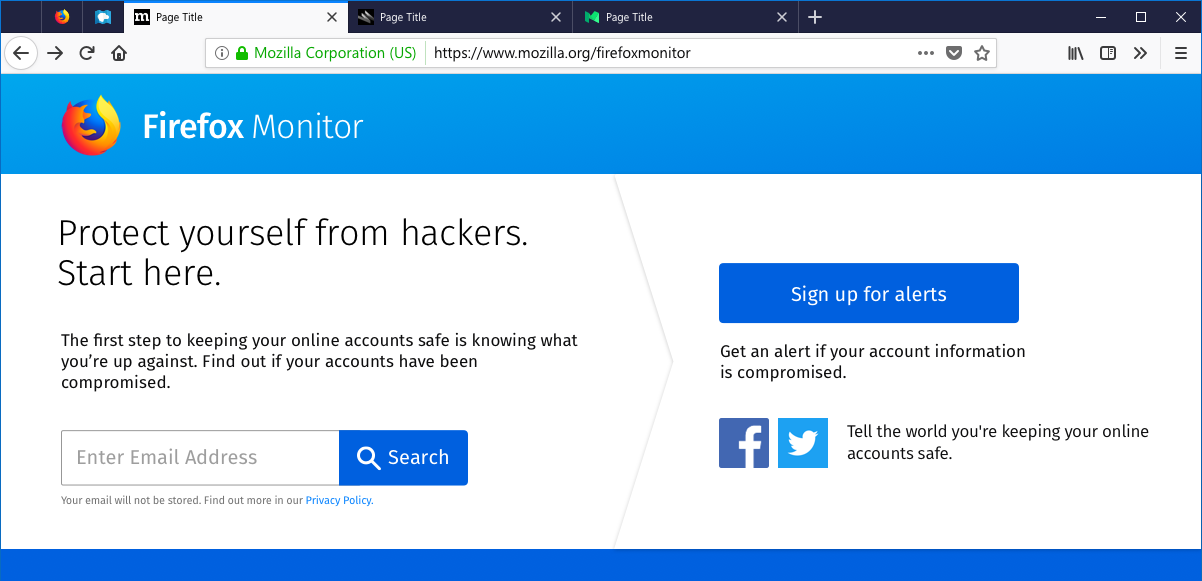
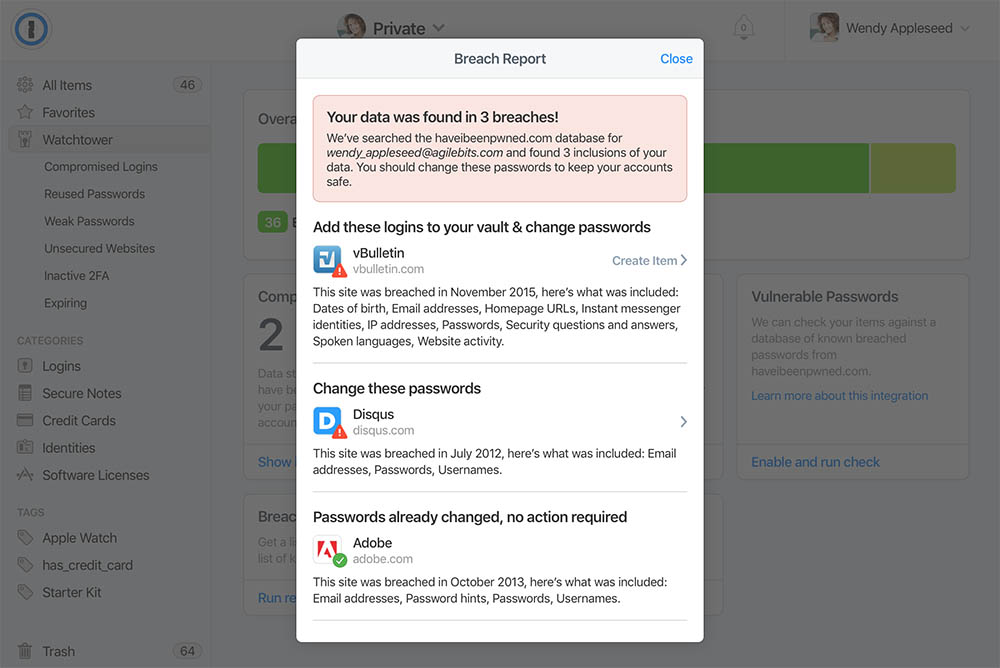
Troy Hunt, web security expert and creator of the website Have I Been Pwned (HIBP), wrote a blog post announcing his partnerships with Firefox and 1Password. For those unfamiliar with the site, Have I Been Pwned allows you to search across multiple data breaches to see if your email address has been compromised. The service is especially handy now that data breaches are becoming a daily occurrence. Hunt writes: Last November, there was much press about Mozilla integrating HIBP into Firefox. I was a bit surprised at the time as it was nothing more than their Breach Alerts feature which simply highlighted if the site being visited had previously been in a data breach (it draws this from the freely accessible breach API on HIBP). But the press picked up on some signals which indicated that in the long term, we had bigger plans than that and the whole thing got a heap of very positive attention. I ended up fielding a heap of media calls just on that one little feature - people loved the idea of HIBP in Firefox, even in a very simple form. As it turns out, we had much bigger plans and that's what I'm sharing here today. Over the coming weeks, Mozilla will begin trialling integration between HIBP and Firefox to make breach data searchable via a new tool called "Firefox Monitor." Here's what Hunt has to say about 1Password: As of now, you can search HIBP from directly within 1Password via the Watchtower feature in the web version of the product. This helps Watchtower become "mission control" for accounts and introduces the "Breach Report" feature. If you're a 1Password user you can use this feature right now, just head on over to the 1Password login page. -
'Have I Been Pwned' Is Being Integrated Into Firefox, 1Password (troyhunt.com)
Troy Hunt, web security expert and creator of the website Have I Been Pwned (HIBP), wrote a blog post announcing his partnerships with Firefox and 1Password. For those unfamiliar with the site, Have I Been Pwned allows you to search across multiple data breaches to see if your email address has been compromised. The service is especially handy now that data breaches are becoming a daily occurrence. Hunt writes: Last November, there was much press about Mozilla integrating HIBP into Firefox. I was a bit surprised at the time as it was nothing more than their Breach Alerts feature which simply highlighted if the site being visited had previously been in a data breach (it draws this from the freely accessible breach API on HIBP). But the press picked up on some signals which indicated that in the long term, we had bigger plans than that and the whole thing got a heap of very positive attention. I ended up fielding a heap of media calls just on that one little feature - people loved the idea of HIBP in Firefox, even in a very simple form. As it turns out, we had much bigger plans and that's what I'm sharing here today. Over the coming weeks, Mozilla will begin trialling integration between HIBP and Firefox to make breach data searchable via a new tool called "Firefox Monitor." Here's what Hunt has to say about 1Password: As of now, you can search HIBP from directly within 1Password via the Watchtower feature in the web version of the product. This helps Watchtower become "mission control" for accounts and introduces the "Breach Report" feature. If you're a 1Password user you can use this feature right now, just head on over to the 1Password login page. -
Firefox In 2018: We'll Tackle Bad Ads, Breach Alerts, Autoplay Video, Says Mozilla (zdnet.com)
An anonymous reader quotes a report from ZDNet: Firefox maker Mozilla has outlined its 2018 roadmap to make the web less intrusive and safer for users. First up, Mozilla says it will proceed and implement last year's experiment with a breach alerts service, which will warn users when their credentials have been leaked or stolen in a data breach. Mozilla aims to roll out the service around October. Breach Alerts is based on security consultant Troy Hunt's data breach site Have I Been Pwned. Firefox will also implement a similar block on autoplay video to the one Chrome 66 will introduce next month, and that Safari already has. However, Dotzler says Firefox's implementation will "provide users with a way to block video auto-play that doesn't break websites". This feature is set to arrive in Firefox 62, which is scheduled for release in May.
After Firefox 62 the browser will gain an optional Chrome-like ad filter and several privacy-enhancing features similar to those that Apple's WebKit developers have been working on for Safari's Intelligent Tracking Prevention. By the third quarter of 2018, Firefox should also be blocking ad-retargeting through cross-domain tracking. It's also going to move all key privacy controls into a single location in the browser, and offer more "fine-grained" tracking protection. Dotzler says Mozilla is in the "early stages" of determining what types of ads Firefox should block by default. Also on the roadmap is a feature that arrived in Firefox 59, released earlier this month. A new Global Permissions feature will help users avoid having to deny every site that requests permission for location, camera, microphone and notifications. Beyond security and privacy, Mozilla plans to build on speed-focused Quantum improvements that came in Firefox 57 with smoother page rendering. -
Imgur Confirms Email Addresses, Passwords Stolen In 2014 Hack (zdnet.com)
An anonymous reader quotes a report from ZDNet: Imgur, one of the world's most visited websites, has confirmed a hack dating back to 2014. The company confirmed to ZDNet that hackers stole 1.7 million email addresses and passwords, scrambled with the SHA-256 algorithm, which has been passed over in recent years in favor of stronger password scramblers. Imgur said the breach didn't include personal information because the site has "never asked" for real names, addresses, or phone numbers. The stolen accounts represent a fraction of Imgur's 150 million monthly users. The hack went unnoticed for four years until the stolen data was sent to Troy Hunt, who runs data breach notification service Have I Been Pwned. Hunt informed the company on Thursday, a US national holiday observing Thanksgiving, when most businesses are closed. A day later, the company started resetting the passwords of affected accounts, and published a public disclosure alerting users of the breach. -
Firefox Will Warn Users When Visiting Sites That Suffered a Data Breach (bleepingcomputer.com)
An anonymous reader writes: Mozilla engineers are working on a notifications system for Firefox that shows a security warning to users visiting sites that have suffered data breaches. The notifications system will use data provided by Have I Been Pwned?, a website that indexes public data breaches and allows users to search and see if their details have been compromised in any of these incidents. Work on this project has only recently started. The code to show these warnings is not even in the Firefox codebase but managed separately as an add-on available (on GitHub). The alert also includes an input field. In the add-ons current version this field doesn't do anything, but we presume it's there to allow users to search and see if their data was exposed during that site's security breach. Troy Hunt, Have I Been Pwned's author has confirmed his official collaboration with Mozilla on this feature. -
Disqus Confirms Over 17.5 Million Email Addresses Were Stolen In 2012 Hack of Its Comments Tool (zdnet.com)
Disqus, a company that builds and provides a web-based comment plugin for news websites, said Friday that hackers stole more than 17.5 million email addresses in a data breach in July 2012. "About a third of those accounts contained passwords, salted and hashed using the weak SHA-1 algorithm, which has largely been deprecated in recent years in favor of stronger password scramblers," reports ZDNet. From the report: Some of the exposed user information dates back to 2007. Many of the accounts don't have passwords because they signed up to the commenting tool using a third-party service, like Facebook or Google. The theft was only discovered this week after the database was sent to Troy Hunt, who runs data breach notification service Have I Been Pwned, who then informed Disqus of the breach. The company said in a blog post, posted less than a day after Hunt's private disclosure, that although there was no evidence of unauthorized logins, affected users will be emailed about the breach. Users whose passwords were exposed will have their passwords force-reset. The company warned users who have used their Disqus password on other sites to change the password on those accounts. -
2.5 Million Xbox and PlayStation Gamers' Details Have Been Leaked From Piracy Forums (thenextweb.com)
Xbox360ISO.com and PSPISO.com have been hacked by an unknown attacker in late 2015 and the details of the 2.5 million users affected have been leaked online. The leaked information contains email addresses, IP addresses, usernames and passwords. The Next Web reports: It seems that the operator of these sites did nothing to protect the latter, as all passwords were "protected" using the MD5 hashing system, which is trivially easy to overcome. For reference, that's the same hashing system used by LinkedIn. As the names of these sites imply, they were used to share pirated copies of games for Microsoft and Sony's gaming platforms. They also both have a thriving community where people discussed a variety of tech-related topics, including gaming news and software development. If you think you might have had an account on these sites at one point, and want to check if you were affected, you can visit Troy Hunt's Have I Been Pwned. If you have, it's worth emphasizing that anyone who gained access to that site, and anyone who has since downloaded the data dump, will be able to discern your password. If you've used it on another website or platform, you should change it. -
Hackers Stole Account Details for Over 60 Million Dropbox Users
The Dropbox hack is more severe than we expected. Motherboard has the details: Hackers have stolen over 60 million account details for online cloud storage platform Dropbox. Although the accounts were stolen during a previously disclosed breach, and Dropbox says it has already forced password resets, it was not known how many users had been affected, and only now is the true extent of the hack coming to light. Motherboard obtained a selection of files containing email addresses and hashed passwords for the Dropbox users through sources in the database trading community. In all, the four files total in at around 5GB, and contain details on 68,680,741 accounts. The data is legitimate, according to a senior Dropbox employee. Security expert Troy Hunt has corroborated on Motherboard's claims, and has updated Have I Been Pwned website where you can go and see if you're among one of the victims.