Slashdot Mirror
Domain: iap.fr
Stories and comments across the archive that link to iap.fr.
Comments · 10
-
Re:Make sense if pinch instead of hole
Here is the article that ticked me off : http://www.jp-petit.org/scienc...
Which is a reply to : http://www2.iap.fr/users/riazu...
All these conversations are in French.Here, a cosmologist named Alain Riazuelo criticized J.P. Petit work regarding his theories. He points several mathematical mistakes. J.P. Petit answers by requesting a public confrontation, which, for some reason, doesn't get. He then goes on by saying how cowardly Alain Riazuelo, that he didn't understand anything about his theory, blah blah blah... But nowhere I see him address the technical points raised by his opponent. And no, I don't buy his excuse that he absolutely needs a seminar to defend his position.
-
Re:Jean-Pierre Petit
To a degree. Science is a human activity, and so necessarily flawed. However Jean-Pierre Petit's work is very speculative. There is a critique of his work in the linked page that you give here. It is in bloody french, but the gist of it is that is work is not coherent and not predictive. It does not seem very interesting then. It may be that his work has been rejected for very good reasons.
Authors are not necessarily the best people to be objective about their own work.
-
Deducing facts
Actually Martin is staff, not a student, but yes, it was a stupid question. We've detected this planet purely by its gravity - we know it's mass, position in the galaxy, and projected instantaeneous distance from its star, anything more is deduced from those three facts. We haven't isolated a single photon of light from its _star_, let alone the planet, so asking if it has life is pretty silly.
If you plot mass versus orbital radius for all planets discovered so far, all 169 sit up in the high-mass/small-orbit corner, because most were found using a technique that can only find planets of that type. The closest match in weight to this planet has a 3-day orbit, rather than 10-year. That sensitivity region doesn't overlap the area on that diagram that the planets in our solar system cover - with larger orbits and smaller planets.
This new planet on the other hand, sits right in the middle of the region on that plot that our solar system covers - it's not quite like Earth, Neptune, or Pluto, but it would fit in perfectly.
We've done some nice raytraced movies showing how light is bent by the planet's gravity, distorting the face of the background star - that's how we found the planet. Have a look at:
http://planet.iap.fr/Media/OB05390other/press_rele ases.html
Especially:
http://planet.iap.fr/Media/OB05390figs/OB05390-ada ptive-hires.mp4
and
http://planet.iap.fr/Media/OB05390figs/OB05390-zoo m-hires.mp4
The planet is shown as a small blue dot. These movies are exactly what you would have seen if you'd been using a telescope with nano-arcsecond seeing - roughly a quarter-million kilometers across...
Andrew Williams
(another author on the Nature paper) -
Deducing facts
Actually Martin is staff, not a student, but yes, it was a stupid question. We've detected this planet purely by its gravity - we know it's mass, position in the galaxy, and projected instantaeneous distance from its star, anything more is deduced from those three facts. We haven't isolated a single photon of light from its _star_, let alone the planet, so asking if it has life is pretty silly.
If you plot mass versus orbital radius for all planets discovered so far, all 169 sit up in the high-mass/small-orbit corner, because most were found using a technique that can only find planets of that type. The closest match in weight to this planet has a 3-day orbit, rather than 10-year. That sensitivity region doesn't overlap the area on that diagram that the planets in our solar system cover - with larger orbits and smaller planets.
This new planet on the other hand, sits right in the middle of the region on that plot that our solar system covers - it's not quite like Earth, Neptune, or Pluto, but it would fit in perfectly.
We've done some nice raytraced movies showing how light is bent by the planet's gravity, distorting the face of the background star - that's how we found the planet. Have a look at:
http://planet.iap.fr/Media/OB05390other/press_rele ases.html
Especially:
http://planet.iap.fr/Media/OB05390figs/OB05390-ada ptive-hires.mp4
and
http://planet.iap.fr/Media/OB05390figs/OB05390-zoo m-hires.mp4
The planet is shown as a small blue dot. These movies are exactly what you would have seen if you'd been using a telescope with nano-arcsecond seeing - roughly a quarter-million kilometers across...
Andrew Williams
(another author on the Nature paper) -
Deducing facts
Actually Martin is staff, not a student, but yes, it was a stupid question. We've detected this planet purely by its gravity - we know it's mass, position in the galaxy, and projected instantaeneous distance from its star, anything more is deduced from those three facts. We haven't isolated a single photon of light from its _star_, let alone the planet, so asking if it has life is pretty silly.
If you plot mass versus orbital radius for all planets discovered so far, all 169 sit up in the high-mass/small-orbit corner, because most were found using a technique that can only find planets of that type. The closest match in weight to this planet has a 3-day orbit, rather than 10-year. That sensitivity region doesn't overlap the area on that diagram that the planets in our solar system cover - with larger orbits and smaller planets.
This new planet on the other hand, sits right in the middle of the region on that plot that our solar system covers - it's not quite like Earth, Neptune, or Pluto, but it would fit in perfectly.
We've done some nice raytraced movies showing how light is bent by the planet's gravity, distorting the face of the background star - that's how we found the planet. Have a look at:
http://planet.iap.fr/Media/OB05390other/press_rele ases.html
Especially:
http://planet.iap.fr/Media/OB05390figs/OB05390-ada ptive-hires.mp4
and
http://planet.iap.fr/Media/OB05390figs/OB05390-zoo m-hires.mp4
The planet is shown as a small blue dot. These movies are exactly what you would have seen if you'd been using a telescope with nano-arcsecond seeing - roughly a quarter-million kilometers across...
Andrew Williams
(another author on the Nature paper) -
Re:Terminology, people!
What, like a fart?
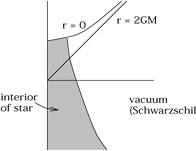
Sounds like you're thinking that black hole formation results in a topology change (a "tear") in spacetime. For astrophysical black hole formation, in classical general relativity....eh, it seriously depends on your coordinate system, but maybe the most relevant answer is "no". Even so, we expect classical GR to break down anyway near the center of the black hole (the "singularity"), which is where any "rip" would occur.
I'm looking on the web for a nice "Kruskal diagram" of astrophysical BH formation, and all I'm finding t right now is this one:
http://www-cosmosaf.iap.fr/MIT-RG7_fichiers/fig_se ven18.jpeg -
Re:Summarize what it does in one word
Try Czech:
Strc prst skrz krk (Czech sentence: "Put your finger through your throat")
from http://www2.iap.fr/users/esposito/words.html -
Re:Einstein...You are completely right, of course. It was not Dirac, but Poincare who invented relativity theory. Correct basic idea, but wrong French Scientist
Strangely enough, this glaring error still netted me a +4 Informative
(A more serious reference for the issue appeared in a not so recent edition of La Jaune et la Rouge, for those who doubt the link. Unfortunately, however, that story is not online)
Another link (mentioning btw the La Jaune et la Rouge article): Henri Poincaré : A decisive contribution to Special Relativity The short story
-
Re:Filesize of the picturesFrom the project description at CEA:
Each exposure will produce about 770 MB of data; the mosaic will be read out in about 20 seconds which means that Megacam will produce approximately 100 images (science fields and calibration) per night, ie 77 GB of data each night or about 1 TB of data for an average observing run.
So it will likely be 16bpp, not 24. Astronomical images are usually FITS, not JPEG.
Large images like this are becoming the norm in astronomy. Double the dimensions of a CCD and you quadruple the file size. With mosaiced chips like this one, you can easily get monster images. Then there's the processing, where you're usually juggling several similar-sized images. Looks like CEA is addressing this.
Incidentally, if they did want to compress these, some lossy algorithms (wavelets, Starck) do well on astronomical images. Most of what you lose in those cases is the sky noise, as long as you don't select too high a compression factor. The DSS did very well with 10x wavelet compression. -
Re:Some Say it Has Already Happened ...
The consequences of time travel have been explored a great deal in General Relativity literature.
A conjectured time machine immediately produces a time-loop, which is an inextricable linking of past and future. This is exactly like taking a piece of string and closing it into a circle. Before closure, one could orient the string along some axis and state that part of the string was "ahead" or "behind". However, once you make the loop, only relative, not absolute comparisons, are possible.
Hence "backwards" and "forwards" in time cease to have meaning in a time loop.
A paradoxical event, ie, the Grandfather Paradox, will be prevented from occuring. This is the well-known Novikov Self-Consistency Principle, as detailed by Novikov here:
http://www.iap.fr/eas/EAS18/time18/ontime.html
You cannot have the "free will" to kill your grandfather in the same way you cannot have the "free will" to prevent yourself from falling off a cliff (unless you're Wile E. Coyote
As I've referenced in another discussion concerning Wormhole Physics, time travel = FTL travel, with all of the implications for General Relativity, causality, and engineering. The energies required for large scale "metric engineering" are orders of magnitude larger than available to us even with the entire sun's energy as a budget.
--Adam