Slashdot Mirror
Domain: inria.fr
Stories and comments across the archive that link to inria.fr.
Stories · 30
-
How Web Apps Can Turn Browser Extensions Into Backdoors (threatpost.com)
"Threatpost has a link to some recent research about ways web pages can exploit browser extensions to steal information or write files," writes Slashdot reader jbmartin6. "Did we need another reason to be deeply suspicious of any browser extension? Not only do they spy on us for their makers, now other people can use them to spy on us as well. The academic paper is titled 'Empowering Web Applications with Browser Extensions' (PDF)." From the report: "An attacker [uses] a script that is present in a web application currently running in the user browser. The script either belongs to the web application or to a third party. The goal of the attacker is to interact with installed extensions, in order to access user sensitive information. It relies on extensions whose privileged capabilities can be exploited via an exchange of messages with scripts in the web application," researchers wrote. They added, "Even though content scripts, background pages and web applications run in separate execution contexts, they can establish communication channels to exchange messages with one another... APIs [are used] for sending and receiving (listening for) messages between the content scripts, background pages and web applications."
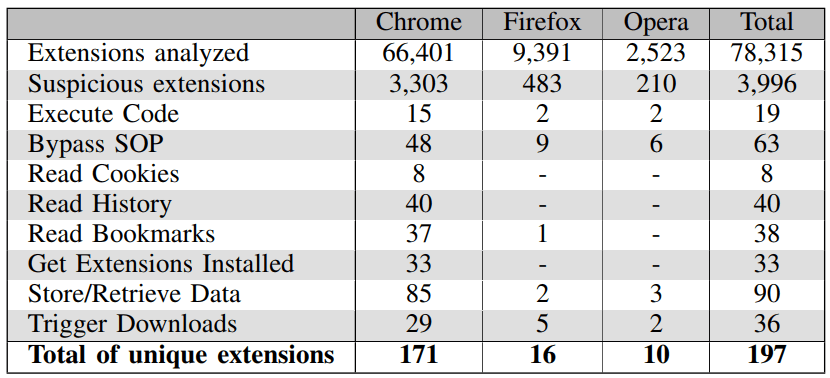
The researcher behind the paper focused on a specific class of web extension called "WebExtensions API," a cross-browser extensions system compatible with major browsers including Chrome, Firefox, Opera and Microsoft Edge. After analyzing 78,315 extensions that used the specific WebExtension API, it found 3,996 that were suspicious. While it seems voluminous, they noted that research found a small number of vulnerable extensions overall, and that concern should be measured. However, "browser vendors need to review extensions more rigorously, in particular take into consideration the use of message passing interfaces in extensions." -
High-Frequency Trading For Your Private Data
New submitter fierman writes "In a work to be presented at the Network and Distributed System Security Symposium (ISOC NDSS'14), INRIA researchers show the privacy risks of Real-Time Bidding (PDF) and High-Frequency Trading for selling advertisement spaces. Combining Real-Time Bidding and Cookie Matching, advertisers can significantly improve their tracking and profiling capabilities. Both technologies are already prevalent on the Web. The research discusses the value of users' private data (browsing history) retrieved directly from the advertisers, leveraging an exposed information leak in RTB systems. Advertisers will pay about $0.0005 to display a targeted ad to a single user, while at the same time acquiring information about them. The research also shows evidence of price variation with users' profiles, physical location, time of day and content of visited sites." -
Anyone Can Play Big Brother With BitTorrent
An anonymous reader writes "I was at the 3rd USENIX Workshop on Large-Scale Exploits and Emergent Threats yesterday, and there were people from the French Institute for Computer Science who have continuously spied on most BitTorrent users on the Internet for 100 days, from a single machine. They've also identified 70% of all content providers; yes, those guys that insert the new contents into BitTorrent. As a BitTorrent user, I was shocked that anyone with a box connected to the Internet can spy on what everyone is downloading on BitTorrent." -
Developing Applications With Objective Caml
Fahrenheit 450 (William D. Neumann) writes "Developing Applications With Objective Caml was originally published in French by O'Reilly, and later translated into English by a group of volunteers (note that the reviewer was a volunteer proofreader during the translation effort), and graciously made available online as HTML or PDF at the Caml website. For those not familiar with Objective Caml (or OCaml, as it is commonly called), it is a strongly, statically typed (but don't be thinking about Pascal-style typing), eagerly evaluated language with a functional core that also offers many imperative programming features. OCaml also has full support for object-oriented programming that fits in completely with OCaml's strong type system. On top of that, OCaml code can be interpreted for simple scripting, compiled to bytecode for portability, or compiled to native code for speed and resource utilization that rival even that of Intel's C++ compiler. Intrigued?" If so, read on for the rest of Neumann's review. Developing Applications With Objective Caml author Emmanuel Challoux, Pascal Manoury, and Bruno Pagano pages 742 publisher O'Reilly France rating 8/10 reviewer William D. Neumann ISBN 2841771210 summary A comprehensive book on Objective Caml, covering not only the core language, but also modules, objects and classes, threads and systems programming, and interoperability with C.
The Book The book itself is quite comprehensive, clocking in at over 700 pages and covering material ranging from an introduction to the language to concurrent and distributed programming. To organize all of this material, the book is broken into four main sections that build upon each other. Each section has a set of chapters that present some related concepts, followed by an "Applications" chapter that uses those concepts to create a few small applications such as a minesweeper game, a graphical interface library, a couple of different two-player games, a distributed robot simulation, and a basic HTTP servlet. These four sections are as follows:I. Language Core
This section serves primarily as an introduction to the OCaml language, with chapters on the functional core and imperative aspects of the language, a chapter on the differences between the two styles that shows how the two can be melded, and a chapter on the OCaml Graphics module. The introduction to OCaml is complete enough that anyone with a background in programming should be able to achieve a good understanding of the basics of the language. Especially when combined with other freely available resources, like Jason Hickey's Introduction to Objective Caml , and Richard Jones' Learning OCaml for C, C++, Perl and Java programmers, one should be able to obtain a strong OCaml foundation to use while reading the rest of this book.II. Development Tools
The second section covers, as the title states, the OCaml development tools. The chapters in this section provide information on the OCaml compilers, interpreter, and interactive toplevel environment; some of the libraries included with the standard distribution; OCaml's garbage collection mechanism; Ocaml's debugging and profiling tools; OCaml's versions of lex and yacc; and interfacing OCaml with C. This is perhaps the most valuable section of the book, as it provides good coverage of some important topics that are covered a bit too briefly in the OCaml manual.III. Application Structure
This section covers the OCaml Module system, and its interface and functor (parameterized module) facilities. Also included in this section is a well written chapter on object oriented programming in OCaml, and a chapter comparing the two models of program organization, offering a brief look at how the two systems can be combined to reap the benefits of both.IV. Concurrency and Distribution
The final section covers the topics that many folks might consider to be the "real world" programming topics: File I/O, process management and communication, concurrent programming using threads, and distributed programming. The coverage in this section is, again, well done, but perhaps a bit light, and it would have been nice to see more time spent on this subject matter. However, the book is already quite hefty, and the services provided by OCaml's Unix module should look familiar enough to most programmers that the material that is presented should be sufficient to get a competent programmer up and running.
The Upshot For the most part, Developing Applications With Objective Caml does a very good job at presenting the OCaml language in more of a "practical" light than other books on languages in the ML family (and functional languages in general). And while the applications that are constructed throughout this book aren't anything particularly great or interesting in and of themselves (a simple BASIC interpreter, a rudimentary database, a client-server toolbox, etc.), they aren't the primary purpose of the book. What the applications are used for is to illustrate how the concepts presented earlier in the book are used in within the framework of an application, and not just as isolated examples. This is especially important, as most people who might read the book will be unfamiliar not just with Objective Caml, but with the entire functional programming paradigm. Repeated exposure to working OCaml code helps to familiarize the reader with functional programming and OCaml idioms while reinforcing the book's material.There are, of course, some problems with the book. For one thing, Developing Applications is nearly five years old, half a lifetime when dealing with most computer related topics. This issue is first brought to light in the introduction where it's mentioned that chapter one tells how to install version 2.04 (OCaml is currently at version 3.08), and then in chapter one, when the reader is warned that, "Objective Caml only works under recent versions of Windows : Windows 95, 98 and NT." Fortunately, the information presented about the language remains valid (and Appendix B presents some of the features added to the language by version 3.04, the release that was current at the time of the translation). There are also a few spots where the code in the book contains minor errors, but both of these issues can easily be overcome with the help of the resources listed earlier in this review, or with the help of the OCaml community. Other minor issues crop up as a result of the translation, with the occasional odd sounding phrase popping up in the text and examples. These problems are, however, few and far between and do little to detract from the material or the presentation. And so this book still remains one of the best resources for learning Objective Caml. I used it when I was learning the language, and I still turn to it from time to time as a useful resource.
Will the book turn you into an OCaml guru, or teach you all sorts of advanced type system trickery? No, of course not. But it can teach you enough about the language to start you writing real apps in it. And it will allow you to add a fast, flexible, and powerful language to your toolbox.
Slashdot welcomes readers' book reviews -- to see your own review here, read the book review guidelines, then visit the submission page. -
Developing Applications With Objective Caml
Fahrenheit 450 (William D. Neumann) writes "Developing Applications With Objective Caml was originally published in French by O'Reilly, and later translated into English by a group of volunteers (note that the reviewer was a volunteer proofreader during the translation effort), and graciously made available online as HTML or PDF at the Caml website. For those not familiar with Objective Caml (or OCaml, as it is commonly called), it is a strongly, statically typed (but don't be thinking about Pascal-style typing), eagerly evaluated language with a functional core that also offers many imperative programming features. OCaml also has full support for object-oriented programming that fits in completely with OCaml's strong type system. On top of that, OCaml code can be interpreted for simple scripting, compiled to bytecode for portability, or compiled to native code for speed and resource utilization that rival even that of Intel's C++ compiler. Intrigued?" If so, read on for the rest of Neumann's review. Developing Applications With Objective Caml author Emmanuel Challoux, Pascal Manoury, and Bruno Pagano pages 742 publisher O'Reilly France rating 8/10 reviewer William D. Neumann ISBN 2841771210 summary A comprehensive book on Objective Caml, covering not only the core language, but also modules, objects and classes, threads and systems programming, and interoperability with C.
The Book The book itself is quite comprehensive, clocking in at over 700 pages and covering material ranging from an introduction to the language to concurrent and distributed programming. To organize all of this material, the book is broken into four main sections that build upon each other. Each section has a set of chapters that present some related concepts, followed by an "Applications" chapter that uses those concepts to create a few small applications such as a minesweeper game, a graphical interface library, a couple of different two-player games, a distributed robot simulation, and a basic HTTP servlet. These four sections are as follows:I. Language Core
This section serves primarily as an introduction to the OCaml language, with chapters on the functional core and imperative aspects of the language, a chapter on the differences between the two styles that shows how the two can be melded, and a chapter on the OCaml Graphics module. The introduction to OCaml is complete enough that anyone with a background in programming should be able to achieve a good understanding of the basics of the language. Especially when combined with other freely available resources, like Jason Hickey's Introduction to Objective Caml , and Richard Jones' Learning OCaml for C, C++, Perl and Java programmers, one should be able to obtain a strong OCaml foundation to use while reading the rest of this book.II. Development Tools
The second section covers, as the title states, the OCaml development tools. The chapters in this section provide information on the OCaml compilers, interpreter, and interactive toplevel environment; some of the libraries included with the standard distribution; OCaml's garbage collection mechanism; Ocaml's debugging and profiling tools; OCaml's versions of lex and yacc; and interfacing OCaml with C. This is perhaps the most valuable section of the book, as it provides good coverage of some important topics that are covered a bit too briefly in the OCaml manual.III. Application Structure
This section covers the OCaml Module system, and its interface and functor (parameterized module) facilities. Also included in this section is a well written chapter on object oriented programming in OCaml, and a chapter comparing the two models of program organization, offering a brief look at how the two systems can be combined to reap the benefits of both.IV. Concurrency and Distribution
The final section covers the topics that many folks might consider to be the "real world" programming topics: File I/O, process management and communication, concurrent programming using threads, and distributed programming. The coverage in this section is, again, well done, but perhaps a bit light, and it would have been nice to see more time spent on this subject matter. However, the book is already quite hefty, and the services provided by OCaml's Unix module should look familiar enough to most programmers that the material that is presented should be sufficient to get a competent programmer up and running.
The Upshot For the most part, Developing Applications With Objective Caml does a very good job at presenting the OCaml language in more of a "practical" light than other books on languages in the ML family (and functional languages in general). And while the applications that are constructed throughout this book aren't anything particularly great or interesting in and of themselves (a simple BASIC interpreter, a rudimentary database, a client-server toolbox, etc.), they aren't the primary purpose of the book. What the applications are used for is to illustrate how the concepts presented earlier in the book are used in within the framework of an application, and not just as isolated examples. This is especially important, as most people who might read the book will be unfamiliar not just with Objective Caml, but with the entire functional programming paradigm. Repeated exposure to working OCaml code helps to familiarize the reader with functional programming and OCaml idioms while reinforcing the book's material.There are, of course, some problems with the book. For one thing, Developing Applications is nearly five years old, half a lifetime when dealing with most computer related topics. This issue is first brought to light in the introduction where it's mentioned that chapter one tells how to install version 2.04 (OCaml is currently at version 3.08), and then in chapter one, when the reader is warned that, "Objective Caml only works under recent versions of Windows : Windows 95, 98 and NT." Fortunately, the information presented about the language remains valid (and Appendix B presents some of the features added to the language by version 3.04, the release that was current at the time of the translation). There are also a few spots where the code in the book contains minor errors, but both of these issues can easily be overcome with the help of the resources listed earlier in this review, or with the help of the OCaml community. Other minor issues crop up as a result of the translation, with the occasional odd sounding phrase popping up in the text and examples. These problems are, however, few and far between and do little to detract from the material or the presentation. And so this book still remains one of the best resources for learning Objective Caml. I used it when I was learning the language, and I still turn to it from time to time as a useful resource.
Will the book turn you into an OCaml guru, or teach you all sorts of advanced type system trickery? No, of course not. But it can teach you enough about the language to start you writing real apps in it. And it will allow you to add a fast, flexible, and powerful language to your toolbox.
Slashdot welcomes readers' book reviews -- to see your own review here, read the book review guidelines, then visit the submission page. -
Developing Applications With Objective Caml
Fahrenheit 450 (William D. Neumann) writes "Developing Applications With Objective Caml was originally published in French by O'Reilly, and later translated into English by a group of volunteers (note that the reviewer was a volunteer proofreader during the translation effort), and graciously made available online as HTML or PDF at the Caml website. For those not familiar with Objective Caml (or OCaml, as it is commonly called), it is a strongly, statically typed (but don't be thinking about Pascal-style typing), eagerly evaluated language with a functional core that also offers many imperative programming features. OCaml also has full support for object-oriented programming that fits in completely with OCaml's strong type system. On top of that, OCaml code can be interpreted for simple scripting, compiled to bytecode for portability, or compiled to native code for speed and resource utilization that rival even that of Intel's C++ compiler. Intrigued?" If so, read on for the rest of Neumann's review. Developing Applications With Objective Caml author Emmanuel Challoux, Pascal Manoury, and Bruno Pagano pages 742 publisher O'Reilly France rating 8/10 reviewer William D. Neumann ISBN 2841771210 summary A comprehensive book on Objective Caml, covering not only the core language, but also modules, objects and classes, threads and systems programming, and interoperability with C.
The Book The book itself is quite comprehensive, clocking in at over 700 pages and covering material ranging from an introduction to the language to concurrent and distributed programming. To organize all of this material, the book is broken into four main sections that build upon each other. Each section has a set of chapters that present some related concepts, followed by an "Applications" chapter that uses those concepts to create a few small applications such as a minesweeper game, a graphical interface library, a couple of different two-player games, a distributed robot simulation, and a basic HTTP servlet. These four sections are as follows:I. Language Core
This section serves primarily as an introduction to the OCaml language, with chapters on the functional core and imperative aspects of the language, a chapter on the differences between the two styles that shows how the two can be melded, and a chapter on the OCaml Graphics module. The introduction to OCaml is complete enough that anyone with a background in programming should be able to achieve a good understanding of the basics of the language. Especially when combined with other freely available resources, like Jason Hickey's Introduction to Objective Caml , and Richard Jones' Learning OCaml for C, C++, Perl and Java programmers, one should be able to obtain a strong OCaml foundation to use while reading the rest of this book.II. Development Tools
The second section covers, as the title states, the OCaml development tools. The chapters in this section provide information on the OCaml compilers, interpreter, and interactive toplevel environment; some of the libraries included with the standard distribution; OCaml's garbage collection mechanism; Ocaml's debugging and profiling tools; OCaml's versions of lex and yacc; and interfacing OCaml with C. This is perhaps the most valuable section of the book, as it provides good coverage of some important topics that are covered a bit too briefly in the OCaml manual.III. Application Structure
This section covers the OCaml Module system, and its interface and functor (parameterized module) facilities. Also included in this section is a well written chapter on object oriented programming in OCaml, and a chapter comparing the two models of program organization, offering a brief look at how the two systems can be combined to reap the benefits of both.IV. Concurrency and Distribution
The final section covers the topics that many folks might consider to be the "real world" programming topics: File I/O, process management and communication, concurrent programming using threads, and distributed programming. The coverage in this section is, again, well done, but perhaps a bit light, and it would have been nice to see more time spent on this subject matter. However, the book is already quite hefty, and the services provided by OCaml's Unix module should look familiar enough to most programmers that the material that is presented should be sufficient to get a competent programmer up and running.
The Upshot For the most part, Developing Applications With Objective Caml does a very good job at presenting the OCaml language in more of a "practical" light than other books on languages in the ML family (and functional languages in general). And while the applications that are constructed throughout this book aren't anything particularly great or interesting in and of themselves (a simple BASIC interpreter, a rudimentary database, a client-server toolbox, etc.), they aren't the primary purpose of the book. What the applications are used for is to illustrate how the concepts presented earlier in the book are used in within the framework of an application, and not just as isolated examples. This is especially important, as most people who might read the book will be unfamiliar not just with Objective Caml, but with the entire functional programming paradigm. Repeated exposure to working OCaml code helps to familiarize the reader with functional programming and OCaml idioms while reinforcing the book's material.There are, of course, some problems with the book. For one thing, Developing Applications is nearly five years old, half a lifetime when dealing with most computer related topics. This issue is first brought to light in the introduction where it's mentioned that chapter one tells how to install version 2.04 (OCaml is currently at version 3.08), and then in chapter one, when the reader is warned that, "Objective Caml only works under recent versions of Windows : Windows 95, 98 and NT." Fortunately, the information presented about the language remains valid (and Appendix B presents some of the features added to the language by version 3.04, the release that was current at the time of the translation). There are also a few spots where the code in the book contains minor errors, but both of these issues can easily be overcome with the help of the resources listed earlier in this review, or with the help of the OCaml community. Other minor issues crop up as a result of the translation, with the occasional odd sounding phrase popping up in the text and examples. These problems are, however, few and far between and do little to detract from the material or the presentation. And so this book still remains one of the best resources for learning Objective Caml. I used it when I was learning the language, and I still turn to it from time to time as a useful resource.
Will the book turn you into an OCaml guru, or teach you all sorts of advanced type system trickery? No, of course not. But it can teach you enough about the language to start you writing real apps in it. And it will allow you to add a fast, flexible, and powerful language to your toolbox.
Slashdot welcomes readers' book reviews -- to see your own review here, read the book review guidelines, then visit the submission page. -
PHP 5 Released; PHP Compiler, Too
TheTomcat writes "After years of anticipation, PHP 5 was released today. This release represents a milestone in the evolution of PHP. It sports the new Zend Engine II, a completely re-worked object model, and many many new features. Check it and the changelog out." In other PHP news, remote_bob writes "There have been many attempts, like BinaryPHP and PASM, but finally there is a complete compiler for PHP. The Roadsend compiler produces standalone, native executables, and supports the entire PHP language (but not all extensions). It uses Bigloo Scheme to do its job, a variant of Lisp, the language that Paul Graham writes about. Benchmarks say that performance is pretty good. Is this another sign that dynamic languages are the future?" -
CeCILL: La Licence Francaise Du Logiciel Libre
News for nerds writes "Researchers at three French government-funded research organizations revealed the new Open-Source license, known as CeCILL (English .pdf here), which they say is compatible with the FSF's GPL. CeCILL is intended to make free software more compatible with French law in two areas where it differs significantly from U.S. law: copyright and product liability. I, for one, welcome our nouvelle overlord of freedom." -
CeCILL: La Licence Francaise Du Logiciel Libre
News for nerds writes "Researchers at three French government-funded research organizations revealed the new Open-Source license, known as CeCILL (English .pdf here), which they say is compatible with the FSF's GPL. CeCILL is intended to make free software more compatible with French law in two areas where it differs significantly from U.S. law: copyright and product liability. I, for one, welcome our nouvelle overlord of freedom." -
Get Ready for For The 7th ICFP Programming Contest
nate writes "Convinced your favorite programming language provides unbeatable productivity? Convinced you and your friends are world-class programmers? If so, we're providing you the opportunity to prove it! We are pleased to announce the 7th ICFP Programming Contest to be held in conjunction with ICFP 2004. All programmers are invited to enter the contest, either individually or in teams; we especially encourage students to enter. You may use any programming language (or combination of languages) to show your skill." Read on below for the details."On Friday, 4 June at 12:00 Noon (EDT), we will publish a challenge task on the Web site and by e-mail to the contest mailing list. Teams will have 72 hours until Monday, 7 June 12:00 Noon (EDT) to implement a program to perform this task and submit it to the contest judges. We have designed the contest for direct, head-to-head comparison of language technology and programming skill. We have a range of prizes including cash awards and, of course, unlimited bragging rights for the winners.
Previous contests included: 2003, 2002, 2001, 2000, 1999 and 1998."
-
Learning Functional Programming through Multimedia
ijones writes "Andrew Cooke recently reviewed for Slashdot Purely Functional Data Structures, which is on my book shelf next to The Haskell School of Expression: Learning Functional Programming through Multimedia by Paul Hudak from the Yale Haskell Group. In his review, Cooke presented an overview of some available functional programming languages, such as OCaml, SML, and of course Haskell. Havoc Pennington once called Haskell 'the least-broken programming language available today.' Haskell is a purely functional, lazy, statically typed programming language. You can read more about Haskell itself here." Read on for ijones' review of The Haskell School of Expression. The Haskell School of Expression: Learning Functional Programming through Multimedia author Paul Hudak pages 363 publisher Cambridge University Press rating 9 reviewer Isaac Jones ISBN 0521644089 summary Learn to program in a functional style in Haskell by implementing graphics, music, and robots simulations.As the title implies, The Haskell School of Expression introduces functional programming through the Haskell programming language and through the use of graphics and music. It serves as an effective introduction to both the language and the concepts behind functional programming. This text was published in 2000, but since Haskell 98 is the current standard, this is still a very relevant book.
Haskell's standardization process gives us a window into two different facets of the community: Haskell is designed to be both a stable, standardized language (called Haskell 98), and a platform for experimentation in cutting-edge programming language research. So though we have a standard from 1998, the implementations (both compilers and interpreters) are continually evolving to implement new, experimental features which may or may not make it into the next standard.
For instance, the Glasgow Haskell Compiler has implemented a meta-programming environment called Template Haskell. Haskell is also easy to extend in directions that don't change the language itself, through the use of Embedded Domain-Specific Languages (EDSLs) such as WASH for web authoring, Parsec for parsing, and Dance (more of Paul Hudak's work) for controlling humanoid robots.
Before we get too far, I should offer a disclaimer: The Haskell community is rather small, and if you scour the net, you may find conversations between myself and Paul Hudak or folks in his research group, since I use some of their software. That said, I don't work directly with Hudak or his research group.
In fact, the small size of the Haskell community is a useful feature. It is very easy to get involved, and folks are always willing to help newbies learn, since we love sharing what we know. You may even find that if you post a question about an exercise in The Haskell School of Expression , you'll get a reply from the author himself.
I consider this book to be written in a "tutorial" style. It walks the reader through the building of applications, but doesn't skimp on the concepts (indeed, the chapters are meant to alternate between "concepts" and "applications"). In some ways, the code examples make it a little difficult to jump around, since you are expected to build upon previous code. The web site provides code, however, so you can always grab that and use it to fill in the missing pieces.
For readers who wish to use this book as a tutorial, and to implement all of the examples (which is highly recommended), I suggest that you grab the Hugs interpreter and read the User's Guide while you're reading the first few chapters of The Haskell School of Expression. Hugs is very portable, free, and easy to use. It also has an interface with Emacs. Unfortunately, some of the example code has suffered from bit-rot, and certain things don't work out-of-the-box for X11-based systems. The bit-rot can be solved by using the "November 2002" version of Hugs. This is all explained on SOE's web page.
The Haskell School of Expression should be very effective for programmers who have experience in more traditional languages, and programmers with a Lisp background can probably move quickly through some of the early material. If you've never learned a functional language, I highly recommend Haskell: Since Haskell is purely functional (unlike Lisp), it will more or less prevent you from "cheating" by reverting to a non-functional style. In fact, if you've never really looked at functional programming languages, it may surprise you to learn that Haskell has no looping constructs or destructive assignment (that is, no x = x + 1). All of the tasks that you would accomplish through the use of loops are accomplished instead through recursion, or through higher-level abstractions upon recursion.
Since I was already comfortable with recursion when I started this book, it is hard for me to gauge how a reader who has never encountered recursion would find this book's explanation of the concept. The Haskell School of Expression introduces recursion early on, in section 1.4. It is used in examples throughout the book, and if you follow along with these examples, you will most certainly be using it a lot. The introduction seems natural enough to me, but I note that Hudak does not give the reader any extra insight or tricks to help them along. Not to worry, though; recursion is very natural in Haskell and the reader may not even notice that they are doing something a little tricky.
The use of multimedia was a lot of fun for me, and should quickly dispel the myth that IO is difficult in Haskell. For instance, Hudak has the reader drawing fractals by page 44, and throughout the book, the reader will be drawing shapes, playing music, and controlling animated robots.
Any book on Haskell must be appraised for its explanation of monads in general and IO specifically. Monads are a purely functional way to elegantly carry state across several computations (rather than passing state explicitly as a parameter to each function). They are a common stumbling block in learning Haskell, though in my opinion, their difficulty is over-hyped.
Since input and output cause side-effects, they are not purely functional, and don't fit nicely into a function-call and recursion structure. Haskell has therefore evolved a way to deal safely and logically with IO through the use of monads, which encapsulate mutable state. In order to perform IO in Haskell, one must use monads, but not necessarily understand them.
Some people find monads confusing; I've even heard a joke that you need a Ph.D. in computer science in order to perform IO in Haskell. This is clearly not true, and this book takes an approach which I whole-heartedly agree with. It gets the reader using monads and IO in chapter 3 without explaining them deeply until chapters 16 (IO) and 18 (monads). By the time you get there, if you have heard that monads are confusing, you might be inclined to say "how is this different from what we've been doing all along?" Over all, I was pleased with the explanation of monads, especially state monads in chapter 18, but I felt that the reader is not given enough exercises where they implement their own monads.
If you're worried that drawing shapes and playing music will not appeal to your mathematic side, you will be pleased by the focus on algebraic reasoning for shapes (section 8.3) and music (section 21.2), and a chapter on proof by induction (chapter 11).
After reading this book you will be prepared to take either of the two paths that Haskell is designed for: You can start writing useful and elegant tools, or you can dig into the fascinating programming language research going on. You will be prepared to approach arrows, a newer addition to Haskell which, like monads, have a deep relationship to category theory. Arrows are used extensively in some of the Yale Haskell group's recent work. You will see a lot of shared concepts between the animation in The Haskell School of Expression and Yale's "Functional Reactive Programming" framework, Yampa. If you like little languages, you'll appreciate how useful Haskell is for embedded domain-specific languages. It may be even more useful now that Template Haskell is in the works. Andrew Cooke described Purely Functional Data Structures as a great second book on functional programming. In my opinion, The Haskell School of Expression is the great first book you're looking for.
You can purchase Learning Functional Programming through Multimedia from bn.com. Slashdot welcomes readers' book reviews -- to see your own review here, read the book review guidelines, then visit the submission page. -
Purely Functional Data Structures
andrew cooke writes "A while ago I read the comments following a Slashdot book review. Someone had posted a request for books that covered a wider range of languages than Java, C, Python, etc. Well, I thought, why not review Okasaki's Purely Functional Data Structures? It's a classic from the underworld of functional programming - recognised as the standard reference, yet clear enough to work as an introduction to the subject for anyone with a basic functional programming background. Of course, some readers won't know what functional programming is, or what is special about pure data structures. So I hope that this review can also serve as something of an introduction to the languages that I (a software engineer paid to work with Java, C, Python, etc) choose to use in my spare time, just for the joy of coding." Read on for the rest; even if you're not planning to give up C or Perl, there are links here worth exploring. Purely Functional Data Structures author Chris Okasaki pages 220 publisher Cambridge University Press rating 8/10 reviewer Andrew Cooke ISBN 0521663504 summary Functional programming for grown-ups.In Okasaki's introduction he says that the "[...] benefits of functional languages are well known, but still the vast majority of programs are written in imperative languages such as C. This apparent contradiction is easily explained by the fact that functional languages have historically been slower than their more traditional cousins, but this gap is narrowing."
Indeed, OCaml has a reputation for being "as fast as C," yet it contains automatic memory management and supports object-oriented, as well as functional, programming. It's also probably the most widely used functional language outside academia (except perhaps Lisp/Scheme).
I mention OCaml not just because it's fast, free and popular, but because Okasaki uses a related language - ML - in his book. The ML family of languages are the standard strict, functional languages (Standard ML of New Jersey is perhaps the reference implementation but see also standardml.org). Okasaki also includes an appendix with examples in Haskell, which is the standard lazy functional language.
The difference between lazy and strict languages is the order in which code is evaluated. Most languages are strict. Unlike most languages, Haskell only evaluates something when it is absolutely necessary. Each parameter to a function, for example, is passed as a "thunk" of code, not a value. If the value is not required inside the function, the parameter is left unused; if it is required (say as part of a result that needs to be displayed) then the thunk is evaluated. This evaluation may trigger a whole slew of evaluations of functions that "should" have been called earlier (from a Java programmer's point of view).
Laziness is both good and bad. The bad side is obvious: the order in which code is executed my be very different from the order in which the program was written and some serious book-keeping is necessary in the compiler to juggle the thunks of code and their final values. The reordering of code could cause mayhem for IO operations, for example (in practice, of course, Haskell includes a solution to this problem).
The good side is that laziness can help make programs more efficient and, while the definition of ML doesn't include laziness, individual ML implementations -- including OCaml and SML/NJ -- include it as an extra.
Much of Purely Functional Data Structures (the second of three parts) focuses on how to use laziness to make data structures efficient. Lazy evaluation allows book-keeping actions to be postponed, for example, so that the cost of maintaining the data structure in an efficient form can be averaged across several read/write operations (improving worst case limits - avoiding a very slow response if the data happen to be in a "bad" order).
An understanding of how the efficiency of algorithms is rated (the big-O notation) is one piece of knowledge that this book does assume, along with a basic grasp of what Stacks, Queues, Trees, etc, are.
This lazy boost in efficiency is needed because, even though functional languages may be getting faster, it's not always possible for them to implement the efficient algorithms used in imperative (non-functional) programming.
But I'm getting ahead of myself, because I haven't described what a functional language is, or why it is useful. These are the topics of the first part of the book, which explains how functional languages, which make it impossible to change variable values by direct assignment, support persistent data structures. This section is fairly brief, and while it's a good refresher course for someone who's not had to worry about such things since studying at university, it's not sufficient as an initial introduction to functional programming in general.
There's a good explanation of functional programming in the Wikipedia, but, in all honesty, I don't see how anyone can really "get it" without writing functional code (just as I, at least, couldn't understand how OOP worked until I wrote code that used objects).
So forgive me for not telling you why functional programming is good (This paper is one famous attempt), but perhaps a better question to focus on is "Why should you spend the time to investigate this?" The best answer I can give is that it leads to a whole new way of thinking about programming. Describing functional programming as "excluding assignment to variables" doesn't do justice to the consequences of such a profound change (one I found almost unimaginable - how can you program without loop counters, for example?).
There's a practical side to all this too - learning new ways of thinking about programs makes you a better programmer. This ties in closely with the final part of Okasaki's book, which explores a few fairly esoteric approaches to data structures. Who would have thought that you can design data structures that parallel the way in which you represent numbers? Some of this is pretty heavy going - I can't say I understood it all, but I'm taking this book with me on holiday (it's slim - just over 200 pages) and I'll be bending my brain around some of the points in the last few chapters as I lie in the sun (here in the southern hemisphere it's late summer).
So just who would benefit from this book? It seems to me that it's most valuable as a second book on functional programming. There are a bunch of texts (and online guides) that can get you started in functional programming. This one goes further. It shows how to exploit the features of functional languages to solve real problems in applied computing. Admittedly, they are problems that have already been solved in imperative languages, but you might find that you, too, come to enjoy those famous benefits of functional languages. The algorithms in this book let you enjoy those benefits without paying the price of inefficiency.
Andrew Cooke last reviewed for Slashdot The Aardvark is Ready for War . You can purchase Purely Functional Data Structures from bn.com. Slashdot welcomes readers' book reviews -- to see your own review here, read the book review guidelines, then visit the submission page. -
Interview With Turing-Award Winner Robin Milner
Martin Berger writes "Turing Award (1991) winner Robin Milner is one of the most influential computer scientists. He may not be as well-known as he deserves to be, but his research contributions are ubiquitous: he developed the first mathematically sound yet practical tool for machine assisted proof construction. This research has been continued successfully and led to many useful proof assistants such as HOL, Coq or Isabelle that are being used heavily for verification purposes today." Read on for more information about Milner, and a link to Berger's excellent interview with him. Berger continues "There is also a direct line from this strand of Milner's work to what may be one of the hottest topics in computer science: proof carrying code. Milner also headed the effort to develop ML (best known today by its descendant Ocaml), the first language to include polymorphic type inference together with type-safe exception-handling and module mechanisms. Most modern programming languages can trace some of their advanced features directly back to ML's pioneering efforts. Most of all, he established concurrency theory as a scientific field by creating and studying idealised concurrent programming languages like the Pi-Calculus. That calculus is becoming more and more influential in the design of new programming languages (for example Microsoft's XLANG) and the WWW infrastructure. A few weeks ago, I interviewed Milner. I wanted to find out about the man and the stories behind all this great research. I hope you find it as interesting as I do. The transcript of the interview can be found here." -
Interview With Turing-Award Winner Robin Milner
Martin Berger writes "Turing Award (1991) winner Robin Milner is one of the most influential computer scientists. He may not be as well-known as he deserves to be, but his research contributions are ubiquitous: he developed the first mathematically sound yet practical tool for machine assisted proof construction. This research has been continued successfully and led to many useful proof assistants such as HOL, Coq or Isabelle that are being used heavily for verification purposes today." Read on for more information about Milner, and a link to Berger's excellent interview with him. Berger continues "There is also a direct line from this strand of Milner's work to what may be one of the hottest topics in computer science: proof carrying code. Milner also headed the effort to develop ML (best known today by its descendant Ocaml), the first language to include polymorphic type inference together with type-safe exception-handling and module mechanisms. Most modern programming languages can trace some of their advanced features directly back to ML's pioneering efforts. Most of all, he established concurrency theory as a scientific field by creating and studying idealised concurrent programming languages like the Pi-Calculus. That calculus is becoming more and more influential in the design of new programming languages (for example Microsoft's XLANG) and the WWW infrastructure. A few weeks ago, I interviewed Milner. I wanted to find out about the man and the stories behind all this great research. I hope you find it as interesting as I do. The transcript of the interview can be found here." -
Kishotenketsu Programming?
mike_stay asks: "Imperative Programming follows closely the 'outline' style of writing most of us were taught in elementary school. Japanese, however, have a very hard time with that writing style, as they've been trained in the concept of kishotenketsu: stories are usually told by bouncing around between various points of view, which necessarily give different accounts; no attempt is made to say what 'really' happened. 'Good writing style' expects readers to draw the conclusions; writing that is too explicit is not valued. The writing, therefore, tends to be inductive: specific examples precede general principles. The closest thing I can think of to kishotenketsu in programming is functional programming or declarative languages, but then, I'm American. Would other readers point me at other languages with this type of 'eastern' feel?" -
ICFP 2001 Contest Results
Phil Bewig writes: "Results of the 2001 ICFP Programming Contest (previously mentioned at SlashDot here and here) have been announced. First place is to a program in Haskell, second place is to a program in Dylan, and the judges' prize is to a program in Erlang. The judges also named third place (ocaml) and fourth place (C) entries that were not awarded prizes. ICFP Programming Contest pages for prior years are available: 2000, 1999, and 1998." -
ICFP 2001 Contest Results
Phil Bewig writes: "Results of the 2001 ICFP Programming Contest (previously mentioned at SlashDot here and here) have been announced. First place is to a program in Haskell, second place is to a program in Dylan, and the judges' prize is to a program in Erlang. The judges also named third place (ocaml) and fourth place (C) entries that were not awarded prizes. ICFP Programming Contest pages for prior years are available: 2000, 1999, and 1998." -
ICFP 2001 Contest Results
Phil Bewig writes: "Results of the 2001 ICFP Programming Contest (previously mentioned at SlashDot here and here) have been announced. First place is to a program in Haskell, second place is to a program in Dylan, and the judges' prize is to a program in Erlang. The judges also named third place (ocaml) and fourth place (C) entries that were not awarded prizes. ICFP Programming Contest pages for prior years are available: 2000, 1999, and 1998." -
ICFP 2001 Contest Results
Phil Bewig writes: "Results of the 2001 ICFP Programming Contest (previously mentioned at SlashDot here and here) have been announced. First place is to a program in Haskell, second place is to a program in Dylan, and the judges' prize is to a program in Erlang. The judges also named third place (ocaml) and fourth place (C) entries that were not awarded prizes. ICFP Programming Contest pages for prior years are available: 2000, 1999, and 1998." -
ICFP 2001 Task
David Mentré writes: "The ICFP 2001 programming contest TASK is now available. The objective is to write an optimizer (aka compressor) for an HTML-like language. It must work for arbitrarily big inputs and in a limited wall-clock time. Can you guess what will be the winning language? ;)" We already announced the contest, but now that the task is available, it might be fun to look at. So what will the contestants come up with? Anyone think perl might be the language of choice? :) -
ICFP 2001 Task
David Mentré writes: "The ICFP 2001 programming contest TASK is now available. The objective is to write an optimizer (aka compressor) for an HTML-like language. It must work for arbitrarily big inputs and in a limited wall-clock time. Can you guess what will be the winning language? ;)" We already announced the contest, but now that the task is available, it might be fun to look at. So what will the contestants come up with? Anyone think perl might be the language of choice? :) -
ICFP 2001 Task
David Mentré writes: "The ICFP 2001 programming contest TASK is now available. The objective is to write an optimizer (aka compressor) for an HTML-like language. It must work for arbitrarily big inputs and in a limited wall-clock time. Can you guess what will be the winning language? ;)" We already announced the contest, but now that the task is available, it might be fun to look at. So what will the contestants come up with? Anyone think perl might be the language of choice? :) -
4th ICFP Programming Contest Announced
gdon writes: "So you are the best and fastest coder in town? Take a chance to exhibit your skills and maybe win a prize at the 4th ICFP programming contest at the International Conference on Functional Programming. The programming challenge task will be published on July 26, 2001 at 15:00 UTC and program submission ends 72 hours later." Check out the previous contests: 1998, 1999, or 2000. -
4th ICFP Programming Contest Announced
gdon writes: "So you are the best and fastest coder in town? Take a chance to exhibit your skills and maybe win a prize at the 4th ICFP programming contest at the International Conference on Functional Programming. The programming challenge task will be published on July 26, 2001 at 15:00 UTC and program submission ends 72 hours later." Check out the previous contests: 1998, 1999, or 2000. -
Distributed Computing Projects Other Than Distributed.Net?
setec asks: "After the end of the ECDL Project last April, I fell out of the practice of participating in distributed processing projects. However, I'm gettin' the itch again, and I've run into a problem that many others have faced, I'm sure. Besides, distributed.net, there really aren't many cool projects out there. And none match the comraderie that the ECDL project offered... Where does a geek go to find a good distributed project?" Actually, I've always found the Great Internet Prime Search to be a worthwhile distributed project and moved my spare cycles there after getting tired with Distributed.Net. There's Seti@Home as well. What other distributed computing projects do you all contribute your idle processor time to? -
Biggest Public-key Crypto Crack Ever
galore writes "Certicom's ECC2k-108 Elliptic Curve Discrete Logarithm challenge has been broken! This was the largest public calculation ever to use a complex parallel algorithm. $5,000 dollars in winnings will be donated to the Free Software Foundation. Congratulations to everyone who participated, including team Slashdot! " There seems to be conflicting versions of info about the prize money - some says 8,000 to the Apache Foundation, others say 5,000 to the FSF. -
Biggest Public-key Crypto Crack Ever
galore writes "Certicom's ECC2k-108 Elliptic Curve Discrete Logarithm challenge has been broken! This was the largest public calculation ever to use a complex parallel algorithm. $5,000 dollars in winnings will be donated to the Free Software Foundation. Congratulations to everyone who participated, including team Slashdot! " There seems to be conflicting versions of info about the prize money - some says 8,000 to the Apache Foundation, others say 5,000 to the FSF. -
Where can I Find the Perfect Mouse?
Roar Lauritzsen asks: "After enabling scrolling with the wheel of my Logitech mouse in Linux/X, I find it indispensable. But holding the mouse in a natural grip while using the middle finger to scroll is quite uncomfortable, and soon after enabling this feature my hand started to hurt. To ease the pain I am now trying the Anir vertical mouse, but I don't think I like it. Personally, I think the thumb would be perfect for scrolling, but I have been unable to find a 3-button mouse (a must in X) with a wheel on the side for the thumb. What do YOU think is the perfect mouse, and where can I buy it? " -
Help solve Certicom's ECC Challenge and help ASF
The Elliptic Curve Discrete Logarithms project has made a generous proposal to the Apache Software Foundation: They are looking for help in solving part of Certicom's ECC Challenge. If they win, they will give donate $8000 of the $10000 prize to the ASF, with the remaining $2000 being divided between the 2 volunteers who find the match (so it's $1000 each). It's a cool challenge, a piece of cake to participate and it helps out your favorite server. -
Using the Microsoft Knob under X
Elliot Lee wrote in with a link to this page which explains how you can make use of the previously-worthless-under-X knob that is now standard on Microsoft Mice (and like all microsoft innovations, is probably going to be the defacto standard everywhere by sometime next thursday). I actually like the knob sometimes (not as much as those cool IBM mice that had a trackpoint to allow left and right as well as up and down) and wouldn't mind seeing applications made aware of it. The page has Examples for KDE, Netscape and others.