 Slashdot Mirror
How Web Apps Can Turn Browser Extensions Into Backdoors (threatpost.com)
"Threatpost has a link to some recent research about ways web pages can exploit browser extensions to steal information or write files," writes Slashdot reader jbmartin6. "Did we need another reason to be deeply suspicious of any browser extension? Not only do they spy on us for their makers, now other people can use them to spy on us as well. The academic paper is titled 'Empowering Web Applications with Browser Extensions' (PDF)." From the report: "An attacker [uses] a script that is present in a web application currently running in the user browser. The script either belongs to the web application or to a third party. The goal of the attacker is to interact with installed extensions, in order to access user sensitive information. It relies on extensions whose privileged capabilities can be exploited via an exchange of messages with scripts in the web application," researchers wrote. They added, "Even though content scripts, background pages and web applications run in separate execution contexts, they can establish communication channels to exchange messages with one another... APIs [are used] for sending and receiving (listening for) messages between the content scripts, background pages and web applications."
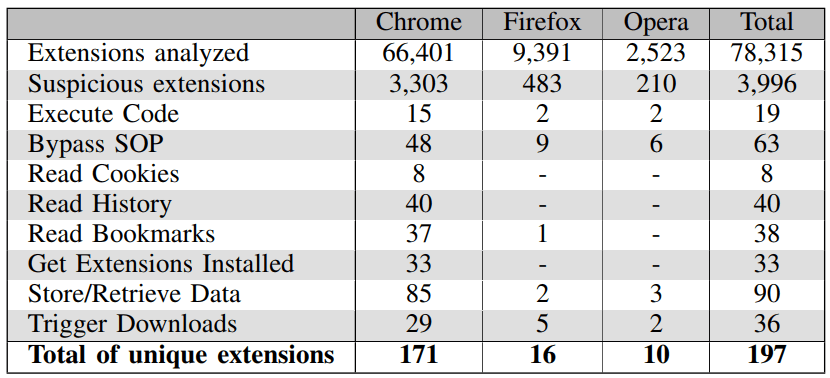
The researcher behind the paper focused on a specific class of web extension called "WebExtensions API," a cross-browser extensions system compatible with major browsers including Chrome, Firefox, Opera and Microsoft Edge. After analyzing 78,315 extensions that used the specific WebExtension API, it found 3,996 that were suspicious. While it seems voluminous, they noted that research found a small number of vulnerable extensions overall, and that concern should be measured. However, "browser vendors need to review extensions more rigorously, in particular take into consideration the use of message passing interfaces in extensions."
The researcher behind the paper focused on a specific class of web extension called "WebExtensions API," a cross-browser extensions system compatible with major browsers including Chrome, Firefox, Opera and Microsoft Edge. After analyzing 78,315 extensions that used the specific WebExtension API, it found 3,996 that were suspicious. While it seems voluminous, they noted that research found a small number of vulnerable extensions overall, and that concern should be measured. However, "browser vendors need to review extensions more rigorously, in particular take into consideration the use of message passing interfaces in extensions."
So basically the whole "we're dropping XUL for webextensions. Because...uh...security!" thing from mozilla which crippled all my favourite extensions was pointless.
So you think your free ad blocking extension is above suspicion? That's the dumbest thing I ever heard.
No, I think that my OPEN SOURCE blocking extensions (uBlock Origin and Privacy Badger) are above suspicion. Trust but verify.
Everything is supposed to run that way anyway, right? This shouldn't be an issue.
“He’s not deformed, he’s just drunk!”
In any case, when people mean "security" l, they do not mean security for you, but security *from* you.
Just like how "freedom", for neocons (and SJWs), does not mean freedom from harm, but freedom *to* harm. (The Romans had two different words for that, I've been told.)
The level at which people are afraid nowadays, can only be called a collective anxiety disorder anyway.
Has anyone ever seen such a beast?
I mean *ever*?
And wouldn't that just be a table of products, with measurable properties as columns and numbers with SI units as field values? (Like skinflint.co.uk alias geizhals.at.)
He said: "Trust but verify."
In the latter case, open source is above suspicion, and in any case, it's more trustworthy than closed source, where you cannot even tell without a massive effort.
QED. You're a moron and an asshole.
Mobile Browser Apps, completely closed system. Thats where the big hoses hook up to.
The Google Chrome dev team.
Isnâ(TM)t it amazing how whenever google is trying to promote some stupid thing, we start to get stories that further support their ideas?
We should build underground tomb cells to put serious felons in, and seal them off with a a giant pyramid on top. Trump can be the very first inmate. In fact, let's do what NYC did over a century ago and think like an egyptian:
https://en.m.wikipedia.org/wiki/File:New_York_Halls_of_Justice.jpg
Only I would build it MUCH bigger, with giant, intimidating statues lining the outside, and features exaggerated to make it feel very threatening. Instead of regular cell doors, it would have giant stone and steel doors with threatening heiroglyphics on both sides.
EASY TO BEAT IN FireFox about:config:
network.dnsCacheEntries 0
network.trr.mode to 5 (SHUTS IT OFF)
network.trr.uri (set to 208.67.222.222)
* All that CRAP HTTPS does is SLOW YOU DOWN & it always gets bypassed/broken inevitably anyhow (SSL to TLS anyone? What's NEXT, for Pete's sake??)
APK
P.S.=> For the best hosts file multiplatform:
APK Hosts File Engine 2.0++ 64-bit for Linux h t t p : / / a p k . i t - m a t e . c o . u k / A P K H o s t s F i l e E n g i n e F o r L i n u x . z i p (remove spaces between chars & download)
APK Hosts File Engine 10++ SR-1 32/64-bit for Windows https://hosts-file.net/?s=Down... (DL link @ bottom)
Soon for MacOS too (I just got a NEW Mac-Mini to port it there too)... apk
MacOS model's NOT done yet so you can STOP now as you IMPERSONATE me here on /. nigh constantly, ok? Good!
* Port Filters are not supported in my work on hosts (in fact, my program STOPS that error) & here's proof of it https://news.slashdot.org/comm...
APK
P.S.=> Hopefully, this 'sinks in' to your DULL BRAIN @ last, finally (for the 100th time now)... apk
APK Hosts File Engine 2.0++ 64-bit for Linux/BSD h t t p : / / a p k . i t - m a t e . c o . u k / A P K H o s t s F i l e E n g i n e F o r L i n u x . z i p
Yields more security/speed/reliability/anonymity vs. any 1 solution (99% of threats use hostnames vs. IP address most firewalls use) more efficiently/FASTER + NATIVELY 4 less!
Vs. "Bolt on 'MoAr' illogic-logic" slowing u hosts speed u up 2 ways: Adblocks + Hardcode fav. sites u spend most time @ vs. competition w/ security bugs (DNS/AntiVir) + overheads slowing u (messagepass 'souled-out' to advertisers easily detected & blocked addons + firewall filtering drivers) & their complexity leads to exploit!
* ONLY 1 of its kind in GUI 4 Linux/BSD (soon 4 MacOS)!
APK
P.S.=> Protects vs. scripts/trackers (kernelmode faster vs. usermode slower NoScript vs. 3rd party script)/ads/DNS request tracking + redirect poisoned or downed DNS/botnets/malware download/malcript/email malicious payload... apk
The anonymous post that included "Trust but verify." was right; only software freedom gives us the best known defense against malware. I don't agree with post moderation but if a discussion forum will have such censorious distractions, posts like that deserve far more than 0 points.
Your post, on the other hand, in which you claim that software freedom is "bullshit" ironically highlights how valuable software freedom is: separating functionality into components solves nothing if those components are implemented with non-free (user-subjugating, proprietary) software. Whatever value the separation purports to grant users is entirely lost by not respecting a user's software freedom. In fact we know that proprietary software is often malware.
Digital Citizen