Slashdot Mirror
Domain: long-lines.net
Stories and comments across the archive that link to long-lines.net.
Comments · 7
-
Re:Prior art
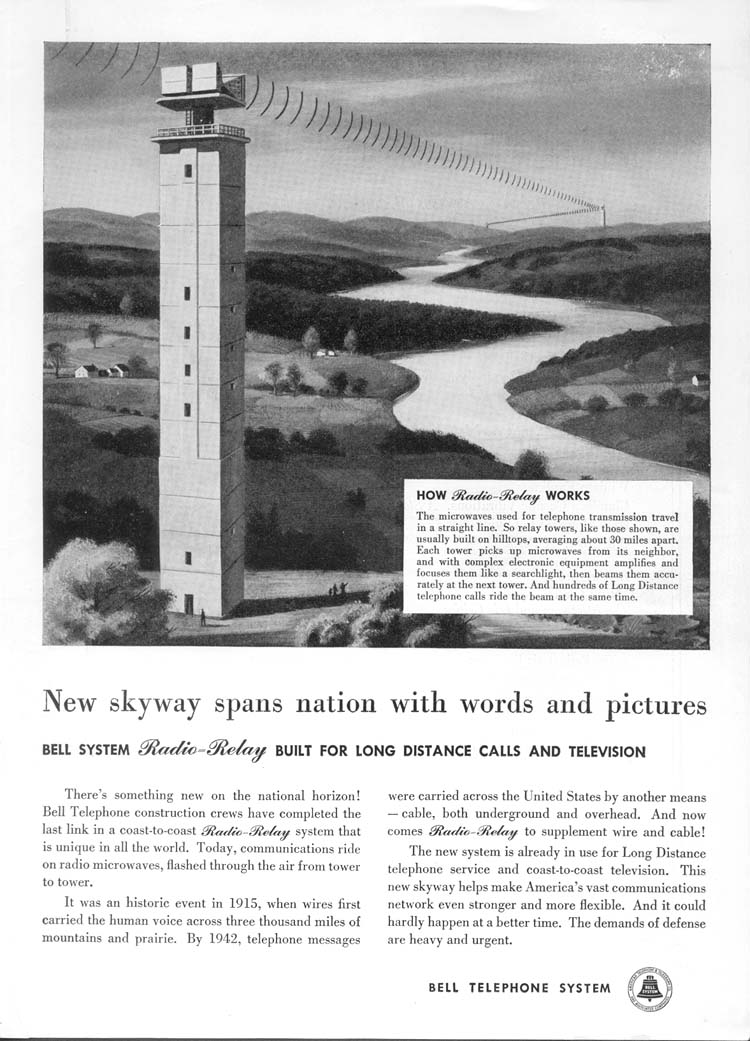
I always smile when passing old long-lines towers on the road (or seeing them on top of central office buildings in large cities). You can get an idea of the size and scope of the network at http://long-lines.net/ which has some excellent maps such as http://i.imgur.com/HI0cMJ1.jpg showing the network.
-
There's still a Bell Labs?
There's no more Western Electric or Bell System, so it surprises me to hear that Bell Labs is still around. That's good if it is the Bell Labs, the one that invented the transistor, laser, microwave communications, the UNIX operating system, satellites, etc.
Then again, AT&T is not the same AT&T that was around before Judge Greene broke it up in 1984, so I hope it hasn't become some kind of "no Bell Labs left behind" that provides jobs for underachieving American Dilbertized engineers... -
About those postal roads...
I think you jumped over a few historical facts when you mentioned the Interstate Highways were unfair competition to the railroads. When the Interstate Highways were designed in the early 1950's and built in the late 50's and early 60's, they were paid for by
The Department of Defense.
Of course the railroads could not compete with the Interstate Highways. But why would the DOD build the Interstate Highways? Well, to understand that, you needed to look at the first Interstate Highways built, and notice they were all very flat, and that NOTHING crossed over them, not even power lines. These new highways were built with several hundred feet of separation between the opposite direction traffic lanes. And they were incredibly straight. The few curves these highways had were all very gradual.
Any ideas yet why DOD paid for building the Interstate Highways? Here's a hint -- the Strategic Air Command.
During the late 50's and early 60's, the Strategic Air Command was a very large part of our national defense, with many long range bombers in the air at any one time. But, an enemy might attack our airfields, in particular, those with 10,000 foot runways. Such an attack could prevent many of our long range bombers from taking off, and prevent the bombers already in the air from refueling before they flew to their targets over the North Pole.
AH HA!
Our Interstate Highways were built to be used as runways -- runways for our bombers to use for refueling. By covering the countryside with runways, there was no way a potential adversary could prevent our long range bombers from refueling so they could reach their targets. But technology eventually obsoleted the Strategic Air Command as our primary defense, and we no longer needed those runways all over the countryside.
At about the same time as the Interstate Highway system was being built, a nationwide broadband network was being built by AT&T. This nationwide network, consisting of microwave relay stations and coaxial cable repeaters, carried long distance telephone calls and network television programs. About 1/2 of the capacity of this broadband network was leased to the Federal Government. The Federal Government provided guaranteed traffic for this nationwide network, insuring it would be built. Here are two links to some of the history and technical details of AT&T's broadband network.
http://www.corp.att.com/history/nethistory/milesto nes.html
http://long-lines.net/
The AT&T "Long Lines" network was built with no central control point, specifically so it would survive a nuclear war. But eventually, the AT&T microwave and coaxial cable network approached saturation, and more bandwidth was needed. Worse, many of the consulates and embassies belonging to our adversaries now had arrays of microwave antennas on their roofs.
Here is are two links to what some of the government traffic passing through the AT&T microwave and coaxial cable physical network was:
http://www.albany.edu/ltl/using/history.html
http://www.inetdaemon.com/tutorials/internet/histo ry.shtml
In the 1990's, AT&T sold off their microwave and coaxial cable physical network because by then AT&T had deployed a fiber mesh network with far higher bandwidth. This fiber network also offered significantly better security than the microwave network did because intercepting message traffic on a fiber network without being detected is quite difficult. AT&T's conversion to an all fiber network made those consulate and embassy roof microwave antennas largely obsolete for gathering electronic intelligence.
About our trans-oceanic te -
GEP - Ground Entry PointPer: http://long-lines.net/places-routes/Lyons_NE/
Those antennas served as a Ground Entry Point (GEP) for the UHF air-ground radio system code-named "Combat Ciders", which provided communications to the Post-Attack Command and Control System (PACCS) aircraft. Those planes, such as "Looking Glass", were flying command posts on continuous airborne alert, capable of delivering orders to launch nuclear-tipped intercontinental ballistic missiles. In addition, the UHF network was used by Air Force One when the plane was within the system's range.
-
So what is AT&T up to?
I've seen many of the towers they are talking about in the article. Many are being sold off as business bunkers or dismantled due to fiber optics being the medium of choice these days. The towers belong to what was called the 'long lines' division of AT&T.
The primary purpose of these towers was to relay AT&T's transcontinental long distance communications but they also seemed to be a source of backup communications for govt. sites around the US, including the Congressional Relocation Facility, hidden under the Greenbriar Hotel in SE West Virginia. Another use was to serve as a network feed for many local TV stations, a need that requires high bandwidth. This is of course before satellite took over for that purpose.
I have noticed that many sites have 4 identical antennas at the very top in a square shape. This is a configuration I recently observed on the rooftop of what I can assume was a secret service Chevy Suburban that was leading the motorcade for VP Dick Cheney. I saw the motorcade in Pittsburgh on Saturday as I exited the Fort Pitt tunnels on to the Parkway West, they were coming down the hill about to enter the tubes and go in to the city. I also saw another suburban behind the first that appeared to have a large dome on the roof, possibly a radar of some kind.
Some really good links with in-depth descriptions including interior photos of the bunkers:
http://www.drgibson.com/towers/
http://long-lines.net -
Re:Of copper pipes and microwaves
This sounds like the logical extension of the L-carrier systems. Before digital encoding was invented, radio techniques (frequency division multiplexing) were used to shift the frequency of each voice channel, and pack dozens of channels into a wide-band signal which could ride a twisted pair, or itself be muxed into a still wider signal, which was transmitted on coaxial cable.
I'm guessing that the megahertz-range signals on the coax were then muxed into gigahertz-range signals to be transmitted down the tubes. Fascinating.
Lots more details at long-lines.net for the curious. -
Microwave, rf, big bucks and bandwidth
oh my!
This sounds expensive.
This sounds only like a service provider tool from a big building to a lot of locations with the downstread demarc connecting to service provider equipment with ethernet out or long haul out to remote locations. I can see this probably will be a tool for telcos or big companies/governments in the 3rd world or other locations in the US. I can see this used to feed bandwidth into more rural areas where high capacity fiber won't be pushed and then the big boys can push DSL while waiting to sell bandwidth do their smaller competitorsIf you've got pockets with money and can pay alot to use a big building's roof ala TowerStream. But you still need your bandwidth from somewhere.
Wow, the future is the past. Microwave for broadband like AT&T Long Lines. Now it looks like selling those towers off was like Polaroid selling off anything digital.