Slashdot Mirror
Domain: mako.cc
Stories and comments across the archive that link to mako.cc.
Comments · 20
-
Invisible Technology and things to keep in mindBenjamin Mako Hill has discussed invisible technology and ubiquitous computing. Hill observes that "The reason most people don't understand the power of technology is that they don't realize technology exists." Put another way, it is easy to not notice (or even forget about) matters of power, control, and autonomy that come along with any technology that is, "quite explicitly, mitigating and mediating our lives", when we aren't even noticing the technology we are interacting with and relying upon in the first place. In this talk he quotes, Marc Wiesner, who was a director of Computer Science at Xerox PARC and wrote a paper seen as the birth of "Ubiquitous Computing" that made a call for invisible computing, stating:
"A good tool is an invisible tool. By invisible, I mean that the tool does not intrude on your consciousness; you focus on the task, not the tool. Eyeglasses are a good tool -- you look at the world, not the eyeglasses. The blind man tapping the cane feels the street, not the cane. Of course, tools are not invisible in themselves, but as part of a context of use. With enough practice we can make many apparently difficult things disappear: my fingers know vi editing commands that my conscious mind has long forgotten. But good tools enhance invisibility."
Hill points out that one of the times we actually do notice technology is when it breaks. He also has a rather clever blog, Revealing Errors , in which he and other contributors "reveal errors that reveal technologies" so as to learn how they affect our lives.
-
Invisible Technology and things to keep in mindBenjamin Mako Hill has discussed invisible technology and ubiquitous computing. Hill observes that "The reason most people don't understand the power of technology is that they don't realize technology exists." Put another way, it is easy to not notice (or even forget about) matters of power, control, and autonomy that come along with any technology that is, "quite explicitly, mitigating and mediating our lives", when we aren't even noticing the technology we are interacting with and relying upon in the first place. In this talk he quotes, Marc Wiesner, who was a director of Computer Science at Xerox PARC and wrote a paper seen as the birth of "Ubiquitous Computing" that made a call for invisible computing, stating:
"A good tool is an invisible tool. By invisible, I mean that the tool does not intrude on your consciousness; you focus on the task, not the tool. Eyeglasses are a good tool -- you look at the world, not the eyeglasses. The blind man tapping the cane feels the street, not the cane. Of course, tools are not invisible in themselves, but as part of a context of use. With enough practice we can make many apparently difficult things disappear: my fingers know vi editing commands that my conscious mind has long forgotten. But good tools enhance invisibility."
Hill points out that one of the times we actually do notice technology is when it breaks. He also has a rather clever blog, Revealing Errors , in which he and other contributors "reveal errors that reveal technologies" so as to learn how they affect our lives.
-
Re:Fuck Google
Yes, I don't use Gmail. Yes, I block Facebook and Google's script library. Yes, it breaks pages because stupid webmasters needlessly make their pages dependent on a third party server. Yes, my phone uses a custom ROM, is rooted and Google services are not installed. It doesn't matter. Google has most of my email because it has all of yours. Google has my picture, my address, my phone numbers and basically everything else, because other people give it to them. Just like the Indians who accepted trinkets in return for real value, it's not those people who are doing evil. Google needs a new motto.
-
Re:Forgotten one's history?
I owned a Seiko MessageWatch (see http://mako.cc/copyrighteous/t...). It was functional for about 3 years. Off course, a modern-day variant can be connected to a laptop or desktop computer to upgrade the firmware, which the MessageWatch could not. So the idea is ancient, but maybe the time is ripe now.
On the other hand, My Nokia N900 was supported for about 3 years as well. Maybe people want to spend a lot of money on phones, but I doubt if they want to spend that much money on a watch that is already obsolete when you open the package.
Conversely, I have one of my grandfather's pocket watches. It still tells time just like it did the day he bought it 80 years ago, presuming it's wound.
No firmware updates, no planned obsolescence.
-
Re:Forgotten one's history?
I owned a Seiko MessageWatch (see http://mako.cc/copyrighteous/t...). It was functional for about 3 years. Off course, a modern-day variant can be connected to a laptop or desktop computer to upgrade the firmware, which the MessageWatch could not. So the idea is ancient, but maybe the time is ripe now.
On the other hand, My Nokia N900 was supported for about 3 years as well. Maybe people want to spend a lot of money on phones, but I doubt if they want to spend that much money on a watch that is already obsolete when you open the package.
-
Re:First Post
IBM would sue them for ripping off their business model.
There, fixed that for you.
-
Re:What's wrong?
I realize Slashdot has a certain "information should be free" ethos, but it doesn't make much sense to build in the ability to give unlimited copies to everyone and think that it won't undermine the business. While the publishers "wish you to engage in two separate hallucinations", it seems like lots of other people want us to engage in another hallucination: that giving out unlimited copies won't turn into a financial problem for booksellers.
Just for the sake of argument, let's accept that assertion of yours as truth: Infinite distribution necessarily causes financial problems for publishers. That doesn't explain why they would choose to give fewer lending rights to possessors of digital copies than to those who buy the paper object. Nor does it explain why they charge pretty much the same price for this reduced capability.
We seem to be dealing (yet again) with anti-features: The publishers are actually adding to the consumer's burden in exchange for nominally lowering the cost and 'allowing' them the convenience of reading an electronic copy of a given book.
As the Economist rightly notes, this won't stand. Anti-features (including DRM) only need to be removed once. Argue however much you like about the rights of the author. As a writer, I'm pretty damn sympathetic. But realistically, writers have to adjust to the world as it is. People will share things that delight them. They do so with photos, with posters, books, music, TV shows and movies... in short, with everything they can.
Yes, it puts creators in a quandary. Yes, it threatens livelihoods and, potentially, might even prevent the next great opus. But to attempt to remodel the world to fit an outdated vision? That's just insane. I don't mean stupid -it actually requires a fair amount of imagination to get there- I mean insane - nuts, cuckoo. The idea is premised on the fact that all of society (save the poor, beleaguered author) is wrong, and must change. Even if the first clause is correct, the second does not follow. And even if we accept it logically, we still have no hope of effecting that change through technical means.
I suppose it is possible that we could change society. It's happened before. But we will not do it with DRM and anti-features.
-
Re:Its not just sony
Some people call this an antifeature.
-
Re:Again?
I really like the fact that Benjamin Mako Hill call that "antifeatures"
A great great way to explain the problem.
See also the DRMequation:http://ploum.frimouvy.org/?145-do-i-have-to-protect-my-content-with-drm-the-drm-equation
-
Re:The Money Quote
O rly? I think they do care.
-
Re:Ubuntu contributions?
I did some reading and Canonical (Ubuntu's backer) puts a lot of effort into improving Debian
I feel the same way about Redhat that you do (I am currently on Fedora). I also feel good about Ubuntu, but for a different reason. They do a great job of providing an easy-to-use distro[1] that non-linux geeks can get their feet wet on, and thereby become linux geeks. While it's important to contribute to the core packages that everyone can use; Ubuntu fits the need of getting the word out. If that's their main focus (besides what directly helps them and Debian) then I can see that doing as much as writing pieces of code.
[1]Fedora 8 by the way has a great installer. It seemed no harder then Ubuntu to me. -
Re:Everybody would want to do this
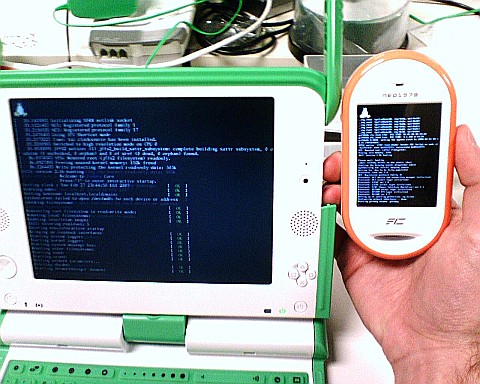
"I'm a bit more cynical about Linux than I used to be, but I still think I'd feel a little thrill if I saw a bash prompt on my phone."
http://mako.cc/copyrighteous/images/xo_plus_openmoko-03-boot.jpg
OpenMoko has SSH in and out of course (get a shell on your phone's OS, or use your phone to connect to a prompt on some other computer) -
Re:On the other hand...
I 2nd this statement. In fact, Mark Shuttleworth and Ubuntu have already begun doing things that undermine the idea of free software. For example, Ubuntu now ships with binary blobs in the kernel, non-free wireless drivers, and proprietary nvidia drivers (for which free alternatives readily exist.) See Scott James Remnant's blog for details. Likewise, it's been reported and substantiated that Mark Shuttleworth is preventing the Debian GNOME maintainer (who also works for Canonical) from updating GNOME packages until after Ubuntu LSO had shipped. Of the two top committees governing Ubuntu, the Ubuntu Community Council and the Technical Board, are both made up of Mark Shuttleworth and people he employs, and Shuttleworth has been given "benevolent dictator for life" status within the project. A lot of people do not trust Shuttleworth either, and some, such as Debian Developer, Otavio Salvador, have made comments like, "what he says and what he does are different." You should be wary of supporting Shuttleworth's efforts as there's good reason to question his commitment to the ideals of free software and to the interests of the rest of the community.
-
Bad article, full of misinformation
IMO, this is a bad article. It's full of misinformation and factual errors, and it paints a very inaccurate picture of the current state of Debian.
From the article:
Debian has a long history of being late, ever since its first version in 1997. This is one of the reasons why entrepreneur Mark Shuttleworth launched alternative Linux distribution Ubuntu two years ago.
The date of Debian's first release given in this article is only one of the many factual errors that it contains. The Wikipedia article on Debian ( http://en.wikipedia.org/wiki/Debian ) tells that "The Debian distribution was first announced on August 16, 1993 by Ian Murdock" and "The Debian Project grew slowly at first and released its first 0.9x versions in 1994 and 1995." Debian version 1.1 was released in June 1996, version 1.2 in December 1996, and version 1.3 in June 1997.
Of course, the article also fails to mention that the Ubuntu distribution is based on Debian and Ubuntu's each new release relies heavily on the work that is constantly being done in Debian, and the article also fails to tell that Ubuntu takes most of the code it releases from Debian's development branch.
http://mako.cc/writing/to_fork_or_not_to_fork.html
From the article:
The upcoming release of Debian is being delayed because of a slowdown by key developers.
Actually, there's no factual evidence at all that the delay in Debian's release schedule is caused by developers doing their work slower than usual. It is not easy to grasp how large and complex the Debian project has grown and many journalists also obviously fail to understand the not-for-profit and volunteer nature of the work that is done in Debian. The huge size of the project and the volunteer nature of its work are sufficient reasons alone to explain why the release has been delayed for a month or two. Such delays can happen for purely organizational reasons even if every developer is working as hard as they can.
Debian is a non-profit volunteer organization where all the important decisions are made democratically. ( http://en.wikipedia.org/wiki/Democracy ) This means that all important issues in the project management are openly discussed over a period of time and every developer has a chance to get their voice heard. From time to time there are disagreements among the developers and these disagreements are settled by voting where the opinion of the majority wins.
There was recently some disagreement among the Debian Developers about the experimental idea to fund two release managers' full-time work for a short period of time just before the upcoming Debian release. The Debian Developers voted about this issue and the majority of them decided to support the experiment. ( http://lists.debian.org/debian-devel-announce/2006
http://lists.debian.org/debian-devel-announce/2006
-
Site is slow - here's the textAs A/C - I've plenty of karma.
Opera on the green machine
On Friday, I received a call from Opera's accounting department. That normally means trouble. My warning lights starts flashing.
There's a package for you waiting here. I'm looking for the invoice for customs purposes. Can I open it?
Sure, I said, hoping to quickly return to whatever I was doing.
There's no invoice inside. Strange. The value has been declared to be 100 dollars
100 dollars?
Yes. There's a machine inside the package. It's cute. Green.
GREEN? A GREEN MACHINE? 100 DOLLARS?
Yes.
DON'T MOVE. DON'T LET ANYONE ELSE SEE IT. LOCK THE DOORS. I'LL BE RIGHT THERE!
As the alert reader has figured out by now, the machine inside the box was a prototype of the $100 laptop from the OLPC project. Since then, I've kept the machine close to me, but lots of people around here have seen it. The Opera geeks gathered around it at the Friday night beer bash. Someone suggested testing to see if the machine could keep running in rough environments. For example, would the rubbery keyboard withstand beer? Better not try.
Invariably, the machine gets attention. It attracts people more than any other unit I've seen. (Only Wii comes close.) People want to see it, touch it, and feel it. They want to know why the USB ports are placed where they are (on both sides of the screen), how the SD card can be inserted (the SD port is under the screen), and where the crank is. The crank, meant to generate power to run the machine, was part of an early design. It has been replaced with a foot pedal which is still under construction. However, it seems that people somehow got emotionally attached to the hand crank and want it back.
Once the machine is turned on, a Linux boot sequence appears. Red Hat is one of the sponsors and the machine comes with a tuned version of Fedora. New boot images are published regularly, and the first thing to do was to install the latest build. All of this is documented at the project's Wiki. The next thing to do was to find a shell. The magical key combination is Alt-Shift-F11. However, the keys don't have function numbers and finding F11 requires counting. When you get it right, a shell appears and you can start typing. Typing would have been easier if my hands were smaller. That's a feature, not a bug.
For me, the next thing to do was to install Opera. This is also the reason why the OLPC people are kind enough to send us an early prototype: we want to make sure the machine has a choice of good browsers. The browser is easily the most important application on the machine. In fact, a modern browser is more than an application — it could be the platform onto which OLPC applications are built, like Opera Platform is for mobile phones. OLPC has decided to only include open source software on the machine. I have discussed this issue at length with Nicholas, Walter and Mako. At Opera, we think that what really counts is open standards. It's less important what runs inside the box as long as what crosses the wire is standards-compliant. They argue that, in an education project, students must be allowed to peek inside the box. That's nice, I say, but if Opera makes the difference between a usable or an unusable machine, perhaps you will reconsider?
Getting Opera to run was quite simp
-
Re:Misleading Headline
BSDi / FreeBSD / OpenBSD / NetBSD / Dragonfly
and, of course, the definitive pre-emptive fork :
Minix / Linux
Others I can think of
Mozilla / Firefox
Postgres / Postgres95 (now PostgreSQL)
Can I count OS/2 / Windows ?
Debian / Ubuntu
While I was googling for forks I found these :
http://mako.cc/writing/to_fork_or_not_to_fork.html
http://producingoss.com/html-chunk/forks.html -
Re:People on the street...
Dammed Mako.
http://mako.cc/
He just moved to Cambridge MA from NYC. -
Not QuiteIt's too bad that Ubuntu won't join the DCCA. Ubuntu right now is pretty hot, they have a big fan base, and Kubuntu allows KDE people to join the fun too. I suppose the reason is that Ubuntu seems bent on forking Debian almost to where it's unrecognizable as Debian.
As a moderator for the Ubuntu Forums, I feel compelled to give you the correct information.
Ubuntu does not consider joining the DCCA because part of the purpose of that group is to keep things compatible with Debian Sarge. The group intends to rally around the newly released Debian stable and remain compatible with it. Ubuntu cannot and will not do this, because Ubuntu uses packages from Sid to form its distro.
I quote a member of the Ubuntu's Community Council governance board:
"I don't think Ubuntu is a "fork" of Debian, at least not in the traditional sense. A fork suggests that at some point we go our separate way from Debian and then occasionally merge in changes as we carry on down our own path. Our model is quite different; every six months we take a snapshot of Debian's unstable distribution, apply any outstanding patches from our last release to it and spend a couple of months testing and bug-fixing it."
Therefore Ubuntu could not even join the DCCA even if it wanted to, because using Sarge (even testing) as a base instead of Sid would break the development model. Ubuntu will stay as compatible with Sarge as Sid does, maybe less.
Have a nice day.
-
Re:Making a Big Deal of Nothing
This is why there is a Non-Commercial version of the license.
That's also why the Non-Commercial Creative Commons licenses suck. The whole point of sharing something with a Creative Commons license is to allow other people to build upon work that you've created, resulting in more creative works for people to enjoy. When you tack on the non-commercial restriction, you're making people jump through hoops to make sure they don't make any money with the new work that has been created. Let's look at an example of a blatant commercial use of a work, such as using a song in a television commercial. If a company uses a Creative Commons licensed song with the ShareAlike and Attribution requirements, that means the resulting commercial will be shared as well, allowing other people to make derivative works as well. That's supposed to be the goal: free usage of and derivation from creative works. Adding on the non-commercial restriction is supposed to let the creator earn money on the work, but far more often it just makes potential derivers look for alternatives, along with hampering the overall goal.
If someone wants to sell a movie with your song in it, they're either going to have to allow free redistribution of the movie, or ask you how much they have to pay to use your song in the movie. Both of those options are the goals of someone who is sharing their work. The non-commercial clause is unnecessary, and hampers the usage of shared works by many people. The only use that people often want to prevent when they add the non-commercial restriction is when the derivative work is an advertisement, as I've described above. When someone shares there Flickr pictures, they don't want to stop me from using their pictures just because I have Google ads on my blog, but that's what they end up doing. (Okay, I don't know what the non-commercial clause says exactly, but that's another problem. From the wording on the "Human-readable license summary, I think it would be prohibited.) When you combine the existance of the non-commercial clause with many people's latent distrust of corporations, you end up with a lot of people who limit the usefulness of works that they really want to share with people. The whole point of Creative Commons is to make it easy to share, so the murkiness and ill effects of the non-commercial clause hurt the goals of the licenses. If I want to ship people copies of Wired's Creative Commons CD but charge for shipping and the media itself, I can't do that, because some of the tracks are licensed with a non-commerical clause. Or can I? Do I have to provide receipts for the media and shipping to prove that I didn't make money off of it?
The success of copyleft licenses in the software arena is based heavily on the simplicity of the main license: the GPL. All you have to do is share alike, and you can use the code however you want. The only confusion that crops up is how much you have to share (do I have to pipe in commands from my closed source binary?), not whether or not one can make derivative works at all. If you're aiming for freedom, restricting usage is a bad idea, especially when it's done in such a way that many people choose to restrict usage without being aware of the consequences.
See also: Towards a Standard of Freedom: Creative Commons and the Free Software Movement -
Re:Ooooh!
While we are wishing, I want a money tree in the back yard that sheds $100 bills.
And world peace.
And a pony!
No, you can't have a pony