Slashdot Mirror
Domain: n2h2.com
Stories and comments across the archive that link to n2h2.com.
Stories · 9
-
From Bess to Worse
Frequent Slashdot contributor Bennett Haselton writes " From about 1996 to 2003, there were regular reports listing examples of sites stupidly blocked by blocking software. The genre has tapered off recently, probably as a result of the Supreme Court ruling in 2003 that the Children's Internet Protection Act (CIPA) was constitutional, requiring blocking software in schools and libraries that receive federal funds, despite all the evidence of over-blocking presented at the trial. The last high-profile story about a site blocked by blocking software was about the blocking of BoingBoing almost a year ago. But the lack of recent reports on blocking software errors doesn't mean that the software has gotten better." The rest of his essay follows.One product that generated several reports over the years was "Bess, the Internet Retriever" from N2H2, which has since been bought out by Secure Computing, which also makes a blocking program called SmartFilter (the one that blocked BoingBoing) and now sells "SmartFilter, Bess Edition" which uses the same database as Bess. Different organizations and individuals published a series of investigative reports about Bess from 1997 until 2002, listing sites about gay rights, eating disorders, and other subjects that were blocked as "pornography". In Ben Edelman's supplemental report, submitted as testimony in the CIPA trial, he listed examples of erroneously blocked sites that he had reported to N2H2 in his first expert report, and which were still being blocked five months later.
Since Bess represents a set of data points showing how the accuracy of a blocking program can change, or not change, over the years, recently I began testing it again. I didn't know whether to expect it to be better or worse. On the one hand, advances in technology and greater revenue to censorware companies could have caused the software to improve. On the other hand, the number of Web pages, and the rate at which dynamic sites like blogs change content every day, has exploded. The result? I'm still tabulating data, but it looks as if the accuracy rate is roughly the same as it was in 2000, when about 30% of blocked sites were obvious errors. Then and now, I found most of the errors by starting with a large list of URLs culled from search engines and other sources, and simply running them through the software to see what was blocked.
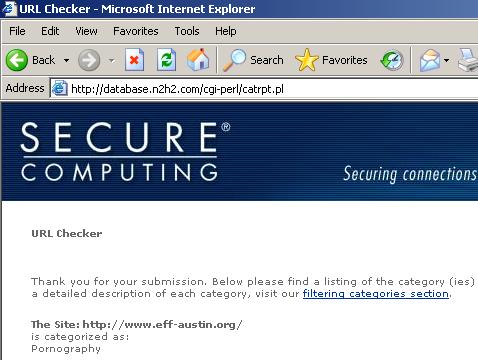
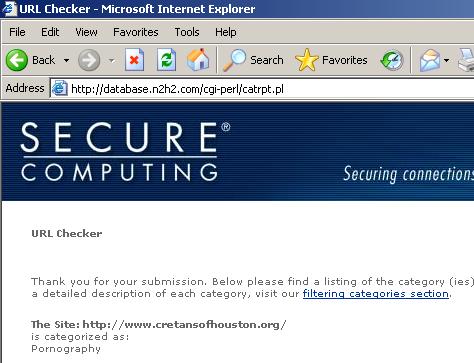
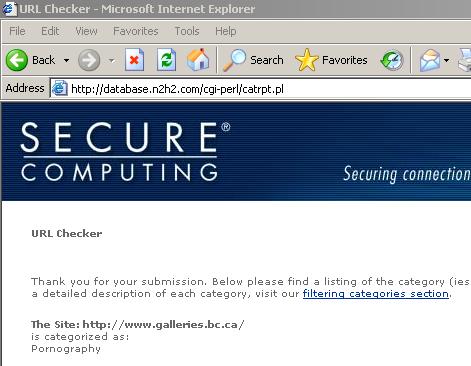
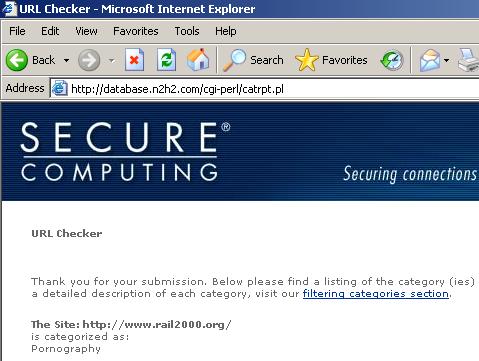
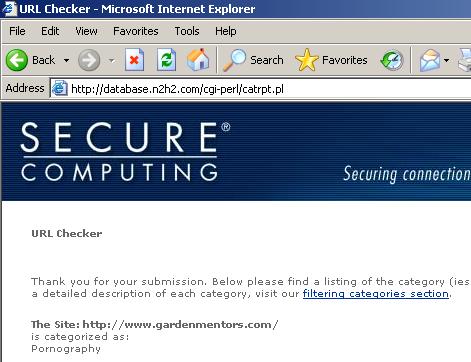
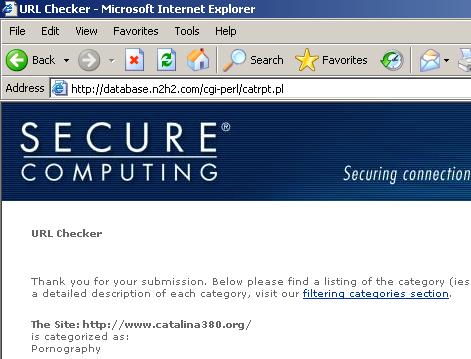
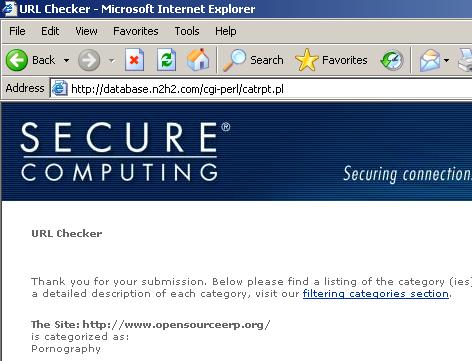
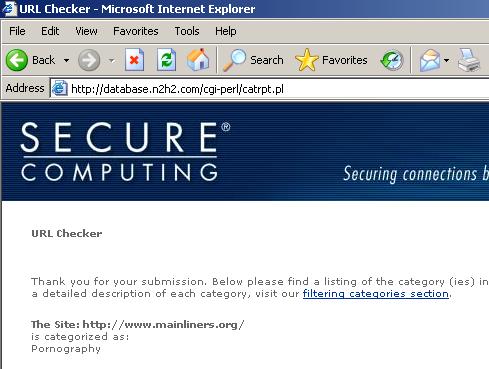
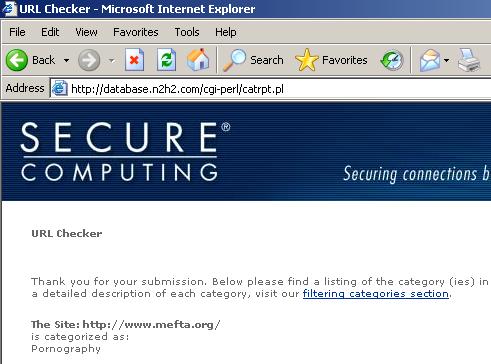
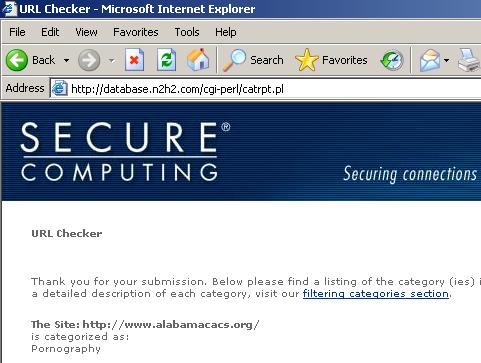
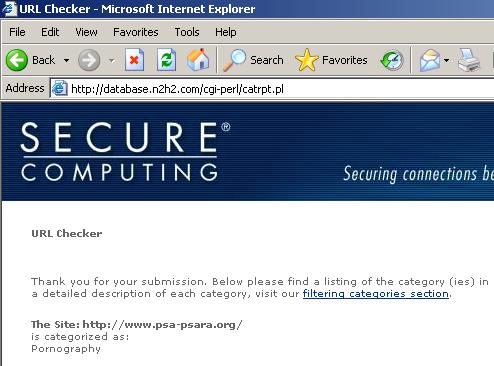
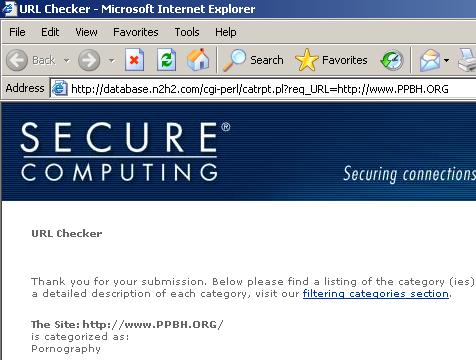
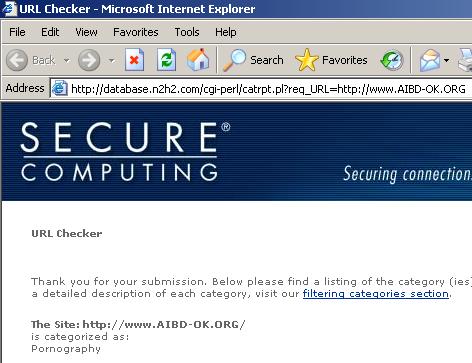
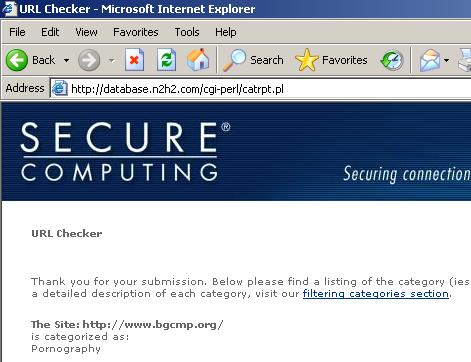
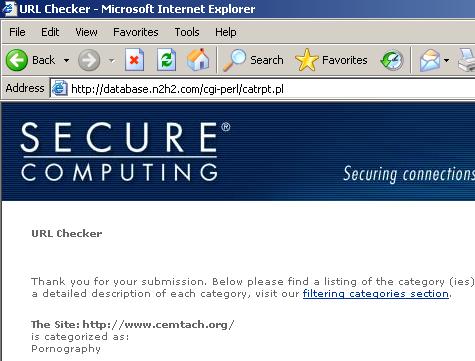
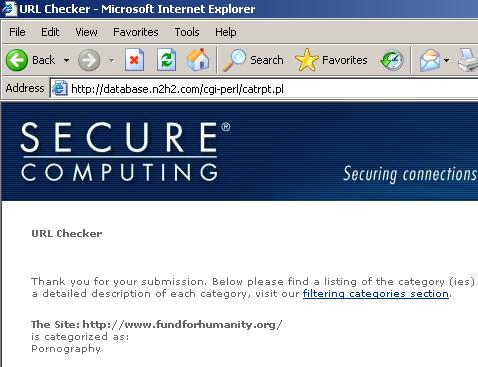
Here is a partial list of some of the questionable categorizations made by Bess; as of this writing, all of the following sites are listed as "Pornography" when you look them up on Secure Computing's Bess lookup form. (This is not just a fluke of the lookup tool; I tested against a copy of the software that all of these sites really were blocked.) The "screen cap" link next to each site links to a snapshot of the results taken from the lookup form (you can check on http://database.n2h2.com/ to see if the page is still returning the same results, although the more obvious errors will probably be fixed after this article is published):
- The Electronic Frontier Foundation, Austin chapter (screen cap)
- Cretans of Houston (screen cap). That's Cretans, as in "people from the island of Crete". Not to be confused with the Cretins of Houston, located here.
- The Rhode Island Coalition Against Domestic Violence (screen cap)
- The website of the public art galleries of British Columbia, Canada (screen cap)
- Rail2000, now the Bay Rail Alliance, a consumer group lobbying for a San Francisco regional rail system (screen cap)
- Rainbow Service Organization, a gay rights advocacy group (screen cap)
- GardenMentors.com, a custom gardening services company in Seattle (screen cap)
- A web site for Catalina 380 series boats (screen cap)
- Open Source ERP, a site promoting open source software for enterprise resource planning and customer relationship management (screen cap)
- The Bryn Mawr Mainliners, a barbershop harmony group (screen cap)
- Timber Trails, an outdoor recreation site (screen cap)
- The MEFTA Institute: "Middle East Free Trade Areas for Business Peace" -- world peace through cheap oil! (screen cap)
- Topple Rummy, a (somewhat out-of-date) site calling for the ouster of Donald Rumsfeld (screen cap)
- The Alabama Network of Children's Advocacy Centers (screen cap)
- PSARA, a non-profit organization for training cruise travel agents (screen cap)
- Park Place Behavioral Health Care, a non-profit mental health care agency (screen cap)
- The Oklahoma chapter of the American Institute of Building Design (screen cap)
- The Boys & Girls Clubs of Metropolitan Phoenix (screen cap)
- CEMTACH -- Computational ElectroMagnetics Theory-Algorithm-Code-Hardware. "Our goal is to develop systems simulations capabilities based on time-domain computational electromagnetics methods." Thanks for clearing that up. (screen cap)
- Fund for Humanity, a San Francisco non-profit supporting environmental organizations and organizations that assist the poor. (screen cap)
A long-standing point of contention while earlier reports about Bess were coming out, was whether every site on their blacklist had been reviewed by a human before being blocked. In 1998 the CEO testified before Congress that "All sites that are blocked are reviewed by N2H2 staff before being added to the block lists." However in their 2002 annual report the company finally admitted that not all sites were reviewed before being blocked: "Through automated categorization or human review, Web sites are identified as fitting into one or more of our categories". At one point an N2H2 employee also told me that when one site is blocked, they will often block all sites hosted on that machine or at that IP -- which of course means that those sites are also not reviewed before being blocked. In any case, it's possible to access some of these sites by IP address, such as the BC Art Galleries site via this link, or the or the Rhode Island Coalition Against Domestic Violence via this link -- so if they're not sharing their IP with other sites, that wouldn't explain how they got blocked either. Smartfilter spokesperson Tomo Foote-Lennox said that one other blocked URL that I found, http://www.arbiol.org/, was the result of an experiment N2H2 once did with fully automated website ratings.
Foote-Lennox added, "In general, we find that schools are VERY sensitive to under-blocking. The would rather block a whole lot of useful reference sites to avoid exposing one porn site." Probably true, although keep in mind we're talking about liability issues, not actual moral outrage. (If they were really morally outraged, they'd be trying to keep kids away from uncensored Internet access everywhere, not just in school! That is in fact the approach that schools take with things like drugs, which do inspire moral outrage because they really are harmful.) Perhaps what is needed is a law explicitly shielding schools from all liability for what students do or see on the Internet at school, if the faculty had no knowledge of it.
(Obligatory interstitial advertisement for common sense: I still don't see what the big deal is about porn anyway. Ask yourself: Why is it harmful to see a picture of a naked person, or even a picture of people having sex? And try to find an answer to that question that doesn't involve, "Lots of other people think so." That includes all variations like "Our society has determined...", "We as a people have decided...", which are just re-phrasings of "Lots of other people think so." I submit that if you disallow those variations of grownup-peer-pressure as an excuse, most people can't really come up with any reason at all.)
OK, flame-retardant suit off, lab coat back on. Previous reports have listed absurd examples of sites blocked by Bess, and looking at any one of those examples or the ones listed here, I'd say that in terms of public policy discussions -- specifically, whether a blocking software company should be trusted to decide what students can look at -- any one of these blocked sites would be more significant than, say, the blocking of BoingBoing which got so much attention. BoingBoing got blocked because of a non-sexual picture of a bare breast on the cover of one of the books they reviewed -- and in fact they were blocked only in the "nudity" category, which includes only "non-pornographic images of the bare human body". So the block on BoingBoing really only revealed that Secure Computing was a bit heavy-handed. (The real problem is that SmartFilter has the category for non-pornographic nudity blocked by default, even though the CIPA filtering law certainly doesn't require schools to block non-pornographic artistic images!) On the other hand, the fact that EFF Austin and the Rhode Island Coalition Against Domestic Violence are currently blocked as "Pornography", suggests that in many instances the blocking companies have nobody at the controls at all. To focus on stupid-but-not-completely-insane blocks like BoingBoing is letting them off easy.
So why did the laundry lists of blocked sites released over the years never become as widely known as BoingBoing, or the guffaw-inducing examples like "Beaver College", which had to change their name in part because of students reportedly being blocked from accessing their website? I think it's because the news favors a good "punch line" -- a fact that anybody can understand that makes us feel smarter than the computers making these dumb mistakes. "Oh, I get it, it was blocked because it was called Beaver College!" But the "punch line" anecdotes are precisely the ones that let the blocking companies off lightly, because it gives them a plausible-sounding excuse for making an error. On the other hand, when the Rhode Island Coalition Against Domestic Violence gets blocked as "Pornography", that could probably force the blocking company to answer some tough questions if it got more press, but there's no good punch line there, so the story just fizzles.
So, while I'm looking through the rest of the data, let me try and come up with some punch lines for reporters to make these blocked sites newsworthy. OK: Why was GardenMentor.com blocked? To keep kids away from all the dirty bitches and hoes! Get it? Ha ha! Why was the Catalina 380 yachting site blocked from kids? Because teens are too vulnerable to pier pressure! Hey, where are you going?
-
From Bess to Worse
Frequent Slashdot contributor Bennett Haselton writes " From about 1996 to 2003, there were regular reports listing examples of sites stupidly blocked by blocking software. The genre has tapered off recently, probably as a result of the Supreme Court ruling in 2003 that the Children's Internet Protection Act (CIPA) was constitutional, requiring blocking software in schools and libraries that receive federal funds, despite all the evidence of over-blocking presented at the trial. The last high-profile story about a site blocked by blocking software was about the blocking of BoingBoing almost a year ago. But the lack of recent reports on blocking software errors doesn't mean that the software has gotten better." The rest of his essay follows.One product that generated several reports over the years was "Bess, the Internet Retriever" from N2H2, which has since been bought out by Secure Computing, which also makes a blocking program called SmartFilter (the one that blocked BoingBoing) and now sells "SmartFilter, Bess Edition" which uses the same database as Bess. Different organizations and individuals published a series of investigative reports about Bess from 1997 until 2002, listing sites about gay rights, eating disorders, and other subjects that were blocked as "pornography". In Ben Edelman's supplemental report, submitted as testimony in the CIPA trial, he listed examples of erroneously blocked sites that he had reported to N2H2 in his first expert report, and which were still being blocked five months later.
Since Bess represents a set of data points showing how the accuracy of a blocking program can change, or not change, over the years, recently I began testing it again. I didn't know whether to expect it to be better or worse. On the one hand, advances in technology and greater revenue to censorware companies could have caused the software to improve. On the other hand, the number of Web pages, and the rate at which dynamic sites like blogs change content every day, has exploded. The result? I'm still tabulating data, but it looks as if the accuracy rate is roughly the same as it was in 2000, when about 30% of blocked sites were obvious errors. Then and now, I found most of the errors by starting with a large list of URLs culled from search engines and other sources, and simply running them through the software to see what was blocked.
Here is a partial list of some of the questionable categorizations made by Bess; as of this writing, all of the following sites are listed as "Pornography" when you look them up on Secure Computing's Bess lookup form. (This is not just a fluke of the lookup tool; I tested against a copy of the software that all of these sites really were blocked.) The "screen cap" link next to each site links to a snapshot of the results taken from the lookup form (you can check on http://database.n2h2.com/ to see if the page is still returning the same results, although the more obvious errors will probably be fixed after this article is published):
- The Electronic Frontier Foundation, Austin chapter (screen cap)
- Cretans of Houston (screen cap). That's Cretans, as in "people from the island of Crete". Not to be confused with the Cretins of Houston, located here.
- The Rhode Island Coalition Against Domestic Violence (screen cap)
- The website of the public art galleries of British Columbia, Canada (screen cap)
- Rail2000, now the Bay Rail Alliance, a consumer group lobbying for a San Francisco regional rail system (screen cap)
- Rainbow Service Organization, a gay rights advocacy group (screen cap)
- GardenMentors.com, a custom gardening services company in Seattle (screen cap)
- A web site for Catalina 380 series boats (screen cap)
- Open Source ERP, a site promoting open source software for enterprise resource planning and customer relationship management (screen cap)
- The Bryn Mawr Mainliners, a barbershop harmony group (screen cap)
- Timber Trails, an outdoor recreation site (screen cap)
- The MEFTA Institute: "Middle East Free Trade Areas for Business Peace" -- world peace through cheap oil! (screen cap)
- Topple Rummy, a (somewhat out-of-date) site calling for the ouster of Donald Rumsfeld (screen cap)
- The Alabama Network of Children's Advocacy Centers (screen cap)
- PSARA, a non-profit organization for training cruise travel agents (screen cap)
- Park Place Behavioral Health Care, a non-profit mental health care agency (screen cap)
- The Oklahoma chapter of the American Institute of Building Design (screen cap)
- The Boys & Girls Clubs of Metropolitan Phoenix (screen cap)
- CEMTACH -- Computational ElectroMagnetics Theory-Algorithm-Code-Hardware. "Our goal is to develop systems simulations capabilities based on time-domain computational electromagnetics methods." Thanks for clearing that up. (screen cap)
- Fund for Humanity, a San Francisco non-profit supporting environmental organizations and organizations that assist the poor. (screen cap)
A long-standing point of contention while earlier reports about Bess were coming out, was whether every site on their blacklist had been reviewed by a human before being blocked. In 1998 the CEO testified before Congress that "All sites that are blocked are reviewed by N2H2 staff before being added to the block lists." However in their 2002 annual report the company finally admitted that not all sites were reviewed before being blocked: "Through automated categorization or human review, Web sites are identified as fitting into one or more of our categories". At one point an N2H2 employee also told me that when one site is blocked, they will often block all sites hosted on that machine or at that IP -- which of course means that those sites are also not reviewed before being blocked. In any case, it's possible to access some of these sites by IP address, such as the BC Art Galleries site via this link, or the or the Rhode Island Coalition Against Domestic Violence via this link -- so if they're not sharing their IP with other sites, that wouldn't explain how they got blocked either. Smartfilter spokesperson Tomo Foote-Lennox said that one other blocked URL that I found, http://www.arbiol.org/, was the result of an experiment N2H2 once did with fully automated website ratings.
Foote-Lennox added, "In general, we find that schools are VERY sensitive to under-blocking. The would rather block a whole lot of useful reference sites to avoid exposing one porn site." Probably true, although keep in mind we're talking about liability issues, not actual moral outrage. (If they were really morally outraged, they'd be trying to keep kids away from uncensored Internet access everywhere, not just in school! That is in fact the approach that schools take with things like drugs, which do inspire moral outrage because they really are harmful.) Perhaps what is needed is a law explicitly shielding schools from all liability for what students do or see on the Internet at school, if the faculty had no knowledge of it.
(Obligatory interstitial advertisement for common sense: I still don't see what the big deal is about porn anyway. Ask yourself: Why is it harmful to see a picture of a naked person, or even a picture of people having sex? And try to find an answer to that question that doesn't involve, "Lots of other people think so." That includes all variations like "Our society has determined...", "We as a people have decided...", which are just re-phrasings of "Lots of other people think so." I submit that if you disallow those variations of grownup-peer-pressure as an excuse, most people can't really come up with any reason at all.)
OK, flame-retardant suit off, lab coat back on. Previous reports have listed absurd examples of sites blocked by Bess, and looking at any one of those examples or the ones listed here, I'd say that in terms of public policy discussions -- specifically, whether a blocking software company should be trusted to decide what students can look at -- any one of these blocked sites would be more significant than, say, the blocking of BoingBoing which got so much attention. BoingBoing got blocked because of a non-sexual picture of a bare breast on the cover of one of the books they reviewed -- and in fact they were blocked only in the "nudity" category, which includes only "non-pornographic images of the bare human body". So the block on BoingBoing really only revealed that Secure Computing was a bit heavy-handed. (The real problem is that SmartFilter has the category for non-pornographic nudity blocked by default, even though the CIPA filtering law certainly doesn't require schools to block non-pornographic artistic images!) On the other hand, the fact that EFF Austin and the Rhode Island Coalition Against Domestic Violence are currently blocked as "Pornography", suggests that in many instances the blocking companies have nobody at the controls at all. To focus on stupid-but-not-completely-insane blocks like BoingBoing is letting them off easy.
So why did the laundry lists of blocked sites released over the years never become as widely known as BoingBoing, or the guffaw-inducing examples like "Beaver College", which had to change their name in part because of students reportedly being blocked from accessing their website? I think it's because the news favors a good "punch line" -- a fact that anybody can understand that makes us feel smarter than the computers making these dumb mistakes. "Oh, I get it, it was blocked because it was called Beaver College!" But the "punch line" anecdotes are precisely the ones that let the blocking companies off lightly, because it gives them a plausible-sounding excuse for making an error. On the other hand, when the Rhode Island Coalition Against Domestic Violence gets blocked as "Pornography", that could probably force the blocking company to answer some tough questions if it got more press, but there's no good punch line there, so the story just fizzles.
So, while I'm looking through the rest of the data, let me try and come up with some punch lines for reporters to make these blocked sites newsworthy. OK: Why was GardenMentor.com blocked? To keep kids away from all the dirty bitches and hoes! Get it? Ha ha! Why was the Catalina 380 yachting site blocked from kids? Because teens are too vulnerable to pier pressure! Hey, where are you going?
-
VDARE Fights Blocking By Censorware
Bennett Haselton writes "The anti-immigration site VDARE is publicizing the fact that it has been blocked as a 'hate site' by several Internet blocking programs, although some of them backed off and un-blocked it after receiving a letter from VDARE's lawyer. Since blocking software is bound to remain in use in most public schools for the foreseeable future, this raises the question: Is it possible for a blocking company to define a 'hate site' in a consistent way, without including conservative groups that might file a First Amendment lawsuit if their sites were blocked from public school computers? See what VDARE says about the content on their own site, and how blocking software companies have handled this issue in the past and what they might do this time." This is the first in a series of article by Bennett Haselton, writing for us from the Peacefire group. Read on for the rest of his piece. The anti-immigration site VDARE.com is publicizing the fact that their site is blocked as a "hate site" by several different blocking programs. They don't name the programs, although they say that four companies used to block VDARE and "backed off after receiving a lawyer's letter".
It seems to be working, since according to the online lookup forms provided by WebSense, N2H2, SurfControl and SmartFilter, only SmartFilter lists the site under "hate speech"; the rest either don't categorize it or list it in innocuous categories. (N2H2 lists it as "Web Page Hosting/Free Pages", which makes no sense -- but not only that, N2H2 is now owned by the same company that makes SmartFilter, which means the company has VDARE listed one way in one product, and a different way in another.)
VDARE says they decided that showing legal muscle was a good way to get unblocked, after reading about an experiment Peacefire did in which we found that censorware companies would block sites with anti-gay content when they thought the sites were run by individuals, but would not block the *exact same content* when it was hosted by "mainstream" groups like Focus on the Family. Concludes VDARE: "The obvious reason for the double standard is that the foundations have lawyers on staff, and volunteer lawyers, and the Censorware companies are afraid of them." True -- although we did nominate AFA.net as a "hate site" at about the same time, and it did get blocked by Cyber Patrol, so it is possible if the content is extreme enough.
I'm against blocking VDARE, even from people under 18, but only because I'm against such blocking in general. Polls show that most people under 18 are more liberally-minded about race than their parents, suggesting that if you want to end racism, give minors more rights and freedom of information, not less. There was a big flap when it came out that in some Islamic schools in New York, parents had their children taught with textbooks which said that "the Jews killed their own prophets" and "you will find them ever deceitful", but without more civil rights for people under 18 to seek information for themselves, there's not much that anybody can do about it.
But as for whether VDARE really should be listed as a "hate site", the site owner himself says that VDARE is not "white nationalist", but adds, "We also publish on VDARE.COM a few writers, for example Jared Taylor, whom I would regard as 'white nationalist'". Well even if VDARE itself claims not to be 'white nationalist', if they host white nationalist writings, it's still accurate to classify the site as a place where such content is located. VDARE itself is also listed by the Southern Poverty Law Center as a hate group. VDARE's founder insists they are merely anti-immigration, not white nationalist, although he admits he once thought about adding a chapter to his anti-immigration book Alien Nation about the "last white family" (not the "last non-illegal-immigrant family") to leave Los Angeles.
Like BoingBoing.Net did before them, VDARE is retaliating against the block by encouraging people to learn how to get around blocking software. I wonder if they looked closely at our site first, since we fight censorship from the point of view of advocating greater civil rights for minors, which would probably not be a popular view with VDARE's ultra-conservative base. And if that's not enough, I'm planning to contact WebSense, SurfControl, and any other company that doesn't currently list VDARE as a "hate site", and ask them why not. So, VDARE sends us traffic, and this is how we repay them. -
When N2H2 Mistakenly Calls Your Website 'Porn'?
Scott Auge asks: "Should one be able to sue a filtering company for libel? After seeing an article top) about filtering software for sites, I decided to take a look at how mine is listed. Upon punching my site in at this N2H2 form, I see it listed as pornography. One look at my site, and you will know it is far from pornography. doesn't seem quite right to me. Opinions?" -
Federal Judge Rules Against Reverse-engineering
zurab writes "A federal judge in Boston threw out a challenge to the DMCA brought by the ACLU for a Harvard Law School student. Ben Edelman decided to ask court's permission to reverse-engineer the Internet filtering software made by N2H2 in fears of being sued by the company. Of interest is a quote from the ruling: "there is no plausibly protected constitutional interest that Edelman can assert that outweighs N2H2's right to protect its copyrighted material from an invasive and destructive trespass." Full story on Yahoo." -
Kid Clicks For Sale
evenprime writes "Zdnet is reporting that N2H2 is selling statistics from their BESS filtering software (a product designed for use in schools) to marketing companies who are interested in students' browsing habits." N2H2's stock price jumped dramatically last month when they put up a helpful website to explain how schools can comply with the new federal mandate which requires the installation of censorware. And just wait for the profit reports once Europe makes it mandatory too. Anyway, this selling-traffic-patterns story is interesting because it's the next logical step in the continuing trend to cash in on kids -- if anyone gets suspended for reading Coke.com on Pepsi Day, let us know, OK? -
Mandated Mediocrity
I took some time over the last few days to sample what kind of political speech is censored by a typical filtering software package. The result is a report released jointly by EPIC (EPIC's copy) and Peacefire (Peacefire's copy). The software this time is N2H2 Bess, and if you're an American K-12 student, there's roughly a one-in-three chance you're forced to surf the net with its 'help.' It bans political speech ranging from campaign finance reform to the Second Amendment to Minnesota newspapers' election coverage.My favorite block was the Traditional Values Coalition. Can I say "you reap what you sow" or would that just be rude?
In other news:
(an unrelated) Coalition To Promote Voluntary Net Filtering, Standards
"A new coalition of high-tech companies and industry groups is hoping to shift the focus of the national debate over Internet filtering by promoting the value of filtering software as an exclusively voluntary parental tool. ... the Committee on Internet Management and Safety will tout the value of filtering products while at the same time opposing legally mandated filtering."
Did they say "exclusively voluntary"? Good on 'em! Let's have a real debate about the value of this software, so that people can make up their own minds rather than having the government decide what's best for our schools and libraries. A level playing field would be a lot better than what we have now.
-
Passing Porn, Banning the Bible
Please read this press release from The Censorware Project. Their target today is Bess, a new piece of protect-the kiddies software from N2H2 that seems to be even more defective than some of its competitors. Look at the list of sites Bess bans (it's in the Censorware Project press release), and at some of the ones it allows to pass. Then laugh. I did, but sadly, because many U.S. legislators want this kind of software installed in all public schools and libraries. I could go on and on here, but why bother? Read the Censorware Project press release for yourself. It may lead you to a few porno sites, but at least they're ones that have passed Bess's scrutiny, and that's all that counts, right? -
Passing Porn, Banning the Bible
Please read this press release from The Censorware Project. Their target today is Bess, a new piece of protect-the kiddies software from N2H2 that seems to be even more defective than some of its competitors. Look at the list of sites Bess bans (it's in the Censorware Project press release), and at some of the ones it allows to pass. Then laugh. I did, but sadly, because many U.S. legislators want this kind of software installed in all public schools and libraries. I could go on and on here, but why bother? Read the Censorware Project press release for yourself. It may lead you to a few porno sites, but at least they're ones that have passed Bess's scrutiny, and that's all that counts, right?