Slashdot Mirror
Domain: nasa.gov
Stories and comments across the archive that link to nasa.gov.
Comments · 16,365
-
About the dust storm
I wonder how the global dust storm on Mars is going to effect the Odyssey's gamma ray spectrometer and other systems. It'd be an aweful pitty to go all that way just to find out you've got an obstructed view
-
Re:Distributed Telescope...
Yes but my understanding from the article is that the problem isn't finding the asteroids, it's in long-term tracking of them to get proper orbits. The big telescopes can easily find them, they just don't have time to track them long enough to get good orbital elements. That's why you would want a distributed network of small automated telescopes. For example NEAT discovered 5 new NEAs just this month. SpaceWatch is also doing a pretty good job of finding stuff, as is the Catalina Sky Survey.
-
Old news
Of course, NASA released Blackjack a while ago.
And they wouldn't post my story about rotten.com being banned in Germany. -
Re:The newest hip thing is "encrypted linux"
All I have to do is break into NASA and steal one of the Mars rocks and I'm golden!
-
Re:Why bother when there are better alternatives!One thing I don't know about though: what is the effect of hard radiation (cosmic rays, solar wind, etc.) on solar panels?
this site has the following information:
The principal factor affecting the loss in power with time is the Space radiation environment. For low radiation environments, such as low Earth orbiting, their effectiveness decreases around 1 to 2 percent a year. This means after a five year mission the solar panels will still be making more than 90% of what they made at the beginning of the mission (as long as they haven't gotten farther away from the Sun). In contrast, for missions in higher radiation environments, such as mid altitude Earth orbit (2000 to 10000 kilometers), arrays can lose half their power within 1 year. That is one reason few missions fly in this orbital range. -
Re:Public Relations
Why not NASA-sponsored rocketry competitions?
Why not recruit college students into NASA fellowships?
Why not a whole lot more visits to elementary schools?
Or maybe you'd like to see how:
NASA sponsors high school robotics
or how
NASA flies student designed experiements aboard the shuttle
NASA actually does spend a lot of time and money on reaching out to kids and enthusiasts alike. Yes, there is room for improvement, but give me a break, they are fighting a loosing battle just to get funding to safely deorbit spacecraft. And as for the simplicity of some of the displays at the centers, well I'm sorry that they don't have astrophysicits manning all the exhibits, they're off doing important science and engineering. If you really want to be a space enthusiast, support full funding so they have the money to do even more public outreach. -
Re:Public Relations
Why not NASA-sponsored rocketry competitions?
Why not recruit college students into NASA fellowships?
Why not a whole lot more visits to elementary schools?
Or maybe you'd like to see how:
NASA sponsors high school robotics
or how
NASA flies student designed experiements aboard the shuttle
NASA actually does spend a lot of time and money on reaching out to kids and enthusiasts alike. Yes, there is room for improvement, but give me a break, they are fighting a loosing battle just to get funding to safely deorbit spacecraft. And as for the simplicity of some of the displays at the centers, well I'm sorry that they don't have astrophysicits manning all the exhibits, they're off doing important science and engineering. If you really want to be a space enthusiast, support full funding so they have the money to do even more public outreach. -
Re:Public Relations
Why not NASA-sponsored rocketry competitions?
Why not recruit college students into NASA fellowships?
Why not a whole lot more visits to elementary schools?
Or maybe you'd like to see how:
NASA sponsors high school robotics
or how
NASA flies student designed experiements aboard the shuttle
NASA actually does spend a lot of time and money on reaching out to kids and enthusiasts alike. Yes, there is room for improvement, but give me a break, they are fighting a loosing battle just to get funding to safely deorbit spacecraft. And as for the simplicity of some of the displays at the centers, well I'm sorry that they don't have astrophysicits manning all the exhibits, they're off doing important science and engineering. If you really want to be a space enthusiast, support full funding so they have the money to do even more public outreach. -
Re:Public Relations
Why not NASA-sponsored rocketry competitions?
Why not recruit college students into NASA fellowships?
Why not a whole lot more visits to elementary schools?
Or maybe you'd like to see how:
NASA sponsors high school robotics
or how
NASA flies student designed experiements aboard the shuttle
NASA actually does spend a lot of time and money on reaching out to kids and enthusiasts alike. Yes, there is room for improvement, but give me a break, they are fighting a loosing battle just to get funding to safely deorbit spacecraft. And as for the simplicity of some of the displays at the centers, well I'm sorry that they don't have astrophysicits manning all the exhibits, they're off doing important science and engineering. If you really want to be a space enthusiast, support full funding so they have the money to do even more public outreach. -
Re:Space Junk a problem?
I remember watching Discovery channel where they discussed the space junk floating out there. I would think that would be a major hinderance to having a reliable power supply.
Well, you don't put it in low earth orbit where the junk is; you put it in geosynchronous orbit or, better yet, one of the Lagrange points, where it can be tended by the residents of O'Neill colonies. (I have now posted this link twice in two days. Funny old world.)
-
Jupiter's moons
To answer the question in the story, if I were taking over, I would do two things. First, get a moon station, as many others have suggested. Second, get some damn probes into Europa already!!! For those unaware, Europa and even Callisto supposedly have oceans underneath their frozen crusts. Life can exist there, and life that is more than just bacteria. I want to see it before I die. You can get info about the moons if you're interested.
-
Terraforming
Terraforming Mars is a popular idea but it's just not going to work. Martian gravity is about a third of Earth's and Mars is never going to be able to hold any kind of atmosphere. The Martian atmosphere is about 1/100th as thick as Earth's and bringing that up to breathable would be nearly impossible. Plus Mars receives only 43% of the sunlight Earth does and it would need a very thick atmosphere to trap enough heat to be livable. Some people suggest solar mirrors to increase heat but these would need to be moon-sized structures before they'd produce any perceptible difference.
What we need to do instead - and yes, this will take a *long* time - is terraform Venus. Venus has a surface gravity 90% of Earth's and already has a thick atmosphere. Venus is obviously far too hot at present to even explore, but we can take steps toward terraforming it if we're willing to take a long-term approach.
First off, we can stick Venus in the shade. This isn't going to require another gigantic structure to accomplish, since we don't need to focus the sunlight. Something as simple as a series of paint bombs set off between Venus and the Sun would produce a cloud that would scatter quite a bit of incoming sunlight. Obviously the solar wind would blow it away sooner or later, but if we were to move a few asteroids into position and set up automated (solar-powered!) factories to slowly convert them into dust clouds, we could keep Venus shaded continously.
Once the surface temperature drops, we can seed the atmosphere with microbes to break up the CO2 and sequester the carbon, releasing the O2 and making the atmosphere eventually breathable.
Some useful stats on planets can be found here -
Can CMM.
I would experiment with some new software development methodolgies on a pilot basis. At least until I came up with some better then the NASA approach or attempts at CMM at NASA. CMM and it's ilk are combersome enough initially, I cannot imagine how burdensome it is in a organization where that Capability Maturity Model stuff is entrenched.
Sure I don't know what would come out of the experiments but I suspect it would be something better. At the same time I'd rate the odds of this happening are as good as me being picked for a Mars mission. -
get us to the top of the gravity well.Get us their permanently, with O'Neill colonies in the L4 and L5 points. Beam collected solar energy to collectors on Earth, and solve the energy problem. Move from internal combustion to fuel cells with the collected energy. Clean up the sky.
Then start thinking space elevator. Once we've done that, we can start thinking about getting off this rock.
Then the future is here.
-
Re:Give me a break!
Well, at first glance at http://spaceplace.jpl.nasa.gov/spinoffs2.htm, my two favorites are the space pen and the football helmet, though you may prefer the medical imaging, plastic packaging, and fire fighting equipment.
Yeah, it's a kiddie page, but there are plenty of sources for real valuable spin-offs... -
Re:NASA should retire with him
According to http://ifmp.nasa.gov/codeb/budget2002/03_multiyea
r _budget.pdf, the proposed 2002 NASA budget is $5.584 billion. According to http://www.whitehouse.gov/news/usbudget/blueprint/ budx.html, the total outlays for the 2002 US Budget is $1.969 trillion. According to my math, that's less than 0.3%. And then, the shuttle budget is of course less than half the total NASA budget... -
Here's the Math...
5% of the federal budget????
The shuttle's estimated annual cost is 2.98 billion according to nasa (for the year 2000). 1999 total budget outlays were 1.7 Trillion dollars according to government records. So in reality the shuttle program is roughly 1/10th of 1 percent of the entire federal budget. Now if you took the total budget of NASA for 2001 it comes to approximately 14 billion according to NASA.
If you take that number the budget is still a mere 4/5ths of 1 percent of the overall budget.
It's merely a drop in the bucket in the grand schem of things, and frankly we've gained a lot from having it. We've gained amazing advances in materials science, aeronautics, and life sciences. Also, where would be without Tang?!? So if you're gonna try to save money, how about finding something truely useless to cut. -
Here's the Math...
5% of the federal budget????
The shuttle's estimated annual cost is 2.98 billion according to nasa (for the year 2000). 1999 total budget outlays were 1.7 Trillion dollars according to government records. So in reality the shuttle program is roughly 1/10th of 1 percent of the entire federal budget. Now if you took the total budget of NASA for 2001 it comes to approximately 14 billion according to NASA.
If you take that number the budget is still a mere 4/5ths of 1 percent of the overall budget.
It's merely a drop in the bucket in the grand schem of things, and frankly we've gained a lot from having it. We've gained amazing advances in materials science, aeronautics, and life sciences. Also, where would be without Tang?!? So if you're gonna try to save money, how about finding something truely useless to cut. -
Photographs
-
Photographs
-
Photographs
-
Photographs
-
Photographs
-
Photographs
-
Photographs
-
Goodbye, IO
NASA's Galileo spacecraft successfully completed a close flyby to study Jupiter's moon Io at 0123 Universal Time today (6:23 p.m. Oct. 15, Pacific Daylight Time), during the long-lived spacecraft's 32nd orbit around Jupiter.
Galileo passed closer to Io than ever before, within about 181 kilometers (112 miles) of ground level near Io's south pole.
-
Re:Hey, two articles in a row! ;-)Remember that you can't "lose" gravity. Even when the pieces are separated, if there is nothing else to continually draw them apart they will still want to reassemble through mutual attraction. It is like watching an exploding firework; after the explosion all the pieces are moving with the same center of mass. In the case of the firework the aerodynamic drag on the little pieces as well as wanting to fall back to Earth keeps the little pieces from reassembling. If the firework was exploded in space, if the initial explosion was not large enough to give the pieces enough escape velocity (that is, enough velocity to escape the gravitational attraction from all the other pieces), the firework would eventually fall back together.
It all depends on what the local environment is like. For instance, the rings around the planets (most notably Saturn) are composed of a bunch of material that doesn't seem to want to reassemble (at least on the several hundred year timescales that we have observed it), and it is believed that the shepherd moons provide enough disturbance to keep the ring material in a ring (actually they keep the material from spreading out uniformly; it is the Roche limit that keeps them from clumping).
-
Re:Hey, two articles in a row! ;-)Remember that you can't "lose" gravity. Even when the pieces are separated, if there is nothing else to continually draw them apart they will still want to reassemble through mutual attraction. It is like watching an exploding firework; after the explosion all the pieces are moving with the same center of mass. In the case of the firework the aerodynamic drag on the little pieces as well as wanting to fall back to Earth keeps the little pieces from reassembling. If the firework was exploded in space, if the initial explosion was not large enough to give the pieces enough escape velocity (that is, enough velocity to escape the gravitational attraction from all the other pieces), the firework would eventually fall back together.
It all depends on what the local environment is like. For instance, the rings around the planets (most notably Saturn) are composed of a bunch of material that doesn't seem to want to reassemble (at least on the several hundred year timescales that we have observed it), and it is believed that the shepherd moons provide enough disturbance to keep the ring material in a ring (actually they keep the material from spreading out uniformly; it is the Roche limit that keeps them from clumping).
-
Lisp in a hardcore science/engineering environment
I had an all-too-brief love affair with Lisp back in college in the 70s, but I never used it in my subsequent career in various scientific environments, thinking of it as an interpreter (somewhat slow) for doing symbolic processing rather than number crunching. However, a report from JPL recently came to my attention, which suggests that Lisp (using new compilers/interpreters) is competitive with Java or C++ in terms of programming time and execution speed & memory. While the authors themselves admit the study is not very conclusive or scientific, it did re-kindle my old love with the language.
Do you think its worthwhile pursuing Lisp solutions to everyday-type problems in scientific/engineering enviroment, which are numerically intensive or data-intensive? (for example, a particle physics monte-carlo simulation, or searching gigabytes of DNA sequence for patterns)
Sean McCorkle
Genome Group, Brookhaven National Laboratory -
lots of good stuff to learnmanned exploration of mars is certainly a good long way away, but this is certainly something that needs to be kept in mind. as far as that goes, unmanned surface explorer designers would probably want to know about it too...
considering NASA/JPL has plans for inflatable rovers for surface exploration, it might be good for them to know how these craft will peform in high wind dust storms.
right now, the more immediate question is how will this affect the aerobraking performance of the Mars Odyssey spacecraft which is supposed to arrive in 11 days. Last week, there was an article/discussion on aerobraking, if you feel like browsing it at +3 and seeing if anyone had something really intelligent to say about it.
-
lots of good stuff to learnmanned exploration of mars is certainly a good long way away, but this is certainly something that needs to be kept in mind. as far as that goes, unmanned surface explorer designers would probably want to know about it too...
considering NASA/JPL has plans for inflatable rovers for surface exploration, it might be good for them to know how these craft will peform in high wind dust storms.
right now, the more immediate question is how will this affect the aerobraking performance of the Mars Odyssey spacecraft which is supposed to arrive in 11 days. Last week, there was an article/discussion on aerobraking, if you feel like browsing it at +3 and seeing if anyone had something really intelligent to say about it.
-
More information...
Here's some facts about how to do if you want to look at this meteor shower. For those who really wants to read alot about this, here's an extensive guide to meteor showers and their observation. They are best wieved in the late evening. The peak for the meteor shower is calculated to be today (2001-10-09) but remember that the date of maximum is approximate, viewing is possible +/- 2 days of it. The radiant at maximum will be at 262 degrees, ie. RA 17h 28.2m, Dec +54, which is about 2 degrees north of the star beta Draconis, called Restaban, on the shortest side of the head of Draco. (Need a glossary or a star chart?) Anyway these are slow meteors, at about 20 km/sec, so they will be very distinctive - and much easier to catch on photographs!
If you don't wanna go out to look for the showers, you can always tune in to NASA's forward scatter meteor radar system at the Marshall Space Flight Center in Huntsville. On a typical day, when there's no intense meteor shower, radar listeners will hear about one ping per minute or so. Rates could become substantially higher during a meteor shower.
Some recently updated graph of Giacobinids 2001 from observations shows unfortunately that they seem to be rather weak this year, just about 5-6 per hour
But there will be more meteor showers this month, for example the Orionids (October 21-22) which are predicted to be stronger than the Draconids (atleast compared with the observational data for the Draconids recently reported -
NASA Spinoffs
NASA has a program called "Spinoffs." Which _gives_ new technologies away to companies who want to develop/market it. Every year they publish a nice little book of all the spinoffs for the year. Check out The Spinoff site or, The best of NASA Spinoffs.
You can't have looked into this at all and still say "We don't benefit from space exploration."
These are just the direct benefits. I think the intangible benefits are much greater. The space race inspired many people growing up in the Kennedy era to go into the science field. Many people litteraly owe their lives to technology developed for the Space Program. -
NASA Spinoffs
NASA has a program called "Spinoffs." Which _gives_ new technologies away to companies who want to develop/market it. Every year they publish a nice little book of all the spinoffs for the year. Check out The Spinoff site or, The best of NASA Spinoffs.
You can't have looked into this at all and still say "We don't benefit from space exploration."
These are just the direct benefits. I think the intangible benefits are much greater. The space race inspired many people growing up in the Kennedy era to go into the science field. Many people litteraly owe their lives to technology developed for the Space Program. -
Weakly interacting massive particles (WIMPs)
Looky. A little-considered effect of all this inter discplinary convergence is that we're going to start running out of acronyms. Some poor slob has been trying to use T&A to mean "theory and application".
-
Re:Is this worth it?
I actually happen to work at NASA (Goddard SFC, in Maryland, if you're interested), and we do a lot of work behind the scenes that not many people see.
NASA has a big push these days towards developing technology for use in the private sector, in essence serving as a public research lab. The project I'm now working on, in fact, is being developed by NASA for a private company on a contract basis. So, although NASA may not be making the headlines that it did during the space race days, it's still very much alive and well and contributing techological innovation to society. -
Re:NASA is fundamentally flawed
They currently have a $4 billion and some cost overrun. Think about that. NASA has spent (or allocated) $4 billion more than it has, only it's not sure where it spent it. The fuck? No company in the world would be allowed to do that. This is a big boondoggle even by government standards. Think how far $4 billion would go if spent on researching new technologies, rather than poured into supporting old ones.
I don't view this $4 billion overrun as incompetence. I view it as theft. Theft from people who could have spent it on improving the future rather than maintaining the status quo.
I could use the same argument against "defense" spending, which has a vastly larger budget and has zero *direct* return on investment. No one is saying there is any way to be *directly* profitable going into space. The space program is our ticket into the future, possibly on another planet in case something happens to this one - be it our fault, a huge meteor or heck even hostile aliens. Plus many useful spin-off technologies have come out of the space program.
Here's my radical solution. Privatise NASA. Float it on the market. Let it keep all of its assets, gift it five years worth of funding, and wish it good luck. Cut it free of red tape, let it come up with its own projects and it's own standards.
No one is stopping you from starting your own private space company. In fact a few already exist including Orbital.
Why don't you take your brilliant "privitization" theory and apply it to the road system and the military? It won't work there either because they cost money too and reap no profits in return. Face it, R&D costs money and that's exactly what the space program is - a giant R&D program.
We've been promised commercial space exploitation within the next ten years, for at least the past thirty years. It's well past time to put up or shut up.
NASA has launching private satellites into orbit for years.
I propose this not because I think that we shouldn't be in space, but because I want us to get out there and stay out there. If space travel can be sustainable rather than a series of staggeringly expensive proofs of concept, then let's demonstrate that.
No one's stopping you from doing it. PUOSU. BTW, there is this thing called the international space station that is being built right now and people are already inhabiting it. In fact, there have been space stations in orbit since the 1970s. The new ones are getting better and better. That's how all technology works.
-
You may be on to something!
Well that would explain the following two links:
Nasa
And this:
Lena
For those of you unfamiliar with the Lena Image,(or Lenna, if you like,):
To test image compression technologies, engineers use a standard picture to compare the results. What did they use? A scan of a 1972 Playboy centerfold, of course!
Cheers,
Jim in Tokyo
-
No hugging TitoFrom the article
All this from a space agency that forbade its astronauts from hugging Tito on camera during his weeklong visit to the international space station, and which for years balked at even giving a name to the orbital complex. (It's now called Alpha thanks to its gutsy first commander.)
That is the most idiotic thing I've heard in a long time. If you were not a proponent of privatising space exploration, you should be after reading that paragraph.
Nasa's budget for 2001 is 14,035,300. Yes folks, that's 14 billion dollars. Take a significant fraction of that- Say 3 billion dollars and offer it to the first organisation that puts people on Mars for over a month and returns them.
Privatise the space station and make it pay for itself via advertising and space tourists. ("Yum, nothing tastes better than a hot Domino's Pizza in 0 gravity, and it still arrived in less than 30 minutes!")
Replace the aging white elephant space shuttle with cheaper heavy lift boosters.
Use the rest of the money for holding up core Nasa programs like the Hubble.
Just my two cents... flame throwers- Ready... aim...
-
Re:Is it not a waste?
Did anyone ever calculate how much energy a civilization would need to use in order to send a signal that would happen to arrive at us. Presumably the civilzation does not know we are here so they would have to radiate enegy to a large portion of their sky. I did a quick calculation assuming they had to do it in all directions and 1 watt would arrive at the destination.
One watt of power to be received is quite a lot more than is neccessary; the _sending_ power of Pioneer 10 is only 8 watts and at the current distance the strenght of received signal is "only about a billionth of a trillionth of a watt", as this link proves.
-
Re:anyone got a link to a map of the universe?Not really a true "map of the universie" per se, but here are a few links:
Map of the Microwave Background (nasa.gov)
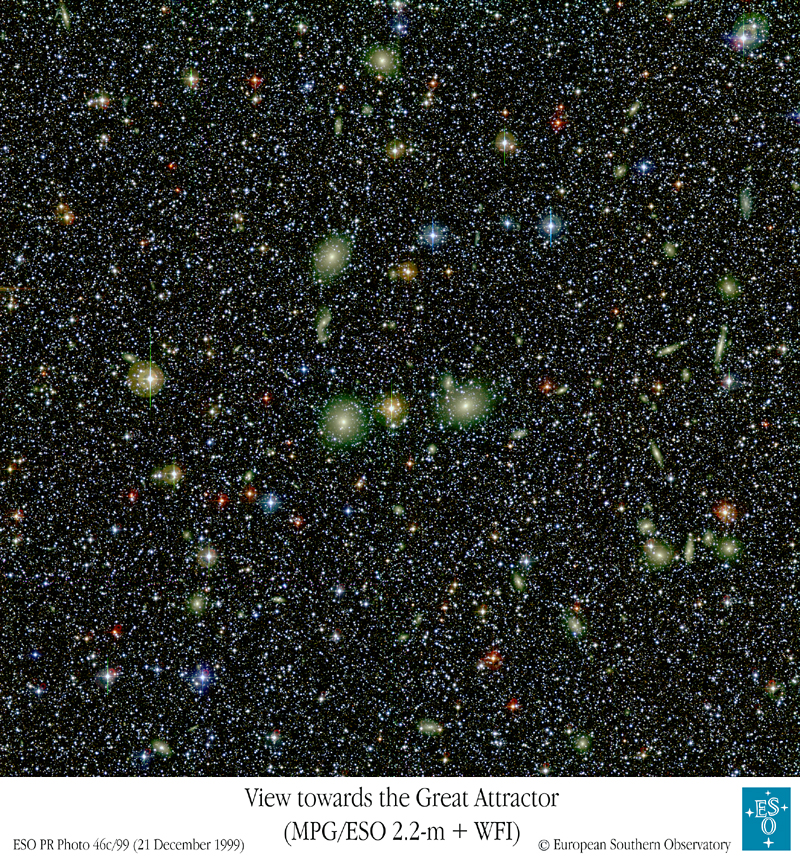
View of galaxies toward the great Attractor (nasa.gov)
These images are from nasa's astronomy picture of the day, indexed here!
--R
-
Re:anyone got a link to a map of the universe?Not really a true "map of the universie" per se, but here are a few links:
Map of the Microwave Background (nasa.gov)
View of galaxies toward the great Attractor (nasa.gov)
These images are from nasa's astronomy picture of the day, indexed here!
--R
-
Re:anyone got a link to a map of the universe?Not really a true "map of the universie" per se, but here are a few links:
Map of the Microwave Background (nasa.gov)
View of galaxies toward the great Attractor (nasa.gov)
These images are from nasa's astronomy picture of the day, indexed here!
--R
-
Re:Searching for astronomy dataNot sure if you're serious or not: if you're serious, there are tons of data out there, all public and for the taking. However, I think your project is somewhat fishy: most astronomy data is "noiselike" and random, so it really shouldn't compress very well. (Of course, I'm talking about packed floats, not ASCII representations.)
Anyhow, assuming you're serious:
- Try radio astronomy data. For example, pulsar searches (related to what I do, forgive my bias) use simple time series data I(t) which would seem to be ideal for your work. Try this: http://www.atnf.csiro.au/research/pulsar/pmsurv/
- HST data is always available for download, once the proprietary period has expired, from the HST archive. You don't care what the data is from, right? Note, though, that this is a 2-dimensional image, so it might have some "fake" compressibility due to redundant information. Radio data does not have this weakness, so I recommend that instead.
- For most astronomy data, you'll need to learn to read FITS format: try this.
-
Re:Cool!
Stars are usually formed from nebulae, the dust from which blocks most light, but less of the longer wavelengths like red and infrared. So we see mostly the red light.
More info can be found on the NGST Science Page. -
Re:Rocket racing may be the "killer app".
Think of how much money goes into car racing. Rocket racing would be an incredible spectacle.
Yes, but think about the audience for auto racing - namely rednecks. Rednecks like auto racing because they drive too and watching people drive cars fast apparently makes them think their dick will become larger when they drive their trucks fast. I say apparently because I don't know since I think auto racing is boring and stupid.
Rocket racing won't have an audience because rednecks *don't drive rockets*. Despite the obvious phallic look of rockets, rednecks will not go to rocket races in droves.
Furthermore, auto races are confined to small stadiums where the cars tediously go around and around the same tiny track many times. Rockets cannot be confined to such a small sanitized "track" and instead will blast-off in a few seconds never to be seen again. I suppose rocket racing is more akin to the even more boring drag racing which has a much smaller audience.
Geeks, the only remaining potential audience for this will go to something significant like STS launches. STS = the space shuttle program for those not in the know.
That leaves redneck geeks as the only people who will go to rocket races!
-
Will the Martians allow this one?
Don't forget, the Martians have an excellent track record of taking out our spacecraft. I wonder if they'll let this one into orbit, or take it out the way they did the Mars Observer in 92 or the Russian Phobos missions.
-
Aerosmash
Eek! It would probably not be possible to enter and land through mars atmosphere 'perpendicularly'. For 'entry' purposes, assume mars atmosphere to be 125Km high. The spacecraft is travelling at interplanetery velocity, say 7.5Km per sec. If we decide not to slow down, we will hit the surface in 17 seconds with a *big* bang.
The time is too short to run the entry sequence (jetesson heatshield, deploy parachutes, fire retros etc)
The deceleration G forces required to slow down in the limited time would be massive, (>100 Gs, causing structural engineering design issues)
The total integrated heat load on the heatshield would be the same, but the peak loads would be much higher (up to half a gigawatt. Thats a lot of asbestos)
And since you are going 'straight down', once you jetesson your heat shield (and its stored thermal energy), you will probably land on it a few seconds later and melt.
The ideal solution (as demonstrated by mars pathfinder) is to come in at an shallow angle of about 15 degrees, and in this case the whole entry sequence takes a good few minutes, the peak deceleration is about 20Gs and the peak heat load is about 100Megawatts.
See the Mars PathfinderEntry Descent and Landing website for more details.
-
Re:Aerobraking and probe intelligence...for christ sakes, I can get a Lego Mindstorms to run around my livingroom by itself; one would hope that we might be able to build a semi-autonomous space probe.
You mean like Deep Space 1? Or Clementine? Yep, it's being done.
(3 minutes later, and atmosphere unexpectedly thickens) SP: oh no! Quick, recalculate! rocket, give me a 2 second burn then turn 43 degress for a 1 second burn!
Oop, doesn't work that way. Orbital mechanics is funny until you wrap your head around it. To change the perigee, you have to burn at the apogee. Once you're in the atmosphere, there's bugger all you can do about it until the next time around. (Well, unless you're carrying gobs of fuel, and if you can do that, the screw this aerobraking stuff.)
Of course, you can make the probe autonomously adjust the next pass based on the results of the current one. But I wouldn't want to even try until we have at least one more probe's worth of data on exactly how to model all this.
And in response to the AC who thinks that rad-hard processors aren't up to this, all I have to say is HAW! Go look up what processing power the guidance computer on Apollo 11 had, and marvel at how much you can do when you're not spending cycles drawing aqua-colored drop shadows. I could make a useful aerobraking auto-adjust system with an RTX-2010 and half a meg of RAM. (That's an 8 MHz Forth processor, folks.) If that's not enough for you, Lockheed-Martin is selling rad-hard 250 MHz PowerPC 750 boards for only two arms and a leg.
-
Re:The secret is in the storageNASA has looked at hydrogen as an aircraft fuel as far back as 1955. For those who want the comprehensive details, here's all of NASA's hydrogen fuel research from 1945-1959
Because hydrogen has 1/4 the energy density of the kerosene fuel currently used, we'll need lots of it. This means either flying our current planes with very few passengers (most of the cabin would be taken up by fuel tanks!).
Airbus has a project called Cryoplane which will assess the technical feasibility, safety, environmental compatibility and economic viability of using liquid hydrogen as an aviation fuel.
No one seems to be seriously pursuing the metal hydride storage route, although some research has been conducted on so-called "slush" hydrogen, which is a combination of liquid and solid hydrogen. Slush hydrogen has a lower temperature and a higher density than liquid hydrogen.