Slashdot Mirror
Domain: nasa.gov
Stories and comments across the archive that link to nasa.gov.
Comments · 16,365
-
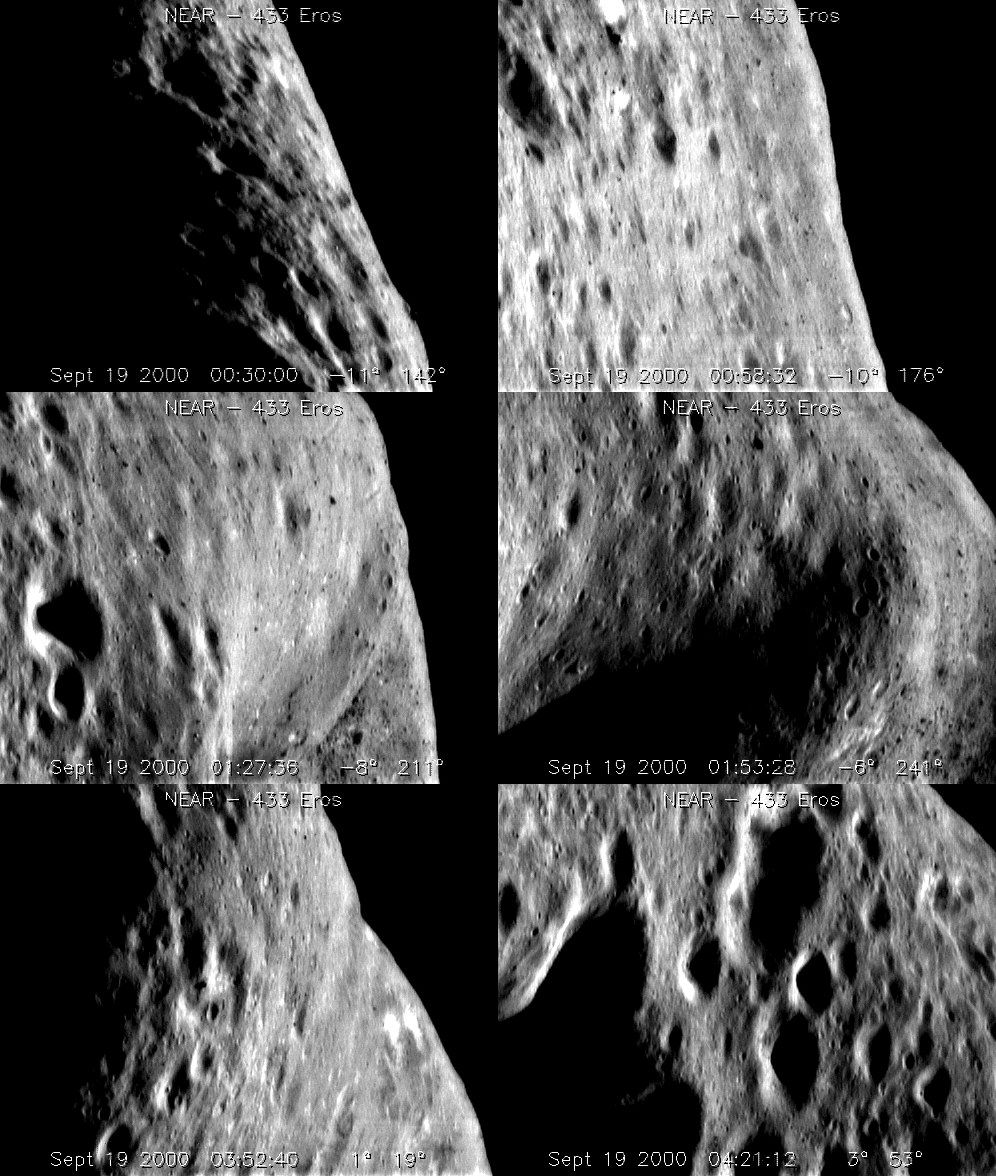
Proposed Place NamesHere's a link to a pic of Eros with proposed place names for surface features:
http://antwrp.gsfc.nasa.gov/apod/ ap0 01026.html
I see 'Lolita' -- but where, as a friend of mine pointed out, is 'Humbert Humbert'?
--
-
Physics lesson #3
I wonder how much gravity it felt from that.
Do a little Google searching, and see what it gets ya. I found this (cited above), from which I quote:A 100-pound (45-kilogram) object on Earth would weigh about an ounce on Eros
... from which you can deduce that the acceleration would be about 1/1600 G at the surface, and somewhat less at the 5 km fly-by distance (depending exactly where the fly-by occurred; a pass near the middle would have a lesser relative reduction in gravity than a pass over one end).
-- -
Physics lesson #2
Mind you the orbital speed at such a low gravity approximates walking speed.
Not according to this NASA page; the escape velocity is around 22 MPH (from where on the asteroid, they don't say). Divide by sqrt(2) to get the surface-skimming orbital velocity for a spherical body (yeah, right) and it comes out to about 15 MPH. Definitely a fast run, not a walk. I have not run the numbers to see where on Eros that escape velocity figure would apply, but if it's at either of the ends the rotational velocity (33 km * 3.14 / 5.27 hours = 19.7 km/hr = 12.2 MPH) would give you well over half of it.If you want to try working out the orbital speeds yourself, you'll need the gravitational constant G (6.67 * 10^-11 N m^2/kg^2) plus the mass and dimensional data on the NASA page linked above.
I find it interesting that you could land on Eros with the equivalent of a big pogo stick, and launch yourself to escape velocity the same way.
-- -
Face on Eros
If you look at frames 43, 44 & 45 of this orbital animation of eros you can clearly see a huge boo-scary tortured-looking face on the surface! I know it's a meritless thing to point out and has no real scientific significance (like the infamous "face on Mars"), but considering that:- It's named after the Greek god of love (dual entendre, anyone?)
- It's shaped like a loaf
- It's almost Hallowe'en
- Following Probe, Lusty Anthropomorphic Asteroid Hurtles Toward Uranus
- Mister Hanky's Mothership Arrives
- Approaching Space Demon "Eros" Denies Connection to Ancient Ones, Intention to Destroy Earth
g e_anim.gif -
Face on Eros
If you look at frames 43, 44 & 45 of this orbital animation of eros you can clearly see a huge boo-scary tortured-looking face on the surface! I know it's a meritless thing to point out and has no real scientific significance (like the infamous "face on Mars"), but considering that:- It's named after the Greek god of love (dual entendre, anyone?)
- It's shaped like a loaf
- It's almost Hallowe'en
- Following Probe, Lusty Anthropomorphic Asteroid Hurtles Toward Uranus
- Mister Hanky's Mothership Arrives
- Approaching Space Demon "Eros" Denies Connection to Ancient Ones, Intention to Destroy Earth
g e_anim.gif -
Re:High Value Mission
I agree! Now, why is it that the NASA homepage starts with links to speeches by NASA bureaucrats, and not to these amazing close-up photos of Eros? In fact, there are no links to NEAR anywhere on the homepage. In fact, there are no links to NEAR even on the "Hot Topics" page. Of course, you can still get directly to the bureaucrat speeches from there. Cause that's a pretty hot topic. Probably you'll all want to do that right away. Yeah. I'm thinkin' those speeches are gonna get purdy damn Slashdotted in jusasec here. Uh-huh.
-
Re:High Value Mission
I agree! Now, why is it that the NASA homepage starts with links to speeches by NASA bureaucrats, and not to these amazing close-up photos of Eros? In fact, there are no links to NEAR anywhere on the homepage. In fact, there are no links to NEAR even on the "Hot Topics" page. Of course, you can still get directly to the bureaucrat speeches from there. Cause that's a pretty hot topic. Probably you'll all want to do that right away. Yeah. I'm thinkin' those speeches are gonna get purdy damn Slashdotted in jusasec here. Uh-huh.
-
some more pictures (and a map of eros)
Nasa's Astronomical Picture Of The Day has some cool information and a picture (a map) of it: here
-
Some Pictures
Here's a number of pictures of it:
http://nssdc.gs fc. nasa.gov/planetary/mission/near/near_eros.html
Enjoy =)
--- -
Pictures!
images here.
-
Re:Anybody remember Chiron?
Indeed. Chiron is a Centaur with a very elliptical orbit taking it into the Kuiper Belt. Possibly because of this it has a coma, more like a comet than an asteroid. It was one of the first clues, aside from Pluto itself, that there might be a broad new class of objects -- the Trans-Neptunians.
---- -
Re:Paco Rabanne
Actually, most people thought that the earth flyby of the Cassini probe was the object of Nostradamus' prophecy.
-
Re:It's called nuclear excavationWhat I wonder is why noone has done this on the moon yet. After venting the space it would make an ideal sealed container for colonization projects. If we had done this during some of the Apollo missions (or at least during that era) the caverns created would have had 30+ years to vent already.
Not a bad idea. Besides the general disinterest in the moon for the last 30 or so years, the reasons for not doing this are probably more political than anything else. First there's a treaty outlawing the detonation of nuclear weapons in space and the last time I checked, the moon was in space.
Second, remember the protests against launching extremely safe plutonium RTGs on NASA probes? Just think of what the protests would be like if we tried to launch an actual bomb.
P.S. Here's the actual link, it doesn't seem to be coming out right in preview (take out the extra spaces):
http://spacelink.msfc.nasa.gov/NASA.Projects/Human .Exploration.and.Development.of.Space/Hu man.Space.Flight/Shuttle/Shuttle.Missions/Flight.0 31.STS-34/Galileos.Power.Supply/RTG.Fact -
Re:Space anyone?
I, for one, am eagerly awaiting 10^9 meter baseline radio interferometers. Also, if you build an optical interferometer of that kind of scale, you can pick out the canals on Mars from Alpha Centauri. Or vice-versa.
Well, there's always the Japanese HALCA satellite, part of the VSOP project. This was the first working satellite for a Space VLBI mission, and it had the expected problems with dealing with interferometry between quickly moving objects. True, it's apogee is only at 21 400 km, so it's not quite at the 10^9m level, but it's close.
While HALCA itself is nearing the end of its useful operating lifespan (There were some problems with the satellite losing its targetting that resulted in using up the maneuvering fuel faster than planned), the success of the mission has helped get the Russian Radioastron project back on its feet, and pave the way for other Space VLBI projects.
The main problems in space interferometry have already been tested and dealt with, and there's been some work in the radio astronomy community for dual-satellite interferometry, once some of the second-genaration systems like VSOP-2 and ARISE are in space in a few years. With two satellites each with a 50 000km apogee, we can actually hit the 10^9 meter baseline level.
(Yes, I know a moderate amount about this from my work with the S2 data recording system which is used at a number of radio observatories around the world for VLBI.)
-- Bryan Feir -
Actually, it's 6 spacecraft.
Check out LISA .
-
Re:Space anyone?
Believe me, plenty of people would like to. Thing is, space-based interferometry is a tricky business. I believe the first mission to seriously test this technology will be this one, scheduled for 2005. Once space-based interferometry gets developed, though, you're going to see all sorts of cool science come out of these missions, especially since the probes are relatively cheap to build. Just tricky.
I, for one, am eagerly awaiting 10^9 meter baseline radio interferometers. Also, if you build an optical interferometer of that kind of scale, you can pick out the canals on Mars from Alpha Centauri. Or vice-versa.
-
Kids, if you want to go into cosmology...
... gravity waves is yours. If you are 15 or younger today, then you'll be exactly at the right age when LISA is going up, you'll be in the middle of the revolution when gravitational wave detectors get some kind of angular resolution, that means, you'll get pictures of the actual mass in the Universe. So, that's my advice to you, start reading about gravity waves!
-
Re:This is good, but...Patience, my friend, patience....
So, first, you would have to detect them, then, perhaps you connect them to events, e.g. Gamma Ray Bursts, then you may be able to tell if it comes from the one direction or the other, and finally, some time in the future (when we're talking LISA), we might talk about angular resolution.
And what that means? It opens a whole new view of the Universe. We're going to see where the matter is, directly. It's just fantastic, I'm telling you....
For an idea of how sensitive these instruments are, I attended a lecture given by a couple of students at a German project, and they once had a signal. Well, not really, it turned out that it couldn't be gravity waves, and they search for a long time to figure out what it could be. Finally, it turned out that a local farmer had bought a heavier tractor, and that shook the ground more than they had thought....
-
Is going below 0 totally necessary?
Sure if you're trying to freeze your head until they find a cure for cancer you'll want to be frosen solid I guess. But for space travel aren't we really only concerned about slowing down life functions?
For a 60 year trip, the time it might take for a nuclear impulse rocket to reach the nearest stars, it wouldn't kill the crew if there bodies aged 6 years.
I guess everyone focuses on freezing because they want to come back in a thousand years and fight those damm dirty apes! -
Re:A Virtual Airport
I worked in a lab at NASA Ames research center that had something much like a virtual atc tower. It was a HMD setup which was fed near real time data and used an HMD with transmissive optics. The result is that the air traffic was overlayed onto the real world. The purpose is obvious: allow air traffic controllers to "see" planes even when they are obstructed by fog, rain, etc.
Here's the site&l t;/a> -
A Virtual AirportMy favorite appliation of SGI's big displays is simulated control tower that looks out over a virtual aiport. Of course, that uses rear projection, which isn't nearly as cool.
__________
-
Re:Ok, I want to see what my tax dollars are buyin
Right, let's try that again. Damn thing mangling the post.
There are lots of high-res photos at http://spaceflight.nasa.gov/gallery/, but it's not updated yet to include the new parts fitted by STS-92.
There are some pictures on the STS-92 site. This one shows the entire station, and the new antenna on the truss they just fitted. -
Re:Ok, I want to see what my tax dollars are buyin
Right, let's try that again. Damn thing mangling the post.
There are lots of high-res photos at http://spaceflight.nasa.gov/gallery/, but it's not updated yet to include the new parts fitted by STS-92.
There are some pictures on the STS-92 site. This one shows the entire station, and the new antenna on the truss they just fitted. -
Re:Ok, I want to see what my tax dollars are buyinCan anyone point me to a site that shows an actual picture of this piece of metal, as it currently looks?
The NASA space flight site has on its space station page a picture of the space station with the Z1 truss attached.
-
Re:Ok, I want to see what my tax dollars are buyinCan anyone point me to a site that shows an actual picture of this piece of metal, as it currently looks?
The NASA space flight site has on its space station page a picture of the space station with the Z1 truss attached.
-
Re:Ok, I want to see what my tax dollars are buyinCan anyone point me to a site that shows an actual picture of this piece of metal, as it currently looks?
The NASA space flight site has on its space station page a picture of the space station with the Z1 truss attached.
-
Re:Ok, I want to see what my tax dollars are buyin
Can anyone point me to a site that shows an actual picture of this piece of metal, as it currently looks?
http://spaceflight.nasa.gov/gallery/
The latest picture on the NASA STS-92 site of the Station itself seems to be , which shows the entire station and the new antenna on the truss. -
Re:Ok, I want to see what my tax dollars are buyin
Can anyone point me to a site that shows an actual picture of this piece of metal, as it currently looks?
http://spaceflight.nasa.gov/gallery/
The latest picture on the NASA STS-92 site of the Station itself seems to be , which shows the entire station and the new antenna on the truss. -
Re:Maybe signals can be picked up again next year?
According to the NASA Voyager Page, Voyager 1 is further out than Voyager 2 (scroll down to the stats)
-
Pioneer 10 not gone for good after allIt seems that Pioneer 10's signal may be reacquired within the next few months, according to NASA's latest Pioneer status page.
It seems that Pioneer 10's antenna pointing mechanism is not working well enough at the moment to accurately point its high-gain antenna at Earth. (It's apparently more than 1.4 degrees off, but we'll move into its beam again as the earth continues to orbit the sun -- projected time of reacquisition is December.) Once signal is reacquired, we'll see if JPL is able to fix the problem somehow, or if we'll be reduced to contacting Pioneer 10 only during certain times of the year when we happen to be within its signal cone.
-
Re:Escape Velocity?I saw you corrected your own estimate, so I'll only comment on this:
Also, isn't the Kupier Belt at around 70-100 AU?
Last time I asked a friend who is studying these objects, he said that their characteristic is that they are mainly outside the orbit of Neptune, which is at about 30 AU. Where's Pluto? 40 AU? Anyway, it may be that there are Kuiper belt objects further out than this, but I think they generally have them a bit closer, but don't take my word for it.
However, the termination shock is believed to be about that distance (in my undergrad courses, a back-of-an-envelope calculation said 75AU, it's obviously inaccurate), but it is heading in the wrong direction, but Voayger may go through it.
-
Re:How things change
As opposed to back in the sixties, when NASA made beautiful, functional and sturdy spacecraft that smashed into the Moon? But worse yet, most of them failed for one reason or another! (e.g. didn't leave Earth orbit, cameras didn't work, and my favorite - missed the Moon entirely
-
Re:Whats the point?
Provide a testbed for developing 21 st Century technology.
How exactly? Give me examples, reasons or some good links to these. Plenty of 21st century technology is already developed on the ground. I doubt there will actually be a huge amount of 21st century technology used in the station on the grounds that in space where just about everything everything is critical tried-and-trusted technology is used.
I think by "21st century technology" they mean technology that relies on space (as opposed to 20th century technology which can be done on ground), rather than technology that is _used_ in space.
One example of such technology is the Space Vacuum Epitaxy Center. They define themselves: "The Space Vacuum Epitaxy Center creates advanced thin film materials and devices for commercial applications through growth technologies using terrestrial and space environments".
They operate a so called Wake Shield Facility: "The WSF is a 12-foot diameter stainless disk-shaped platform launched from the Space Shuttle that creates a unique ultra vacuum environment in its wake, with a combination of pumping speeds and vacuum levels thousands of times better than the best vacuum chambers on earth. Built for eventual long-term autonomous operation, the WSF supports all of the processing and characterization instrumentation required for advanced molecular and chemical beam epitaxy (MBE/CBE) materials processing."
On the role of the ISS for their business they say: "The ISS is the linchpin in long term WSF business planning, serving as the logistics and servicing node in a manufacturing process that will make the Wake Shield Facility a profitable International Space Station commercial tenant."
A range of other projects can be found at Space Product Development.
Information on Commercial development on ISS can be found at http://commercial.hq.nasa.gov/
-
Re:Whats the point?
Provide a testbed for developing 21 st Century technology.
How exactly? Give me examples, reasons or some good links to these. Plenty of 21st century technology is already developed on the ground. I doubt there will actually be a huge amount of 21st century technology used in the station on the grounds that in space where just about everything everything is critical tried-and-trusted technology is used.
I think by "21st century technology" they mean technology that relies on space (as opposed to 20th century technology which can be done on ground), rather than technology that is _used_ in space.
One example of such technology is the Space Vacuum Epitaxy Center. They define themselves: "The Space Vacuum Epitaxy Center creates advanced thin film materials and devices for commercial applications through growth technologies using terrestrial and space environments".
They operate a so called Wake Shield Facility: "The WSF is a 12-foot diameter stainless disk-shaped platform launched from the Space Shuttle that creates a unique ultra vacuum environment in its wake, with a combination of pumping speeds and vacuum levels thousands of times better than the best vacuum chambers on earth. Built for eventual long-term autonomous operation, the WSF supports all of the processing and characterization instrumentation required for advanced molecular and chemical beam epitaxy (MBE/CBE) materials processing."
On the role of the ISS for their business they say: "The ISS is the linchpin in long term WSF business planning, serving as the logistics and servicing node in a manufacturing process that will make the Wake Shield Facility a profitable International Space Station commercial tenant."
A range of other projects can be found at Space Product Development.
Information on Commercial development on ISS can be found at http://commercial.hq.nasa.gov/
-
Re:I can't take the credit, but...
Grr. I KNOW I made that HTML formatted!
Otherwise, the anchor text would've shown up. What, did it just get stripped out?
Let's try again.
http://spaceprojects.arc.nasa.gov/Space_Projects/p ioneer/PNStat.html -
What about the other Pioneers which still work?Odd that such noble sentiment should be given to the loss of Pioneer 10... when, according to 'http://spac epr ojects.arc.nasa.gov/Space_Projects/pioneer/PNhome
. html', Pioneers 6, 7, and 8 were still working okay last time anyone bothered to check in on them!
The NASA web site on the Pioneer projects is fascinating. 'http://spac epr ojects.arc.nasa.gov/Space_Projects/pioneer/PNStat. html' explains how Pioneer is now sailing through a better vacuum than any which can be created on Earth, and how the spacecraft is expected to outlive Earth itself, when our sun will become a red giant in five billion years: "Pioneer 10 and any etched metal message aboard it are likely to survive for much longer periods than any of the works of Man on Earth." I hope that, five billion years from now, Earth is only one of thousands of planets colonized by humans...
Also interesting is an image of the plaque on-board Pioneer, 'http:P Nimgs/Plaque.gif'. I never realized how downright cryptic it looks... I wonder if an alien race would really be able to figure out what it represents? -
What about the other Pioneers which still work?Odd that such noble sentiment should be given to the loss of Pioneer 10... when, according to 'http://spac epr ojects.arc.nasa.gov/Space_Projects/pioneer/PNhome
. html', Pioneers 6, 7, and 8 were still working okay last time anyone bothered to check in on them!
The NASA web site on the Pioneer projects is fascinating. 'http://spac epr ojects.arc.nasa.gov/Space_Projects/pioneer/PNStat. html' explains how Pioneer is now sailing through a better vacuum than any which can be created on Earth, and how the spacecraft is expected to outlive Earth itself, when our sun will become a red giant in five billion years: "Pioneer 10 and any etched metal message aboard it are likely to survive for much longer periods than any of the works of Man on Earth." I hope that, five billion years from now, Earth is only one of thousands of planets colonized by humans...
Also interesting is an image of the plaque on-board Pioneer, 'http:P Nimgs/Plaque.gif'. I never realized how downright cryptic it looks... I wonder if an alien race would really be able to figure out what it represents? -
What about the other Pioneers which still work?Odd that such noble sentiment should be given to the loss of Pioneer 10... when, according to 'http://spac epr ojects.arc.nasa.gov/Space_Projects/pioneer/PNhome
. html', Pioneers 6, 7, and 8 were still working okay last time anyone bothered to check in on them!
The NASA web site on the Pioneer projects is fascinating. 'http://spac epr ojects.arc.nasa.gov/Space_Projects/pioneer/PNStat. html' explains how Pioneer is now sailing through a better vacuum than any which can be created on Earth, and how the spacecraft is expected to outlive Earth itself, when our sun will become a red giant in five billion years: "Pioneer 10 and any etched metal message aboard it are likely to survive for much longer periods than any of the works of Man on Earth." I hope that, five billion years from now, Earth is only one of thousands of planets colonized by humans...
Also interesting is an image of the plaque on-board Pioneer, 'http:P Nimgs/Plaque.gif'. I never realized how downright cryptic it looks... I wonder if an alien race would really be able to figure out what it represents? -
Here's a clicky-linky
-
Follow up? - Deep Space 1Anybody know if NASA plans to launch a newer, bigger, better, faster, more version?
Actually, Deep Space 1 with that fancy ion engine seems like it will be a candidate for one of those ultra long missions. See http://nmp.jpl.nasa.gov/ds1/ .
-
Re:but how will the universe end?
> it started with a bang, but will it end a crunch?
Fortunaley, no. The universe is expanding. I saw a science documentary (Space 2000 I believe) that said the universe was not only expanding (which we knew for ages), but the recently (~ late 1990s) we finally deteremined the rate was accelerating. Others say the rate of expansion is constant.
In either case, the universe will eventually expand out into the void, which you can read one transcript of on pbs/a&g t; -
Re:Photos?
You are right. They have tons of high quality pictures in the Gallery. I like to have them as desktop background images.
-
This thing gets BIG
I was interested to read on Boeing's page that the Truss (which they manufactured for NASA) will end up being the length of a football field. It's hard to imagine when you actually see the thing being delivered to NASA. This will be one awesome piece of kit!
The link to Boeing's page seems to be too long for Slash to let me post it without corrupting it with spaces (!) so here it is (minus the initial "http://"):
www.boeing.com/defense-space/space/spacestation/ components_structure/integrated_truss.html
There are plenty of photos of the Truss and other parts of the Shuttle payload at NASA's STS-92 homepage. -
This thing gets BIG
I was interested to read on Boeing's page that the Truss (which they manufactured for NASA) will end up being the length of a football field. It's hard to imagine when you actually see the thing being delivered to NASA. This will be one awesome piece of kit!
The link to Boeing's page seems to be too long for Slash to let me post it without corrupting it with spaces (!) so here it is (minus the initial "http://"):
www.boeing.com/defense-space/space/spacestation/ components_structure/integrated_truss.html
There are plenty of photos of the Truss and other parts of the Shuttle payload at NASA's STS-92 homepage. -
This thing gets BIG
I was interested to read on Boeing's page that the Truss (which they manufactured for NASA) will end up being the length of a football field. It's hard to imagine when you actually see the thing being delivered to NASA. This will be one awesome piece of kit!
The link to Boeing's page seems to be too long for Slash to let me post it without corrupting it with spaces (!) so here it is (minus the initial "http://"):
www.boeing.com/defense-space/space/spacestation/ components_structure/integrated_truss.html
There are plenty of photos of the Truss and other parts of the Shuttle payload at NASA's STS-92 homepage. -
I can almost bet they won't...
Working as I do at Teledyne Brown Engineering, I see some of the NASA software-development process second-hand. I know they outsource a lot of it--such as the Payload Data Library, which TBE runs for Marshall Space Flight Center. [I wonder if that link is visible by the bulk of
There are, believe it or not, some things that won't benefit from being open source. Besides, the Feds will probably decide that some things will create more trouble than they're worth...
-- -
Why they're not using Linux (for experiments)
I have to wonder -- why the hell are they flying with such flaky systems? And why are all the systems running Windows? I'm not suggesting everything suddenly switch to Linux, but it would seem to make sense that the servers (at least) run something more stable than the ones currently flying have demonstrated themselves to be.
Well, I don't know about the control systems for the shuttle, but they certainly do run Windows on the ground workstations to control experiments, from here:
--------------------------------------------
In addition to cost savings, Bradford promotes broadband connectivity via Internet2 networks as a way to allow wider participation in ISS science activities by academic and commercial entities. Using the Telescience Resource Kit (TReK), a Windows NT-based telemetry and command system developed by Marshall software engineers, researchers can monitor and control space station experiments directly from their offices and laboratories at home.
"This past year, we also put TRek workstations in 26 middle schools and high schools around the country," says Bradford. "We sent simulated space station data over their school networks, allowing them to participate in space station science."
A researcher needs a workstation with considerable horsepower to manage the telemetry, command payload operations, and communicate with the space station via voice and video. The recommended TRek hardware configuration is a dual Pentium III 500 MHz machine with a high-resolution display, 256 MB RAM and a 9 GB SCSI hard drive.
*snip*
"TRek has an open API", says Michelle Schneider, TRek development project lead. "It's basically a DLL library, a set of C functions, that any commercial product that supports an ANSI-C interface, such Visual C++ or Visual Basic, can use to retrieve telemetry data." Researchers also have the option of linking in other libraries such as Huntsville, Ala.-based Global Majic Software's instrumentation library to build end-user displays and computations that contain x-y plots, bar charts and other graphics. "We try to keep our telemetry processing system generic by using a Microsoft Access database to describe how a telemetry stream is put together. There is also a database definition document that details the schema and all of the database tables. We've had some internal discussion about a TRek port to the Linux platform, but that hasn't gotten off the ground yet."
-------------------------------------------
So basically, I don't know about the actual command of the vehicle itself, but the experiments are controlled via Microsoft Windows NT workstations (i.e. TReK). -
Ku Antenna BrokenNASA-TV can be found at various locations on the Web. Most satellite providers broadcast it as well.
This mission features 4 spacewalks, but the Ku antenna is broken so we won't get much for live video.
-
Ku Antenna BrokenNASA-TV can be found at various locations on the Web. Most satellite providers broadcast it as well.
This mission features 4 spacewalks, but the Ku antenna is broken so we won't get much for live video.
-
Direct info
NASA's got a nice shuttle web site with updates during the mission (STS-92). There's also the mission press kit with all and more than you wanted to know.