Slashdot Mirror
Domain: nasa.gov
Stories and comments across the archive that link to nasa.gov.
Comments · 16,365
-
Re:Back atchaOnce again you are making the most hilariously inept arguments. The entire issue of the corrections to the satellite measurements was resolved a couple of years ago. The corrected data, explained in the link by a senior scientist for climate studies at NASA, shows none of the so-called "signatures" of global warming that are predicted by the alarmist computer models of the atmosphere.
More amusing, though, is your claim that measuring the temperature of the lower atmosphere will tell us less about global warming than measuring at a few hundred stations on the ground. Are you aware that "global warming" refers to much, much, much more of the atmosphere than that which exists right outside those stations? In any event, the discrepancy between surface and satellite measurements occurs primarily over ocean, where surface measurement is least accurate. There is virtually no discrepancy between satellite and surface data in North America, where surface data is most accurate. Furthermore, the satellite data is calibrated carefully with baloon thermometers. A good concise NASA article explaining the accuracy of satellite measurements is found here.
The fact, you simply want to ignore excellent data when it does not bear out your foregone conclusion of imminent man-made catastrophe. Most real scientists, fortunately, tend to be more honest than you.
-
Re:Back atchaOnce again you are making the most hilariously inept arguments. The entire issue of the corrections to the satellite measurements was resolved a couple of years ago. The corrected data, explained in the link by a senior scientist for climate studies at NASA, shows none of the so-called "signatures" of global warming that are predicted by the alarmist computer models of the atmosphere.
More amusing, though, is your claim that measuring the temperature of the lower atmosphere will tell us less about global warming than measuring at a few hundred stations on the ground. Are you aware that "global warming" refers to much, much, much more of the atmosphere than that which exists right outside those stations? In any event, the discrepancy between surface and satellite measurements occurs primarily over ocean, where surface measurement is least accurate. There is virtually no discrepancy between satellite and surface data in North America, where surface data is most accurate. Furthermore, the satellite data is calibrated carefully with baloon thermometers. A good concise NASA article explaining the accuracy of satellite measurements is found here.
The fact, you simply want to ignore excellent data when it does not bear out your foregone conclusion of imminent man-made catastrophe. Most real scientists, fortunately, tend to be more honest than you.
-
Re:Back atchaOnce again you are making the most hilariously inept arguments. The entire issue of the corrections to the satellite measurements was resolved a couple of years ago. The corrected data, explained in the link by a senior scientist for climate studies at NASA, shows none of the so-called "signatures" of global warming that are predicted by the alarmist computer models of the atmosphere.
More amusing, though, is your claim that measuring the temperature of the lower atmosphere will tell us less about global warming than measuring at a few hundred stations on the ground. Are you aware that "global warming" refers to much, much, much more of the atmosphere than that which exists right outside those stations? In any event, the discrepancy between surface and satellite measurements occurs primarily over ocean, where surface measurement is least accurate. There is virtually no discrepancy between satellite and surface data in North America, where surface data is most accurate. Furthermore, the satellite data is calibrated carefully with baloon thermometers. A good concise NASA article explaining the accuracy of satellite measurements is found here.
The fact, you simply want to ignore excellent data when it does not bear out your foregone conclusion of imminent man-made catastrophe. Most real scientists, fortunately, tend to be more honest than you.
-
Re:Cheaper, Faster... Better?
actually, the V-ger probes are still running and sending back data.
check out http://vraptor.jpl.nasa
half-assed probes produce half-assed results. the voyager probes pretty much prove that over-engineering a probe pays back a millionfold. -
Re:You can't see the wall of china from space
-
Re:You can't see the wall of china from space
-
7MB Files - no wonder it's a slow downloadThe Nasa Site says that the images are downloadable as 7Mb zip files.
Let's see - 7Mb multiplied by a few thousand bored slashdotters equals how many gigabytes? Yeah, that should shut them down for a while!
-
Long time to load, eh?No, Roblimo, those images only took a long time to load when you were the only one in the western hemisphere loading them.
Now they are taking forever to load, since you posted the link to that poor unsuspecting site. Man, I wish you guys would just quit doing that without organizing some mirrors first.
What the heck, here's another link (don't want to call it a mirror, since it's the original): http://www.nasa.gov/newsinfo/srtm_images.html
--Seen
-
Official site
The first images from this are here.
-
Re:How to fix the vulnerabilities (technical)Update: somebody already tried that fix to SYN flooding and put it into some versions of BSD. This issue was worked on in 1997, and there are some solutions. I'm not totally in agreement with that fix (Dave Borman's), because it doesn't retransmit SYN ACKs, and that's a protocol violation which could affect legitimate connections.
There's a patch for Linux, too, using something called a "SYN-cookie". This is a marginal idea, and I don't know if it made it into any of the standard Linux distributions. But if you're under attack, you might want to turn it on.
-
Cool animation
Check out the "Astronomy picture of the day" for 02/10/00, which features a very cool (but unfortunately very low resolution) movie of asteroid 433, which Eros is set to rendezvous with on 2/14/00... -y
-
No way.A shuttle launch costs more like $500 million (depending on how you do the accounting).
The outside limit of the shuttle's maximum landing payload is about 50,000 pounds. With gold at about $300 per troy ounce, that's about $220 million in bullion you could bring back, if it was already hanging around in low earth orbit.
You still lose plenty. Or rather, the taxpayers do.
PS Sorry about the lame units, that's how NASA gives the numbers. And gold is always troy ounces.
-
Re:Asteroid mining and so on.
Yup. I'm constantly harping on about how we're supposed to have Moon bases and hotels in space, and missions to mars by around about this time.
"People build railroads when it's railroad time." Maybe it's not Mars time yet.I guess the gravity well is bigger than our ability to overcome it right now, alas
Let me rephrase that for you: the gravity well is bigger than our need to get people out of it right now. In the 1960's, we had a need to do something big in space. It was a competition with the Russians designed to build national prestige among other nations and keep more countries from defecting to the Communist bloc. We could have had satellites in the 50's, but Von Braun was told "no" by his superiors. We didn't get them until it became a dick-size contest, and we didn't let anyone forget that we bailed Europe AND the USSR out a mere 20 years earlier: our dick really WAS bigger. And once we'd proved it, we took our bat and glove and went home.Today we have tons of space going on, but national prestige is pretty much out of the picture. It's mostly in the things that pay in the medium of commerce, the greenback. Communications satellites produce revenues in the billions of dollars per year and are definitely worth fighting 5/6 of the way out of Earth's gravity well. We have no similar push to explore the Moon or Mars or return resources from asteroids because there's no profit in it. Space science is science, worth a few billion dollars a year worldwide, otherwise not that big of a deal. The largest manned-space project going today is actually a form of foreign aid and constructive bribery to keep the former USSR from letting its rocket and nuclear scientists go to places like Iraq or North Korea.
When it's railroad time, people will build railroads. What would make it Moon time, or Mars time, or 1992 KD time? Something that would make it pay. Most everything on Earth is far too cheap to be worth going to space to get more. It would certainly be cheaper to get large quantities of iron or oxygen from somewhere in space to ship them to Earth orbit than to launch them up, but there is as yet no market for bulk commodities in orbit to justify the expense of the first mining venture. It is a chicken/egg problem, looking for someone with a clever enough idea to bootstrap it.
-- -
Re:Poor ESA
According to this ion engines have been operating in vacuum chambers since 1959 or so.
Ion propulsion is simply another early concept that was developed to a decent level of usefulness in the 60s but then dropped for the next 30 years. -
Re:Not enough energy
The name of the "fingers" is called streamers. Sorry I can't provide better information. I have limited time. A breif explination is here...
A breif description
some documentation which references steamer here.. Abstract to a more detailed research paper - search for streamer
I origionally learnd this from the discovery channel about 4 years ago. It was a cool program about lightning. They showd 1 picture of a streamer. They said that it was probably the only one to exsist.
-
Re:Not enough energy
The name of the "fingers" is called streamers. Sorry I can't provide better information. I have limited time. A breif explination is here...
A breif description
some documentation which references steamer here.. Abstract to a more detailed research paper - search for streamer
I origionally learnd this from the discovery channel about 4 years ago. It was a cool program about lightning. They showd 1 picture of a streamer. They said that it was probably the only one to exsist.
-
Re:Random questions
You can find the Galileo project's Galileo Millennium Mission on the JPL's pages. Tentatively, there aren't any close flyby opportunities of Callisto scheduled for this extended-extended mission, although there is growing support within NASA to send one of the "faster-better-cheaper" probes to take a closer look. The Europa Orbiter is such a probe that would look closer at the suspected ocean there, so a misson to other Jovian satellites is not out of the question.
In theory, you could have Galileo transmit to Earth at a time when Calisto would be passing between the probe and us; however, such an event isn't likely to occur if a close flyby isn't scheduled, and even if one was, an occultation still isn't a guarantee. And unfortunately, Galileo isn't set up to, for instance, use its antenna as a reflection radar to look for itself. Passive sensors only.
As far as Jovian radiation goes, I would propose that, given current theories regarding life's evolution on Earth, it would increase the probability that life would arise. Besides a fertile chemical environment, it seems that ionizing radiation accelerates the process of dissociating simple molecules which can then recombine into more complex ones. Background radiation in interstellar space is enough to form alcohols in nebulae and amino acids and PAHs in cometary ice; stellar radiation or Jupiter's radiation belts would do this even faster. That said, the ice crust on top of Europa's ocean is probably thick enough to shield any incoming ionizing radiation, so it's likely a non-issue. Life's best bet on Europa is tidally-generated heat and geologic radiation.
Discoloration, meanwhile, suggests eruptions, but smooth, crater-free regions are better evidence of this. Of course, cratering doesn't tell us much more than that volcanism happened within the last half-billion years or so. What appear to be fresh escarpments along fault lines might bring that date a little closer, but discoloration is going to really clinch the issue, once we know what the stuff is. For this, we need the Europa Orbiter to do spectral analysis on the surface. If it turns out to be, for instance, sulpher or iron-rich minerals from the ocean underneath, we don't get much new information about the age of the eruptions. If we're looking at some sort of hydrocarbonish gunk, it would be broken down by radiation rather quickly, so it is more recent. Most exciting of all, it could be some sort of organic residue from subsurface life forms
-
Re:Random questions
You can find the Galileo project's Galileo Millennium Mission on the JPL's pages. Tentatively, there aren't any close flyby opportunities of Callisto scheduled for this extended-extended mission, although there is growing support within NASA to send one of the "faster-better-cheaper" probes to take a closer look. The Europa Orbiter is such a probe that would look closer at the suspected ocean there, so a misson to other Jovian satellites is not out of the question.
In theory, you could have Galileo transmit to Earth at a time when Calisto would be passing between the probe and us; however, such an event isn't likely to occur if a close flyby isn't scheduled, and even if one was, an occultation still isn't a guarantee. And unfortunately, Galileo isn't set up to, for instance, use its antenna as a reflection radar to look for itself. Passive sensors only.
As far as Jovian radiation goes, I would propose that, given current theories regarding life's evolution on Earth, it would increase the probability that life would arise. Besides a fertile chemical environment, it seems that ionizing radiation accelerates the process of dissociating simple molecules which can then recombine into more complex ones. Background radiation in interstellar space is enough to form alcohols in nebulae and amino acids and PAHs in cometary ice; stellar radiation or Jupiter's radiation belts would do this even faster. That said, the ice crust on top of Europa's ocean is probably thick enough to shield any incoming ionizing radiation, so it's likely a non-issue. Life's best bet on Europa is tidally-generated heat and geologic radiation.
Discoloration, meanwhile, suggests eruptions, but smooth, crater-free regions are better evidence of this. Of course, cratering doesn't tell us much more than that volcanism happened within the last half-billion years or so. What appear to be fresh escarpments along fault lines might bring that date a little closer, but discoloration is going to really clinch the issue, once we know what the stuff is. For this, we need the Europa Orbiter to do spectral analysis on the surface. If it turns out to be, for instance, sulpher or iron-rich minerals from the ocean underneath, we don't get much new information about the age of the eruptions. If we're looking at some sort of hydrocarbonish gunk, it would be broken down by radiation rather quickly, so it is more recent. Most exciting of all, it could be some sort of organic residue from subsurface life forms
-
Re:Random questions
You can find the Galileo project's Galileo Millennium Mission on the JPL's pages. Tentatively, there aren't any close flyby opportunities of Callisto scheduled for this extended-extended mission, although there is growing support within NASA to send one of the "faster-better-cheaper" probes to take a closer look. The Europa Orbiter is such a probe that would look closer at the suspected ocean there, so a misson to other Jovian satellites is not out of the question.
In theory, you could have Galileo transmit to Earth at a time when Calisto would be passing between the probe and us; however, such an event isn't likely to occur if a close flyby isn't scheduled, and even if one was, an occultation still isn't a guarantee. And unfortunately, Galileo isn't set up to, for instance, use its antenna as a reflection radar to look for itself. Passive sensors only.
As far as Jovian radiation goes, I would propose that, given current theories regarding life's evolution on Earth, it would increase the probability that life would arise. Besides a fertile chemical environment, it seems that ionizing radiation accelerates the process of dissociating simple molecules which can then recombine into more complex ones. Background radiation in interstellar space is enough to form alcohols in nebulae and amino acids and PAHs in cometary ice; stellar radiation or Jupiter's radiation belts would do this even faster. That said, the ice crust on top of Europa's ocean is probably thick enough to shield any incoming ionizing radiation, so it's likely a non-issue. Life's best bet on Europa is tidally-generated heat and geologic radiation.
Discoloration, meanwhile, suggests eruptions, but smooth, crater-free regions are better evidence of this. Of course, cratering doesn't tell us much more than that volcanism happened within the last half-billion years or so. What appear to be fresh escarpments along fault lines might bring that date a little closer, but discoloration is going to really clinch the issue, once we know what the stuff is. For this, we need the Europa Orbiter to do spectral analysis on the surface. If it turns out to be, for instance, sulpher or iron-rich minerals from the ocean underneath, we don't get much new information about the age of the eruptions. If we're looking at some sort of hydrocarbonish gunk, it would be broken down by radiation rather quickly, so it is more recent. Most exciting of all, it could be some sort of organic residue from subsurface life forms
-
Re:Should I cheer or should I boo?...the first manned mission is not that big. After all we did it back in the 40s
Get your facts right...
From NASA: (http://www.ksc.nasa.gov/ history/mercury/flight-summary.txt)
THE MANNED FLIGHTS
Mercury-Redstone 3
FREEDOM 7
May 5, 1961
Alan B. Shepard, Jr.
15 minutes, 28 seconds
Suborbital flight that successfully put
the first American in space.
That's the 60's not the 40's. Back in the 40's the little green men had all of space to them self.
Ost99 -
Re:Images from Nomad
Yep, that was Dante. There's still some stuff up at NASA about it. Actually the other thread on "sending a robot to Hell" reminded me of Dante, too...
-
Rubber Ducky
At first I thought someone was testing rubber duckies in zero-gravity water puddles.
-
You're in luck...
Check out Nasa's Website, specifically the page on STS-99. The shuttle will be fitted with a large arm, capable of creating high-resolution topographical maps of Earth. The mission is eleven days long and dubbed the "Shuttle Radar Topography Mission".
They mention that one of the motivations for the research is the fact that we currently have better maps of other planets than of our own... -
You're in luck...
Check out Nasa's Website, specifically the page on STS-99. The shuttle will be fitted with a large arm, capable of creating high-resolution topographical maps of Earth. The mission is eleven days long and dubbed the "Shuttle Radar Topography Mission".
They mention that one of the motivations for the research is the fact that we currently have better maps of other planets than of our own... -
Re:Data availailabilityI worked on a data recovery project for NASA/GSFC. The spacecraft data was originally recorded on analog 7-track 1/2" instrumentation recorders at ground stations all over the world. There were 100,000 tapes stored in the Public Archives of Canada. The tapes were deteriorating and destined for a landfill. It costs a substantial amount of money, every year, to store that many tapes in a climate controlled facility. That was just the data from one family of spacecraft (Alouette and ISIS).
Recovering the data from just a portion of the tapes requires substantial amounts of time and money due to the labor intensive nature of the task. Think of copying 20,000 LP records to CD-R disks.
With limited budgets, NASA and other scientific research agencies are often in the unhappy position of having huge amounts of potentially valuable data on rapidly deteriorating media, of which only a fraction can be saved. Unless someone invents a time machine, the data is irreplaceable.
For many years, magnetic tape has been the medium of choice for storing spacecraft data. Storing it on an on-line system, on disk, just wasn't practical or affordable. Huge amounts of data were archived on 7-track 1/2" digital computer tapes, the same kind of tapes that you see in cheesy science fiction movies from the 1960s. Try to find one of those tape drives today, or a computer that can talk to it.
-
A problem if the storage speed doesn't increaseIt will be a problem if the speed of the storage media does not keep pace with the capacity. There is a long technical paper on the issue of a storage surviability crisis over at the nasa site:
Over the past 10 years, tape data storage density (with the same form factor) has increased according to Moore's law, doubling every 18 months. However, during the same period, data transfer speeds have only increased at a rate of about 1.3 times every 18 months, and thus have fallen behind data density growth rates by a factor of at least 3.
-
Offical press release from NASA
Here is the official Press relese from NASA giving details into the MSNBC article. But dont put too much hope into it..
"If in fact the signal were from Polar Lander, two failures would have had to occur. First, the lander's X-band radio that it would use to transmit
directly to Earth would have to be broken. Second, there would have to be a problem somewhere in the relay with Mars Global Surveyor that
prevented the signal from being picked up and relayed by the orbiter. It is unlikely that a broken transmitter on the lander could be fixed, and
unclear whether a problem with the relay could be resolved"
Still... it would..
"Even if the signal were coming from the lander, there is little hope that any science could be returned. However, it would give the team a few more
clues in trying to eliminate possible failure modes.
"
enjoy.
-- -
The correct link to the JPL press release
is here
-
Re:URL of the original JPL PR
Actually, that URL should read http://mars.jpl.nasa.gov/msp98/news/mpl000125.htm
l . -
Re:New SETI@home task?The press release from the JPL says that, now that they know what the signal should look like in the data stream, analysis should only take a few days. It would take considerably longer than that to modify the SETI@Home (or distributed.net, etc) clients and distribute them widely enough to be useful.
This isn't a bad thought, though -- perhaps in the future, projects such as this actually could make use of distributed processing on the internet. However, this strikes me as unlikely because, considering how cheap processing power actually is these days, projects like this one don't generally spend very long on any one problem, and so benefit greatly from being able to change the running algorithms at will.
Anyway, I wish the JPL teams the best of luck on this one. Who knows, maybe they'll even figure out a way to fix the relay to Global Surveyor. At any rate, it would be a great relief to everybody involved just to know what actually went wrong with the mission.
-
Re:unstable orbit
I was thinking of the moon orbiting Ida. The moon's name is Dactyl. Anyway, I just looked it up and I was wrong. Dactyl is in a regular circular orbit around Ida.
This link has more info -
Re:unstable orbit
The orbit isn't technically *around* the Earth. The orbit is a sort of horseshoe shaped wobbly motion as the moon follows behind the earth.
The moon isn't stable, and it will probably leave it's position within a few hundred years. There's some evidence that the moon was in a similar situation about 100,000 years ago. It sort of falls into place every once in awhile.
As a point of interest, the first object discovered in such a peculiar horseshoe shaped orbit was a moon of an asteroid.
A good website about these strange orbits is:
right here -
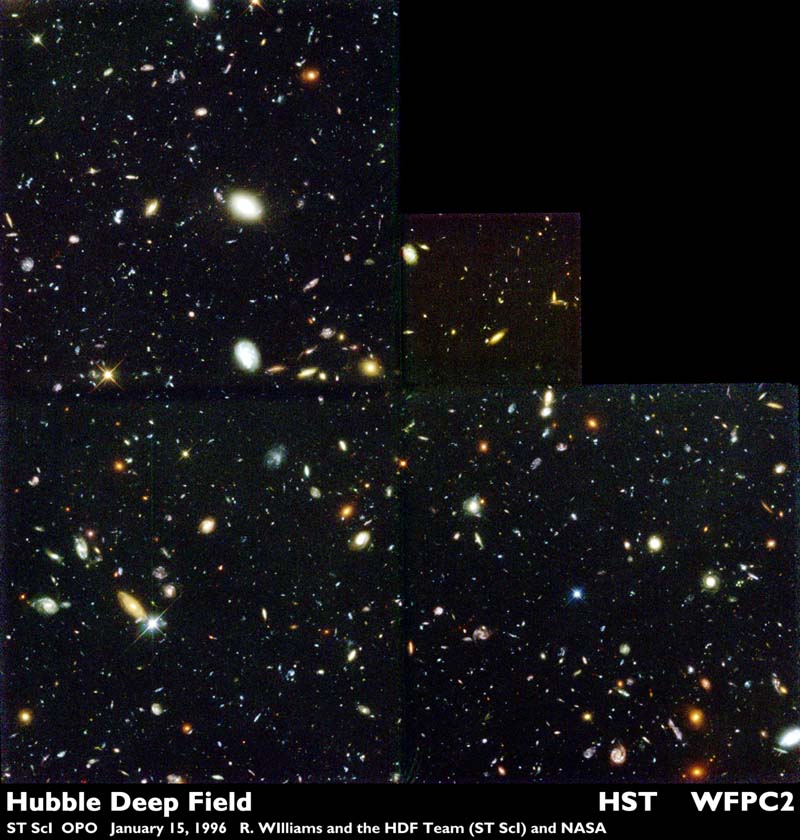
Re:'Deep Field View'Are you sure that they didn't find this instead?
Hint: the previous post left a colon on the URL. The link in this little reply works. Pretty cool image, BTW.
Your welcome and good afternoon... -
Re:Better resolution images.Also check out The astronomy picture of the day. This site has the same picture as the above link, but has lots of other suitable-for-root-window astronomy pictures (like the bubble nebula, the full moon, and the Andromeda galaxy (my current root window image))
Share & enjoy
-
Re:Better resolution images.Also check out The astronomy picture of the day. This site has the same picture as the above link, but has lots of other suitable-for-root-window astronomy pictures (like the bubble nebula, the full moon, and the Andromeda galaxy (my current root window image))
Share & enjoy
-
Re:Better resolution images.Also check out The astronomy picture of the day. This site has the same picture as the above link, but has lots of other suitable-for-root-window astronomy pictures (like the bubble nebula, the full moon, and the Andromeda galaxy (my current root window image))
Share & enjoy
-
Re:Better resolution images.Also check out The astronomy picture of the day. This site has the same picture as the above link, but has lots of other suitable-for-root-window astronomy pictures (like the bubble nebula, the full moon, and the Andromeda galaxy (my current root window image))
Share & enjoy
-
Re:Slashdot Poll
All of these people have it wrong.
Sure, the ones mentioned so far are pretty, but they pale in comparison.
The BEST Hubble image is the 'Deep Field View'. You know the one with all of the galaxies?
They just pointed the telescope into empty space and they found this. If that doesn't give you a feeling of the immensity of space, I don't know what does.
Thank you, and goodnight. -
Re:Hats off to NASA!
that should be NASA.
-
NASA's Press Release on This
You can see NASA's press release on this at http://hubble.nasa.gov/updates/1- 24-00update.html
-
Re: Chromatic abberation?
Sure, take a look: http://antwrp.gsfc.nasa.gov/apod/ap9 90830.html
-
Donald Becker for Unsung Hero...Donald Becker, Open Source Unsung Hero
Die-hard Open Source programmer that help maintained and delivered most common Linux network drivers ranging from IDE/PCI Ethernet, Fast Ethernet, 100VG Ethernet, Gigabit Ethernet, PCMCIA Ethernet and supported Infrared Networking for a wide range of platforms (Intel, Sun, Mac).
Let us not forget Beowulf
I've put many hours support his endeavor and would like to see his name recognized for all of us hard workers.
-
Donald Becker for Unsung Hero...Donald Becker, Open Source Unsung Hero
Die-hard Open Source programmer that help maintained and delivered most common Linux network drivers ranging from IDE/PCI Ethernet, Fast Ethernet, 100VG Ethernet, Gigabit Ethernet, PCMCIA Ethernet and supported Infrared Networking for a wide range of platforms (Intel, Sun, Mac).
Let us not forget Beowulf
I've put many hours support his endeavor and would like to see his name recognized for all of us hard workers.
-
Donald Becker for Unsung Hero...Donald Becker, Open Source Unsung Hero
Die-hard Open Source programmer that help maintained and delivered most common Linux network drivers ranging from IDE/PCI Ethernet, Fast Ethernet, 100VG Ethernet, Gigabit Ethernet, PCMCIA Ethernet and supported Infrared Networking for a wide range of platforms (Intel, Sun, Mac).
Let us not forget Beowulf
I've put many hours support his endeavor and would like to see his name recognized for all of us hard workers.
-
The most important thing from the space programThis image, and the many like it.
When people ask "What has the space program done for us", people reply 'Tang' or 'Teflon' or 'Concentrated Orange Juice'.
They are trivialities that distract from the true answer.
What's the Weather going to be like tommorow ? How do you know ?
Strange, that a country that seemed to spend half of 1999 getting hit by hurricanes and storms, suddenly forgets why they get 2 day warnings before hand. What would the Eastern seaboard be like if they got 30 minutes warning instead ? How many people would die ?
But even weather prediction isn't the most important gift.
When did the enviromental movement really start to get into high gear ? The Silent Spring was certainly the first widely known warning, but what is the standard image of the enviromental lobby ?
When we started getting pictures like the above - not a vast limitless area that we can do anything we like to, but a small blue ball, hovering above the horizon of the moon, or the last crescent of the Earth taken by a space probe that is sailing into an almost infinte darkness. That's when terms like 'Small' and 'Fragile' began to be used about the Earth, which was historically regarded as the largest thing you can imagine.
Look at any enviromental message, and you will almost always find a shot of the Earth from space. These pictures have made quite an impression on the thought processes of this race.
And the impression is so deepy ingrained, that most people never think where they came from.
Whatever money NASA spends, it's a bargain, for the results of their programs might just save the planet from ourselves.
-
ok. a few changes.
I don't think we're there yet on combating resistance mutations. I feel that we're going to get much better in the near future, maybe very good within 25 years. Evolution is very old, though. As far as I can tell, there will always be risks from infections and risks from their treatments. It is sad that these biotech companies pick an area based solely on financial potential. We are inviting danger. The danger arises from selfishness and greedy doctors. People want to feel better now. Too many doctors cave. Public health takes a back seat to personal health.
I'm less a believer in the doom of drug resistance. Drug resistance is bad, yes, but the treatment of apparently trivial disease can have great benefits. One argument is that we are going to create supermutants that will kill people. Another argument is that we already suffer. These diseases already kill people. A regular bug can look like a supermutant when there are no effective treatments. The mutants aren't going to put us anywhere new; they'll just return us to where we were, to a time of untreatable influenza (or whatever). The Golden Mean. We should not spew medicines out so much that we create mdr bugs that will kill pepole. We should not tell people they have to suffer and even die because we don't want to create mdr bugs. People do die from trivial disease. Having thousands of untreated contagious people everywhere has its own risks. We have to balance the tradeoffs. Of course, we don't understand quite what the tradeoffs are. It's tricky.
Thought: How will resistance affect virulence? If a drug becomes ineffective, will the new resistant bugs--I'll assume viruses.--be any worse than the virus strains before we had the drug? I would guess that the answer rests with the drug's mechanism. Imagine that the drug is a competitive inhibitor that closely imitates a cell receptor. It would be very hard for the virus to develop resistance without losing virulence. Imagine that the drug imitates some immune response. A resistance mutation could spell disaster. The new virus strain would be more resistant to the drug and to our immune response. At this time, we might not be smart enough to think clearly about this question.
When Dr. Hubbard was here, I asked whether she advocated a socialized health care system. As I expected, she said yes and contrasted us with nearly every other developed country on earth. IIRC, I then asked about how we are supposed to implement one, and she said something vague about legislation. I have little faith in public opinion, legislative integrity and healthcare company ethics. While she has good ideas and so do you, you both are living in fantasies from my perspective. Intolerant idealism does not solve problems. A perceived solution that has no hope of ever being implemented is not a solution. Take the Clinton healthcare initiative. His ideas may have been terrible. Maybe they were good. I do not know. I just know that he got nowhere with them and that people were in an uproar. Knowing what human forces we are up against is as much a part of the battle as knowing what disease forces we face.
Sidenote: When I tried to do a little (and very light) web research on these new antiviral drugs, I came across a NASA page. They grew neuraminidase protein crystals in microgravity. I guess they couldn't get good crystals on earth for x-ray crystallography.
I saw the movie Awakenings, I think. I don't know anything about the epidemic. I would write that I'll look into it. I'm sure it's interesting. Honestly, I probably won't look into it.
Europeans are idiots. So are Americans, but it's a different kind of idiocy. I used to think Europe was great until I started meeting Europeans. They were generally more aware than Americans in historical and cultural terms. They also tended to be very dogmatic and critical. They never seemed much different in critical thinking and debating abilities, just more offensive and rude.
My eyelids are getting heavy. I'm done writing for tonight.
-
How does chandra work?I went and sniffed around at chandra.nasa.gov and I couldn't find anything about:
How does chandra work? How are X-rays focused? Pinhole camera? I doubt that because it would really cut down on light gathering.
-
Re:Its about time
According to this Expendable Launch Vehicle Cost Comparison, Soyuz is actually one of the cheapest ways to orbit at US$18M a pop. (It's those 27 years to depreciate base manufacturing costs that helps.) And each flight could presumably carry one cosmonaut and two passengers. I'm not sure anyone has a good way to estimate Energia's numbers, though: Russia's financial situation is such that cold hard American cash is worth far more than its paper conversion value, and they've probably run flights at a worse loss basis for the Russian government. Besides, this will help subsidize a running production line (more vehicles == cheaper costs), as well as advertise their satellite launch services.
I wonder what makes space travel so expensive? Is it the fuel (liquid oxygen and liquid hydrogen I believe), the cost of the vehicle itself (the various booster stages and so on) or the maintenance costs(engineers, repairs and general upkeep).
Fuels differ. LOX/LH is what the shuttle rockets use, but Soyuz uses a LOX/Kerosene fuel in all 3 stages. Figure 30 cents/kg for the combination, and you'll need something like 270,000 kg., but that's less than $100,000. The Soyuz crew vehicle is theoretically reusable, but they tend to land hard and space-rating afterward would be tricky. In practice Energia probably salvages what they can and sticks it back in the assembly line. What you're looking at are the overall costs of running the infrastructure. The shuttle has basically the same problem: if you look at pure materials and other "just this time" costs, you can come up with ridiculously low numbers (say, $60-100 million); but when you have 5 launches in a year and pay $5 billion for the privilege, you know there's more to it than that.
Soyuz launch vehicles (the type that go to Mir).
Why haven't we developed cool spacecrafts like they had in Star Wars:TPM that can go straight into the atmosphere? [you mean out of?] It would seem to be more an economic issue as opposed to a technological issue. I guess they can't develop quite enough thrust to escape the Earth's gravity without using those huge rockets.
SSTO (Single Stage to Orbit) vehicles have been on the drawing board since the earliest days of NASA, but none has ever been built. The closest prototypes from recent years have suffered from the existence of the shuttle and other working launch systems. The DC-X was a promising vehicle, but it was damaged during a hard landing. The VentureStar project is billed as a next-generation shuttle, but since STS will be around for at least another 15-20 years it's not imminent. The X-33 is a prototype of some of its technology, but it's been delayed by problems of its own. The X-38 is a similarly-shaped (flying wing) vehicle, that would be a lifeboat for an ISS crew of up to 7; but it's an orbit-to-ground vehicle only.
Meanwhile, the non-governmental "space launches for profit" crowd has a number of possibilities close to reality. Kistler Aerospace has a two-stage reusable design, and Rotary Rocket uses an innovative rotor design to land a cone-shaped vehicle straight up (just like those 50s sci-fi flicks). The main obstacle remains a robust launching industry, with competition keeping the prices of expendable rockets low. Boeing and LockMart pretty much have this market sewn up; in fact there are more launches than can be accomodated at American facilities. A company called SeaLaunch partners with Boeing and Ukraine to orbit satellites from a floating oil-derrick-platform that lives in Hawaii. Launch facilities are being worked on in Canada and Alaska (to serve the polar orbit market), while India and China beef up their launch facilities. Indonesia and the Phillipines are proposing launch sites. It's really a wide-open market, as long as you're not talking about people yet. Give some of these systems a couple of years to mature and lower costs, and you'll have $1000/pound to earth orbit. That's when launching people will become easy.
http://www.space.com/business/launching/new_rock ets_wg.html
---- -
Re:Its about timeWell, here's MIR-18 launch pics and video. I think this may be a Soyuz launch also.
The Soyuz rocket is used for launching freight or the Soyuz capsule. CNN describes leaving Mir in Soyuz.
-
Ground-to-Space being worked onWe've been able to build ground-to-space aircraft for a while, we just haven't tried to do it. To have enough fuel in orbit, the easiest would have been to actually carry the spaceplane up with another aircraft. But fully self-contained is just a little harder.
NASA doing development with X-33 and X-34. The X-33 will be flying this year. It's a test ship, so will not be reaching orbit.