Slashdot Mirror
Domain: nasa.gov
Stories and comments across the archive that link to nasa.gov.
Comments · 16,365
-
Re:Good
You mean, "maybe now the Chinese will stop blowing up their own satellites as a show of strength"?
the debris cloud of Fengyun 1-C was only 17% of the trackable debris in Aug 2007
Only? Humans have been putting junk into earth orbit for half a century. That a one-time event now accounts for 17% of all trackable debris is actually kind of shocking.
-
Re:Good
You mean, "maybe now the Chinese will stop blowing up their own satellites as a show of strength"?
the debris cloud of Fengyun 1-C was only 17% of the trackable debris in Aug 2007
Yeah, fat chance - it's not like China has any space station that might be at risk.
You are aware that China is building it's own station? And that in 2007 the country tried to become a partner of the ISS (with positive reactions from Russia and the ESA) but was not invited?
-
Re:Okay, but....
Actually, aerodynamics technology can make a supersonic airplane signature (aka "boom") almost silent - the military and NASA has been investing in that for years.
For instance, from NASA's website:
Ltpinter: Hi Ed. I hope NASA is keeping you busy on really cool stuff. I would like to know if sonic booms can be reduced to a low rumble?
Ed.: Yes, we can make sonic booms that are very quiet, and can't be heard over normal conversation. It sometimes sounds like distant thunder. And referring to my last comment sometimes you can make the boom totally quiet if the aircraft is slow enough or high enough in altitude.
I know Eurocopter is working on a quiet helicopter, but I couldn't find the one I know about (nor can I talk about it, because they are a customer I'm working with). It may be the same technology as I was able to find, but I'm not sure.
This technology has a different application - it bends sound around the object it surrounds, so sonically it appears to not be there. Being able to bend waves of different kinds around objects has fundamental uses - for instance, if you can bend radiation around a spaceship, you eliminate one of the problems with the theoretical Alcubierre drive (though I would say the theory existed before he wrote about it, as people in my physics class discussed it amongst other "further than light" ideas before 1994 - the two that we couldn't debunk were time bubbles and one that is difficult to describe, but I'd call it uncertainty tunneling).
-
Re:It's too bad NASA doesn't do anything anymore.
-
Re:It's too bad NASA doesn't do anything anymore.
-
Re:It's too bad NASA doesn't do anything anymore.
-
Re:It's too bad NASA doesn't do anything anymore.
-
Re:It's too bad NASA doesn't do anything anymore.
-
Re:It's too bad NASA doesn't do anything anymore.
-
Re:It's too bad NASA doesn't do anything anymore.
-
Re:It's too bad NASA doesn't do anything anymore.
-
Re:It's too bad NASA doesn't do anything anymore.
-
Re:It's too bad NASA doesn't do anything anymore.
-
Re:It's too bad NASA doesn't do anything anymore.
-
Re:It's too bad NASA doesn't do anything anymore.
-
Re:It's too bad NASA doesn't do anything anymore.
-
Re:It's too bad NASA doesn't do anything anymore.
-
Re:It's too bad NASA doesn't do anything anymore.
-
Re:Don't underestimate the energy of small asteroi
Yes. Yes, we have. Orbited an asteroid, that is, not the nuking bit. And we'll do it again next month. Of course, these are much, much bigger hunks of rock.
-
Re:Sure thing
An asteroid eventually hitting the earth is a sure thing, but hitting "us" is far from a sure thing. The asteroid most likely to hit earth in our lifetime has a 99.918% chance of missing.
-
Re:Oh good...
As I said, on the models I'm familiar with, like the GISS ModelE> , it doesn't matter so much where you start although it's better if your starting point is realistic. The +5 degrees of warming are not relative to the cold temperatures during the LIA but something like the mean temperature from 1900-1989 (I don't know if that's the baseline for the projection you're specifically referring to but it's undoubtedly something similar).
The current models are far from perfect, they're just the best thing we have at this time. They'll get better in the future.
-
Re:Err, waitaminute.
"In truly great magnetic fields like those of Jupiter, atomic particles may be heated to millions of degrees, and a great electric arc flows between the planet and its moon lo." - NASA
-
Re:Just bitchin'
Precise landing with a parachute, in the biggest ocean, awaiting then the recovery.
Was done back in the 1960's - all but two of the Apollo missions landed within two nautical miles of the target. The biggest miss was three nautical miles. (See the Entry, Splashdown, and Recovery page of Apollo By The Numbers.)
I does sound kind of silly on the surface, but it a valuable capability. Precise landing means landing close to the recovery vessel which means faster recovery. -
Re:Just bitchin'
Precise landing with a parachute, in the biggest ocean, awaiting then the recovery.
Was done back in the 1960's - all but two of the Apollo missions landed within two nautical miles of the target. The biggest miss was three nautical miles. (See the Entry, Splashdown, and Recovery page of Apollo By The Numbers.)
I does sound kind of silly on the surface, but it a valuable capability. Precise landing means landing close to the recovery vessel which means faster recovery. -
Re:Oh good...
Actually it has been rising steadily this past decade. So yeah, you are completely wrong. http://data.giss.nasa.gov/gistemp/
-
Increasingly Irrelevant Benchmark
the top 500 is based upon the Linpack benchmark and it is not really a good reflection on 'how fast' a super computer really is. Newer benchmarks, such as graph500 and NAS parallel benchmarks try to make the benchmark more real world. But if all you plan to do is solve linear equations then I guess Linpack is your thing.
-
Re:The data shows...
That's very nice, but it doesn't explain why the Arctic and Antarctic ice is melting. We have temperature observations in the ocean and from satellites also. They all show warming. It's nice to show some pictures of temperature stations in parking lots and pretend that they invalidate all temperature measurements because you find the warming to be inconvenient.
-
Re:And we know this because...?
Look, solar irradiance averages about 1366 W/m^2 and a has a variation of about 1 W/m^2 (using a one-year moving average). That's 0.073%.
You are referring to the Total Solar Irradiance (TSI). But it is not total: the satellites used to measure it have a spectral window from 2000 nm down to 200nm. That leaves out the EUV and X-Ray region. There, the variation is huge. See for example this factor-of-three variation over the solar cycle in the 26-34 nm band.
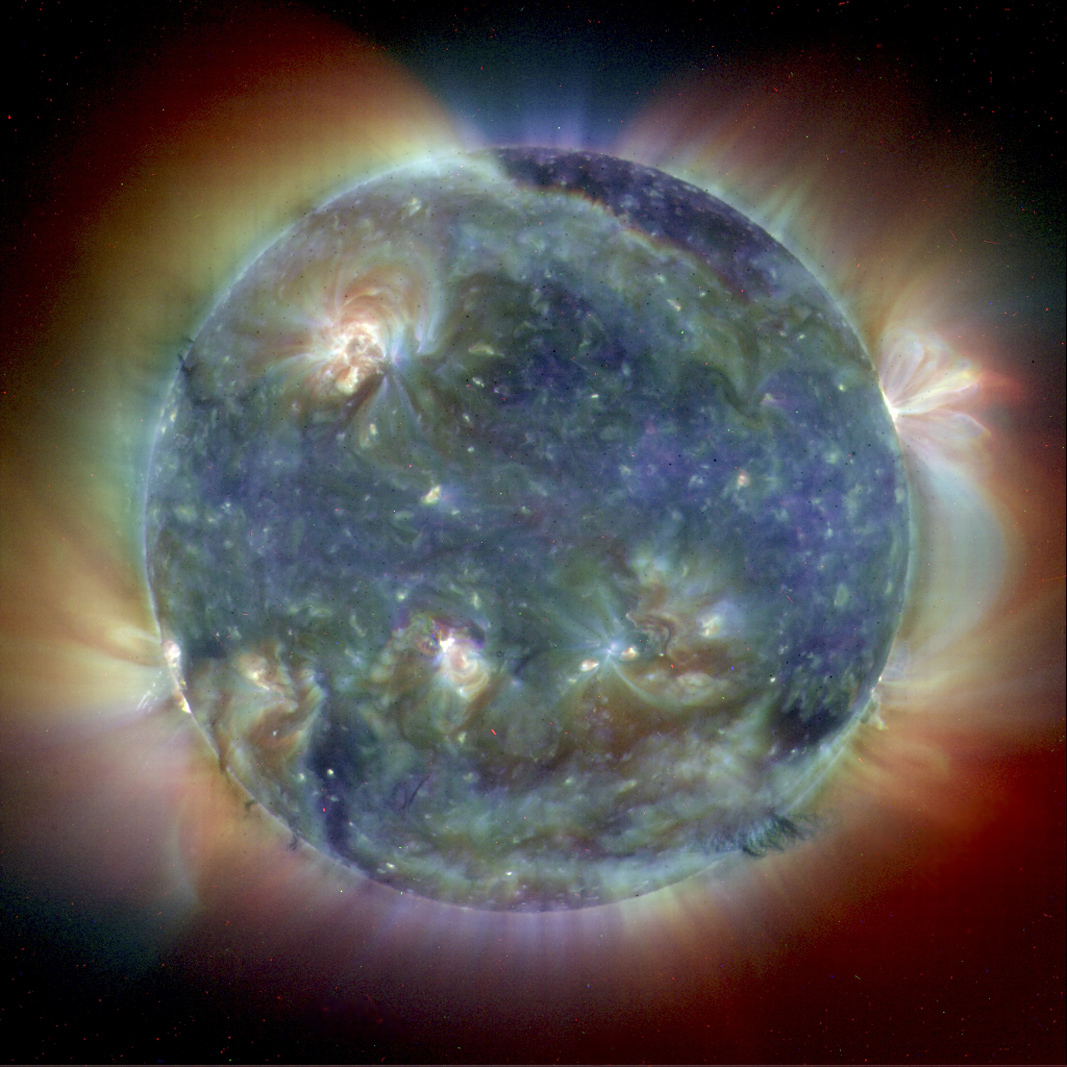
In the X-ray region variations can be orders of magnitude. Looking at any EUV of X-ray image, it is obvious that the short wavelength intensity from the corona much exceeds the black body radiation coming off the surface. So the conventional view that the EUV and X-Ray region is just an irrelevant tail of the black-body curve is wrong:the flux there is much more intense.
Then there are serious doubts about whether the TSI time series as published are actually all that constant. There have been per-instrument aging calibrations that have removed slopes in the raw data. The question though is whether this slope was really due to aging or due to a systematic trend in the solar irradiance. Also, the long-term TSI curve spans a number of instruments (satellites) with some gap in between. There is a lot of discussion about whether this gap has been bridged without skewing the data towards less variance than there really is.
There. A tiny bit more research shows that the sun can have a rather greater effect on Earth's temperature than it is given credit for.
And no, climate scientists are not familiar with this. The importance of the EUV and X-Ray region has been overlooked in the past and only recently has started to gain attention.
-
Re:And we know this because...?
Look, solar irradiance averages about 1366 W/m^2 and a has a variation of about 1 W/m^2 (using a one-year moving average). That's 0.073%.
You are referring to the Total Solar Irradiance (TSI). But it is not total: the satellites used to measure it have a spectral window from 2000 nm down to 200nm. That leaves out the EUV and X-Ray region. There, the variation is huge. See for example this factor-of-three variation over the solar cycle in the 26-34 nm band.
In the X-ray region variations can be orders of magnitude. Looking at any EUV of X-ray image, it is obvious that the short wavelength intensity from the corona much exceeds the black body radiation coming off the surface. So the conventional view that the EUV and X-Ray region is just an irrelevant tail of the black-body curve is wrong:the flux there is much more intense.
Then there are serious doubts about whether the TSI time series as published are actually all that constant. There have been per-instrument aging calibrations that have removed slopes in the raw data. The question though is whether this slope was really due to aging or due to a systematic trend in the solar irradiance. Also, the long-term TSI curve spans a number of instruments (satellites) with some gap in between. There is a lot of discussion about whether this gap has been bridged without skewing the data towards less variance than there really is.
There. A tiny bit more research shows that the sun can have a rather greater effect on Earth's temperature than it is given credit for.
And no, climate scientists are not familiar with this. The importance of the EUV and X-Ray region has been overlooked in the past and only recently has started to gain attention.
-
Re:The data shows...
According to what I've read the variance is much smaller, and the heat island effect is adjusted out of the cleaned up data sets like NASA's GISS. You might want to read up on that process.
-
Re:Global Warming alarmists
http://data.giss.nasa.gov/gistemp/graphs/Fig.A2.gif
Since the 1990's, global temperatures have gone up 0.3 of a degree (Celsius). I wouldn't call that "none".
-
Re:The data shows...
My data indicates that your claim that "we are in a cooling period" is wrong. It indicates exactly the opposite. If you feel that my data is not from a trustworthy source, please feel free to explain why.
"No one will trust my data so I'm not going to bother giving you any" is not an acceptable argument. You should be able to support your positions, and fortunately, you have made a claim for which plenty of data exists. Unfortunately, a great deal of it is contrary to your statement.
-
Re:A link to the actual press release
Yeah! It's not like NASA has any current missions that are providing valuable science to our society at all. It's nothing but a worthless jobs program!
I don't necessarily agree or disagree with the rest of your post, but please educate yourself about the space industry before commenting on it. I'm getting really tired of correcting ignorance on what is supposed to be a News for Nerds site. Thanks. -
Re:Global Warming is Over!
a fact for you http://airs.jpl.nasa.gov/overview/quintessential_ghg/
-
Re:Global Warming is Over!
not just clouds which are condensed water, but the water vapor (humidity, we might say) makes up the over thirteen trillion tons of water in the atmosphere. It is a surprise to many of the armchair apers of the CRU propaganda organ, but of course water vapor is the dominant greenhouse gas on this planet, and modeling it is quite difficult http://airs.jpl.nasa.gov/overview/quintessential_ghg/
-
Re:Watch for Hidden Warming
I"ll disagree, 2005 to 2010 warming essentially stopped, as differences were in the realm of statistical noise. Except for 2008, the coolest year since 2000.
http://svs.gsfc.nasa.gov/vis/a000000/a003800/a003817/
http://data.giss.nasa.gov/gistemp/tabledata/ZonAnn.Ts+dSST.txt -
Re:Watch for Hidden Warming
I"ll disagree, 2005 to 2010 warming essentially stopped, as differences were in the realm of statistical noise. Except for 2008, the coolest year since 2000.
http://svs.gsfc.nasa.gov/vis/a000000/a003800/a003817/
http://data.giss.nasa.gov/gistemp/tabledata/ZonAnn.Ts+dSST.txt -
Re:Global Warming is Over!
that is false, temperature rise stopped, the differences over 2005 to 2010 according to NASA were less than 0.03 degrees C, in the realm of noise (ignore the agenda driven nonsense pumped out by the propaganda organ known as CRU):
http://svs.gsfc.nasa.gov/vis/a000000/a003800/a003817/ -
The Universe Electric
"Electrical Circuit Between Saturn and Enceladus"
http://www.nasa.gov/mission_pages/cassini/multimedia/pia13765.html
With this example in mind, consider Saturn having an electric circuit between every single body within its field.
Replace Saturn with the Sun and the moon with Saturn.
Replace the Sun with "black hole" of our galaxy and Saturn with our Sun.
There are most likely intermediate steps between our Sun and the black hole...
Regardless, with this model, it is assumed that as the Sun moves through it's parents variable EM field, and the differences are moderated down to us through the Sun, electrically, back to Earth. And Saturn.
-
Re:Mechanism?
There's a very nice website at: aquarius.gsfc.nasa.gov I can't find anything that describes how they do it, but there's a list of interesting email addresses here.
-
NASA is using GPUs too
NASA is also using GPUs -- looks for climate / atmospheric modeling.
-
Re:It's all about the angle
Skylab was pretty damned big. 60% the mass of the completed Mir, 80% the interior pressurized volume - and all in one large tube rather than a set of smaller ones.
http://ntrs.nasa.gov/archive/nasa/casi.ntrs.nasa.gov/19790075817_1979075817.pdf shows lots of drawings of what the Shuttle and Skylab would have looked like docked.
-
Re:Size
It's interesting to see how people estimate the size of the shuttle. Most people assume that the ET is about the size of a petrol tanker truck because it's (roughly) the same dimensions and this is the only recognizable thing they can think of (this seems to all be done subconsciously). . From this, you extrapolate up and you end up with the size of the orbiter being about the size of a large business jet as you say.
In actual fact, the external tank is a LOT bigger: http://www.nasa.gov/centers/marshall/images/content/166996main_ET-119_2571_516.jpg
-
Re:Not True
Pedant. It's obvious that they mean "but never before in actual photos from close-by with detail". You'd have also gained better kudos if you'd used this image: http://apod.nasa.gov/apod/ap070628.html
-
Re:It's all about the angle
You must have been thinking of Mir. This is the first time that a shuttle has been photographed attached to the ISS from space. There have been several stunning ones from the ground though, like this one taken a few years ago when the ISS was smaller: http://apod.nasa.gov/apod/ap070628.html
-
NASA source footage
Go here and you can view animations of the sun using all the different telescopes on SDO...
http://sdo.gsfc.nasa.gov/data/aiahmi/rangeform.php
Instructions to view the subject solar flare: select browse by date range, enter 2011-06-07 00:00:00 as the beginning and 2011-06-07 12:00:00 as the end dates, select movie as the display, select resolution 1024x1024, and set nth = 1, submit and enjoy. Also, you can play with the different telescopes. -
Re:What video
-
Re:Size
It's not that big - remember that it can be transported strapped to the top of a 747.
http://www.dfrc.nasa.gov/gallery/photo/ALT/Small/ECN-6887.jpg
The ISS is probably smaller than the GP thought.
-
Re:It's all about the angle
The ISS equivalent would be that one, which gives you a better view of Endeavour, but misses out a lot of the ISS.
-
Photographic tools
Shot in aperture priority (@ f8, ISO 200) with a Nikon D3X with 24-120mm f3.5-f5.6 zoom. Looks like it was focused at infinity.
Full resolutions photos available via link in article, or here.