Slashdot Mirror
Domain: nro.net
Stories and comments across the archive that link to nro.net.
Comments · 6
-
Re:IPv6
I thought there was an announcement that the IPv4 address space is now totally exhausted. Or at least there are no new blocks to be assigned. The tunnel broker, Hurricane Electric indicates that IPv4 is exahusted.
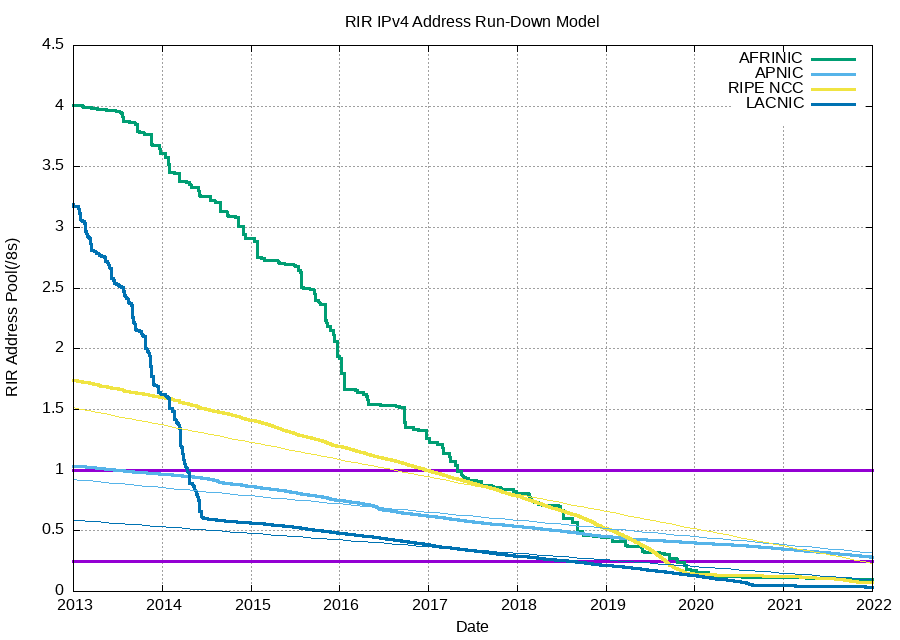
The announcement - http://www.nro.net/news/ipv4-free-pool-depleted - was made when IANA, the central authority, ran out of addresses to give to the five regional internet registries. These regional registries will run out at different speeds. Geoff Huston's graph is very useful to see how fast this will happen - http://www.potaroo.net/tools/ipv4/plotend.png
-
ipv4 is dead....long live ipv4!
NRO (Number Resource Organization) had a press conference on 3rd Feb where they formally handed out the last 5
http://www.nro.net/media-center/video-archive-3-february-2011
-
Free Pool of IPv4 Address Space Depleted
From http://www.nro.net/news/ipv4-free-pool-depleted: "Montevideo, 3 February 2011 – The Number Resource Organization (NRO) announced today that the free pool of available IPv4 addresses is now fully depleted. On Monday, January 31, the Internet Assigned Numbers Authority (IANA) allocated two blocks of IPv4 address space to APNIC, the Regional Internet Registry (RIR) for the Asia Pacific region, which triggered a global policy to allocate the remaining IANA pool equally between the five RIRs. Today IANA allocated those blocks. This means that there are no longer any IPv4 addresses available for allocation from the IANA to the five RIRs."
-
Re:ICANN
Actually, IP address allocations are handled by ARIN (http://www.arin.net/) and other regional registries (like RIPE http://www.ripe.net/) and the NRO (http://www.nro.net/). If you consider them the Phone Company, then ICANN is simply the Yellow and White Pages.
-
I get a surprising number of IPv6 hits...
I get a surprising number of IPv6 hits on my webserver at home. Most of these appear to be XP or Vista boxes with Internet connection sharing turned on that automatically assign themselves a 6to4 addresses when they have an interface with a public IPv4 address.
IPv6 with 6to4 is easy to set up, and I'd recommend it to anybody who has a static IPv4 address. You can use NAT-PT so all your IPv6 hosts can still get to the IPv4 network. If you have a couple of DNS servers, you can even set up reverse DNS for your IPv6 network just the way you want using this nice web interface from the NRO.
I maintain some good links to stuff about IPv6 on del.icio.us.
I hate NAT. And I think IPv6 can be just as secure. Partly because a 64-bit address space is really hard to effectively randomly probe working addresses and partly because it's fairly easy to configure a firewall to not allow incoming connections.
-
I get a surprising number of IPv6 hits...
I get a surprising number of IPv6 hits on my webserver at home. Most of these appear to be XP or Vista boxes with Internet connection sharing turned on that automatically assign themselves a 6to4 addresses when they have an interface with a public IPv4 address.
IPv6 with 6to4 is easy to set up, and I'd recommend it to anybody who has a static IPv4 address. You can use NAT-PT so all your IPv6 hosts can still get to the IPv4 network. If you have a couple of DNS servers, you can even set up reverse DNS for your IPv6 network just the way you want using this nice web interface from the NRO.
I maintain some good links to stuff about IPv6 on del.icio.us.
I hate NAT. And I think IPv6 can be just as secure. Partly because a 64-bit address space is really hard to effectively randomly probe working addresses and partly because it's fairly easy to configure a firewall to not allow incoming connections.