Slashdot Mirror
Domain: owt.com
Stories and comments across the archive that link to owt.com.
Comments · 13
-
Re:We should all be concerned
Actually, the heart of Tokyo is 140 miles away from the reactor site. If you want to see how wide-spread the fallout area can be and the levels at different distances then have a look here;-
http://users.owt.com/smsrpm/Chernobyl/glbrad.htmlI certainly wouldn't be planning on staying in Tokyo or returning there for a long time if the reactor does go.
-
Re:Do they have any of his old DNA
HAHAHAHAHAHAA
Nope, drug labs were created in 1990. There were no illegal drugs before that. Well, except:
- Opium
- Morphine
- Heroin
- Cocaine
- Crack cocaine (popularized in the 1980's)
- Marijuana (sorting and processing counts as a lab),
- Methamphetamine (invented 1893, popularized in the 1960's)
- Crystal methamphetamine (invented 1919)
- Methylenedioxymethamphetamine (MDMA/Adam/Ecstasy/X) (invented 1912, popularized in the 1970's and 1980's),
- and we can't forget the all time favorite Lysergic acid diethylamide (LSD) (invented 1938, popularized in the 1960's)
Sorry, it's not an all inclusive list, it's just a sampling of
You can find more information at Erowid and Lycaeum
The Chernobyl accident happened April 25th, 1986. Since I'm guessing you weren't alive yet, or old enough to remember, there was a bit of a pesky problem of nuclear fallout that spread quite a bit.
Drugs a bit tainted by radioactive fallout could still be sold for a profit. Who are you going to complain to. It's just like if you buy an 8 ball of coke, but it turns out to be baby powder. It's not like you can just call the cops and say "I paid for coke, but he gave me baby powder!" Drugs destroyed because they may be radioactive are lost money. Drug manufacturers and dealers are just like any big business. They want to make a profit. They aren't going to throw away perfectly good product, if they can sell it.
-
Re:Reason
Several modes of failure are possible with the same outcome if a generator becomes disconnected to the load at high loading. AC generators run locked to the line frequency regardless of the load. 5% or 100% load the RPM is the same. The power generated is directly controlled by the throttle of the prime mover.
When the load is disconnected from either a transformer fault or relay, the input power continues to provide power until it is throttled or shut off. 3 things can happen. Two can cause catastrophic failure.
1, The system holds. The RPM picks up, the gates close and peak pressure of the slowing flow are within system safety limits, then everything dissipates energy and comes to a safe stop.
2. The surge in pressure from closing the control valve too fast causes a valve failure and valve parts get blown into the turbine and the wreckage causes a volute failure under the generator rupturing the generator room floor and blowing debris into the spinning generator. Kinetic energy shreds the shell of the generator.
3. The surge in pressure from closing the control valve is contained, but the slow operation permits the generator to over speed to destruction. A thrown winding quickly binds and starts tearing pieces from the armature and stator, This high energy wreck inside the generator rips it loose from the mounting and the armature pulls the turbine out of the floor damaging the control valve in the process.
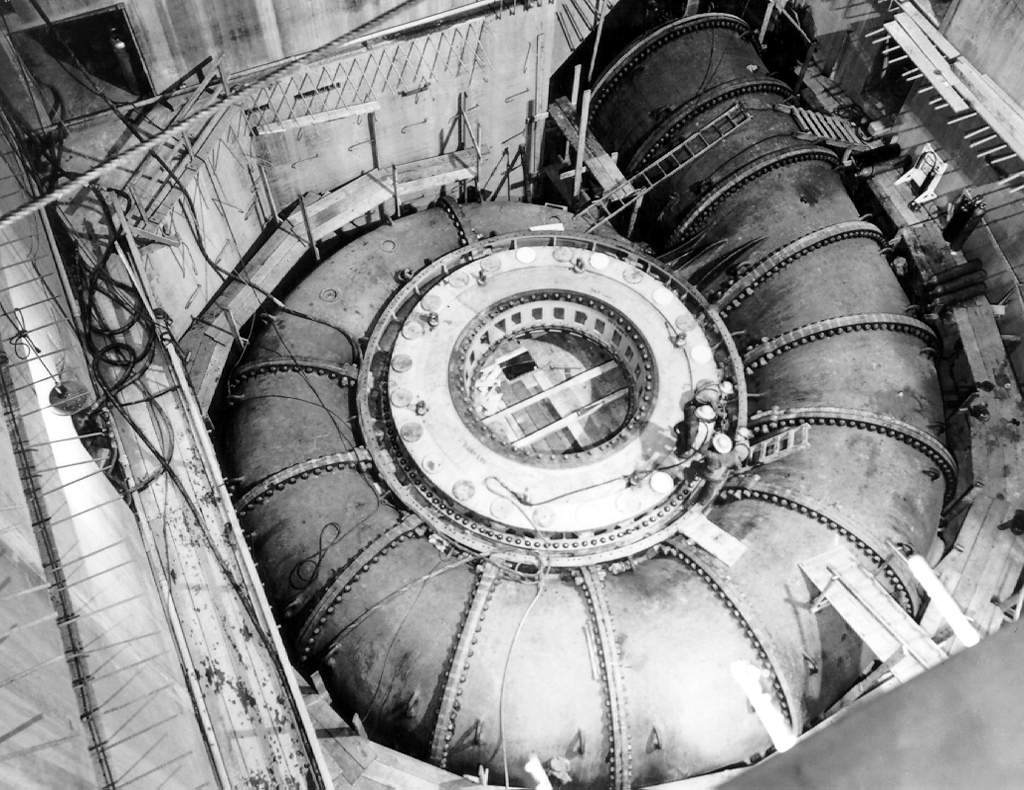
It is possible the generator had a mechanical failure without the stress of an emergency shutdown with the same results. I find this unlikely due to the nature of the failure. The damage looks like it happened while in an over speed condition, but that is just speculation. The Grand Coulee dam construction photos has a great photo of the volute during construction. They call it a scroll cage. My best guess at this time is the generator relayed out under heavy load and went over speed with the resulting mechanical failure.
http://users.owt.com/chubbard/gcdam/highres/build11.jpg
In AC generation the speed of a syncronous generator or motor is related to the number of poles and the frequency. I don't know if Russia is 50 or 60 HZ. In the USA a 60 HZ single phase 2 pole motor runs 3600 RPM. A 3 phase 3 pole also runs 3600 RPM. 6 pole runs 1800, 12 pole 1200, 24 pole 600, 48 at 300, 92 at 150. Figures can be adjusted for 50 HZ. To get an idea of the possible speed involved there, I can only compare to one of the larger US dams, the Grand Coulee Dam.
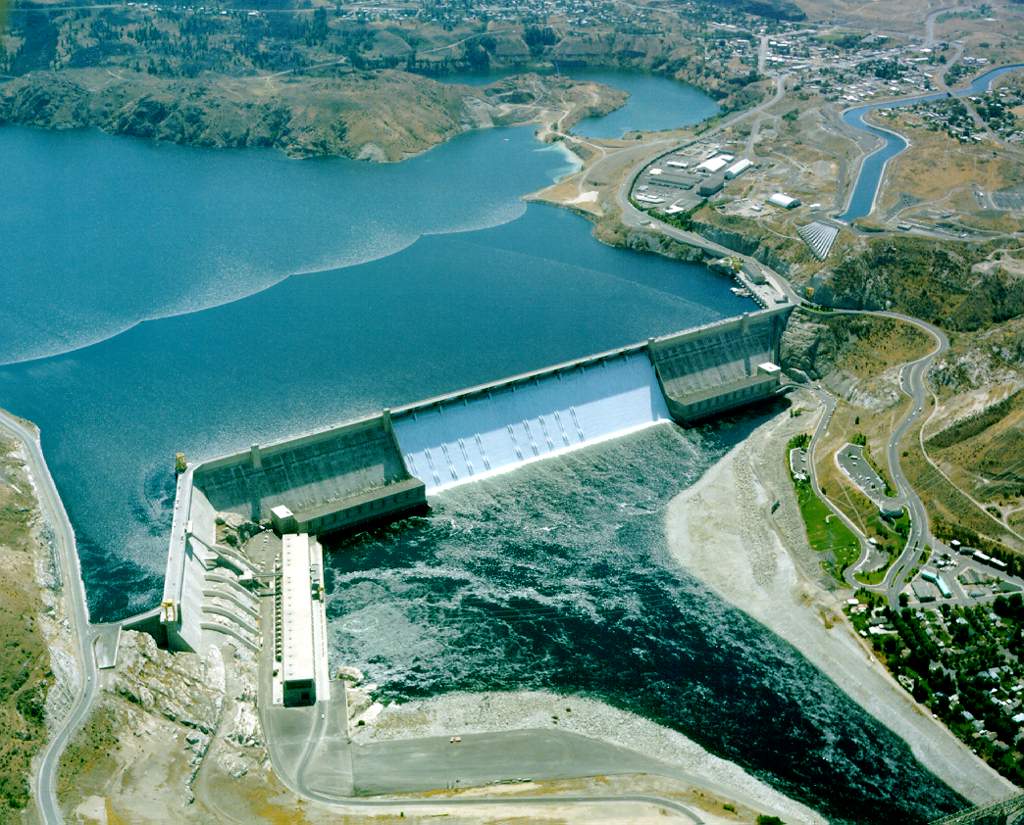
http://users.owt.com/chubbard/gcdam/html/photos/construction.htmlThe Grand Coulee dam has generators rotating at 120 RPM This is only 2 revolutions/second. This would indicate a 120 pole 3 phase generator for 60 cycle power.
The long pipes feeding the powerhouse make the two failure modes very possible. This is the reason most US powerhouses are fed from as short a path as possible. The shorter path is safer to shut down faster as inertia is much less with a shorter path.
I mentioned in another post that Ice Harbor dam on the Snake River while testing shutdown did close too fast on one generator. Peak pressure was well within limits. That dam only has a 100 foot drop. The problem they had was on the other side where water leaves. A vacuum was drawn as the inertia of the water leaving continued, stopped and returned. This water hammer did not break the volute, but it did damage the turbine blades. This was detected when returning to operation after the test. The turbine efficiency was very low. The generator was pulled, then the turbine was pulled for inspection of the turbine and volute. The turbine and vanes leading to the turbine were both damaged.
-
Re:Reason
Several modes of failure are possible with the same outcome if a generator becomes disconnected to the load at high loading. AC generators run locked to the line frequency regardless of the load. 5% or 100% load the RPM is the same. The power generated is directly controlled by the throttle of the prime mover.
When the load is disconnected from either a transformer fault or relay, the input power continues to provide power until it is throttled or shut off. 3 things can happen. Two can cause catastrophic failure.
1, The system holds. The RPM picks up, the gates close and peak pressure of the slowing flow are within system safety limits, then everything dissipates energy and comes to a safe stop.
2. The surge in pressure from closing the control valve too fast causes a valve failure and valve parts get blown into the turbine and the wreckage causes a volute failure under the generator rupturing the generator room floor and blowing debris into the spinning generator. Kinetic energy shreds the shell of the generator.
3. The surge in pressure from closing the control valve is contained, but the slow operation permits the generator to over speed to destruction. A thrown winding quickly binds and starts tearing pieces from the armature and stator, This high energy wreck inside the generator rips it loose from the mounting and the armature pulls the turbine out of the floor damaging the control valve in the process.
It is possible the generator had a mechanical failure without the stress of an emergency shutdown with the same results. I find this unlikely due to the nature of the failure. The damage looks like it happened while in an over speed condition, but that is just speculation. The Grand Coulee dam construction photos has a great photo of the volute during construction. They call it a scroll cage. My best guess at this time is the generator relayed out under heavy load and went over speed with the resulting mechanical failure.
http://users.owt.com/chubbard/gcdam/highres/build11.jpg
In AC generation the speed of a syncronous generator or motor is related to the number of poles and the frequency. I don't know if Russia is 50 or 60 HZ. In the USA a 60 HZ single phase 2 pole motor runs 3600 RPM. A 3 phase 3 pole also runs 3600 RPM. 6 pole runs 1800, 12 pole 1200, 24 pole 600, 48 at 300, 92 at 150. Figures can be adjusted for 50 HZ. To get an idea of the possible speed involved there, I can only compare to one of the larger US dams, the Grand Coulee Dam.
http://users.owt.com/chubbard/gcdam/html/photos/construction.htmlThe Grand Coulee dam has generators rotating at 120 RPM This is only 2 revolutions/second. This would indicate a 120 pole 3 phase generator for 60 cycle power.
The long pipes feeding the powerhouse make the two failure modes very possible. This is the reason most US powerhouses are fed from as short a path as possible. The shorter path is safer to shut down faster as inertia is much less with a shorter path.
I mentioned in another post that Ice Harbor dam on the Snake River while testing shutdown did close too fast on one generator. Peak pressure was well within limits. That dam only has a 100 foot drop. The problem they had was on the other side where water leaves. A vacuum was drawn as the inertia of the water leaving continued, stopped and returned. This water hammer did not break the volute, but it did damage the turbine blades. This was detected when returning to operation after the test. The turbine efficiency was very low. The generator was pulled, then the turbine was pulled for inspection of the turbine and volute. The turbine and vanes leading to the turbine were both damaged.
-
Anyone here care to try to poke holes in this?
Dark energy doesn't exist. Rather, the strong equivalence principle is exactly correct: Matter creates space-time and gravitational effects are due to space being created by a massive body, making a reference frame at rest with respect to the massive body an accelerated frame.
This obviates the need for "dark energy". If matter creates space then of course the universe will expand. No need for a fudge factor. I have read through James Lawler's "photonic theory of matter" several times and I can't find much wrong with it.
-
Re:Why are we still so scared of Nuclear power
If you investigate, you'll find you probably face the same risks from agricultural chemicals and household pesticides, and probably to a greater level than any likely radiation
I totally disagree with you.
Nuclear power has the potential to be incredibly dangerous, far more dangerous than risks aggregated from using agricultural chemicals and household pesticides. It may be clean and efficient and cheaper in the long run than many of our current energy solutions, but at what price?:
Civilian Nuclear Accidents - http://en.wikipedia.org/wiki/List_of_civilian_nucl ear_accidents
Civilian Radiation Accidents - http://en.wikipedia.org/wiki/List_of_civilian_radi ation_accidents
Military Nuclear Accidents - http://en.wikipedia.org/wiki/List_of_military_nucl ear_accidents
I'd like to see you pull some sources that show as many incidental damages and as much loss of life through the use of agricultural chemicals and household pesticides.
Not only that, the adverse effects of radiation exposure can span over many generations of people, affecting unborn children and their children as well.
I don't think the question should be why are people so afraid of nuclear power but instead, why shouldn't people be absolutely paranoid and overzealous about possible problems that nuclear power / accidents could create in the future, due to the materials used, and the insanely poisonous waste it produces.
Human nature seems to show that attitude depicts altitude (I apologize for using such a horrible saying) and the less respect and 'healthy-fear' you give to the possibilities of damage that a creation can cause, the more lax you get as the years go by with it's operation, and as a global society we simply can not afford to do that with Nuclear Power, not when radioactive clouds can float from a busted reactor to another country and poison its residents (Chernobyl)...not when people today are still having malformed children from having a bomb dropped 'near' their families over 61 years ago (Hiroshima) and it can go on and on...
I don't know about you, but
I'm pretty fucking scared of invisible particles flying through the air that can unravel / destroy / mutate the genetic code in my cells...and don't give me that 'the sun and uv radiation / cosmic radiation' rap either, because there's a huge difference in the degree of relativity between standing next to a reactor core after melt down, and getting a sunburn.
The issue here isn't what 'happens', but the horrendous pictures of what 'can' happen if something goes wrong. -
Re:Lists Lists Lists
Grand Coolee Dam? http://users.owt.com/chubbard/gcdam/highres/dam08
. jpg -
Nuclear Power: The Way to Go!
Nuclear Power has always been the way to go. People fear nuclear power because of a few lies:
1) What really happend at Chernobyl.
2) Nuclear power plants emit cancer causing radiation.
3) Nuclear power plants are expensive to run.
1) First off, Chernobyl exploded because of idiocy in the Ukraine. You do not conduct an experiment on a nuclear power plant and turn all the safeties off. That is asking for trouble. However, NO FALLOUT WAS EVER RELEASED FROM THE FACILITY. The facility was 100% lost, but everyone was safe that was not inside the plant. Not to mention, the United States have safety measures that far exceed most, if not all countries running nuclear power in the world.
Every nuclear power plant after the Chernobyl incident was constructed more towards US safety specifications.
2) Yes, nuclear power plants give off radiation. 1 millirem of radiation per year. Cosmic rays from outer space, radon gas, television sets, microwaves, smoke detectors, etc. which we receive constantly gives off 360 milirem's of radiation. That 1 extra millirem will not kill you. If your still paranoid about radiation, concider this:
Coal plants emit 100,000 tons of sulphur dioxide, 75,000 tons of nitrogen oxides, and 5000 tons of fly ash into the environment per year. Oil-burning plants emit about 16,000 tons of sulphur dioxide and 20,000 tons of nitrogen oxides per year.
That's all equal, by weight, to about a half million elephants. Kenya can't compete to that many elephants. So compare, 1 millirem of radiation, or enough pollution to create thousands of gas chambers?
3) To create the amount of energy that a nuclear pellet can muster, you would need (2003-2004 dollars):
Three barrels of oil $150
One ton of coal $35
One nuclear fuel pellet $7
In 1993, Using nuclear power saved the world $13 Billion in fuel costs in just one year, not to mention hundreds of thousands of tons of pollution.
So, I don't know what everyone is so paranoid over. The statistics are there, nuclear power is better.
http://users.owt.com/smsrpm/nksafe/ ~ Nice link on nuclear power. -
Re:Solve the War on Terrorism.Actually, one group of people pushing the most for widespread semi-autonomous power generation is... guess who... the military. That is because they have a real need for heavy duty mobile power generation to carry out their tasks. The military has invested in portable nuclear reactors (US Navy: pushed for LWR reactors and uses them in submarines and carriers), fuel cells for the US Army and Navy, solar cells for military satellites, etc. The military is also a technological leader in energy and food conservation, or recycling for much the same reasons. The US Army is converting their vehicle fleet to diesel vehicles which can run on biodiesel and is investing in recycling cooking oil for use in vehicles. Napoleon gave a prize to the person which invented canned food for the army.
As for fusion, we do not have cheap fusion because fusion is bloody hard, and billions of dollars and decades of work have not managed to crack it yet.
-
Re:Oil industry?
Here in Western Canada, we use hydroelectric dams to get our power. Unfortunately most of it is stolen by the state of California.
Go visit a huge hydroelectric dam, even with Homeland Security in place to limit the tour, it is a colossal structure. The Grand Coulee dam in Washington state is amazing, what's even more amazing is it's age. -
Accident timeline
I know this may not have much to do with the post, but here is a timeline of the accident: http://users.owt.com/smsrpm/Chernobyl/tlinedt.htm
l -
Re:Brain as a recording device
The brain would make a very poor recording device for several reasons. Firstly, the quality of the information stored isn't very good, and deteriorates with time. Watching a movie that you downloaded from some guy who saw it earlier instead of actually going to the theatres would be like listening to a 24kbps mp3 that someone "shared" with you instead of buying the orginal CD. Secondly, and more importantly, you can sometimes generate false memories. See this article and this article . This is why it's such a bad idea to base a justice system on eye-witnesses. Through the power of suggestion, and your subconscious biases, your memories can be altered. I don't know where you read that "your brain can recall almost everything." Maybe you were thinking of recognition, not recall. That wouldn't really help someone running a "brain cam" website.
-
Re:Sweet
You said: "The history of nuclear power so far, however, doesn't leave one optimistic."
What metric are you using to say that nuclear power has historically been unsafe? The number of deaths caused per MWh produced? Deaths or injuries per reactor-hour of operation? Average deaths per year at a given plant?
Really, compare these metrics to that of any other power distribution plant and you will see historically, even with the huge publicized disasters like Chernobyl and TMI, that no other large scale power producer even compares in safety to nuclear power.
But since we're on the topic of nuclear power safety history, the website The History of Nuclear Power Safety is an excellent resource.