Slashdot Mirror
Domain: realclimate.org
Stories and comments across the archive that link to realclimate.org.
Comments · 1,734
-
Re:How is plankton a good carbon sink?
Is anyone actually recording the carbon isotope ratios in fossil fuels?
Yes.
From:
http://bgc.mpg.de/service/iso_gas_lab/publications/PG_WB_IJMS.pdf
In contrast, current annual fossil fuel burning amounts to about 6 Gt of carbon. About half of this amount is observed as an increase of the atmospheric CO2 concentration. The other half is sequestered by other compartments. Currently, both the oceans and the terrestrial system show a net uptake of carbon [6]. The oxygen and carbon isotopic compositions of individual components, in particular air-CO2 provide a potentially powerful tool towards quantifying the contribution of different components to ecosystem exchange. When this is used in conjunction with concentration or ïux measurements, further insight can be gained into the sources and sinks of CO2 in the ecosystem [7,8].
Plant photosynthesis discriminates against 13 C. In other words, plant carbon tends to have less 13 C than the CO2 from which it is formed (Fig. 1). This discrimination provides a tool for interpreting changes in 13C of atmospheric CO2
Also:
How do we know where the carbon comes form?
-
Re:Real science means listening to scientists
You are ignoring the work of REAL scientists
And there are no real scientists here?
-
Re:What is obvious is what has happened
it is "obviously" not as the supposed "huge increase" in CO2 levels has led to very little actual warming for the climate overall.
Data, not speculation, please
The fears of some kind of runaway reaction have been totally debunked.
Point to a study (by real climatologists, not whackjobs)? I pointed to some. When are you going to?
As for the climate getting slowly warmer, as a species we would be very lucky if that is actually the case
Again, too much of anything... The fear is a runaway effect will produce too much warming.
- but it's too soon to tell, people are trying to use year to year swings to guess what the climate will be like 100 years hence, and so far utterly botched even a simple five or ten year prediction.
5-10 years is not really statistically significant. But in any case, there are some interesting model-data comparisons at RealClimate which show some good comparisons of model with actuals. Interestingly, the climate isn't as sensitive as our worst-case scenario would have us believe, but it can be estimated roughly to 3.4C per doubling of CO2, down from 4.2.
Fairly good performance for a model that "isn't even close" in your words...
-
Re:Foxy Cherry Picking
Yep, that's a great demonstration of a conservative making a fact free assertion in an attempt to paint an opponent as having inconsistent views.
Here's the problem though: we pretty much know (as far as anything can be known) that AGW is real. So it's pretty fair to point out that AGW deniers are ignoring anything that doesn't fit the narrative that they're wrong, because, well, if they weren't ignoring them, they'd not have the views they have.
"Warmers", however, or "people who follow the scientific method, and those who respect the results of those who follow the scientific method" to use a fairer description, may or may not be "ignoring anything that doesn't fit their narrative" but there's no way to tell. You see, if someone comes along and says "Aha! AGW is a ridiculous liberal myth! You see, MARS IS WARMING UP!" then, actually, one of two things may happen.
The first is that the person concerned about AGW might ignore it in the way you say. However, by happy chance, the person is still right, just as he or she'd be right if they were told "The sky's BROWN!!" and, instead of looking up to check, they rolled their eyes and walked on.
The second is that the person concerned might look into it, and come to the conclusion that the fact is interesting, but not pertinent. These latter people who look into things and check to see if they do falsify a theory are called "scientists". They often write up their results too, sometimes in a way that means the non-scientists can understand it.
That's how it works. So, while it's safe to say that ALL AGW deniers ignore anything that doesn't fit their narrative, it's demonstrably false to say that ALL of those concerned about AGW ignore anything that doesn't fit their narrative. In fact, sites like RealClimate.org prove pretty conclusively that they do, actually, investigate what AGW deniers claim. The problem is... virtually nothing the AGW Denial community has proves the AGW theory wrong, which is why it's such a solid theory.
-
Re:An English translation, for us non-sociologists
Just for you the following link compares actual data up to the end of 2011 to climate model projections:
Did you even bother to read the FAQ's I linked or did you just base you statement on your "superior knowledge"?
-
Re:An English translation, for us non-sociologists
Here are a couple of FAQ's on the big General Circulation Models (aka Global Climate Models) from the guys who actually write them. They should give you a good idea about what they are all about.
-
Re:An English translation, for us non-sociologists
Here are a couple of FAQ's on the big General Circulation Models (aka Global Climate Models) from the guys who actually write them. They should give you a good idea about what they are all about.
-
Re:Its a blessing
Every time you deniers "call us on it", we link again and again and again to the real science. You ask for the data, the data is available. You cast aspersions on the data, and it's independently verified. You fund studies meant to show that there's no warming, the study shows that there really is warming.
When we "call you on it", you disappear into the woods.
-
Re:Science comes when results are confirmedI am only going to take the first of this denier meme because I am short on time. perhaps someone else has heard of Google and can contribute rebuttals to the other denialist talking points
"Bristlecones falsified" WRONG WRONG WRONG.
This is completely normal science where papers are properly subjected to post publishing criticism, and then that criticism is answered and back and forth like this. There was NO FALSIFICATION and if you want the details they're here
http://www.realclimate.org/index.php/archives/2005/01/peer-review-ii/
Number 5 at the bottom.
-
Re:kids are worried ...
I doubt this will penetrate your tinfoil, but the term "climate change" has been around since the '70s, and had a recent resurgence in popularity under the Bush Jr. administration thanks to a rebranding effort by Frank Luntz.
And here are the secret closed climate models:
-
Re:Good science and hats off to him
Global Warming: Separating the noise from the signal
Separating Signal from Noise in Global Warming
Uncertainty, noise and the art of model-data comparisonI wasn't able to find any articles that I consider credible that talk about this small signal to noise ratio (when dealing with appropriate lengths of time). Do you know of any I could read?
-
Re:Obvious Complex System
For balance, please read consider the opposing view on the history of McIntyre, Briffa and the Yamal data. And no, the two terms are not synonymous (although group think is a type of positive bias).
-
Re:crazy
We can acknowledge this without accepting with 100% certainty that current models that statistically fit old data can accurately predict future temperatures.
When you say that climate models "statistically fit old data" it becomes obvious you don't know what you're talking about. The big GCM's (General Circulation Model or Global Climate Model) use the physical relationships that have been derived from studying the atmosphere. They don't just take some weather data and derive a statistical trend from them. Here are a couple of FAQ's from the scientists who actually write one of the major GCM's that explains what they do:
FAQ on climate models
FAQ on climate models, part IIAnd here is an analysis of model projections to actual data through 2011:
Any scientist worth his salt will not jump straight to the easy conclusion because if they care about their scientific reputation at all they care that the science they present is as accurate as they can make it. If they are presenting bad science for political reasons eventually the scientific reality will overtake them and their reputations will be destroyed. I don't doubt that there are some in the scientific world who would take that chance but when it comes to global warming there are just too many scientists involved for it to be a tenable contention that they're all ignoring the actual science.
-
Re:crazy
We can acknowledge this without accepting with 100% certainty that current models that statistically fit old data can accurately predict future temperatures.
When you say that climate models "statistically fit old data" it becomes obvious you don't know what you're talking about. The big GCM's (General Circulation Model or Global Climate Model) use the physical relationships that have been derived from studying the atmosphere. They don't just take some weather data and derive a statistical trend from them. Here are a couple of FAQ's from the scientists who actually write one of the major GCM's that explains what they do:
FAQ on climate models
FAQ on climate models, part IIAnd here is an analysis of model projections to actual data through 2011:
Any scientist worth his salt will not jump straight to the easy conclusion because if they care about their scientific reputation at all they care that the science they present is as accurate as they can make it. If they are presenting bad science for political reasons eventually the scientific reality will overtake them and their reputations will be destroyed. I don't doubt that there are some in the scientific world who would take that chance but when it comes to global warming there are just too many scientists involved for it to be a tenable contention that they're all ignoring the actual science.
-
Re:crazy
We can acknowledge this without accepting with 100% certainty that current models that statistically fit old data can accurately predict future temperatures.
When you say that climate models "statistically fit old data" it becomes obvious you don't know what you're talking about. The big GCM's (General Circulation Model or Global Climate Model) use the physical relationships that have been derived from studying the atmosphere. They don't just take some weather data and derive a statistical trend from them. Here are a couple of FAQ's from the scientists who actually write one of the major GCM's that explains what they do:
FAQ on climate models
FAQ on climate models, part IIAnd here is an analysis of model projections to actual data through 2011:
Any scientist worth his salt will not jump straight to the easy conclusion because if they care about their scientific reputation at all they care that the science they present is as accurate as they can make it. If they are presenting bad science for political reasons eventually the scientific reality will overtake them and their reputations will be destroyed. I don't doubt that there are some in the scientific world who would take that chance but when it comes to global warming there are just too many scientists involved for it to be a tenable contention that they're all ignoring the actual science.
-
Re:When I make Taco breathe hard...
You are right that saying "the scientific community" is a little nebulous but if you drill down to actual climate researchers which is the scientific community in question here and what I was referring to well over 90% of them are in agreement with the basics of anthropogenic global warming. These people are not saying there is no room for argument but you're going to have to give them a good scientific argument that holds water before they're going to listen to you. I have no doubt if someone came up with a revolutionary new argument that explained current conditions better than the current theory they would be all over it. The problem is the arguments that the "anti" side keeps bringing up have all been debunked numerous times and it's a waste of their time to keep trying to answer the same questions over and over. Regarding the specific subject of this
Computer models are not fundamental to climate science but merely tools to bring together what we know about climate into a coherent whole that helps our understanding. They are only as good as the scenarios they use are realistic. The basics of AGW are 1. CO2 is a greenhouse gas. That is easily measured in the laboratory. 2. The level of CO2 in the atmosphere has been increasing. Again, easily measured. 3. Human burning of fossil fuels are the cause of the majority of the increase in atmospheric CO2. The explanation for that is a bit more complex but the conclusion is not in doubt. So given 1 & 2 it would be surprising if the globe wasn't warming and given 3 humans are the cause of most of it.
If you want to know more about the General Circulation Models (aka Global Climate Models) here are a couple of FAQ's from some of the scientists who actually write them:
http://www.realclimate.org/index.php/archives/2008/11/faq-on-climate-models/
http://www.realclimate.org/index.php/archives/2009/01/faq-on-climate-models-part-ii/ -
Re:When I make Taco breathe hard...
You are right that saying "the scientific community" is a little nebulous but if you drill down to actual climate researchers which is the scientific community in question here and what I was referring to well over 90% of them are in agreement with the basics of anthropogenic global warming. These people are not saying there is no room for argument but you're going to have to give them a good scientific argument that holds water before they're going to listen to you. I have no doubt if someone came up with a revolutionary new argument that explained current conditions better than the current theory they would be all over it. The problem is the arguments that the "anti" side keeps bringing up have all been debunked numerous times and it's a waste of their time to keep trying to answer the same questions over and over. Regarding the specific subject of this
Computer models are not fundamental to climate science but merely tools to bring together what we know about climate into a coherent whole that helps our understanding. They are only as good as the scenarios they use are realistic. The basics of AGW are 1. CO2 is a greenhouse gas. That is easily measured in the laboratory. 2. The level of CO2 in the atmosphere has been increasing. Again, easily measured. 3. Human burning of fossil fuels are the cause of the majority of the increase in atmospheric CO2. The explanation for that is a bit more complex but the conclusion is not in doubt. So given 1 & 2 it would be surprising if the globe wasn't warming and given 3 humans are the cause of most of it.
If you want to know more about the General Circulation Models (aka Global Climate Models) here are a couple of FAQ's from some of the scientists who actually write them:
http://www.realclimate.org/index.php/archives/2008/11/faq-on-climate-models/
http://www.realclimate.org/index.php/archives/2009/01/faq-on-climate-models-part-ii/ -
Re:That's odd...
Yep, that's right. Slashdot was refusing to post -- "nonstandard characters" that I couldn't find, so I ended up deleting the detail about the AR4.
Detail for those who want it, as it's been confusing: http://www.realclimate.org/index.php/archives/2007/03/the-ipcc-sea-level-numbers/ -
Re:Vindication
How did this make the front page of Slashdot??? James Lovelock is not a Climate Scientist, he's and an independent scientist and environmentalist who is famous for the Gaia Hypothesis a half-scientific half-philosophical metaphor for understanding Earth's biosphere. There is no reason anyone should give this man any credibility when it comes to speaking on the subject of Climate Change projections.
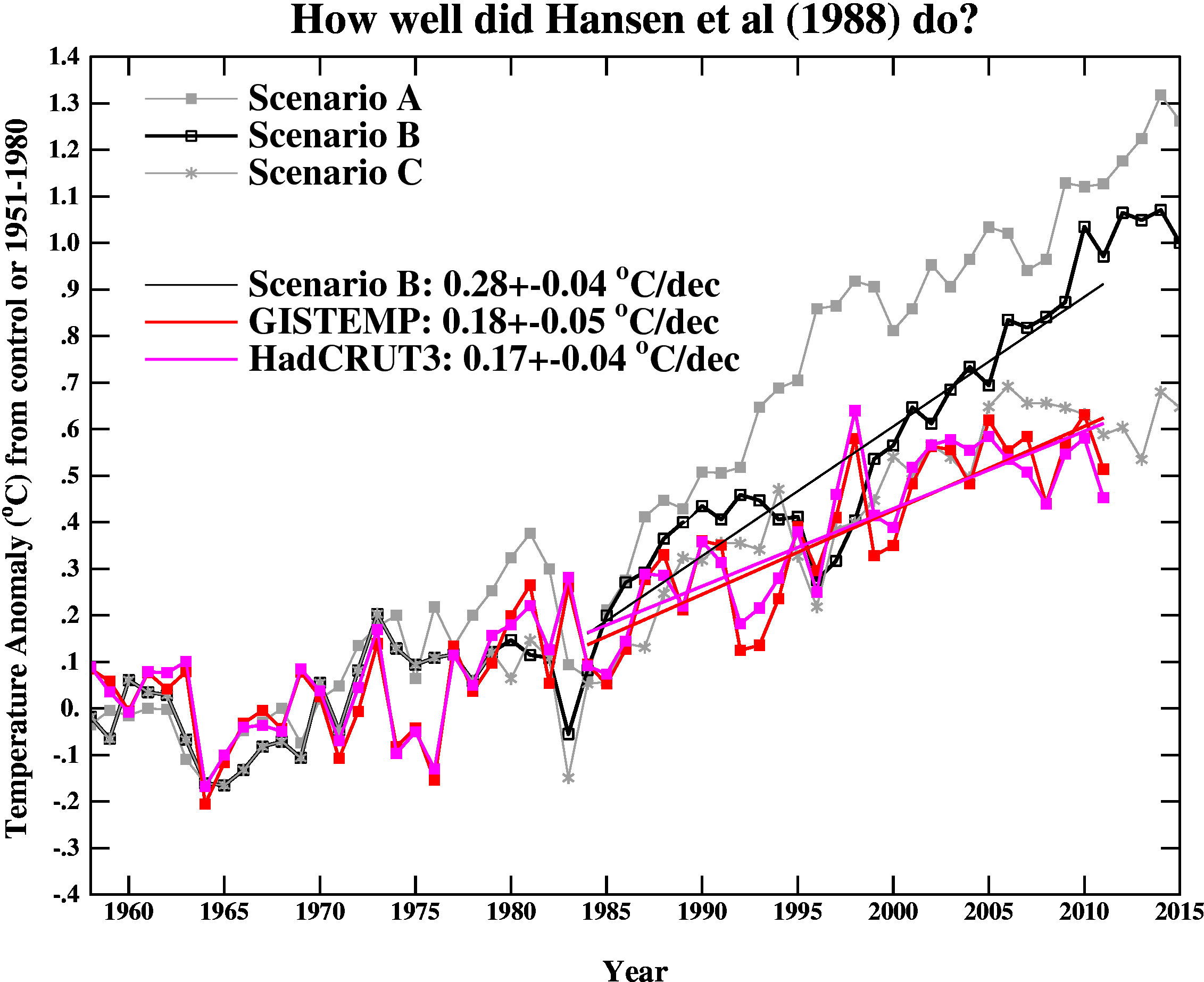
Do you know who is qualified to speak on this subject? James Hanson, and a 1981 paper he published in a peer-reviewed journal attempted to project the rise in temperatures over the next 30 years. Those projections still managed to underestimate the observed rise in temperatures by 30 percent and even the worst case scenario of those projections managed to underestimate the observed trend.
So no. You are not vindicated. You have demonstrated that you have no understanding of how science works, elevating the opinion of someone speaking outside their realm of expertise over the peer-reviewed published research of an expert with over three decades working inside the subject of climate change.
-
Re:Model fits the data [Re:Vindication]
The mainstream climate scientists are not and have not been mispredicting the rate of climate change. If you look at the data from models from 1979 (the National Academy of Science study), or even the models from 1967 (the Manabe greenhouse-effect calculation)-- the actual data fits the model very nearly exactly.
Here's a checkup on a Hansen prediction from 1981. I wouldn't call it near-exact, but still pretty good for a 30-year-old model of a very complicated set of things.
Speaking of graphs, I find this one really scary, and would want to see it flatten out or drop for a good few years before I stop caring about my energy usage.
-
Re:Greenland history
I somewhat suspect you would find a way to protect your preconceptions no matter what
Why would I have preconceptions? Debating how best top characterize the degree of accuracy of a 1988 paper is a bit like debating whether the 1998 Yankees were better than the 2011 team. It's the sort of thing one might discuss for a few moments of idle amusement, but not exactly a matter of great concern. Continually attacking an old paper seems very odd to me as a scientist. Scientists don't think this way. If you think there are weaknesses in a study, you demonstrate it by doing a better job. And certainly there have been a lot of research groups that have developed their own models since Hansen's early work. The only people I see doing this thing are cranks: creationists attack Darwin; germ theory denialists attack Pasteur; HIV/AIDS denialists attack Gallo. And global warming "skeptics" attack the early work of Hansen or Mann. Perhaps you can explain the motivation for me. Is it out of a misunderstanding of scientific thought, and a mistaken belief that the whole field will collapse if errors are found in this early work? Or is it just personal anger at these researchers for their contributions in getting the whole field started? Certainly, a lot of posts that I see on Climateaudit or WUWT seem to exhibit a level of personal animus that strikes me as frankly bizarre.
Would you estimate that in future, the temperature will more closely track the red line, the green line, or the blue line?
This strikes me also as very strange. Those 3 lines reflect completely different scenarios in terms of CO2 control. Are you asking me to make a guess as to the politics of future CO2 control? And why make projections based on a decades-old paper when the field has advanced considerably since then? Not only have the models been refined, but computing power has increased, so that it is not more feasible to run models repeatedly with slightly different starting conditions to get a better idea of expected weather variability around the overall trend. So if I actually wanted to make a projection, I'd guess that it temperatures would tend to track somewhere within range estimated from the ensemble of model runs. But if you insist on using an out-of-date model, I'd say that over the long-run temperatures would probably track somewhere between Hansen's A and C scenarios, since these represent fairly extreme assumptions regarding CO2 mitigation that are unlikely to be realized in practice. These days, it is thought that Hansen's model had the climate sensitivity a bit high, but not so much that the temperatures are likely to track outside this range for long.
-
Re:Greenland history
One thing that scientists look at is the range of variation of different climate models, or multiple runs of a single model.
This is discussed in the IPCC reports that I referred you to previously. See here, here, and here, for example. Additional explanation can be found here -
Re:Public concern
I take it you're not disputing that 98% of climatologists are convinced that climate change is occurring, and is human-caused.
As for the negative effects of this change, IPCC Working Group II covered that pretty well. There's plenty of similar reports from other bodies too, including individual climatologists.Are you claiming that these do not represent the majority opinion, or just nit-picking about the exact figure?
-
Re:Greenland history
Yeah. Remember what we said about realclimate.org? That article is by a guy talking about his boss. Do you think he's going to say how bad the predictions are?
If you look at the graph you linked to, the green line means we add a lot of CO2 to the atmosphere, the blue line means we add a little CO2 to the atmosphere, and the purple line means we stop adding CO2 to the atmosphere entirely by the year 2000. The reality is we added more CO2 than the blue line, but less than the green line. So if the model were accurate, temperature should track between the two.
If you look at updated data in that first diagram, you can see that the land-sea temperatures are below scenario C, ie below what he estimated if we stopped emitted CO2 completely. The satellite temperature reading is off from between A and B by nearly half a degree. If I were trying to be misleading, I could say he was off by 100%.
Our other dataset, the land-only dataset, can be seen updated here, but even that is off by 30% or so. It's not clear why the land data is diverging from the other two records. -
Re:Greenland history
Keep in mind that these physical models do not model the complex social and economic factors that dictate the time course of atmospheric CO2 increase. As a result, they do not predict the trajectory of global temperature change—they predict the temperature change given a specific trajectory of CO2 increase. For this reason, the term "projection" is commonly used instead of "prediction" to describe the model output. So to evaluate the predictions of a climate model, it is necessary to plug in the actual CO2 values. When this is done, Hansen's 1988 model still looks quite good. Of course, as historically important as Hansen's pioneering work was in demonstrating that rising CO2 implies a problematic rise in global temperatures (a prediction that has been dramatically confirmed since then), there has been considerable scientific progress in quarter century plus since then, and he is no longer the only scientist doing this kind of work. There are multiple competing models from independent research groups, although they agree qualitatively in predicting that rising CO2 will result in climate change sufficient to cause multiple severe problems. For a full discussion of the modern state of the art in climate models, see the IPCC reports.
-
Re:Ice age
-
Re:Greenland history
It DOES, however, tell us that the current climate change is (1) within the normal variation of climate, and (2) shoots some large holes in the "anthropocentric" part of the theory.
Strawman! Climate science does not claim the that the current climate change is not within the range of "normal variation of climate," (in fact, it states the opposite of that) but rather that the scientific evidence shows that the natural causes that have produced large variations in the past are not present today.
Especially as the predicted changes from the computer models have not occurred.
-
Re:The problem is chicken little
This is complete and utter crap. This kind of arrogance is why people are pushing back against you. You've created a theory that, rather conveniently can't be disproven.
Completely false. See here for a list of some of the confirmed falsifiable predictions of climate theory. And that includes the big one: predicting global warming before it was evident in the temperature record.
Never mind all of the predictions that haven't come true
Citation needed. Please provide IPCC report references for the consensus climate science predictions that supposedly have not come true
-
Re:Hansen Must Go
The problem with 1000AD warm Greenland is that it is sea level then was considerably lower than today. This suggests it's local.
http://www.realclimate.org/index.php/archives/2011/06/2000-years-of-sea-level/
-
Re:In other news...
"Dr. Peiser doesn't have the scientific background to judge whether Hansen's predictions are correct, incorrect, or somwhere in between"
Okay, how about Gavin Schmidt, who does this for a living? Granted, he works at NASA GISS with Hansen, but you can't deny he's an expert.
http://www.realclimate.org/index.php/archives/2007/05/hansens-1988-projections/And this isn't something you need to trust an expert on. Look up Hansen's 1988 paper for yourself, compare it to your favorite observations, and draw your own conclusions. I have: Hansen's 1980s models are dead on. His model was oversensitive to CO2 changes by a little bit, and his middle-of-the-road scenario underestimated human CO2 output by little bit. 1980s climate science predicts 2011 temperatures accurately to within a tenth of a degree.
-
Here's what sealed the deal for me
I was always somewhat sceptical of anthropogenic theories of climate change that humans were the blame and we were causing the increase. I certainly felt we had part of the blame but there's so many complex systems at play, were we at fault alone? How do we know it's our CO2 up there? I think the climate change advocacy folks need to present better evidence in order to convince folks who are somewhat educated in science. The evidence that CO2 isotope composition is changing in the atmosphere points the finger at burning fossil fuels. Take a look at http://www.realclimate.org/index.php/archives/2004/12/how-do-we-know-that-recent-cosub2sub-increases-are-due-to-human-activities-updated/ for example, which highlights this. The carbon isotopes in the CO2 in the atmosphere are changing and match closely with fossil fuel composition. Pretty compelling, IMO.
-
Re:Specious use of percentages
Why don't you type that up in an article and see if you can get it published in a peer-reviewed journal?
Before you do that, I suggest you save yourself some time and try googling your little theory. You may find this link and this link interesting.
Here's a quote:
[...] One common refrain from skeptics is that the atmosphere is already saturated with CO2 – in other words, that the greenhouse effect has already reached “its peak performance,” as Nova puts it – so adding more of it, even doubling its atmospheric concentration, shouldn’t make a difference. The problem with this logic is that it ignores the complex, multi-layered structure of the atmosphere by essentially treating it as one unit.
I'm continually amazed how people who clearly aren't experts in climate modeling think they can debunk theories from people who have worked in the field for decades without even researching whether their debunk makes any sense.
-
Re:monkeys throwing darts...
It's worth noting that Hansen predictions got worse when he testified before a 1988 committee of Congress in the usual staged congressional hearing. Sure, these predictions aren't random, but the way they aren't random often is unscientific and biased.
-
Re:Always the wrong angle
Oh, there are plenty of examples, such as these, but it is clear that you are not interested in educating yourself. You will keep denying.
-
Re:Simple solution...
In a word, no. It is more the rule than the exception in physical processes for causality to be able to run in either direction, depending upon boundary conditions.
Really? So, we can heat a pot of water with fire, and also cause a fire with a heated pot of water?
Let's have an actual example.
The reason that they are not sure of the sign is that the evidence indicates that net cloud feedback is close to zero.
Hardly. They have no idea about the magnitude *or* the quantity.
And no, nobody has managed to come up with a model that creates the modern warming through cloud feedback and that is at all consistent with the known climate records.
Again, you're trying to take a failure of the GCMs you have so much faith in, and then assert that this failure must somehow represent an entire solution for the problem at hand? We know cloud feedback is real. We don't have any model that accurately deals with cloud feedback. How can we rely on a model that ignores reality?
every model that is consistent with the known climate record
Models are consistent with the known climate record because they've been curve fitted. Understand this isn't one of their strengths.
You can't tell much of anything from a graph in which the axes are unlabeled. Warming arising from "natural" sources can be distinguished because "natural" does not mean magic.
The graphs are the same period of time, and the same vertical scale, simply unlabeled as to the absolute value. You cannot discern from either of them which one is supposed to be "natural" as per your AGW hypothesis, and which one is supposed to be CO2 driven.
Given that such a similar period of 50 years exists within the climate record, before any proposed CO2 impact should have even existed, shows great weakness, don't you think?
For example, warming due to an increase in solar output predicts that the upper atmosphere will warm more than the lower (in fact, the upper atmosphere has cooled).
Funny you should mention that:
http://www.realclimate.org/?comments_popup=2019Note
“what would FALSIFY [linking CO2 to ‘warming’]?”Schmidt swings again:
”that the stratosphere is not cooling as expected (this is a cleaner test than the surface temperatures because there are less extraneous factors)”And it’s a miss! The stratosphere hasn’t been cooling in over a decade:
http://www.acd.ucar.edu/Research/Highlight/stratosphere.shtml
http://www1.ncdc.noaa.gov/pub/data/cmb/temp-and-precip/upper-air/uahncdc.ls
http://www.arl.noaa.gov/documents/JournalPDFs/RandelEtal.JGR2009.pdfLike many physical processes, it can run in either direction, depending upon circumstances
Ah, back to the pots of heated water than can create fires
-
Re:I don't think so.
Trust is not inherent in science as an ideal(which is one big thing that makes it different from religion), but as a social construct it is unavoidable. When scientists say they've detected a neutrino even if I were provided the equipment and methodology the results would be meaningless to me and others without understanding the subtleties in what I was detecting to prove the hypothesis. Basically specialized knowledge is required to make such observations worthwhile.
I don't know what fake "AGW fisaco" you're referring to, but here's some data that you claim the scientists don't have. -
Re:Simple solution...
You're talking about perhaps *necessary* requirements
That's what a "falsifiable prediction" means.
You've given us no reason to believe that your predictions are indicative that your hypothesis is correct.
Real science never claims to prove that a theory is correct. Indeed, it is a logical impossibility to prove any theory correct. It is always possible that there could be some other theory that could be equally consistent with the data. In the case of climate science, critics have had a long time to come up with competing theories. The physics upon which climate science is based is published and the equations are well known. Code for many climate models has been made publicly available. Yet no critic has been able to come up with a climate model that is based on valid physics and is equally consistent with the existing climate data and that does not predict a worrisome degree of warming as a consequence of CO2 emissions. This is about as strong as evidence ever gets in science.
No, you've got it wrong again. "No correlation" (as opposed to "no causation", which is requires correlation, but then it also needs a bit more), doesn't mean *zero* average change in one variable when the other one changes. That's daft.
Wrong. Pick up a statistics textbook. The null model of correlation is that there is zero average change in one variable when the other one changes. Showing that the change in measured values is significantly greater than would be expected from chance variation constitutes rejection of the null model. Of course, correlation does not imply causality. Statistics is inherently unable to determine causality.
Again, you're playing a trick on yourself - you cannot simply prove your hypothesis by picking a trivial null to disprove, asserting that once it is gone nothing replaces it
The null model is the zero model--zero change or zero correlation. I didn't pick it; that's how it's defined. You are trying to call a tail a leg again.
hat's the kind of argument you get from creationists who insist that BAM, once you discard the null hypothesis of evolution, which breaks the 2nd law since it goes from disorder to order, that the only reasonable explanation is an intelligent designer.
Sorry, but this is scientifically illiterate nonsense. No biologist will tell you that natural selection is a null model. Remember, a null model is purely statistical, and therefore cannot be causal. One could of course create statistical null models that would be relevant to the theory of evolution. One such model might be "the genetic code of [insert species] has not changed over time." But the theory of natural selection is a causal model, not a statistical model, and hence can never be a null model.
You've managed to write a lot, but you've still failed the most basic test of science - the existence of the necessary and sufficient falsifiable hypothesis.
I can't help being amused when amateurs try to tell scientists how to do science--and get it ludicrously wrong. In this case, "necessary and sufficient" is not even wrong--it's impossible based on elementary logic.
-
Re:A witch hunt, but...
Want the raw data? Here! The first segment, as you can see, is called "Climate data - Raw". Want the code? Here! They're cleaning up the scientist-written code to see if it performs the same as the published results.
There's plenty of scrutiny, that dosen't involve harassment or intimidation of scientists and shifting goalposts.
With that in mind, why spend literally trillions of dollars trying to prevent the climate from changing, when it's going to change anyway? Maybe not in the exact same way as it would sans humanity, but it's going to change. Better to use the resources and effort to address that, than using it tilting at the useless windmill of trying to make the Earth's climate static.
If you're going to die of cancer anyway, why spend literally tens of thousands of dollars in treatment to prevent it from metastasizing when it may happen anyway? What a question!
Here's my answer: I live on the coast. In a place about 7 metres above the mean sea level. In a "third world" country. In a part of the country that's relatively borderline between arid and lush. In the tropics, yet. My city and region both have several millions (several hundreds of millions, even) of people living here, and a good couple of billion should be living in similar areas around the world. A few degrees increase in the global temperature may not seem much for someone living in the arctic - indeed, it may even be welcome, but for us, this would mean the end of any kind of sustainable life.
Do you really want to create a billion-strong exodus of people who've got nothing to lose anymore if it can be prevented at all? If there's even the tiniest chance of preventing it?
-
Re:Closing one's ears
Heavy rainfall may continue but there is a limit to how much rainfall the land will absorb once it becomes saturated. Then the rainfall just runs off. At some point the effect loses the ability to continue to lower sea levels as the ocean continues to warm and land ice continues to melt. But I don't expect that we will see rainfall like the past two years in every year. There is still natural variation and there will be dry and wet years. Two years of sea level drop is pretty meaningless. If it continues for another 8 years then I'll take it more seriously.
I had to look up the "Miskolczi theory of a ‘saturated greenhouse effect’". I'd never heard about it before. But if even Dr. Roy Spencer is debunking it I have to think there is not much validity to it. Other debunkings here.
-
Re:So...
If you go here: Data Sources
You will find a link to Mann et al (1998/1999) which has the data and code that Michael Mann and his coauthors used in the original "Hockey Stick" graph. If you want the original raw data I think you'll have to go to the original papers that Mann got his data from.
-
Re:So...
Knock yourself out buddy:
-
Re:Global meltdown, they say ...
Hmm. In your (insightful? Really?) response, I see a lot of opinion and ranting, but I don't see a single cogent statement that refutes any of the claims in the paper. They explain the lags, the feedbacks, and the modeling they used in their paper. Real climate even has a more layman's description of the mechanism: http://www.realclimate.org/ .
Of course, you're probably counting on the fact that people rarely RTFA and fewer would RTFP. But basically your entire premise is incorrect and refuted in the paper itself.
-
Re:How "An Inconvenient Truth" can it get
It's not the CO2 from glaciers that's worrisome, but methane in the sediments. It's far more potent greenhouse has then CO2, and we have quite a bit of evidence in our studies of the issue (specifically historic evidence in relation to atmospheric concentrations of methane relative to temperature of the period) that suggests that once we hit the critical point where methane starts to get released, reaction will accelerate at a completely different rate from now and become utterly unstoppable.
Well let's see what the warmists have to say about that
The methane bubbles coming from the Siberian shelf are part of a system that takes centuries to respond to changes in temperature. The methane from the Arctic lakes is also potentially part of a new, enhanced, chronic methane release to the atmosphere. Neither of them could release a catastrophic amount of methane (hundreds of Gtons) within a short time frame (a few years or less). There isn’t some huge bubble of methane waiting to erupt as soon as its roof melts. Much ado about methane
and
... the methane worst case does not suddenly spell the extinction of human life on Earth. It does not lead to a runaway greenhouse. The worst-case methane scenario stands comparable to what CO2 can do. What CO2 will do, under business-as-usual, not in a wild blow-the-doors-off unpleasant surprise, but just in the absence of any pleasant surprises (like emission controls). An Arctic methane worst-case scenario
seems they aren't real excited about methane.
-
Re:How "An Inconvenient Truth" can it get
It's not the CO2 from glaciers that's worrisome, but methane in the sediments. It's far more potent greenhouse has then CO2, and we have quite a bit of evidence in our studies of the issue (specifically historic evidence in relation to atmospheric concentrations of methane relative to temperature of the period) that suggests that once we hit the critical point where methane starts to get released, reaction will accelerate at a completely different rate from now and become utterly unstoppable.
Well let's see what the warmists have to say about that
The methane bubbles coming from the Siberian shelf are part of a system that takes centuries to respond to changes in temperature. The methane from the Arctic lakes is also potentially part of a new, enhanced, chronic methane release to the atmosphere. Neither of them could release a catastrophic amount of methane (hundreds of Gtons) within a short time frame (a few years or less). There isn’t some huge bubble of methane waiting to erupt as soon as its roof melts. Much ado about methane
and
... the methane worst case does not suddenly spell the extinction of human life on Earth. It does not lead to a runaway greenhouse. The worst-case methane scenario stands comparable to what CO2 can do. What CO2 will do, under business-as-usual, not in a wild blow-the-doors-off unpleasant surprise, but just in the absence of any pleasant surprises (like emission controls). An Arctic methane worst-case scenario
seems they aren't real excited about methane.
-
Re:Have you also solved the "dark matter" problem?
If you are a climate scientist, please publish your data and your methods. Thank you.
The data and methods are published. You just want it simplified enough so you can understand it. That may not be possible.
-
Re:Isn't that anti-science?
in fact IPCC has been consistently wrong, even with their more conservative predictions ?
Untrue.
http://www.realclimate.org/index.php/archives/2011/01/2010-updates-to-model-data-comparisons/
-
Re:Both sides of debate anti-science
-
Re:Isn't that anti-science?
All models require initial conditions. You can't just put a model in some random state and run it forward. The results would be utterly meaningless.
Actually that isn't true. Climate models are based on actual physics as much as possible so from any starting condition they will eventually converge on the reality they project. Of course the closer you start to real conditions the faster that convergence is. See the question "Do climate models have global warming built in?" at the climate model FAQ here.
-
Re:Isn't that anti-science?
Climate models don't even attempt to predict real world weather. If you think that's what they do you've got it wrong. And comparing the results of a climate model run to the actual results where the various inputs are well known is one of the primary ways that climate models are tested. If you want to know more about climate models here are a couple of FAQ's from the guys that are actually doing climate modeling:
http://www.realclimate.org/index.php/archives/2008/11/faq-on-climate-models/
http://www.realclimate.org/index.php/archives/2009/01/faq-on-climate-models-part-ii/ -
Re:Isn't that anti-science?
Climate models don't even attempt to predict real world weather. If you think that's what they do you've got it wrong. And comparing the results of a climate model run to the actual results where the various inputs are well known is one of the primary ways that climate models are tested. If you want to know more about climate models here are a couple of FAQ's from the guys that are actually doing climate modeling:
http://www.realclimate.org/index.php/archives/2008/11/faq-on-climate-models/
http://www.realclimate.org/index.php/archives/2009/01/faq-on-climate-models-part-ii/