Slashdot Mirror
Domain: renewablesinternational.net
Stories and comments across the archive that link to renewablesinternational.net.
Comments · 15
-
Re:baseload myth busted
Fukushima affected Germany's schedule to end nuclear power, but there is more to the coal story. http://www.renewablesinternati...
It turns out that suprising little storage in the form of batteries is needed. Changing time of use makes RE work. Mostly AC and water heating demand response does the job. -
Re: Not downsizing nuclear
The energy-charts obfuscates energy transits, as stated here: http://www.renewablesinternati... have a look at the last paragraph.
-
Re:France is a Major Exporter of Electricity
Your statement is true for 2013 http://www.renewablesinternati...
Even though Germany is also a big energy exporter, especially to France in summer when the nuclear plants cannot be run at peak levels and in winter when all the French use their electric heating. However that changes over they year. Here is a more concise source of information on the subject:https://www.energy-charts.de/e...
-
Re:Read the Report
What reality do you live in? Perhaps you have some completely different Germans over there.
Your pretty graph shows a % difference year of year. That's nice, but a quick look finds this. Total up the numbers, you get 379 TWH. Renewables total to 30% of the energy produced, but that still leaves 70% of the energy produced by other means, including nuclear.
So has renewables replaced nuclear? No, it's still used, and even drawn down it provides more power than solar and wind combined.
Can renewables replace nuclear? Not likely due to the factors I mentioned before, but it'll be interesting to see it tried.
The total historical subsidies for renewables in Germany are a fraction of the total historical subsidies for coal and nuclear in Germany. Why don't you explain the need for subsidies for coal and nuclear?
Citation, please. What is the true cost of the existing generation, and how does it compare to true costs for renewables?
-
Re:So why is 60GW needed?Okay, I'm gonna explain this really in short steps for you:
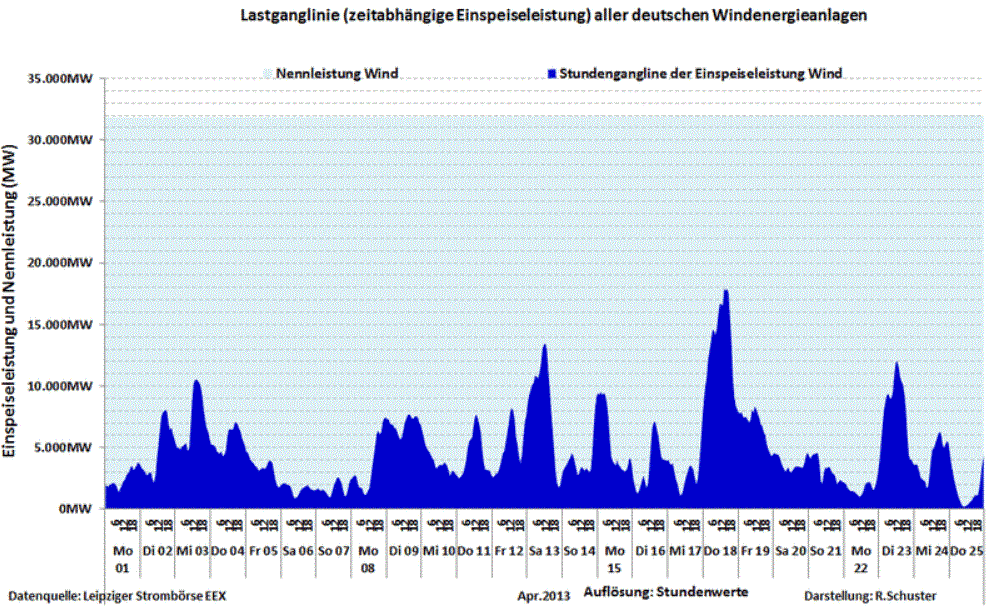
- German wind production is known to periodically drop to essentially zero during the day. Here's the facts showing that.
- Including solar doesn't help this either, as total production from both together varies by as much as 25x. Fact.
- German daily peak power demand is around 80 GW. Again, fact.
- The goal is 80% renewables at latest 2050. Fact.
- 80% of 80 GW is about 60 GW (I stress the word "about" here - these are ballpark figures).
- As such there will be days when Germany hits peak or close to peak demand with essentially the bulk of the REE resources being unavailable, hence the 60 GW figure.
- Your proposal was to import this shortfall from other places where the wind blows, as it always blows somewhere (I didn't dispute that). However, this carries several problems: (1) there's no such large-capacity transmission infrastructure and any expansion projects are being heavily opposed by land owners, (2) this requires installing surplus capacity at remote locations, (3) dealing with the transport losses and complex line control (oversized lines introduce severe problems with lots of reactive power, etc, and finally (4) being willing to absorb the political risks of having the power come from out of the land on really short terms.
You might counter that a portion of that energy can come from hydro & biomass. Hydro is unfortunately already nearly maxed out (*) and biomass has problems with cost and repurposing of lots of farm land for energy crop production (and questionable CO2 benefits due to the excessive use of industrially produced fertilizers and use of heavy agricultural machinery running on fossil fuels; though there is room for improvement here, so no biggie). Still, this requires installing extra capacity, which must be counted against the cost of RE sources of energy. The alternative is to install energy storage on a massive scale to smooth out the intermittent sources and deliver power when needed - not an easy proposition either.
(*) Source: "23% of total technically feasible hydropower potential is exploited in China, 82% in USA, 65% in Canada, 73% in Germany"
-
Re:Citation?
Germany doesn't sell daytime power "at a loss". Power at night on the European grid doesn't sell for high prices. Show some citations, ye of eyebrow raising claims.
Well let's see;
Over the weekend, prices on the power exchange in Germany/Austria (Phelix) fell to roughly -2 cents per kilowatt-hour for peak prices and were also slightly negative at around -0.3 cents for baseload power. The effect of solar and wind in France was even more dramatic, though the roles of baseload and peak power were reversed, with the former costing -4 cents and the latter -2 cents. Negative power prices on the weekend
Selling at a negative price is pretty much the ultimate definition of "at a loss". This is reinforced by
Lower prices “leave a trail of blood in our balance sheet,” Bernhard Guenther, chief financial officer at RWE, Germany’s biggest power producer, Germany’s New Coal Plants Push Power Glut to 4-Year High
While the baseload coal plants are losing money;
Norbert Allnoch, director of the Institute of the Renewable Energy Industry (IWR) in Muenster, said the 22 gigawatts of solar power per hour fed into the national grid on Saturday met nearly 50 percent of the nation's midday electricity needs.
Never before anywhere has a country produced as much photovoltaic electricity," Allnoch told Reuters. "Germany came close to the 20 gigawatt (GW) mark a few times in recent weeks. But this was the first time we made it over." Germany sets new solar power record, institute saysThat's a lot of power to have to replace when the sun goes down or the weather turns to shit.
-
Re:This just illustrates
"All while new coal and gas is being massively built up so that they have hot reserve ready to go for the renewables fluctuations."
The new coal plants are almost all being built to REPLACE older units that are less efficient AND less flexible.
-
Re:So how many of them are actually qualified
(Link heavy...) I think you got the wrong end of the stick, there.
Some studies have been done that show a minimum 30% penetration is possible for *any* region (and this one stopped their modeling at 30%, so its likely higher)...
http://www.renewableenergyworl...An earlier study from Europe (no link at moment) put the figure around 40%.
Another US study comes in around 45%...
http://arstechnica.com/science...UK study comes in at >90%...
http://www.gizmag.com/uk-natio...German study comes in at 100%...
http://onlinelibrary.wiley.com...
More on this...
http://www.renewablesinternati...Some of these show cost savings from adding renewables, another one showed costs rising about 10-15%.
Iowa already got over 25% of power from renewables in 2013; not sure about the mix but I don't recall hydro being a big player there. The state has set a 40% target for 2015!
As for diverse power generation, that is a good rule of thumb, however the non-renewable generators cannot continue to operate in the long-term and nuclear in particular is even worse than variable renewables as the latter has a large correlation with demand curves. Anyone scanning the field for the past few years, however, is getting the idea that a diversity of storage will be at least as important. And there are a LOT of different options. The state of the art in this field has moved completely beyond the 1990s consensus that your post is predicated on.
Hydropower operating permits are up: http://grist.org/news/america-...
In Germany, they have closed a deal with Norway which has vast hydropower resources.
Batteries are considered the least economic storage solution, but I suggest you google "flow batteries". Here are some examples other storage types:
Zynth batteries
http://www.eosenergystorage.co...Battery EV storage pilot in US
http://www.latimes.com/busines...Ice bears (cold storage for hot nights)
http://www.renewgridmag.com/e1...Undersea pumped hydro (you read that right)
http://cleantechnica.com/2013/...Power-to-gas
http://www.nasdaq.com/press-re...Molten salt
http://spectrum.ieee.org/energ... -
Re:Delays not surprising
Also Germany building coal plants as replacment is mostly a myth:
http://www.renewablesinternational.net/power-plant-projects-on-hold-in-germany/150/537/61889/
Not the best source (I have better ones in German), but well you did not provide any source.
-
Re:Hmmm
Germany is a nett exporter of electricity, and is exporting more than ever before. German solar PV in the south is reportedly greatly aiding the French, who are being asked to conserve power in the middle of winter. http://www.renewablesinternational.net/german-power-exports-to-france-increasing/150/537/33036/
-
90% reduction in emissions is quite achievable
I founded an award-winning startup a couple years ago whose software tells you what your potential energy savings are, using only your street address and zipcode as inputs, so I've been tracking developments like this closely. What the experts call "sealing the envelope of the building," or thoroughly insulating the structure, does give you the biggest bang for the buck (although the ROI for triple-paned windows, as the article suggests, just isn't there). But that's not terribly sexy because once the insulation's in it's hard to brag to the neighbors about something that's invisible. An array of solar panels or a cool wind turbine are much better for that.
And NYC's solar potential is decent, at 4.08. That means that on average NYC gets 4.08 hours of peak solar production every day. A 200 Watt panel in NYC would therefore produce 200 Watts/hr for 4.08 hours, or roughly 0.8 kwh/day. You need 15 of those panels to produce the 12kwh/day, or 440kwh/month, that the average family uses.
When you consider those kinds of numbers, it quickly becomes obvious that all the chatter about "stressing the grid" with increased demand for electricity is FUD. What they're really worried about is this, which is already happening in Germany with the solar capacity they have today. That is, the profit curve for the fossil-fuel powered utilities has been gutted by renewables because they make most of their moneye during the height of the day when the demand is highest, and coincidentally exactly when solar performs best.
Especially now that we have seen several times this year, thanks to Hurricane Sandy and the Superstorm last week, that the grid is not reliable everyone is reaching the collective 'aha!' moment that causes a huge shift in energy consumption behavior and that the fossil fuel companies are terrified of.
-
Re:Irony of "affordable" German solar panels
Maybe you should read more about it... http://www.renewablesinternational.net/german-power-providers-raise-prices-by-12-percent/150/537/58855/
Yes, there is some cost to support renewables, no it is not all the increase in power. A far bigger reason Germans can't afford power would be the rate of inflation in food prices.
-
Re:Distributed Grid
-
Re:By coincidence...
In France?
Maybe in France, maybe in Slovenia, maybe in Italy, maybe in Finland. It will probably happen where it is the cheapest.
Do you seriously believe that enough biogas can be generated to replace the quantities of natural gas currently imported? 94e9 m^3 ?
Germany already dedicates 18% of it's agricultural land to biomass production for energy (2.14 million hectares). It may increase this to 4 million hectares. What are they going to eat?
http://www.renewablesinternational.net/german-biomass-growth-continues/150/515/28940/
So it seems to be the choice between importing nuclear material/conventional fuel and food. Right now, I do not have enough knowledge of the subject to make it an informed one.
If the gas plants are a stopgap 'till more wind and solar is ready what are the new coal and lignite plants for?
Probably the same. There are talks of using carbon capture & storage with these plants to reduce their climatic impact, so maybe they will not cause us to miss our emission reduction goals.
-
Re:By coincidence...
Luckily, due to the European CO2 emission certificate trade, the overall European emission of CO2 won't go up at all.
They will simply be reduced elsewhere.
In France?
And those gas power plants
1) can be run with biogas
2) are only a temporary solution to give wind and solar energy time to develop and are recognized as such.Do you seriously believe that enough biogas can be generated to replace the quantities of natural gas currently imported? 94e9 m^3 ?
Germany already dedicates 18% of it's agricultural land to biomass production for energy (2.14 million hectares). It may increase this to 4 million hectares. What are they going to eat?
http://www.renewablesinternational.net/german-biomass-growth-continues/150/515/28940/
If the gas plants are a stopgap 'till more wind and solar is ready what are the new coal and lignite plants for?