Slashdot Mirror
Domain: scripting.com
Stories and comments across the archive that link to scripting.com.
Comments · 116
-
The DTD is available elsewhere
From Dave's Scripting News on Friday, 27 Apr 01:
From the If-It-Weren't-So-Sad-It-Would-Be-Funny Department, yesterday when Netscape (apparently) deprecated RSS and broke all the links to their RSS stuff, they also broke people whose XML parsers require a DTD. The old URL for the RSS 0.91 DTD is totally 404 not found. John Munsch has a report from the field. I put a copy of the DTD into a folder here on scripting.com, and it will stay there, Murphy-willing, for perpetuity.
You can find his copy of the DTD here.
J.J. -
Re:For those who don't know: What is RSS?
Dave has also put the DTD back up on one of Userland's site, available at:
http://www.scripting.com/dtd/rss-0_91.dtd
--- -
Re:Open Standards, hmm?Here's the way the above post would have looked if the letters in the tags had been capitalized
We are an active participant in many of the standards bodies and have been leading the charge in promoting the use of XML, SOAP and other standards for our
Well, a cursory glance at Dave Winer's Scripting News might suggest otherwise. One of the leading exponents of SOAP, and of cross-platform interoperablity, talking fairly frankly about how he's had his fingers burned by "embrace, extend, exclude".I guess it's just a Slashdot thing.
-
Re:ADOBE.COM hijacked!
More info if you're curious, courtesy of Scripting News:
-
Re:Fixed?From the scripting news site:
Update: They deleted the link, 3:14PM Pacific.From previous post:
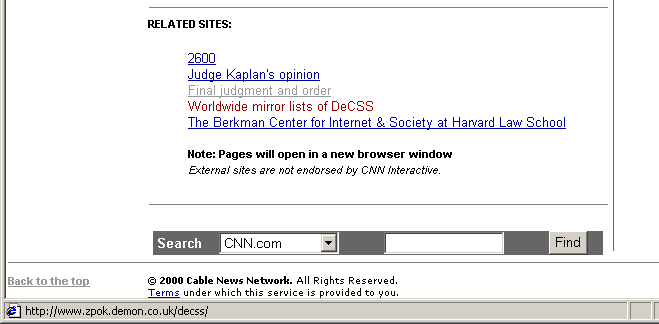
(assuming this isn't a hoax)I'm not really familiar with the scripting news site, are they a reliable source? In the screenshot they included in the story the link in question looks different from the rest of the links shown. Take a look, 3 of the other links are blue underlined, one is gray underlined, and the DeCSS link is maroon and not underlined.
Can anyone else verify having seen the link in the hour between the slashdot posting (5:19pm Eastern) and the alleged removal (3:14pm Pacific)?
-
Re:Not really a conflict of interestThe really sleazy thing would be for Time Warner to force an impartial news service like CNN to pull the article!
Looks like they already did [1].. There's a
screenshot showing the link before it was removed [2].
[1] - Well, the link at least
[2] - assuming it wasn't photoshop'd in in the 1st place.
--A mind is a terrible thing to taste.
-
They've Got A ScreenshotHere...Not that that proves anything, or wouldn't be easily doctorable, but it at least is a record of the link.
Unless of course this whole thing's a hoax. But Scripting News doesn't seem to be the type of site that would bother with a hoax like this.
----- -
Re:Fixed?
Here is a screenshot pre-change (assuming this isn't a hoax).
-
Re:Silly paranoiaok, since you won't research lori fena, i will. and what i found from a google search on her name does question a negative assessment of her commitment to privacy. i'd be interested to see slashdot do an interview of her, and see what her impressions of the privacy board are.
some links follow in case you're too lazy to hit google. but most of these are not current - 1995-1998 seem to be the ranges. this could just be google's problem, but again i think a slashdot interview with her would be in order.
-
Tilting at Windmills for a Better TomorrowHeh... took me all this time to find the reply button so I could actually post a new topic rather than replying to an existing one...
First, I'd like to thank all the people who have written to me at michael@geometricvisions.com regarding their experiences with manic depression. I'm afraid I'm getting a lot of mail today so I'm going to have to wait until tomorrow to respond to most everyone.
But if you're thinking of writing, please be assured that I take the confidentiality of people who write to me regarding this very seriously. If you like you can encrypt your mail with my PGP key
I want to respond to a number of things that have been posted here and also clarify a few things that were written in Kelly Luker's article about bipolar high-tech workers in the Metro San Jose.
A number of people have posted some very negative things about mental illness or about the mental health profession. While there are instances of bad doctors and certainly a long history of bad science and outright abuse in the history of mental health, there is no doubt that manic depression is a real illness.
This is evidenced by positron emission tomography scans of bipolar patients during various phases. PET scans measure the consumption of radioactive sugar in various parts of the brain.
Manic patients have strong positron emissions from the right hemisphere of the brain, showing that the right hemisphere is very active - suggesting a physical reason for the feeling of creativity and the overabundance of new ideas.
Depressed people have a reduced level of positron emissions relative to a normal patient.
A bipolar patient who is neither manic nor depressed will show a normal level of sugar metabolization.
The illness is thought to be genetic in origin, but the genetic nature of it is not well understood. Several times researchers thought they'd discovered the gene for manic depression but the discovery turned out to be wrong.
It happens that manic depression tends to run in families, but not always. It can appear spontaneously in a family, and after it does it will tend to be passed to successive generations and get worse with each generation.
I don't understand fully why but this is thought to suggest that the disease is caused by a certain morphology of mutation rather than a certain genetic sequence, and that this kind of mutation tends to get worse over generations. Apparently this sort of mutation is understood for other illnesses that do this so they think bipolar depression may work this way too. I'm afraid I don't have a lit reference but I expect I can get some.
Manic depression usually responds to medication. However it is very difficult to treat effectively. The illness varies quite widely in the severity and frequency of its symptoms among individuals, and each individual responds quite differently to the different medications.
It took about twelve years to find the right combinations of medications for me. I didn't work continuously to find the right combo, and in fact I went several years without medication - but it's important for any bipolar reading this to understa nd that you can go years with good health and become profoundly manic or depressed quite suddenly, as I did when I was hospitalized during graduate school during a manic episode.
Another problem is that doctors are often lazy or ill-informed about proper treatment. I was first prescribed lithium and nothing else, even though my most prevalent symptom was depression and I went years with fairly continuous suicidal feelings and no treatment at all for it.
Early on the only direct treatment for manic depression was lithium, so the mental health community seemed to have gotten this idea that lithium was therefore completely effective for everyone. The Only Choice != Effective Treatment
Another problem is that antidepressants tend to provoke manic episodes, especially if they are given without mood stabilizers like lithium, depakote or tegretol. Quite often the new patient's only complaint is depression and the doctor doesn't ask questions that would determine a history of manic behavior, so they prescribe antidepressants without anything to prevent mania, and the patient then has a psychotic episode, as happened to me when I was first given antidepressants and I spent six weeks in a psychiatric hospital.
The doctors then overreact and refuse to prescribe antidepressants at all, and the result is either a miserable life or maybe suicide.
Things are somewhat better now than when I was first diagnosed. Over time it was discovered that a number of epilepsy medications are effective mood stabilizers, and once the first such was found (tegretol) a large number of others followed (I take depakote, or valproic acid). This means that there is a choice for those who either cannot tolerate lithium (as I can't) or for who it is ineffective - lithium only reduces hospitalizations by about 50% overall.
The wide range of medicine and I imagine the overall advances in biology and medical research have combined to yield an understanding of how manic depression actually works in the brain. This understanding has only come about in the last five years or so, so now I understand drugs are under development that effect the processes of bipolar depression directly, by rational drug design.
Most of the existing medications were found to be effective by chance and no one ever understood how they worked.
I understand lithium was discovered because someone noticed that lithium salts made guinea pigs less active so he just fed a bunch of lithium to all the patients in a psychiatric hospital and the bipolar patients happened to get better - most likely the reaction of the guinea pigs resulted from lithium's potent toxicity; regular blood tests are required when one starts taking it because the effective dose is pretty close to the toxic dose.
But basically what got me better isn't just the medication, it was taking responsibility for and control of my treatment. Your doctor only sees you for an hour a week (or 20 minutes a month if you're in a typical state mental health program) while you get to experience your illness every waking moment (plus nightmares during sleep).
So really, if you suffer from this, what you need to do is get informed and get the right treatment. What form that may take I cannot really tell you, but for almost everyone, there is an effective treatment which is not debilitating. If your current medications don't work for you, work with your doctor to find better medications; just give time for the new ones to fully take effect before switching again.
I want to comment on the link between manic depression and creativity. Kelly Luker, the author of the Metro San Jose article, really didn't seem to get it when I explained to her that becoming manic was not a desirable thing. I really did take pains to explain it to her clearly.
Yes, the early stages of mania, or mild mania (called hypomania) do feel pleasurable so she really thought this was something to be desired and all us bipolar programmers were all fired up on our jobs while going through manic episodes.
But that's really not how it is. Mania is a profoundly psychotic state. One goes days on end without sleeping. Thoughts race and crowd the mind so fast that one is able to complete a concept in ones own mind - let alone say a complete sentence to another person. Manic people make extremely poor judgements and often act on them without any regard to the consequences - which all too often come to roost once the manic episode is over and depression sets in.
Hypomania can be a happy and productive time but only in short bursts; it can't be maintained. And for me, severe depression invariably follows any manic phase whether it is mild or severe, so I work very hard to avoid getting manic.
The important thing to understand is that while one feels creative while manic, true creativity only comes during the balanced times (I hesitate to say "normal"), and the work of the manic depressive to heal, as I have over the years in 14 years of psychotherapy, is to learn to live a balanced life without mania or depression.
The link between manic depression and creativity is extensively (and authoritatively) discussed in Kaye Redfield Jamison's Touched with Fire. She gives case studies of many famous poets and writers who were thought to be manic depressive (because of suicides, or manic behaviour) or actually known to be, and also quotes such studies as one about a prestigious writer's workshop, many of the attendees of which went on to commit suicide.
Jamison is a coauthor of the standard medical text on manic depression.
Dr. Jamison kept her own illness largely a secret during her training and career as a psychologist. But she discusses her own (and her father's) manic depression in her biography An Unquiet Mind
The subject of my letter Programming and Madness wasn't about how programming drove me nuts - it was about how it made me sane.
After I cracked up and left college I had no way to support myself, I was broke, hungry, miserable, sick, clinically depressed - not just sad but yearning to kill myself almost continuously, sleeping twenty hours a day.
I needed to find a place for myself in the world where I could live contentedly as the geek I had always been. My first love was, always will be physics (I did research on the 60" and 200" telescopes at Palomar Mountain, and did my senior thesis work for UC Santa Cruz at the particle accellerator at CERN in Geneva, Switzerland). But for some reason I've never been able to survive in the world of physics.
Working with computers, on the other hand, and in the community of computer programmers, I do very well.
It's my experience that there are a lot of other people in the computer industry, and in the scientific and technical world in general, who suffer from mental illness. "Unipolar" depression is most common but manic depression is quite widespread too. I know this both because I see it in others and sometimes we come out of our closet and, at work or on the net, we share our experience with each other. It's been a really long and complicated process for me to get where I am, and a big problem I faced when I first came down with it was a lack of good information. I'm trying to do something about it.
Imagine the day when you could ask a random stranger why the sad face and he'd feel perfectly safe in telling you "I'm clinically depressed". People will tell strangers about a lot of medical conditions, but mental illness still brings up images of Bedlam in a lot of people. And I'm afraid some of the worst stigma is actually self imposed; meaningless comments on the topic of mental illness can often have a devastating effect on someone who suffers from it, causing them to retreat far from the world of light for fear of exposing themselves when often their worst fears are mostly imagined.
I've used this sig for many years, I take it very seriously. Generally only my good friends understand the painful irony in it. I started using it shortly after getting on antidepressants after my first suicide attempt:
Tilting at Windmills for a Better Tomorrow.
Michael D. Crawford -
Re:Coincidence?(Gotta trust Slashdot to provoke some colorful discussion...)
Being a geek has a lot to do with mental illness. There's more to me than being manic depressive; I was always a social outcast growing up and quite long before I came down with manic depression I had plenty of problems with traditional psychological disorders, of the sort that are effectively treated with "talk therapy" (as was done with me as an adult).
In my case as a child my illnesses, both physical and emotional, drove me into the extremes of intellectual inquiry that leads to such scientific and technical achievements as attending CalTech as first an astronomy major, then a physics major, then (while manic) switching to literature.
I did research on the 200" and 60" telescopes at Palomar Observatory. For my senior thesis at UC Santa Cruz I did some numerical analysis and particle detector shift work at CERN in Geneva.
And I taught myself programming because I was too sick to continue school and eventually started my own software consulting company
You could say I was just one mentally ill person who happened to be smart, but I know I'm definitely not alone. I remember from CalTech that there were a number of people that I consider now to likely have been manic depressive (why did we have a full-time staff psychiatrist for such a small school?) at least one person who was schizophrenic, and a substantial portion of the campus sufferred from major depression.
I know one guy who attempted suicide while I was there and eventually succeeded after leaving school, and I once hitched a ride from a pasadena paramedic who commented on the large number of particularly bizarre suicide attempts that he responded to at the school. I heard about the case of an astronomy professor who wrecked his sports car driving to palomar observatory. So he bought another the next day - cash. It was in that car that he killed himself on the way to the observatory. He held a speed record for the drive from campus to the observatory.
Of course this is all just anecdotal evidence. More substantial arguments are given in the book Touched with Fire by Kaye Redfield Jamison, a psychologist who specializes in manic depression. The book gives case studies of many, many creative people who are known or thought to be manic depressive, people who committed suicide or exhibited manic behaviour during their lives, as well as statistical studies such as the attendees at a professional writers workshop many of whom killed themselves later.
Jamison's own study quoted in the book involved some british academics who had been awarded some high academic honor, and also who had sought psychiatric help far out of proportion to the general population.
(Jamison also coauthored the standard medical textbook on manic depressive illness and mostly kept her own illness quiet through her training as a psychologist and most of her career until she wrote a biography that emphasizes her and her father's manic depression, An Unquiet Mind
Something else I want to point out is, I've been around in the mental health game for a long time, been in lots of therapy groups, mental hospitals and such, and I've met people with many disorders. Everyone who wasn't manic depressive could be considered an average person; while I have known a couple unusually intelligent schizophrenics they weren't the usual case. On the other hand, I have yet to meet a manic depressive who wasn't extremely intelligent. This is not to say they are successful; often we are misdirected or we live in poverty because of our illness, but I don't know of a single manic depressive person who isn't really bright.
But what I was really trying to get at though in my letter Programming and Madness is not that programming makes one crazy; it is precisely programming that made me sane. A huge part of my healing process involved finding a place for myself in the world where I could still live happily as a geek. Sadly I've never been able to do that in physics, my first love. But learning to program turned me from a world of sickness and desperation to a life of joy and prosperity.
I still encounter mentally ill people in my work. I've worked in silicon valley companies where I met other manic depressives on the same hall. So in volunteering for the Metro article and posting this on Slashdot I'm trying to make life a little better for others who suffer as I do (and I still do, although not as bad - manic depression is treatable but not curable).
One more factoid. Some study a few years ago found that manic depression was not as common in the scientific community as it was among the artistic and humanities communities. But that is not my experience; the study was done on career members of the communities (college professors in the case of the scientists). It did not include students. My experience of students is that mental illness is just as prevalent as it is among artists and writers. I think one doesn't find so many mentally ill scientists either because they are rejected by the community or because they are successful in hiding their illnesses. I think that is a shame and I'd like to do something to change it.
Michael D. Crawford -
A community that really worked... for awhileBack in 1984, I joined an online community that -- at least for awhile -- actually worked. It was a small BBS that ran on a heavily souped-up Apple ][ with a 10 MB hard disk (considered to be huge and quite expensive at the time). It had a single dial-up line, and ran at only 300 baud until I modified it to run at 1200. (To do this, I litarally soldered bits of paper clips into the circuitry. The owner of the system was so totally a software geek that he didn't have any other kind of usable wire in the house!)
The name of the BBS was Stuart ][. (The name "Stuart" was chosen, nearly at random, by the author; as far as I know, it has no deeper meaning. The "][" was because it was a second impmentation; "Stuart I", the older one, wasn't tree-structured.) The tree structure was inspired by Dave Winer's outline-structured BBS, which he called LBBS (the "Living BBS").
It was, perhaps, the expense of long distance calls (almost no users were local) and the fact that it could take only one call at a time that kept the population of the system from exploding. (One advantage of this was that it really was possible to keep up with every message.) There was no private e-mail (due, probably, to laziness; the owner said that he had planned to write code for it but never got around to it), so all conversations were out in the open. And the tree-structured nature of the system required a certain amount of abstract thinking to sort out. (You really had to read a tutorial -- not a long one, but it did consist of several screens of material -- to get going.)
The board was, until it fell apart due to some unwise (and, some would say, perfidious) actions on the part of the owner, unlike any other. The level of discourse was light years ahead of what one saw on other systems at the time. Many people who are now rich, famous, or both -- names you'd likely know, at least if you work with computers -- stopped in, often under pseudonyms. (I won't name names, since I'm not sure that all of them want to be identified or want this little bit of history to be dredged up.) My name on the system was "Rogue."
Other BBSes began to copy the system's tree structure. XBBS and Pyrzqxgl, two BBSes in the Santa Cruz, CA area, used a nearly identical interface. Steve Manes' Magpie HQ, in New York, was also a derivative. (This was the BBS on which Rahul Dhesi, Thom Henderson, and Phil Katz debated compression software. Soon after, Thom sued Katz for writing PKARC, a program compatible with Thom's ARC. The lawsuit, in turn, caused the hacker community to shun Thom and his products. Soon after, ARC was a distant memory and PKPAK -- later renamed PKZIP -- was the de facto standard compressor for Microsoft platforms.) The WELL, the famous conferencing system run by The Point Foundation/Whole Earth Catalog people, likewise drew some inspiration from the Stuart ][ community, though it was not a tree-structured system.
Years after Stuart ][ fell apart, former users had such fond memories that they took an old snapshot of the tree-structured database and converted it to a tree of Web pages. It can be viewed at http://www.ccil.org:6502/0.html.
--Brett Glass
-
See IDG(NZ)This is being done locally.
I'm in Auckland, New Zealand, where the current time is GMT+13. It's almost 6pm local time, and I'm just trying to psych myself up for the New Year's party that's due shortly.
IDG NZ have set up a nice Y2k news site. Also, according to Dave Winer has commented that Dave Gilmore (spelling, URL) has prepared 2 columns, depending on whether or not we have local power.
I'm currently more worried about the beer supplies holding up until the shops re-open on Sunday. Donations of Heineken gratefully accepted
-
Re:More info on MS's XML/HTTP strategy?
Get yourself over to www.scripting.com and (!Wavey) Davey's world of XML-RPC.
Yes, it's SOAP. SOAP isn't Microsoft proprietary though, nor is there any obvious way in which the progenitors of The Language Formerly Known As XSL can break it as they did with IE5.
SOAP is damned marvellous. Simple, works really well, every home should have some. If the ****** (sorry, NDA'ed) appliance design crew get their way, every home will do.
It's also good for exactly those long-haul firewall-paranoid trans-internet tasks that Corba can't easily cope with (and don't even think about using DCOM).
-
Re:XML is not a silver bullet
Man, You guys are really missing the boat on XML. XML is what HTML SHOULD be: a logically defined set of tags that can later be seen by a database, programming language, etc. Essentially, XML **IS** a database. Go look at www.xml.org to see the benefits.
ANd yes, XML is getting a bad name because of Office2000. The point is that the DOJ could make MS use a CERTAIN set of standard DTDs for their documents.... kinda like saying they could only use OPEN standards like HTML, maybe one for spreadsheets (for excel), etc.
So yes, you CAN embrace and extend XML, just like HTML, but the DOJ could order them NOT to do that.
But XML is very, very cool.... I just wish I could convey to you in this little space how easy it makes web development. (see also scripting.com -
Weblogs are great
These days I get most of my web reading from links on weblogs of one kind or another - I'd personally count Slashdot as a weblog. I read Ars Technica, Scripting News, Robot Wisdom and Tomalak's Realm, and I'm on Haddock which has several great links every day.
NTK is often listed as a weblog, innaccurately - it's a weekly mag. But it's completely brilliant. Subscribe.
Also, h2g2.com (The HitchHiker's Guide To The Galaxy, online) has, amongst its many fab features, the ability for users to create their own weblogs on their homepages, with forums hanging off each entry. Worth a look, and I'm not just saying that 'cos I work there.