Slashdot Mirror
Domain: spacepolicyonline.com
Stories and comments across the archive that link to spacepolicyonline.com.
Stories · 6
-
White House Releases Strategy To Defend Against Killer Asteroids (vice.com)
An anonymous reader quotes a report from Motherboard: On December 30, the White House quietly released its Near-Earth Object Preparedness Strategy, a 25-page document outlining the United States' plans in the event that a giant asteroid is found to be on a collision course with Earth. Among the priorities outlined by the strategy are improving Near-Earth Object (NEO) detection, developing methods for deflecting asteroids, and developing interagency emergency procedures in the event of an NEO impact. Given the stakes, it's clear why NASA and the leading US defense and research agencies came together in January 2016 to form the Detecting and Mitigating the Impact of Earth-bound Near-Earth Objects (DAMIEN) working group to address the issues associated with killer asteroids. The DAMIEN group is behind the White House's new NEO strategy, and will be responsible for hashing out the specifics of the plan to save Earthlings from killer asteroids going forward. To assist in the search, the DAMIEN report calls for a space-based observatory dedicated to finding NEOs, which will work in cooperation with ground-based observatories. Since a telescope in space isn't limited by terrestrial weather conditions, it would greatly enhance Spaceguard's search capacity. The only plans currently underway for a space-based NEO telescope are being carried out by the non-profit B612 foundation whose Sentinel telescope was supposed to launch last December, but has been delayed due to difficulties securing the requisite $450 million in funding required for the project. NASA has also been considering the NEOCam, a space-based telescope that has received provisional funding for "detailed refinement." Unfortunately, during the latest round of budgeting for NASA's Discovery program, two other satellites were greenlit instead of NEOCam, but NASA said it would continue the asteroid-hunter's provisional funding, so there is still hope that NASA may go forward with a space-based NEO observatory in the future, especially in light of the recent White House strategy. In tandem, the report also recommends updating the capabilities of ground-based NEO observatories by endowing them with more powerful planetary radars and improved spectroscopy instruments (this would allow for more accurate determinations of the composition of an asteroid). But detection is only half the battle. In the event that an asteroid is found to be on an impact trajectory with Earth, NASA is also thinking about ways to deflect the killer asteroid. Some pretty far-out ideas have been proposed on this front, ranging from nukes in space to giant sun-powered lasers, but the most likely method is simply ramming into the asteroid to change its course. Finally, should all else fail, the report also considers what to do in an impact scenario. -
Who Will Pay For a Commercial Space Station After the End of the ISS?
MarkWhittington writes: While NASA is planning its road to Mars, a number of commercial interests and place policy experts are discussing what happens after the International Space Station ends its operational life. Currently, the international partners have committed to operating ISS through 2024. Some have suggested that the space station, conceived by President Ronald Reagan in 1984, could last as long as 2028. But, after that, there will still be a need for a space station of some sort, either in low Earth orbit, or at one of the Lagrange points where the gravity of the moon and Earth cancel one another out. -
SOTU: Community Colleges, Employers To Train Workers For High-Paying Coding Jobs
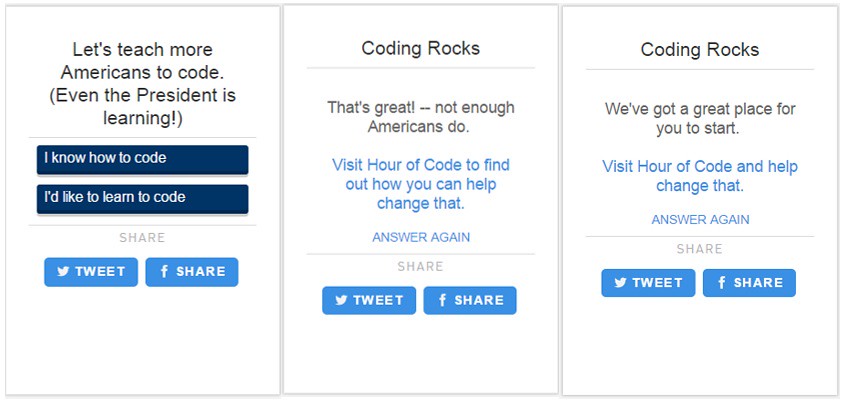
theodp writes: Coding got a couple of shout-outs from the White House in Tuesday's State of the Union Address. "Thanks to Vice President Biden's great work to update our job training system," said President Obama (YouTube), "we're connecting community colleges with local employers to train workers to fill high-paying jobs like coding, and nursing, and robotics." And among the so-called "boats" in the new "River of Content" that the White House social media folks came up with to enhance the State of the Union is a card intended to be shared on Twitter & Facebook which reads, "Let's teach more Americans to code. (Even the President is learning!)." President Obama briefly addressed human spaceflight, saying, "I want Americans to win the race for the kinds of discoveries that unleash new jobs – converting sunlight into liquid fuel; creating revolutionary prosthetics, so that a veteran who gave his arms for his country can play catch with his kid; pushing out into the Solar System not just to visit, but to stay." He also called once more for action on climate change. Politifact has an annotated version of the transcript for more background information on Obama's statements, and FiveThirtyEight has a similar cheat sheet. -
MIT Study Finds Fault With Mars One Colony Concept
MarkWhittington writes The Mars One project created a great deal of fanfare when it was first announced in 2012. The project, based in Holland, aspires to build a colony on Mars with the first uncrewed flight taking place in 2018 and the first colonists setting forth around 2024. The idea is that the colonists would go to Mars to stay, slowly building up the colony in four-person increments every 26-month launch window. However, Space Policy Online on Tuesday reported that an independent study conducted by MIT has poured cold water on the Mars colony idea. The MIT team consisting of engineering students had to make a number of assumptions based on public sources since the Mars One concept lacks a great many technical details. The study made the bottom line conclusion that the Mars One project is overly optimistic at best and unworkable at worst. The concept is "unsustainable" given the current state of technology and the aggressive schedule that the Mars One project has presented. -
US Space Policy Update Urges International Cooperation
eldavojohn writes "The recent shift in NASA's spaceflight goals has caused great stress in the space community and those related to efforts in space. A White House update to the policy is said to emphasize cooperation with the international community and looks to be a move away from individual nations competing in space. Instead, the document urges intense competition (PDF) in the commercial sector and reasons that 'The United States considers the sustainability, stability, and free access to, and use of, space vital to its national interests. It is the shared interest of all nations to act responsibly in ways that emphasize openness and transparency, and help prevent mishaps, misperceptions, and mistrust.' Space.com also notes that you can submit your comments and thoughts to the task force Obama appointed to determine new directions. No doubt this avoidance or departure from another Space Race will have a lot of people concerned that the US is out of the game." -
Astronaut Group Endorses Commercial Spaceflight
FleaPlus writes "Buzz Aldrin and twelve other astronauts have published a joint endorsement of commercial human spaceflight, stating that 'while it's completely appropriate for NASA to continue developing systems and the new technologies necessary to take crews farther out into our solar system, [the astronauts] believe that the commercial sector is fully capable of safely handling the critical task of low-Earth-orbit human transportation.' They are confident that commercial systems (which NASA already relies on for launching multibillion-dollar science payloads) can provide a level of safety equal to the Russian Soyuz and higher than the Space Shuttle, while strengthening US economic competitiveness. They also support the expected endorsement of the White House's Augustine Commission regarding NASA's use of commercial spaceflight — the Commission's final report will be released today." And here's the Augustine report itself (PDF).