Slashdot Mirror
Domain: starsem.com
Stories and comments across the archive that link to starsem.com.
Comments · 12
-
Re:Race goes on
At present time, the 98th Soyuz flight is docked to the International Space Station.
True. But there have also been 26 unmanned flights in the Soyuz programme. And don't forget the Progress spacecraft, derived from the Soyuz spacecraft and used for resupply. According to Wikipedia there have been 42 original Progress flights, 61 Progress M's, and 11 Progress M1's. That's another 114 flights, taking the total of Soyuz + Progress to almost twice as many flights as the STS.
Then there's the Soyuz rocket that is used to launch all of those, as well as other payloads. According to Starsem, who also use the rocket to launch commercial payloads, the Soyuz launch system has been used 1727 times. I don't have figures on how many of those have failed, but I bet the rate is better than the STS.
The Soyuz program is over forty years old and may not be as sexy as the shuttle. But both the rocket and spacecraft are good, simple designs that have had a long time to work most of the bugs out. You'd have to be stupid to not at least consider using them.
-
Re:Why so many?
There hasn't been a *public* Soyuz crew death since 1971
There haven't been any, and so the statistic stands. There are no gaps in the Soyuz launch records, no missing crews. Jim Oberg has pretty much debunked claims of covered up deaths in space. The deaths you explicitly refer to were indeed training accidents, and just as I don't count the crew of Apollo 1 (or people like Eliott See for that matter) in launch reliability statistics, you're correct not to count them either.
The Proton is a rocket family, but it doesn't contain the Soyuz, so I don't know where that non-sequiter comes from, especially given the proton is not human-rated. The Soyuz is also a family, but the differences between the family members comes from what upper stage you stick on top (Fregat, etc). The lower stage plus boosters is the same, right back to the original R-7 ICBM adapted to launch Sputnik. You can find more recent launch data from Starsem, the Soyuz launch company, and historical data can be also be found pretty easily, assuming you're searching for the right rocket family! If you're vague on Russian rocket families, this diagram will help. The Proton statistics -- a completely different, cargo rated booster-- have no bearing on the Soyuz statistics, the actual launch vehicle that is in the same arena as the shuttle (and these days the Long March 2F) in putting humans in orbit. -
Russia and ESA
Russia are involved in a lot of ESA work (and have been for 15 years apparently), as well as working with their Soyuz launch vehicle for many European probes. ESA are currently planning a Soyuz launch pad at Europe's launch site in Kourou, French Guiana.
The article also made no mention of SMART-1, the 'ion-drive' probe heading to the moon. It will be taking various readings and photos - in of course, higher detail than some previous endeavours. Wonder if they'll photograph the US moon landing sites? (Even apart from satisfying the skeptics - it'd be kinda cool to see new aerial shots of the sites!)
Russia are not (yet) members of the ESA. In the last week, Greece and Luxembourg were granted membership - the effort is growing. Members contribute an amount based on GNP, with a corresponding proportion of contracts and research being offered to that member.
Efforts are widely distributed - even my own (relatively small) University in Ireland has a number of researchers working on ESA stuff! -
Re:Where's Ariane?
Cost. The budget was extremely tight and Russia launch cheaper than ESA, even for ESA-run missions. It's a pretty strange state of affairs.
Plus Arianespace was in the process of moving from Ariane-4 (well-understood, pretty reliable) to Ariane-5 (track record not particularly good so far) while the program was being planned. I'd say the project leads called it right. (In any case, ESA also subcontracts Soyuz launches from Starsem where that makes commercial sense.) -
User manual...
I hope there are still some people reading, but not enough to slashdot this site. I was mooching around the Beagle 2 mission site and found a link to Starsem, the Russian company that provided the launcher. They have the user manual for the Soyuz-Fregat launcher online!! How cool is that? Caution, it's an 8MB download.
-
Hey! America doesn't have a monopoly on this!
The UK is also perfectly capable of chucking money at a good project ultimately to have it cancelled after 10 years development.
Did anyone in the U.S. ever hear of HOTOL
I would include the Russian Buran cancellation here as well but that was more as a result of a coup.
It should, however, be noted that the Russian "Starsem" organisation really know how to get a lot into orbit using the disposible Soyuz system.
There have been 1675 Soyuz system launches to date!
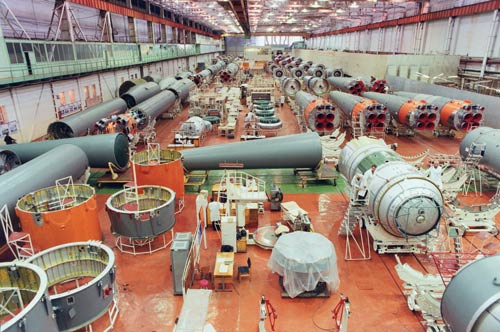
This image of the Soyuz production line show the extent of the operation. -
Hey! America doesn't have a monopoly on this!
The UK is also perfectly capable of chucking money at a good project ultimately to have it cancelled after 10 years development.
Did anyone in the U.S. ever hear of HOTOL
I would include the Russian Buran cancellation here as well but that was more as a result of a coup.
It should, however, be noted that the Russian "Starsem" organisation really know how to get a lot into orbit using the disposible Soyuz system.
There have been 1675 Soyuz system launches to date!
This image of the Soyuz production line show the extent of the operation. -
Oh, yes, really.
The Soyuz system is a veritable box of fireworks; since the 60's its been the principal launch vehicle for all Russian space missions and in terms of unmanned sattelite deployments it has in the past run to more than 6 launches a month.
Here's a link to a photo of the 'production line' it looks pretty busy. -
Re:Why are we picking on thr Russians?
-
Re:Why are we picking on thr Russians?
-
Re:Why are we picking on thr Russians?
-
Payload manuals
Space and tech has information on a lot of production and experimental spacecraft. Including payload user manuals in the expendable launch vehical section. The Soyuz payload user manual makes great three AM reading