Slashdot Mirror
Domain: thelivingmoon.com
Stories and comments across the archive that link to thelivingmoon.com.
Comments · 15
-
Re:No rain?
With a surface temperature in the region of 450degC,
Venus's surface conditions vary greatly with altitude, and are believed to have varied greatly with time; it's atmosphere is believed to being pushed over tipping points than Earth's. Using today's surface conditions, and a global average at that, to draw conclusions about specific features that formed long ago, isn't really helpful.
But yes, cooling rates on Venus even of regular basaltic lavas (apparently rather MORB-like in most locations, although not all) appear to be much slower than on Earth. Melt also is much more prolific after energetic events; for example, melt pools from large impactors often overflow their craters and flow for significant distances (example).
Compounding that, the high ppCO2 in the atmosphere is going to reduce devolatilisation of the lavas, retaining their initial low viscosity for
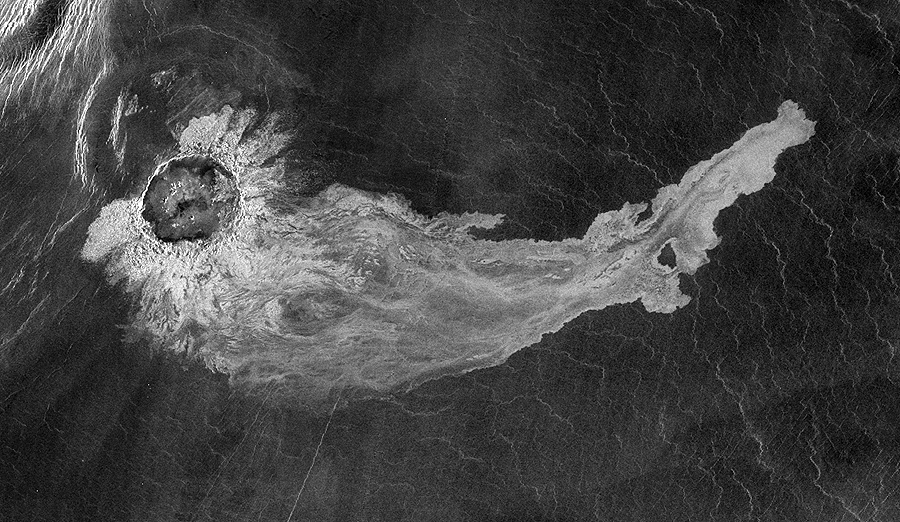
A river as long as Baltis Vallis - nearly 7000km - is going to have more than ample time for gas exchange during its flow. Also remember that Venus's crust is depleted in water, which reduces viscosity.
Don't get me wrong, carbonatites are fascinating (one of my friends while doing my degree was doing his PhD in UK carbonatites- fascinating rocks!), but such exotic melts are probably not necessary to postulate for these long Venusian channels
You're disagreeing with peer-review (note: I did not say carbonatites specifically, but "carbonatites or similar" - carbonatites are one of a few types of low-temperature postulated flows that could have realistically formed such rivers). Higher-temperature magmas simply are not believed to have been capable of flowing such distances with such low viscosities - even in the exotic environment of Venus's surface.
Those many cubic km of other materials processed to produce your carbonatites will be somewhere, and you'll see the structures they generate far more often.
Thankfully for Venus, volcanism isn't exactly rare
That's probably materials like sodium carbonate and sodium hydrogen carbonate weathering out very rapidly as the rocks self-metamorphose on their own residual liquors
They erupt containing large amounts of hygroscopic anhydrides (primarily gregoryite and nyerereite), which quickly absorb water from the air.
They're not panaceas.
"Carbonatites are panaceas" said nobody ever.
-
Ancients used sound to levitate large boulders
Of course all the patents are now hidden under "National Security", inventors murdered.
The Ancient Secrets of Levitation
Cultures From the Past May Have Had Ancient Secrets to Build Their Monuments
https://www.thoughtco.com/the-...Ancient Mysteries of Sound Levitation
http://www.trinfinity8.com/anc...Acoustic Levitation Of Stone
https://www.bibliotecapleyades...Tibetan Sound Levitation Of Large Stones Witnessed By Scientist
http://www.thelivingmoon.com/4... -
Re:Putting it in orbit would solve all these probl
-
Re:Does it really matter?
The X-15 was not relying on those stubby wings for lift during boost.
I seem to recall attitude adjustment jets being added to the wings to try to give some control during the higher attempts.
Those wings were useful during the steep glide/landing phase.
That beast was developed prior to the whole 'lifting body' thing.
Would have liked to see a DynaSoar http://www.thelivingmoon.com/4... actually fly. -
Re:Asia is playing catch up
Actually the Apollo missions did deploy a few UV telescopes on the lunar surface. They weren't much better than Earth-orbit telescopes, and so noone has bothered since. The radar is more interesting, but probably of limited utility given the power requirements to actually penetrate deep enough to see the layered mare deposits.
Where China is decades behind the US, Europe, and Japan is that they don't really release their science products. US missions legally must release all raw and processed data after a short proprietary period (typically a year). Europe and Japan take longer, but still do usually release all their raw data. China does not, and often waits until after the mission is over before releasing even highly processed versions of the data. The lack of raw data (and opacity of how it is processed) means that it is hard to compare to other sources, and belies any claim to actual scientific motivation.
LOL you're so full of shit they ooze out of your ears, NASA has been caught airbrushing moon photos and tinting mars photos.
The True Color of Mars
NASA's images of Mars are the wrong color
Finding NASA's airbushed moon towers using Military's own site
NASA Airbrushed Buildings on the Moon -
That picture
That picture on Space.com makes no sense. If the Moon is back-lit by the Sun, I expect to see an almost totally black disk. The Surveyor pictures on this page (scroll down) look more like what I expect. Can anybody explain why the Space.com picture looks like it does? Long exposure with Earth shine, or did they 'shop it because they thought it would look better?
-
Re:Usual NASA tech progress bullshit
What I have found is showing around 15 military missions, not nearly the 2/3 figure you're suggesting.
Now, if we're talking design features of the shuttle, those were heavily influenced by military requirements. The only way NASA could get enough funding to build the shuttle was to ask the military, which imposed significant performance requirements that drove up the weight and complexity of the shuttle. And, while useful, the additional capability was never fully used, nor was it ever used for its intended purpose.
-
More information
Had some fun looking up and finding some more information about the project and why it is being done.
Seems that ONERA, the French aerospace research institute, builds military radar among other things, and their bistatic experiment worked so well it is practically a finished product, so they are expanding it already. The OP project is probably based on this. So these things are dual-use though the OP's ESA project says it is to protect satellites and European citizens.
Overview of ONERA radar products: http://www.onera.fr/demr-en/references.phpDetails about the French GRAVES experimental bistatic radar facility and how it works with Germany's TIRA.
So successful they are being upgraded now. France, Australia and Canada cooperate with the USAF.
GRAVES was built in 2004 and is owned by the French arms procurement agency.
GRAVES is for objects in Low Earth Orbit, up to 1000km altitude. The upgrade will allow it to broaden the swath of sky and to eliminate errors in trajectory position to more precisely determine on its own whether or not two objects are destined to collide.
TIRA belongs to the German military. Though the new system is for all Germany not just the military they say.
"... Space situational awareness [is seen] as an important element in Germany’s national sovereignty."
From 2012, TIRA personnel will be trained by French and Americans.
http://www.spacenews.com/military/110531-france-germany-anchor-europe-ssa.htmlGRAVES, The French Space Surveillance System
http://www.onera.fr/dcps-en/graves-space-surveillance-system/index.phpAerial views of GRAVES, apparently. Explains that it can make angular measurements and get radial velocity.
http://www.thelivingmoon.com/45jack_files/03files/GRAVES_French_Radar_Surveillance_Facility.htmlA bit more info on the OP article (French so use Google translate)
http://www.smartplanet.fr/smart-technology/un-futur-radar-europeen-contre-les-debris-de-lespace-17211/
It adds:
- work begins Sept. 2012
- The goal is to help European satellite operators to exclude collision risk and improve safety in Earth orbit, an area in which France has recognized expertise, says ESA.
- "The two demonstrators radar will be part of an initial network of sensors that will also include optical telescopes and data processing centers to ensure observation of space debris on all types of orbits. '
- In the case of new experimental radar, the transmitter will be on the influence of the former airbase Crucey-Villages (Eure-et-Loir), about 100 km west of Paris, and the receiver will near Palaiseau (Essonne), south of Paris.
- The SSA
- The SSA program exposes the ESA will provide the final of Europe's ability to detect, predict and evaluate the potential risks to life and property represented by space debris, atmospheric reentry, explosions in orbit launches , collisions, disruption of missions and services using satellites, the potential impacts of NEOs, and the effects of intense space weather events on infrastructure both space and on the ground.
- In summer 2011, a U.S. report had alerted the critical level of waste in orbit . This amount has become so important that it may trigger a snowball e -
Re:Colour Correctness or Correction
This is a good read about the colors of Mars:
http://www.donaldedavis.com/PARTS/MARSCLRS.html
So is this one:
http://www.thelivingmoon.com/43ancients/02files/Mars_Blue_Bird_Color_01.html
I remember those pictures had a much stronger orange-pink colour to the sky because of the atmospheric gas composition.
While sometimes they turn a bit reddish/yellow/orange due to dust clouds, the skies on Mars are about as blue as those on earth, albeit a bit darker since the sun is less intense. In general, it would be pretty difficult to distinguish a picture taken on Mars during good weather from one taken in a rocky desert on earth.
-
Re:How many Star Wars reels were archived?
Compressed/uncompressed makes little difference.
With digital you've got three challenges:
1. Physical preservation of the media
2. Preservation of the format of the digital data
3. Preservation of the mechanical playback deviceWith analog film, only 1 and 3 apply and 3 is arguably much simpler. That 3 is simpler isn't something inherent to being analog. For example, recall NASA's lunar tapes that couldn't be played back until a specific model of Ampex tape player was rebuil. The technology to build a projector for analog film is much more simple than for most digital media.
-
Re:Why are archivists worried?
Yes.
An often overlooked fact is that with media that is reliant on mechanical playback, not only do we need to archive the media but also the machines that play them back. Even for analog data, this is sometimes difficult. Remember NASA's moon tapes that could not be played back until a player was reconstructed?
So even if long-term digital storage is stable, efforts have to be made to also archive the format and how to play back the media. Analog film has an advantage in this arena because playback is relatively obvious and simple.
That doesn't necessarily mean that analog is always better. It just means that digital video archives have different, and arguably more complex, technical challenges compared to analog film.
-
Re:A better idea
Frankly, humans themselves are a *lot* more likely to make Earth uninhabitable and a lot faster than a million years.
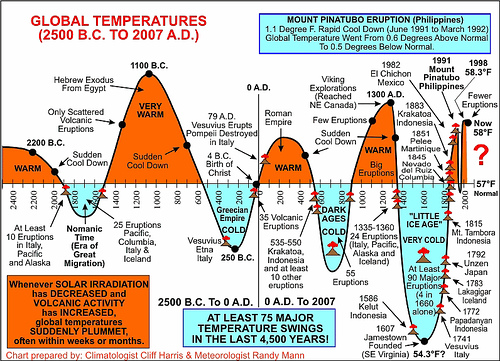
Which just goes to show the arrogance of mankind. Did you know that the sea level has been rising since the end of the last ice age (ancient civilizations even had to deal with this)? In fact it is pretty well accepted that the Earth is still thawing out from the last big ice age. But all this "global warming" nonsense makes for a great way to line certain peoples pockets with sales of books and carbon credits. Not to mention all the so called "green" energy sources that will never yield a return on investment, not to mention the effects that wind and solar farms have on the weather (solar reflects energy into space, cooling the planet, wind power alters wind patterns and is also known to kill flocks of migrating birds).
http://www.thelivingmoon.com/47john_lear/04images/Seas/2065311545_2abdf79551.jpg
-
IceCube?
What, the rapper?
No, seriously. I think I remember reading about this earlier this year in Scientific American or something
I gather that the one in the Antarctic will be bigger, and give a view in a different direction than the Russian one.
-
Terra Papers
Go here and look for the PDF for "Terra Papers". It contains a lot more than Sitchen could even begin to guess. You may laugh at the ridiculousness of it, so if it's too much for to consider than treat it as sci-fi. It's a fascinating read either way.
-
The Sumerian connection
The ancient Sumerians had a Star Gate and in their cuneiforms a tale was told of a craft with a lapiz lazuli underbelly and inside it had walls that talked and gave advice. I can not find a direct link to the text at the moment.