Slashdot Mirror
Domain: tlc-direct.co.uk
Stories and comments across the archive that link to tlc-direct.co.uk.
Comments · 7
-
Re:Unbelievable ? In related news ...
It's worth trying several different types of the compact fluorescents - The older ones tended to have a 100 Hz flicker but the newer ones work in the range of 10's of kHz which the persistence of the phosphor should smooth out. Cheap ones tend to have a worse spectrum - I like the Phillips ones but GE make some reasonable bulbs too. Some of the really crappy ones may also have a 100 Hz modulation caused by insufficient or dried out smoothing capacitors in the input section.
Other than that incandescent light bulbs are still available. Retailers are allowed to sell existing stock (and the rules only came into effect 20 days ago so I'm not sure why you've been struggling to find them for so long, where do you live?). What has been banned are bulbs over 100 W and all frosted bulbs (since these are deemed more easy to replace with fluorescent). This doesn't apply to anything other than standard general purpose lighting so spotlights, candle bulbs, etc are unaffected. Also there are replacements which include a halogen capsule in a standard glass envelope like this.
Where I live in southern England there is no trouble getting incandescent bulbs at the moment - hardware shops, supermarkets, poundland, and DIY shops such as B&Q are all still selling them. Failing that I'd recommend you go to a decent electrical wholesalers such as TLC direct
-
Re:Unbelievable ? In related news ...
It's worth trying several different types of the compact fluorescents - The older ones tended to have a 100 Hz flicker but the newer ones work in the range of 10's of kHz which the persistence of the phosphor should smooth out. Cheap ones tend to have a worse spectrum - I like the Phillips ones but GE make some reasonable bulbs too. Some of the really crappy ones may also have a 100 Hz modulation caused by insufficient or dried out smoothing capacitors in the input section.
Other than that incandescent light bulbs are still available. Retailers are allowed to sell existing stock (and the rules only came into effect 20 days ago so I'm not sure why you've been struggling to find them for so long, where do you live?). What has been banned are bulbs over 100 W and all frosted bulbs (since these are deemed more easy to replace with fluorescent). This doesn't apply to anything other than standard general purpose lighting so spotlights, candle bulbs, etc are unaffected. Also there are replacements which include a halogen capsule in a standard glass envelope like this.
Where I live in southern England there is no trouble getting incandescent bulbs at the moment - hardware shops, supermarkets, poundland, and DIY shops such as B&Q are all still selling them. Failing that I'd recommend you go to a decent electrical wholesalers such as TLC direct
-
Re:I hope they can apply it to cable TV
You can get a selection of stupidity filters for cable tv here
-
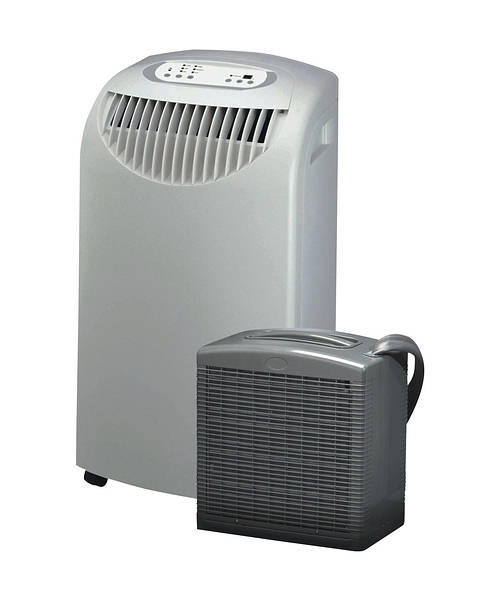
Similar situation here...We have about 15 employees but 5 servers. They're kept in a small room - maybe 12 by 5 feet. For cooling we'd like a professional install but never get approval, so we bought this split unit (image only - didn't buy from that company) and replaced a window with an extractor fan. The fan actually shoves air into the building; in winter this is sufficient and the A/C goes off, while in the summer we get fresh air into the building and it acts as a failsafe if the A/C dies.
The extractor is on the UPS while the A/C isn't, but it takes more time for the room to cook without A/C than it does for the UPS to run out (3 hours). Emails go out to blackberries when the UPSes trip; as another user mentioned, these cheapo units require manual attention when the power comes back on.
-
What's your budget?Well, you've given your power requirements, and suggested cost is a concern. But what's your budget?
4A * 250V = 1kVA
So, you need a 1kVA inverter of effeciency "e", a charger, and 8kwh/e bank of batteries. I'd get at least a 1.5kVA rated inverter unless you've already padded your requirements. I don't like to run any equipment at full rated load unless I really trust the vendor. Yeah, it'll work. But it won't last.
Just googling around, I see you can buy a 1.5kVA inverter for £210.60.
Another company has a 2kVA continuous inverter for £529.45. I have no idea if these vendors are reliable. The one specifies "power", but I didn't see "peak" (aka "starting") or "continuous" (aka "rated") power. More investigation of this one is indicated prior to purchase. The other seems to be the UK version of our JC Whitney. But I guess you can get some idea of cost here.So, we've spec'ed the inverter at somewhere between £250 & £550. Oh, yeah--there's a 1kVA inverter on the speedydelivery site for about 1/2 of the 2kVA one.
If their effeciency ratings are to be believed, (85%), you'll need a little under 5kWH of energy from your batteries. That's a little over 200 amp-hours at 24V.
This guy has a lead acid battery page, discussing some issues pertinent to your application. If he's to be trusted (haven't confirmed his recommendations; spend some time with Google before you buy...), you want:
Deep Cycle Batteries
Only discharge down to 1/2 capacity
Keep discharge current as low as possible
Which means to buy about 400A*H of 24V deep cycle (marine) lead acid batteries. Or 12V pairs in series. Buy 800A*H if you use 12V. I have no idea what batteries cost in the UK. Wire your 24V batteries in parallel. If you put 12V batteries together in series, call that a 24V battery, and forget that it's 2 boxes. If you don't understand this, talk to somebody who does. Boiling sulfuric acid solution and battery shrapnel are dangerous.
I did find a price over here for an "interstate" (a well known US battery mfr) USRM-8D. Each of these has about 189A*H capacity at 25A or 132A*H capacity at 75A. They're 12V, so you'll want 800AH.
Running your system at 1kVA and 85% effeciency, you'll be drawing just under 50A from your battery bank. Wiring 2 (series) sets of 2 batteries in parallel, each battery will see 25A draw. It's up to you if you want 2 or 3 sets of batteries. You're a little short of 800A*H, but we've already doubled the size of the battery bank to increase battery life. I would only buy 4 of these. Over here, you're looking at $189.95 ea. If the only difference is currency conversion, you're looking at about £400, or £200 if you don't care about battery life and are willing to lose power a little earlier than 8 hours.
These guys have a charger for about £60. That seems kind of high to me, but I don't live in the UK, so ???
Alright...So, the battery solution is now looking something like £500 to £1000, depending on the decisions you make above (big vs little inverter; big vs little battery bank). +VAT, but that's a wash, since you haven't specified budget.
Generator: Again, we're looking at only 1kW. The smallest generator I can find (ignoring cutesy satchel-types that cost 10* as much) is 5kw. I looked for UK generator prices and found none. Best I can do is give you some typical prices from Amazon. I recently did a whole lot of research on these units (read last paragraph). There are basically 4 classes of generators I've seen:
Cheapest one you can buy a
-
UK still uses 240V really
Actually the nominal voltage is 230V (-6%+10% see here for the official notes) but nothing actually changed, so whenever I have checked the voltage it has been 239 or 240volts. However there is nothing to say that further away from a substation it may not be lower, or due to other factors, that's the beauty of tolerences.
Europe changed from 220V to 230V (-10%+6%) so now we're nominally on the same, but appliances still have to be built to handle 220-240Vac -
Re:Germany: 220V - 230V
In UK, when EU voltages were 'harmonised', the normal supply at 240v was already within the permitted range, so only the nominal voltage was changed to 230v, the actual supply voltage remained at 240v. See this article for more details and potential problems of this approach.