Slashdot Mirror
Domain: truetex.com
Stories and comments across the archive that link to truetex.com.
Comments · 8
-
Even better if the checks aren't cashed
or one instead offers ``certificates of deposit'' in the (fictional) ``Bank of San Seriffe'': http://en.wikipedia.org/wiki/Knuth_reward_check
William
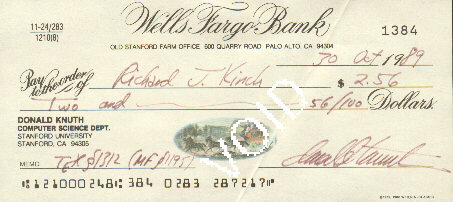
(who is quite bummed that he didn't get his reward check back when Dr. Knuth was using Wells Fargo as his bank: http://www.truetex.com/knuthchk.htm ) -
Re:Existing non-electronic variant
In my area, I've often seen Chinese LR44 alkaline button cells priced around US$3+tax for a package of six, three of which are stored in a combination laser/flashlight/key-chain/battery-tote.
While on the topic of LR44s, here's a pertinent article regarding batteries for users of cheap digital calipers (e.g., General, Pittsburgh):
-
Optical engineering explanation for purple fringeThe purple fringe problem is an old one when it comes to digital cameras. Most famously this spoiled the production models of the Sony DSC-F828 in 2004, which was supposed to be the ultimate high-resolution digital camera in its day with perfectly optimized Zeiss optics. The irony was that the very quality that made the lens superb in visible light made it that much more aberrant in infrared. Infrared blocking filters are not perfect, so out-of-focus infrared images appear whenever there is extreme contrast in the scene at extreme off-axis angles.
Purple fringes like this are not due to lens coatings or sapphire windows. Nor are they due to lens flare, flare being due to internal surface reflections, so it is wrong to call it a purple flare. Strictly speaking, it is a chromatic aberration, compounded with some coma effects.
The cause is simply infrared (IR) light being imaged by the image sensor. The lens is highly corrected to sharply focus visible light, but such corrections result in severe aberrations in focus for for any light outside the visible. These aberrations worsen with wider angles, that is, the farther out toward the edge.
Of course there is an IR blocking filter in the lens, but it is not perfect. A very small proportion of the IR does get through, but not enough to normally be imaged. However, when you have an severely bright highlight in the scene that is overexposed on the edge of the frame, the light itself will be "blown out" (pixels all white), but abberant unfocused IR rays will form a fringe. This fringe is purple because that is the false color that IR light yields in an RGB sensor. This fringe is not blocked by the IR filter because the highlight is far more intense (potentially by huge factors) than the exposure for the rest of the scene, so even 99.99 percent IR blocking filter lets through enough rays that when aberrated show up as a bright fringe.
Example from a Sony DSC-F828. Note the camera flash reflections from the shiny trophy at the edge of the frame have purple fringes, while the reflection off the glass near the center of the frame does not.
This problem only appears when you have a highly corrected lens, a high-resolution sensor, a high-speed-wide-angle lens, less-than-perfect IR filtering, and a scene of high spatial contrast at the edges. That's why it doesn't appear in most cameras, because few cameras are so high-performance in all of those areas at once.
Fixing the problem can be done by reducing the performance in one or more of those areas. Or you can design even better optics, but that is difficult to implement in a compact size like a phone requires, because it takes bigger bits of glass and more of them. You can also correct in firmware or software.
-
Re:paranoia much
Indeed - I was making an example with too much haste. I should just have posted a link to Google images.
http://www.lsi.upc.es/~valiente/knuth-1998-08-10.jpg
http://truetex.com/knuthchk.jpg
http://www.lsi.upc.es/~valiente/knuth-2002-08-24.jpgetc...
The point Knuth makes in his post is that these things got framed and put on CompSci notice boards etc. Obtaining the details became trivial. The OP was suggesting that Knuth's accounts being targeted was in some way odd when in fact it was predictable if unfortunate.
-
Re:Textbook Scam
Were y'all CS majors perchance? (:-) Anyway, the "peer" review is you. You're just no supposed to start the review the day before the final. Of course, a decent prof would give a cookie to the first person who found a typo. Donald Knuth offered 1 penny to the first person to find a bug in TeX, 2 pennies to the 2nd, 4 to the 3rd, and so on. Last I heard he had paid out $10.24. http://www.truetex.com/knuthchk.htm
I know this is blasphemy in most schools, but the best teachers are the students. (An I would hope the best students are the teachers, but that's not always the cast)
As a matter of fact, putting textbooks on sourceforge wouldn't be a bad idea. -
Bug Bounties
I'd love to be in charge of a popular project and embed something into the code that isn't a trojan or hack but a simple sentence or two. Something like "Congratulations - you've actually audited this code. Please email me@address for your $50 reward (To the first person only)".
Your money would probably be better spent on bug bounties like Knuth does. -
Re:Finally!
Here you have it
CC. -
TexOS
I've got the solution: the TeXOS(tm)!
Slogan: Crash-free -- Donald Knuth guarantees it!
-Waldo Jaquith