Slashdot Mirror
Domain: uxc.com
Stories and comments across the archive that link to uxc.com.
Comments · 7
-
Re:cue the nuclear fanbois
Your reading comprehension is incredibly bad.
Considering that you missed the point that the report is discussing Joules as opposed to Dollars I find the irony of your statement hilarious. Specifically EROEI, Energy Return On Energy Investment is the discussion at hand.
I'll also note that personal attacks on me aren't an argument that you are right, just that you are acting like an asshole.
The spot price of uranium oxide is $36.50/lb, which can produce 35,000,000,000 Btu of energy. Each and every pound.
Each and every pound of uranium produced takes different amounts of energy to produce. You are clearly missing the point. One kilo of Uranium from sandstone takes less energy to process than one kilo of uranium from granite. This is an energetic input cost not a financial cost. Below 200grams U per ton of rock Nuclear power is no longer viable.
Which is from the same site that has the quote I pasted in it. Which says "measured over the full cradle-to-grave period". That includes waste storage and mothballing the site of the plant. It says so. And includes the duty cycle of the plant, in sentences just prior to the ones I quoted. There is no massive debt, by their own measure.
No, the study specifically says Large uncertainties exist with respect to the last phase of the nuclear chain: decommissioning and dismantling of the reactor. Preliminary estimates point to a multiple of the construction energy investments.
In other words the decommissioning/dismantling of the plant is an energetic cost deferred to the future and not fully known.
In other words, that site is full of self-contradictions and FUD and can't be trusted to be right about anything at all, since it can't get its own story straight.
Another possibility is that you skimmed one, maybe two pages of a peer reviewed study used to advise European Parliament (including France) that challenge the social proof and rhetoric that you commonly accept and decide to deride the report because the actual science takes a lot more mental energy for you to absorb and process than making baseless criticisms.
Additionally, FYI, these are the Universities internationally that contributed to the report that you claim can't get their story straight:
Australia. University of Sydney, University of New South Wales, Monash University, Belgium. NPX Research Leuven, IMEC Leuven, Germany. Universität Regensburg, Öko Institut Darmstadt, Italy. University of Florence, Netherlands. University of Utrecht, Technical University Eindhoven, ECN Petten, Singapore. National University of Singapore, Spain. Bank of Spain Economics
Switzerland. CERN Geneva, ETH Zürich
UK. Imperial College London, University of Edenburgh, Oxford Research Group London, USA Brookhaven National Laboratory, Columbia University New York, Princeton University
If you are able to overcome your prejudices and stop relying on your assumptions then you might learn what and why the issues exist.
-
Re:cue the nuclear fanbois
AND *IF* the ore grades mean the energetic input costs are low, which they aren't.
The last six words of the quote:
current world average uranium ore grade.
Your reading comprehension is incredibly bad.
That same page references both American and Japanese studies that say reprocessing nuclear fuel isn't cost effective because the price of uranium ore is so incredibly low. And it is that low. The spot price of uranium oxide is $36.50/lb, which can produce 35,000,000,000 Btu of energy. Each and every pound.
I'll refer you to chapter 16 on "Energy Debt"
After closedown of a nuclear power plants a massive energy debt is left to society, increasing over time due to the unavoidable deterioration of the temporary storage facilities and increasing leaks.
Which is from the same site that has the quote I pasted in it. Which says "measured over the full cradle-to-grave period". That includes waste storage and mothballing the site of the plant. It says so. And includes the duty cycle of the plant, in sentences just prior to the ones I quoted. There is no massive debt, by their own measure.
In other words, that site is full of self-contradictions and FUD and can't be trusted to be right about anything at all, since it can't get its own story straight.
-
Re:Higher prices = 80 years
Any argument that...
Please stop. I've now cited an official government source, and a reputable international source. Both of these analysis were done by a team of economists, nuclear engineers, and accounted for as many factors as reasonably can be taken into consideration. You have cited... absolutely nothing.
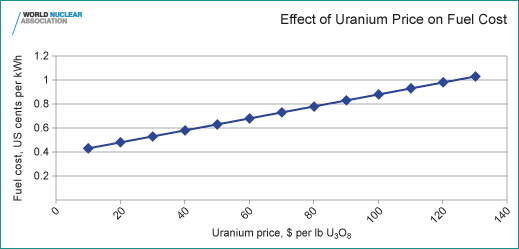
That the oceans contain enough uranium for 10,000 years of once-through energy production is well known and easily confirmed. The IEEE Spectrum article cites current research results that indicate the cost of seawater extraction can be performed at a cost of about $300/kg, a price point that the uranium spot market has already broken in the past, and the additional cost added to electricity by paying $300/kg vs current prices of around $100/kg is only about 0.6 cents per kwh still quite competitive with coal, gas and renewable energy sources.
Economists making government resource projections aren't permitted to consider emerging (aka unproven) technologies. Up until now there has been little incentive to try to develop seawater extraction (more expensive admittedly) as long as conventional mines were cranking out adequate supplies at low prices. This will change, and new technologies developed and exploited.
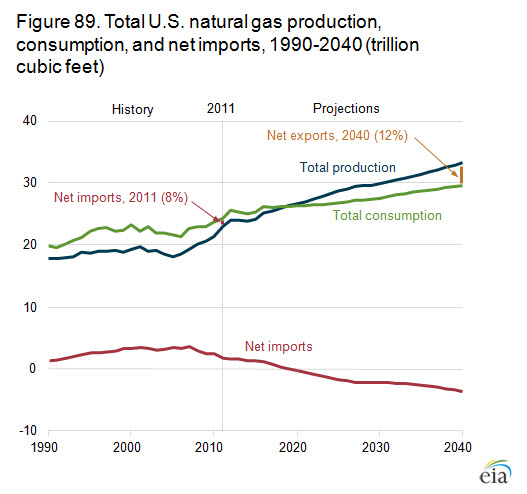
Just look at fracking. No production to speak of 10 years ago, now production is climbing steadily, soon to create a large gas surplus. Or renewable energy, with double digit increases in wind and solar power year after year. New technology and production processes with lower costs aren't limited to gas, solar and wind - uranium extraction benefits also. New processes often do not get perfected until there is economic demand for them.
-
Re:Finally!
I saw an announcement recently about thorium fuel elements being loaded into a reactor for long-term engineering research to see how they perform physically. There's not a great demand for thorium fuel cycle operations at the moment though when uranium is so cheap and plentiful.
-
Re:Interersing trend...
http://www.uxc.com/review/uxc_Prices.aspx
Get all Uranium product prices here
SWU price is what you want. The hexafloride is the thing you need in centrifuges, for example.
Most of the cost of the ship is not the fuel, it is the cost of the reactor, maintenance and reprocessing of waste. I guess that's the "bad" and good thing as same time - nuclear power requires us to deal with all the waste and not just allow it to go up *poof* into the atmosphere (it would hurt us much, much more than wildlife!)
-
Re:Interersing trend...
The SWU (Separative work unit) cost is about $150. Using the Wikipedia example, it would cost about $1.5 million at current prices to produce 1650 kg of fuel at 4.5% enrichment that has a total of 73.9 kg (163 lbs) of U-235.
Fuel costs really aren't an issue with nuclear reactors as this example shows. It is the operation and capital costs that are important.
-
Uranium prices
It had it peak almost a year ago, but i bet 100 bucks that we will have something like that in the next 10 years if we choose to stay only with nuclear plants. http://www.uxc.com/review/uxc_g_price.html