Slashdot Mirror
Domain: w3.org
Stories and comments across the archive that link to w3.org.
Comments · 6,785
-
the acid2 isn't exactly perfect in its logicThe ACID2 test assumes that the correct interpretation of the following rule is that the background should be yellow.
According to w3.org's grammer page, http://www.w3.org/TR/CSS21/grammar.html, the only valid use of the backslash character is if it is followed by up to six numbers in base hex. Also on the page http://www.w3.org/TR/CSS21/syndata.html#parsing-er rors it says that you must match paris of (), [], {}, "", and '' when handling errors.Given those rules, the logic, as I see it would the following interpretation and if any of this is wrong then it is due to my lack of groking the regular expressions in the grammar doc.
- { begins the style declaration body
- error: is an invalid token so it must be ingored.
- \ is not escaping a valid hex notation number, and it should be ignored.
- } closes the declaration
- background: yellow } is invalid because it is outside the body of this style declaration
The w3 spec says that matching pairs of (), [], {}, "", and '' should be respected, but it doesn't say how to match cases where you have a differing number of opening and closing tokens. There are basically two options when tokening such a heirarchial data stream, and that is outer to inner parsing and the oposite direction inner to outer. The w3 spec doesn't say which order of tokenizing it prefers.
I should also point out that the w3 site has only one other use for the backslash escape, and that is to escape certain characters in an unquoted URI. Specificially the characters are parentheses, commas, whitespace characters, single quotes (') and double quotes ("). The { } are not specified and this ACID2 css rule does not use an unquoted URI, so this escaping does not apply.
-
the acid2 isn't exactly perfect in its logicThe ACID2 test assumes that the correct interpretation of the following rule is that the background should be yellow.
According to w3.org's grammer page, http://www.w3.org/TR/CSS21/grammar.html, the only valid use of the backslash character is if it is followed by up to six numbers in base hex. Also on the page http://www.w3.org/TR/CSS21/syndata.html#parsing-er rors it says that you must match paris of (), [], {}, "", and '' when handling errors.Given those rules, the logic, as I see it would the following interpretation and if any of this is wrong then it is due to my lack of groking the regular expressions in the grammar doc.
- { begins the style declaration body
- error: is an invalid token so it must be ingored.
- \ is not escaping a valid hex notation number, and it should be ignored.
- } closes the declaration
- background: yellow } is invalid because it is outside the body of this style declaration
The w3 spec says that matching pairs of (), [], {}, "", and '' should be respected, but it doesn't say how to match cases where you have a differing number of opening and closing tokens. There are basically two options when tokening such a heirarchial data stream, and that is outer to inner parsing and the oposite direction inner to outer. The w3 spec doesn't say which order of tokenizing it prefers.
I should also point out that the w3 site has only one other use for the backslash escape, and that is to escape certain characters in an unquoted URI. Specificially the characters are parentheses, commas, whitespace characters, single quotes (') and double quotes ("). The { } are not specified and this ACID2 css rule does not use an unquoted URI, so this escaping does not apply.
-
Re:Long Time Dreamweaver User - Impressed
You REALLY didn't read the parent post, did you?
Parent is talking about using Expression suite for HTML/CSS editing. As with frontPage, it isn't intended to write dynamic pages. Unlike FrontPage, you CAN write dynamic pages with it, but the primary purpose is for creating and editing static pages. This doesn't involve any C#, VB.NET, or any other functional language except JavaScript. If you want to add tags for other active server languages, you can probably do that just fine, then use Eclipse or Vim or your favorite other editor to write your server code (complete with syntax highlighting).
Speaking of highlighting, there is far more that that to Expression. You can select a DOCTYPE, and it will offer the tags, properties, etc. that are supported. If you enter deprecated tags/parameters, or use elements outside the current doctype, it warns you. Basically, it can validate your web page as you write it. It also has autocompletion, etc. It will help build stylesheets, or inline style parameters, and they are even (oh shock and horror) W3C compliant. (I tested them, both using Opera and Firefox, and by submitting for W3C Validation online using Markup Validation and CSS Validation). I don't know if it has any CSS3 support, and I highly doubt it covers all of CSS2, but it isn't *only* IE6 compliant... although it does some IE6 workarounds for you, which makes web programming more convenient, at least. -
Re:Long Time Dreamweaver User - Impressed
You REALLY didn't read the parent post, did you?
Parent is talking about using Expression suite for HTML/CSS editing. As with frontPage, it isn't intended to write dynamic pages. Unlike FrontPage, you CAN write dynamic pages with it, but the primary purpose is for creating and editing static pages. This doesn't involve any C#, VB.NET, or any other functional language except JavaScript. If you want to add tags for other active server languages, you can probably do that just fine, then use Eclipse or Vim or your favorite other editor to write your server code (complete with syntax highlighting).
Speaking of highlighting, there is far more that that to Expression. You can select a DOCTYPE, and it will offer the tags, properties, etc. that are supported. If you enter deprecated tags/parameters, or use elements outside the current doctype, it warns you. Basically, it can validate your web page as you write it. It also has autocompletion, etc. It will help build stylesheets, or inline style parameters, and they are even (oh shock and horror) W3C compliant. (I tested them, both using Opera and Firefox, and by submitting for W3C Validation online using Markup Validation and CSS Validation). I don't know if it has any CSS3 support, and I highly doubt it covers all of CSS2, but it isn't *only* IE6 compliant... although it does some IE6 workarounds for you, which makes web programming more convenient, at least. -
Re:Okay but what if
The "rule by majority" concept would hold if there were no standard to follow. There is. And as long as there is a correct way to write HTML or XHTML, there is no reason to test web pages by opening it in every browser in existence.
I test my pages against the validator, and for good measure check in Firefox whether it looks the way I wanted it to. This isn't "snubbing IE" either - most of the time, IE still renders the page passably. The problem with IE is not so much that it renders correct mark-up badly, but that it is unpredictable when in "quirks mode" (which is often, since few designers care about valid markup). -
Re:Hrm.
Thats incorrect, the visual rendering of a definition lists depends on the UA. While generally the definition is indented and the term is bold this is not a requirement as per the specification. http://www.w3.org/TR/html4/struct/lists.html
Yes, definition lists don't have bullets, but there's a greater difference you're missing. A UL has no order, it doesn't matter what order the items are read in, they mean the same thing. An OL is the oposite, the order matters. A DL is very different from both of them, it is a list of terms and their corresponding definitons. -
Re:Firefox and usemap
Mmm, the XHTML 1.0 standard says that you may serve documents as text/html, as long as they follow appendix C
I hope you're following the Fragment Identifiers section of Appendix C:In XML, URI-references [RFC2396] that end with fragment identifiers of the form "#foo" do not refer to elements with an attribute name="foo"; rather, they refer to elements with an attribute defined to be of type ID, e.g., the id attribute in HTML 4. Many existing HTML clients don't support the use of ID-type attributes in this way, so identical values may be supplied for both of these attributes to ensure maximum forward and backward compatibility (e.g., <a id="foo" name="foo">...</a>).
-
Re:Firefox and usemapMmm, the XHTML 1.0 standard says that you may serve documents as text/html, as long as they follow appendix C
Appendix C.8 deals with fragment identifiers, and starts out with this gem.In XML, URI-references [RFC2396] that end with fragment identifiers of the form "#foo" do not refer to elements with an attribute name="foo"; rather, they refer to elements with an attribute defined to be of type ID, e.g., the id attribute in HTML 4. Many existing HTML clients don't support the use of ID-type attributes in this way, so identical values may be supplied for both of these attributes to ensure maximum forward and backward compatibility (e.g.,
You see the "Many existing HTML clients..." line? Am I the only one who sees the strong implication that HTML clients should support this?
It then deals with semantics dealing with name attributes in XHTML vs. HTML which isn't relevant to this discussion.
It ends with this.Finally, note that XHTML 1.0 has deprecated the name attribute of the a, applet, form, frame, iframe, img, and map elements, and it will be removed from XHTML in subsequent versions.
Deprecated. As in "do not use."
So, while Gecko is technically correct, supporting usemap with ids in XHTML 1.0 documents when being served as text/html is more correct, because
<map name="something">
is deprecated and should no longer be used. -
Re:Firefox and usemapMmm, the XHTML 1.0 standard says that you may serve documents as text/html, as long as they follow appendix C
Appendix C.8 deals with fragment identifiers, and starts out with this gem.In XML, URI-references [RFC2396] that end with fragment identifiers of the form "#foo" do not refer to elements with an attribute name="foo"; rather, they refer to elements with an attribute defined to be of type ID, e.g., the id attribute in HTML 4. Many existing HTML clients don't support the use of ID-type attributes in this way, so identical values may be supplied for both of these attributes to ensure maximum forward and backward compatibility (e.g.,
You see the "Many existing HTML clients..." line? Am I the only one who sees the strong implication that HTML clients should support this?
It then deals with semantics dealing with name attributes in XHTML vs. HTML which isn't relevant to this discussion.
It ends with this.Finally, note that XHTML 1.0 has deprecated the name attribute of the a, applet, form, frame, iframe, img, and map elements, and it will be removed from XHTML in subsequent versions.
Deprecated. As in "do not use."
So, while Gecko is technically correct, supporting usemap with ids in XHTML 1.0 documents when being served as text/html is more correct, because
<map name="something">
is deprecated and should no longer be used. -
Firefox and usemap
I'll consider using Firefox again once the developers stop marking bugs as INVALID, despite the exhibited behavior going against the standard. Particularly since it works correctly in the other major browsers.
Until then, I'll stick with Opera, thanks. -
Re:Wow.
I thought this http://www.w3.org/Consortium/ [w3.org] was the standard.
Well, you could code to that standard and not having it work in any browsers.
-
Re:Wow.
I thought this http://www.w3.org/Consortium/ was the standard.
Why should everyone just meekly accept everything that is thrust upon them? -
Batik error with baby tuxThe reason that Batik doesn't handle the baby tux file is that there is indeed an error in it. On line 90, the transform attribute doesn't have a closing parenthesis in it. Quoting from SVG 1.1, one of the things that must be done when the document is "in error" is:
A highly perceivable indication of error shall occur. For visual rendering situations, an example of an indication of error would be to render a translucent colored pattern such as a checkerboard on top of the area where the SVG content is rendered.
Batik stops document rendering at that point and pops up a message indicating the error. Not many UAs do this, actually, and many actually just choose to ignore errors. This is likely one of the causes of the difference in behaviour you are seeing. -
Re:On the subject of Website...
your argument is flawed. Website, or web sites, followed the same common naming convention as gopher sites and ftp sites, both of which predate 1994 by quite a bit. Matter of fact, from the WWW mail archives:
Marc Andreessen started working on the Mosaic web browser in 1992.
and also Google's search result comments indicate that WWW and W3 were already in use. The archives also indicate that Mosaic 1.2 was released by Apr 93, thus they had to have something to connect it to, unfortunately I was unable to access the mail archives, and thus could not ascertain what they called the server and documents and collections of documents they connected to at that time. I can't trust 13 year old memories as to whether we called it a "site" back then, but I seem to recall lots of references to ftp sites and such, so it would only be natural (Simtel was a big one in the day). -
Re:Standards support
Did you even read the Bugzilla page you linked to?
Yes, but you obviously didn't read the specific comment I linked to.We never break a line at a soft hyphen, and we never display soft hyphens,
which
is the minimum necessary to follow the semantics:
If a line is broken at a soft hyphen, a hyphen character must be displayed at
the end of the first line. If a line is not broken at a soft hyphen, the user
agent must not display a hyphen character. For operations such as searching
and
sorting, the soft hyphen should always be ignored.
-- http://www.w3.org/TR/REC-html40/struct/text.html#h -9.3.3
Documents would look much nicer if Mozilla were smart enough to break lines at
soft hyphens. Nevertheless, that's an enhancement, not a requirement.I wonder if you're aware how glib your pooh-poohing is of the opacity: and text-shadow: properties. As I said, opacity at the very least would allow authors to finally do away with 1990s-era workarounds like serving redundant PNGs based on browser sniffing.
Sorry if I don't see the need for 'word art' on websites.It's very unimaginative of you to maintain that these properties are useless.
Perhaps not completely useless, but I just don't see the actual need.Don't even get me started on your inane recommendation to use -moz-inline-block as a buggy, unpredictable workaround for inline-block.
The behavior well documented on mozilla.org's website. I don't see how that's unpredictable.Perhaps it has escaped your noticed that WebKit is open source.
Yeah, hosted on opendarwin's servers, which are closing down, and haven't fulfilled their mission.Besides, why would I want to join a team as demonstrably tasteless and unconcerned for comprehensive aesthetics of design as the Firefox development project?
Reading their mailing lists, bugzilla lists etc. tell me otherwise. -
Re:Acid Test
However, it is important to note that all XML parsers MUST report well-formedness violations.
XML parsers must report well-formedness violations to the application. Spec. There's no requirement that the end-user see any error message as far as I know, that's up to the application.
Validating parsers MUST at least offer validity violation messages as a user option.
Yep, but there's no requirement that parsers be validating parsers, you can write a non-validating parser and still conform to the spec
-
Re:More like 6 out of 7
I found the README.dist file in CVS, but no where else.
-
Re:Ok, then he needs to cut US some slack
If - as is implied - he's the ONLY person at Microsoft who gives a damn about standards
I don't think that's implied, just that he was the primary advocate within Microsoft. For example from The CSS saga, co-written by the inventor of CSS:
Had it not been for the browsers, CSS would have remained a lofty proposal of only academic interest. The first commercial browser to support CSS was Microsoft's Internet Explorer 3 which was released in August 1996. At that point, the CSS1 specification had not yet become a W3C Recommendation and discussions within the HTML ERB were to result in changes that Microsoft developers, led by Chris Wilson, could not foresee. IE3 reliably supports most of the
Chris Wilson was certainly important in the development of CSS.
But to turn around and say "hey, we ARE standards-compliant
Except he's not saying that.
If he lacks the time to even establish which parts of the specs are implemented
He's made extensive postings on the Internet Explorer development weblog and his own weblog discussing precisely this. He knows what's implemented and what isn't.
He should also stop and bear in mind that since he himself states he does not know the actual level of compliance
He didn't say that. He said that there isn't an easy way to come up with an objective figure. If you read the weblogs he posts to, it's quite clear he knows what's going on and is discussing the level of compliance publically. But saying "Oh, we're at 52% this week" makes no sense, and he was right to say so. The only way to have an intelligent discussion about the level of compliance is to talk about specifics - which is what he has been doing.
For that matter, the lack of knowledge on compliance would suggest that the browser is improperly tested.
You're drawing all of these dubious conclusions from faulty premises. You've assumed that he's this clueless PHB who doesn't know what's going on, when all he's saying is that it's stupid to assign a number to Internet Explorer's level of compliance. As far as I'm aware, there haven't been any other browser developers giving specific percentages to their compliance level - do you consider all of them to be bumbling idiots too?
-
Content-Type: microsoft/knows-best
But is it yet HTTP-compliant? Specifically, does IE 7 treat the Content-Type header provided by the server as authoritative as required by RFC 2616 Sectino 7.2.1?
I'm sick of sites that, say, put up a Linux boot CD up as a -
Re:More like 6 out of 7
It would have been really nice of the W3C to mention that somewhere in the test suite. Unfortunately they neglect to mention that in the test suite, on the test suite "home page," and in the test suite documentation. They even neglect to offer a full download of the suite (you can use wget for that).
Even their own test suite documentation neglects to mention the font requirement. In fact, the only place they mention it is on the test authoring guidelines which is not something I'd expect to read when just running tests.
If I get the time, I think I'll try and bundle the test suite up WITH the Ahem font and try and run it again. Maybe even use the CSS font-embedding extension so you don't actually need to install the font.
But I can see why people may not like that test suite. Without a "full suite download" it's a bit of a pain to use.
-
Re:More like 6 out of 7
It would have been really nice of the W3C to mention that somewhere in the test suite. Unfortunately they neglect to mention that in the test suite, on the test suite "home page," and in the test suite documentation. They even neglect to offer a full download of the suite (you can use wget for that).
Even their own test suite documentation neglects to mention the font requirement. In fact, the only place they mention it is on the test authoring guidelines which is not something I'd expect to read when just running tests.
If I get the time, I think I'll try and bundle the test suite up WITH the Ahem font and try and run it again. Maybe even use the CSS font-embedding extension so you don't actually need to install the font.
But I can see why people may not like that test suite. Without a "full suite download" it's a bit of a pain to use.
-
Re:"no official CSS test suite"???
That's actually kinda neat. So far, of the seven tests I've run, Firefox 1.5.0.6 has passed one of them.
For the curious:
- float 0 - Fail
- The Height of Lines 0 - Fail
- The Height of Lines 1 - Fail
- The Height of Lines 2 - Fail
- The Height of Lines 3 - Fail
- Inline Elements 0 - Fail
- vertical-align 2 - Pass
Some time when I have more time, I'll have to go through all of them and see how Firefox does.
-
Re:"no official CSS test suite"???
That's actually kinda neat. So far, of the seven tests I've run, Firefox 1.5.0.6 has passed one of them.
For the curious:
- float 0 - Fail
- The Height of Lines 0 - Fail
- The Height of Lines 1 - Fail
- The Height of Lines 2 - Fail
- The Height of Lines 3 - Fail
- Inline Elements 0 - Fail
- vertical-align 2 - Pass
Some time when I have more time, I'll have to go through all of them and see how Firefox does.
-
Re:"no official CSS test suite"???
That's actually kinda neat. So far, of the seven tests I've run, Firefox 1.5.0.6 has passed one of them.
For the curious:
- float 0 - Fail
- The Height of Lines 0 - Fail
- The Height of Lines 1 - Fail
- The Height of Lines 2 - Fail
- The Height of Lines 3 - Fail
- Inline Elements 0 - Fail
- vertical-align 2 - Pass
Some time when I have more time, I'll have to go through all of them and see how Firefox does.
-
Re:"no official CSS test suite"???
That's actually kinda neat. So far, of the seven tests I've run, Firefox 1.5.0.6 has passed one of them.
For the curious:
- float 0 - Fail
- The Height of Lines 0 - Fail
- The Height of Lines 1 - Fail
- The Height of Lines 2 - Fail
- The Height of Lines 3 - Fail
- Inline Elements 0 - Fail
- vertical-align 2 - Pass
Some time when I have more time, I'll have to go through all of them and see how Firefox does.
-
Re:"no official CSS test suite"???
That's actually kinda neat. So far, of the seven tests I've run, Firefox 1.5.0.6 has passed one of them.
For the curious:
- float 0 - Fail
- The Height of Lines 0 - Fail
- The Height of Lines 1 - Fail
- The Height of Lines 2 - Fail
- The Height of Lines 3 - Fail
- Inline Elements 0 - Fail
- vertical-align 2 - Pass
Some time when I have more time, I'll have to go through all of them and see how Firefox does.
-
Re:"no official CSS test suite"???
That's actually kinda neat. So far, of the seven tests I've run, Firefox 1.5.0.6 has passed one of them.
For the curious:
- float 0 - Fail
- The Height of Lines 0 - Fail
- The Height of Lines 1 - Fail
- The Height of Lines 2 - Fail
- The Height of Lines 3 - Fail
- Inline Elements 0 - Fail
- vertical-align 2 - Pass
Some time when I have more time, I'll have to go through all of them and see how Firefox does.
-
Re:"no official CSS test suite"???
That's actually kinda neat. So far, of the seven tests I've run, Firefox 1.5.0.6 has passed one of them.
For the curious:
- float 0 - Fail
- The Height of Lines 0 - Fail
- The Height of Lines 1 - Fail
- The Height of Lines 2 - Fail
- The Height of Lines 3 - Fail
- Inline Elements 0 - Fail
- vertical-align 2 - Pass
Some time when I have more time, I'll have to go through all of them and see how Firefox does.
-
"no official CSS test suite"???
Then WTF is http://www.w3.org/Style/CSS/Test/ ??
-
GNome, Window Maker and other leaders.All should show up pre 1999. They look just as good as Windows 98 did and were widely deployed and easy to get. They might also have included a screen shot of TWM to show how things progressed.
- TWM, 1987
- FVWM, 1993 (Enlightenment puts it at 1992)
- Next Step publishes Open Step which is quickly followed by
- AfterStep, Window Maker and others much nicer than Windows 95. Most are still available and usable with the latest and greatest free software.
- Enlightenment, released 1996, still a leader.
- Gnome used Enlightenment until they moved to Sawfish. The history has just begun
Of course, everyone should see the first web browser from 1990 (actually a screen shot from 1993, but much the same) running on a Next.
It might be hard to dig up screenshots all of desktops, but not much harder than the ones they found. It's nice to see someone including KDE in the line up so people can see a little of what they have been missing, like Virtual desktops, since the early 90's.
-
Re:HTML and committees
Not really. HTML was designed to be in the same style as SGML (and many other markup languages), but it wasn't really SGML, none of the implementations used SGML technology and the DTDs came after the implementations.
Wrong. Tim Berners-Lee's first code used SGML software; check out the section headed "FORMAT CONVERSION FROM SGML".
-
Re:The future of flash...on slashdot.
No need to promote some flash of 3D when the stadard already exist:
X3D (the newly born vrml) seems quite good for 3D: http://www.web3d.org/
Many tools around it, reader for pretty much all browser and all platform, authoring tools with different scope in mind, etc...
Now for SVG (and X3D/VRML?) authoring, you do have some tools: http://www.w3.org/Amaya/
The market isn't there yet, that's why they aren't widespread IMHO -
Re:Flash as an application development platform
Those are good points, but I think the general idea is that SVG is supposed to interoperate with other stuff to provide those functions. For example, you ought to be able to mix the SVG and XHTML namespaces and use XForms to provide GUI widgets.
Of course, regarding the "incomplete implementations" part you're absolutely right. In fact, that namespace mixing I just mentioned doesn't yet work even in Firefox, as far as I know.
-
Re:The future of flash...
..which is spelled SVG.
-
Re:ACID2 - Whoopdeedoo!
Specs say that XHTML must be served with this mime type
Nope. See http://www.w3.org/TR/xhtml1/#media . XHTML documents may be served as text/html unless you are adding stuff from other namespaces (etcetera). Live with it. -
W3C Standard-based ones
There are also toolkits and JavaScript apps that combine W3C standards with AJAX, letting you write a lot of the dynamic page stuff in a declarative fashion, using just markup (XHTML+XForms; I was an editor of the XForms 1.0 recommendation, but new revisions have come out; see http://www.w3.org/TR/xforms).
The FormFaces OSS product is an entire XForms implementation done in JavaScript, running in the browser. You write your page in HTML with XForms markup, and FormFaces does the "HiJax" thing of re-writing it for you. You never need to use XmlHttpRequest, and you can interact with regular servers, RESTful services, etc., all via XML.
Another product that does this, in a slightly different way, is AjaxForms. I just found out about it, but it looks pretty good. AjaxForms uses some server-side components to do the translation from strict XHTML+XForms markup into Ajax (HTML4+JavaScript), but they claim it can work in PHP and Tomcat servers. Again, FOSS, and available at http://ajaxforms.sourceforge.net/ [sourceforge.net]
I recently implemented dynamic forms for weblogs and wikis, and did it using Chiba, another FOSS product, that like AjaxForms does its conversion on the server, using Tomcat as a container.
The Orbeon folks have a nice blog that shows how to use XForms (their implementation, the Mozilla extension, or any of the other above toolkits) to accomplish typical dynamic page tasks such as listing countries and ISO codes, or resizing flickr (also via formsplayer. -
Re:While they're at it ...
Which* standards does Google support?
I mean, MSN Search does a better job of meeting the W3C's "standards" than Google does.
* When I clicked that link I got a validation check for google.co.jp, but google.com has the same "Optimized so it downloads better on my 2400 baud modem" approach to its source. -
Re:While they're at it ...
Which* standards does Google support?
I mean, MSN Search does a better job of meeting the W3C's "standards" than Google does.
* When I clicked that link I got a validation check for google.co.jp, but google.com has the same "Optimized so it downloads better on my 2400 baud modem" approach to its source. -
Re:While they're at it ...
Which* standards does Google support?
I mean, MSN Search does a better job of meeting the W3C's "standards" than Google does.
* When I clicked that link I got a validation check for google.co.jp, but google.com has the same "Optimized so it downloads better on my 2400 baud modem" approach to its source. -
Re:While they're at it ...
Which* standards does Google support?
I mean, MSN Search does a better job of meeting the W3C's "standards" than Google does.
* When I clicked that link I got a validation check for google.co.jp, but google.com has the same "Optimized so it downloads better on my 2400 baud modem" approach to its source. -
Re:While they're at it ...
Which* standards does Google support?
I mean, MSN Search does a better job of meeting the W3C's "standards" than Google does.
* When I clicked that link I got a validation check for google.co.jp, but google.com has the same "Optimized so it downloads better on my 2400 baud modem" approach to its source. -
Re:While they're at it ...
Which* standards does Google support?
I mean, MSN Search does a better job of meeting the W3C's "standards" than Google does.
* When I clicked that link I got a validation check for google.co.jp, but google.com has the same "Optimized so it downloads better on my 2400 baud modem" approach to its source. -
Correct History by Daniel Barbalace
> However, 6 August 1991 is not the only date claimed as the 'birthday of the internet'.
This claim is very wrong. The Internet (notice the capitalization) was born on October 29, 1969 at 10:30 p.m. See http://www.lk.cs.ucla.edu/LK/Inet/1stmesg.html
As for the World Wide Web, here's a brief timeline.
1989 March
"Information Management: A Proposal" written by the great Tim Berners-Lee and circulated for comments at CERN.
http://www.w3.org/History/1989/proposal.html
1990 September
Tim Berners-Lee begins work on a global hypertext system.
1990 October
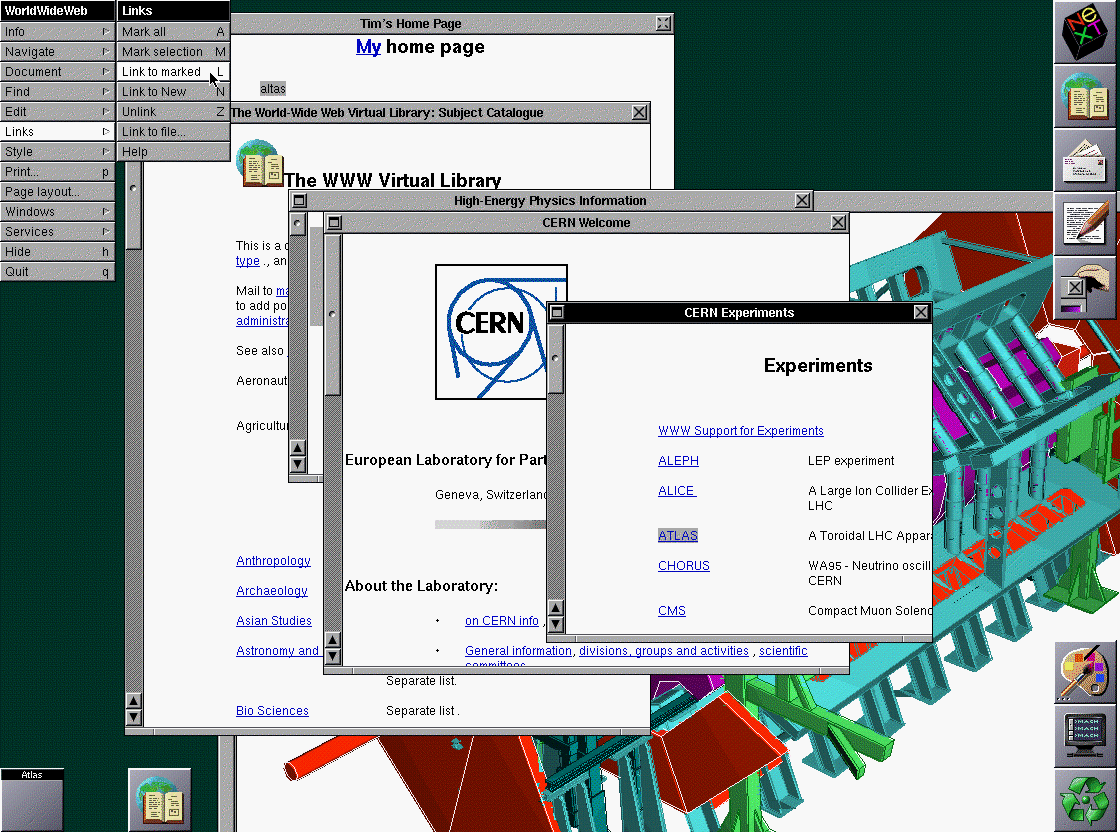
Tim Berners-Lee starts writing a hypertext browser/editor for the NeXTStep operating system. He calls it "WorldWideWeb".
http://www.w3.org/People/Berners-Lee/WorldWideWeb. html
Here are some screenshots of his browser. Although simple by today's standards, the browser is rendering what clearly would be recognized as a web page today.
http://www.w3.org/History/1994/WWW/Journals/CACM/s creensnap2_24c.gif
http://www.w3.org/MarkUp/tims_editor
1991 March
Line mode browser (www) released to limited audience on "priam" vax, rs6000, sun4. This browser was a text-based browser, a major step backwards from "WorldWideWeb" that was meant to be so simple that any computer or terminal could run it.
1992 April-May
Other GUI web browsers are released for X-Windows.
1993 February
NCSA release first alpha version of Marc Andreessen's "Mosaic for X". Computing seminar at CERN. The University of Minnesota announced that they would begin to charge licensing fees for Gopher's use, which caused many volunteers and employees to stop using it and switch to WWW.
Well, there is no clear birthday for the WWW like there is for the Internet. However, the Web as we know it today would have been recognizable in April 1992. At that time there were about two dozen web servers world-wide. -
Correct History by Daniel Barbalace
> However, 6 August 1991 is not the only date claimed as the 'birthday of the internet'.
This claim is very wrong. The Internet (notice the capitalization) was born on October 29, 1969 at 10:30 p.m. See http://www.lk.cs.ucla.edu/LK/Inet/1stmesg.html
As for the World Wide Web, here's a brief timeline.
1989 March
"Information Management: A Proposal" written by the great Tim Berners-Lee and circulated for comments at CERN.
http://www.w3.org/History/1989/proposal.html
1990 September
Tim Berners-Lee begins work on a global hypertext system.
1990 October
Tim Berners-Lee starts writing a hypertext browser/editor for the NeXTStep operating system. He calls it "WorldWideWeb".
http://www.w3.org/People/Berners-Lee/WorldWideWeb. html
Here are some screenshots of his browser. Although simple by today's standards, the browser is rendering what clearly would be recognized as a web page today.
http://www.w3.org/History/1994/WWW/Journals/CACM/s creensnap2_24c.gif
http://www.w3.org/MarkUp/tims_editor
1991 March
Line mode browser (www) released to limited audience on "priam" vax, rs6000, sun4. This browser was a text-based browser, a major step backwards from "WorldWideWeb" that was meant to be so simple that any computer or terminal could run it.
1992 April-May
Other GUI web browsers are released for X-Windows.
1993 February
NCSA release first alpha version of Marc Andreessen's "Mosaic for X". Computing seminar at CERN. The University of Minnesota announced that they would begin to charge licensing fees for Gopher's use, which caused many volunteers and employees to stop using it and switch to WWW.
Well, there is no clear birthday for the WWW like there is for the Internet. However, the Web as we know it today would have been recognizable in April 1992. At that time there were about two dozen web servers world-wide. -
Correct History by Daniel Barbalace
> However, 6 August 1991 is not the only date claimed as the 'birthday of the internet'.
This claim is very wrong. The Internet (notice the capitalization) was born on October 29, 1969 at 10:30 p.m. See http://www.lk.cs.ucla.edu/LK/Inet/1stmesg.html
As for the World Wide Web, here's a brief timeline.
1989 March
"Information Management: A Proposal" written by the great Tim Berners-Lee and circulated for comments at CERN.
http://www.w3.org/History/1989/proposal.html
1990 September
Tim Berners-Lee begins work on a global hypertext system.
1990 October
Tim Berners-Lee starts writing a hypertext browser/editor for the NeXTStep operating system. He calls it "WorldWideWeb".
http://www.w3.org/People/Berners-Lee/WorldWideWeb. html
Here are some screenshots of his browser. Although simple by today's standards, the browser is rendering what clearly would be recognized as a web page today.
http://www.w3.org/History/1994/WWW/Journals/CACM/s creensnap2_24c.gif
http://www.w3.org/MarkUp/tims_editor
1991 March
Line mode browser (www) released to limited audience on "priam" vax, rs6000, sun4. This browser was a text-based browser, a major step backwards from "WorldWideWeb" that was meant to be so simple that any computer or terminal could run it.
1992 April-May
Other GUI web browsers are released for X-Windows.
1993 February
NCSA release first alpha version of Marc Andreessen's "Mosaic for X". Computing seminar at CERN. The University of Minnesota announced that they would begin to charge licensing fees for Gopher's use, which caused many volunteers and employees to stop using it and switch to WWW.
Well, there is no clear birthday for the WWW like there is for the Internet. However, the Web as we know it today would have been recognizable in April 1992. At that time there were about two dozen web servers world-wide. -
Correct History by Daniel Barbalace
> However, 6 August 1991 is not the only date claimed as the 'birthday of the internet'.
This claim is very wrong. The Internet (notice the capitalization) was born on October 29, 1969 at 10:30 p.m. See http://www.lk.cs.ucla.edu/LK/Inet/1stmesg.html
As for the World Wide Web, here's a brief timeline.
1989 March
"Information Management: A Proposal" written by the great Tim Berners-Lee and circulated for comments at CERN.
http://www.w3.org/History/1989/proposal.html
1990 September
Tim Berners-Lee begins work on a global hypertext system.
1990 October
Tim Berners-Lee starts writing a hypertext browser/editor for the NeXTStep operating system. He calls it "WorldWideWeb".
http://www.w3.org/People/Berners-Lee/WorldWideWeb. html
Here are some screenshots of his browser. Although simple by today's standards, the browser is rendering what clearly would be recognized as a web page today.
http://www.w3.org/History/1994/WWW/Journals/CACM/s creensnap2_24c.gif
http://www.w3.org/MarkUp/tims_editor
1991 March
Line mode browser (www) released to limited audience on "priam" vax, rs6000, sun4. This browser was a text-based browser, a major step backwards from "WorldWideWeb" that was meant to be so simple that any computer or terminal could run it.
1992 April-May
Other GUI web browsers are released for X-Windows.
1993 February
NCSA release first alpha version of Marc Andreessen's "Mosaic for X". Computing seminar at CERN. The University of Minnesota announced that they would begin to charge licensing fees for Gopher's use, which caused many volunteers and employees to stop using it and switch to WWW.
Well, there is no clear birthday for the WWW like there is for the Internet. However, the Web as we know it today would have been recognizable in April 1992. At that time there were about two dozen web servers world-wide. -
Re:you republican troll
No-no-no-no-no. Both of you are wrong.
Al Gore created (not invented) the Internet, not the Web. This is the birthday of the Web, which Tim Berners-Lee created.
(The actual Al Gore quote is something along the lines of "I took the initiative to create the Internet," nothing about inventing. Specifically.)
On a slightly serious note, this is the birthday of the Web: HTML delivered over HTTP, I'd assume. Not the Internet, which can be considered to have a birthday of anywhere between 1982 and 1989 depending on your definition.
But then again, so can the web. Looking over the W3C's timeline you can get several different "birthdays" for the WWW. Another good one might be March 1989, when Tim Berners-Lee wrote his first HTML/HTTP proposal.
The August 6th, 1991 date is the first date that an actual browser was made available to the public and could be thought of as the "birth date" as well.
-
Re:you republican troll
No-no-no-no-no. Both of you are wrong.
Al Gore created (not invented) the Internet, not the Web. This is the birthday of the Web, which Tim Berners-Lee created.
(The actual Al Gore quote is something along the lines of "I took the initiative to create the Internet," nothing about inventing. Specifically.)
On a slightly serious note, this is the birthday of the Web: HTML delivered over HTTP, I'd assume. Not the Internet, which can be considered to have a birthday of anywhere between 1982 and 1989 depending on your definition.
But then again, so can the web. Looking over the W3C's timeline you can get several different "birthdays" for the WWW. Another good one might be March 1989, when Tim Berners-Lee wrote his first HTML/HTTP proposal.
The August 6th, 1991 date is the first date that an actual browser was made available to the public and could be thought of as the "birth date" as well.
-
Re:you republican troll
No-no-no-no-no. Both of you are wrong.
Al Gore created (not invented) the Internet, not the Web. This is the birthday of the Web, which Tim Berners-Lee created.
(The actual Al Gore quote is something along the lines of "I took the initiative to create the Internet," nothing about inventing. Specifically.)
On a slightly serious note, this is the birthday of the Web: HTML delivered over HTTP, I'd assume. Not the Internet, which can be considered to have a birthday of anywhere between 1982 and 1989 depending on your definition.
But then again, so can the web. Looking over the W3C's timeline you can get several different "birthdays" for the WWW. Another good one might be March 1989, when Tim Berners-Lee wrote his first HTML/HTTP proposal.
The August 6th, 1991 date is the first date that an actual browser was made available to the public and could be thought of as the "birth date" as well.
-
Re:you republican troll
No-no-no-no-no. Both of you are wrong.
Al Gore created (not invented) the Internet, not the Web. This is the birthday of the Web, which Tim Berners-Lee created.
(The actual Al Gore quote is something along the lines of "I took the initiative to create the Internet," nothing about inventing. Specifically.)
On a slightly serious note, this is the birthday of the Web: HTML delivered over HTTP, I'd assume. Not the Internet, which can be considered to have a birthday of anywhere between 1982 and 1989 depending on your definition.
But then again, so can the web. Looking over the W3C's timeline you can get several different "birthdays" for the WWW. Another good one might be March 1989, when Tim Berners-Lee wrote his first HTML/HTTP proposal.
The August 6th, 1991 date is the first date that an actual browser was made available to the public and could be thought of as the "birth date" as well.