Slashdot Mirror
Domain: z-torque.com
Stories and comments across the archive that link to z-torque.com.
Comments · 7
-
Want to have a good laugh? just read this
-
Re:Salesman Inventors and Snowed Investors
From their site: http://www.z-torque.com/Video.aspx
Results
Participants achieved similar maximal oxygen consumption, peak power outputs and gross efficiencies with the Z-Torque and normal crank configurations (Table 1). In addition, ratings of perceived exertion (RPE) at 150 and 200 W, heart rate (HR) at peak power output, 150, and 200 W, and cadence at 150 and 200 W were not significantly different. However, participants perceived their effort to be significantly lower at peak power output with the Z-Torque crank.
(emphasis mine)So the whole thing is perception and they know it. They've apparently known this since 2000. Con artists to the max.
-
You mean that the placebo effect still works?
This is why "vortex" generators for carburetors are still sold http://www.vorteccyclone.com/ , Magnets for your fuel lines to "align the molecules" http://en.wikipedia.org/wiki/Fuel_saving_device are still sold, and oddly shaped bicycle cranks http://z-torque.com/ are still sold. Its really no surprise that it happens in the software world too. Really, its been happening for a long time. Regcure, anyone?
-
Re:Biomechanics
You miss my point though. I understand that your foot is making the same motion, and that you have the same mechanical leverage given the distance between your foot and the gear center.
However, the angle at which the crank connects to the gear is now shifted from the angle between your foot and the center of the gear (relative to horizontal). In a simple free-body diagram, this also makes zero difference, as the angle of connection does not affect torque. But since the crank actually connects at various points along the bolt, the angle of connection could determine the direction of force at these various connection points. This of course has absolutely nothing to with the z shape, and the same putative effect could probably be achieved simply by changing the shape of the connector. Thus I'd agree that that extra metal going into the elbow of the angled crank is really doing nothing.
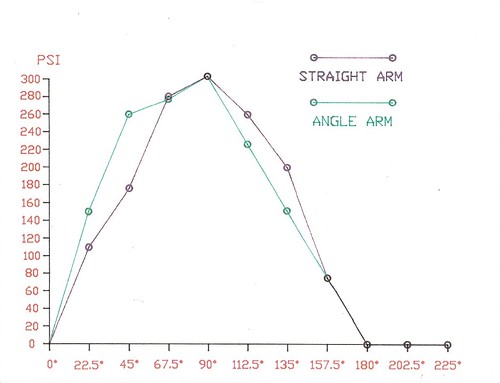
So all I'm investigating, in thought, is how the time-varying direction of forces applied during pedaling may be shifted depending on how the crank connects to the gear. If you are inclined to believe any of the data produced by this dude, which I realize is suspect, then this graph (available in their gallery) presents data qualitatively in line with my reasoning, and, interestingly, NOT in line with their reasoning (which I think we both agree is grossly incorrect). I'd further note that if I were making up data to fit their explanations, I'd have put in some at least small magnitude changes, not just a phase shift as we see here. So is it possible that there is some (probably very small) effect of angle of connection?
Lastly, what does a phase shift do for total work? Nothing for a given amount of force, I think. But that's where biomechanics (OP) comes in; since the leg isn't equally efficient at all pedal positions, this phase shift could result in a change (positive or negative) in total efficiency.
Again, not a mechanical engineer. I'm just speculating on what could cause differences that might not show up in a simple physics model. All models are imperfect, so I'm trying to challenge the model assumptions. Does this make sense, and do you agree that this is a different issue than you present in your rebutta to my post?
-
Actually, it works !
The guy uploaded the analysis from a professor of Florida University which notes improvements over regular cranks... However, not the ones claimed in the video.
What is nice is that the first paragraph contradicts the video : "As far as mechanical advantages is concerned, the angle crank does not offer any more than the traditional straight-link crank[...]". The Pr sees the higher momentum of inertia as beneficial for pedalling as well as the bending mode, concluding that those two properties are obviously not intended.
As far as I am concerned I am not quite sure I would like to have more momentum of inertia to overcome and I find the effective improvement from flexure mode dubious. -
Re:Playing devils advocate here...
What happens with this design if the pedals are at TDC and BDC, with a weight hanging off the top pedal? It should go forward as that is the direction of the "Z" arm.
I suppose. If you could magically have a weight appear only off the top pedal's Z-arm when the pedal was at TDC. (Note that such a magical weight would also give you a perpetual motion machine, since you could set the pedals at TDC/BDC, and they would start accelerating on their own and continue to provide power with no effort.) Of course, if you had such a weight only off the bottom pedal's Z arm, it would go backwards. Or, if you just had the weight from each pedals Z-arms, without magical weights that appeared on one or the arm in a given position to help or hinder, they'd cancel each other out, and you'd have dead spots, which brings us to:
By my understanding that is one of his design goals, to eliminate the dead spots as with regular straight arms in the same situation nothing happens (you would need forward motion to move the arm).
Even the inventor's website expressly acknowledges that the Z-torque crank has the exact same dead spots as any other crank (of course, he doesn't mention that this exactly the same as any other crank), saying:
Except for top dead center and bottom dead center, this crank had no dead spots.
So, no, even the crank making the crank doesn't claim that the crank eliminates the TDC/BDC dead spots inherent in any crank.
-
Re:Biomechanics
An analysis, found on their webpage:
http://www.z-torque.com/Portals/6/DrHuangReport.pdfClaims that the benefit is from two side effects of the claim:
The increased mass gives a flywheel effect, meaning the pedal goes through top dead center easier.
The long shape bends under pressure, which does slightly increase the length of the arm under pressure.So, by going to carbon fiber (lighter, and most likely stiffer), they'll most likely negate any benefits!
> so the cyclist's legs are in a different position during the pedal cycle
Only because of the bending. If it were stiffer, position would be exactly the same.