Slashdot Mirror
Search
Search the archive with full-text matching across story titles, bodies,
and comments. Phrases are quoted; or, -word,
and parentheses behave as in a web search. Queries must be at least
3 characters.
Stories · 3,462
-
Google Hangouts and SMS Integration: A Mess, For Now
Android Headlines reports that a bug in the Google Hangouts app is causing confusion for users who would like to send and receive SMS messages. According to the article, [S]ome users are reporting an issue that is preventing the merging of SMS messages with Hangouts. The exact nature of what is causing this error is still unknown, as Google has not divulged any concrete information. They did state though that they are working on a fix and will have it ready for release as soon as they figure out what is going on. On this front, I wish there were a good roadmap for all the overlapping and sometimes circular-seeming options for Google's various flavors of VoiP and messaging. Between Google Voice, Google Plus, Messenger (not Facebook's Messenger), Gmail, and now Google Fi, it's hard to tell quite where the there begins. After setting up a new phone through Google Fi, I find that the very pleasant full-screen text-message window I used to like with Google Voice is now one I can't figure out how to reach, and the screen directs me to use Hangouts instead.
-
Depression: The Secret Struggle Startup Founders Won't Talk About
mattydread23 writes: In May, Cambrian Genomics CEO Austen Heinz committed suicide. The news stunned friends and family, and sparked a conversation about the growing problem of depression among startup founders. Some estimates say 30% of startup founders suffer from depression, but many are reluctant to talk about their struggle for fear of alienating investors and employees. This feature by Business Insider includes conversations with a friend of Heinz, plus many investors and other startup founders who are starting to talk about the problem and figure out how to make things better.
-
New Study Accuses Google of Anti-competitive Search Behavior
An anonymous reader writes: Columbia Law School professor Tim Wu — the man who coined the term "network neutrality" — has published a new study suggesting that Google's new method of putting answers to simple search queries at the top of the results page is anticompetitive and harmful to consumers. For subjective search queries — e.g. "What's the best [profession] in [city]?" — Google frequently figures out a best-guess answer to display first, favoring its own results to do so. The study did some A/B testing with a group of 2,690 internet users and found they were 45% more likely to click on merit-based results than on Google's listings. Wu writes, "Search engines are widely understood as key mediators of the web's speech environment, given that they have a powerful impact on who gets heard, what speech is neglected, and what information generally is reached. ... The more that Google directs users to its own content and its own properties, the more that speakers who write reviews, blogs and other materials become invisible to their desired audiences."
-
How Television Is Fighting Off the Internet
HughPickens.com writes: Michael Wolff writes in the NY Times that online-media revolutionaries once figured they could eat TV's lunch by stealing TV's business model with free content supported by advertising. But online media is now drowning in free, and internet traffic has glutted the ad market, forcing down rates. Digital publishers, from The Guardian to BuzzFeed, can stay ahead only by chasing more traffic — not loyal readers, but millions of passing eyeballs, so fleeting that advertisers naturally pay less and less for them. Meanwhile, the television industry has been steadily weaning itself off advertising — like an addict in recovery, starting a new life built on fees from cable providers and all those monthly credit-card debits from consumers. Today, half of broadcast and cable's income is non-advertising based. And since adult household members pay the cable bills, TV content has to be grown-up content: "The Sopranos," "Mad Men," "Breaking Bad," "The Wire," "The Good Wife."
So how did this tired, postwar technology seize back the crown? Television, not digital media, is mastering the model of the future: Make 'em pay. And the corollary: Make a product that they'll pay for. BuzzFeed has only its traffic to sell — and can only sell it once. Television shows can be sold again and again, with streaming now a third leg to broadcast and cable, offering a vast new market for licensing and syndication. Television is colonizing the Internet and people still spend more time watching television than they do on the Internet and more time on the Internet watching television. "The fundamental recipe for media success, in other words, is the same as it used to be," concludes Wolff, "a premium product that people pay attention to and pay money for. Credit cards, not eyeballs." -
Political Polls Become Less Reliable As We Head Into 2016 Presidential Election
HughPickens.com writes: Cliff Zukin writes in the NY Times that those paying close attention to the 2016 election should exercise caution as they read the polls — election polling is in near crisis as statisticians say polls are becoming less reliable. According to Zukin, two trends are driving the increasing unreliability of election and other polling in the United States: the growth of cellphones and the decline in people willing to answer surveys. Coupled, they have made high-quality research much more expensive to do, so there is less of it. This has opened the door for less scientifically-based, less well-tested techniques.
To top it off, a perennial election polling problem, how to identify "likely voters," has become even thornier. Today, a majority of people are difficult or impossible to reach on landline phones. One problem is that the 1991 Telephone Consumer Protection Act has been interpreted by the Federal Communications Commission to prohibit the calling of cellphones through automatic dialers, in which calls are passed to live interviewers only after a person picks up the phone. To complete a 1,000-person survey, it's not unusual to have to dial more than 20,000 random numbers, most of which do not go to actual working telephone numbers.
The second unsettling trend is rapidly declining response rates, reaching levels once considered unimaginable. In the late 1970s, pollsters considered an 80 percent response rate acceptable, but by 2014 the response rate has fallen to 8 percent. "Our old paradigm has broken down, and we haven't figured out how to replace it," concludes Zukin. "In short, polls and pollsters are going to be less reliable. We may not even know when we're off base. What this means for 2016 is anybody's guess." -
Dallas Police Falsely Credit TrapWire System For Arrests
In April, the Texas Department of Public Safety told a reporter for the Dallas Morning News, inspired by information leaked by Wikileaks to ask about ways that the agency might be compromising citizen's privacy and other rights, that the TrapWire behavioral analysis system employed in combination with surveillance equipment posted at various high-profile locations around the state had resulted in 44 arrests. However, after numerous public records requests for more information about those claimed arrests, the agency admitted that the true figure is somewhat lower: namely, zero. The story naturally involves "millions" of dollars (though an exact figure for the zero-arrest system isn't named), and Austin-based Stratfor, a company that's been named a few times here on Slashdot.
-
The Science of Incivility
An anonymous reader writes: Stress causes health issues — we've known this for years. But what's harder to figure out is what exactly qualifies as stress. It's easy to understand that working as an EMT or police officer can be stressful. But as medical researchers are beginning to learn, minor stress events common to all workplaces eventually add up — the cumulative stress from workplace incivility can have huge consequences for both health and performance. "A study published in 2012 that tracked women for 10 years concluded that stressful jobs increased the risk of a cardiovascular event by 38 percent. ... In [another] study, the experimenter belittled the peer group of the participants, who then performed 33 percent worse on anagram word puzzles and came up with 39 percent fewer creative ideas during a brainstorming task focused on how they might use a brick." Many people brush off efforts to be civil, saying they have too little time, or too much on their mind. But further studies have shown it takes very little — a smile here and there, or the occasional "thank you" — to have surprisingly strong effects on how people are perceived. The article argues that it's worth the effort, given the costs for failure.
-
Glen Greenwald: Don't Trust Anonymous Anti-Snowden Claims
Glen Greenwald casts a scathing look at the claims (such as by the Sunday Times) that Edward Snowden's leaked information had been cracked by Russian and Chinese spy agencies. Greenwald compares Snowden to some other public figures against whom underhanded tactics were employed by the U.S. government. A slice: There’s an anonymously made claim that Russia and China “cracked the top-secret cache of files” from Snowden’s, but there is literally zero evidence for that claim. These hidden officials also claim that American and British agents were unmasked and had to be rescued, but not a single one is identified. There is speculation that Russia and China learned things from obtaining the Snowden files, but how could these officials possibly know that, particularly since other government officials are constantly accusing both countries of successfully hacking sensitive government databases?
-
Woz To Be Immortalized In Wax
mikejuk writes: Having already made wax figures of Steve Jobs and Mark Zuckerberg, the Madame Tussauds museum recently put out a call for nominations for who should be next, with the stipulation that the nominees have a connection with the Bay Area. The shortlist was then whittled down to ten, including Google co-founder Larry Page, Tesla's Elon Musk, Marc Benioff of Salesforce, Facebook's Sheryl Sandberg and Marissa Mayer of Yahoo. Any of them would look great as wax figures, but outcome of the public vote was a clear winner — Steve Wozniak. Once his statue is complete Woz will be on display next to Steve Jobs in San Francisco and an ideal setting for a selfie.
-
Kaspersky Explains Why They Won't Say Who Hacked Them
New submitter ChannelGonzo writes: Larry Walsh at Channelnomics scores the scoop in a Q&A with Kaspersky's Chris Doggett who says it's not the Russian security company's job to figure out who is responsible for a sophisticated cyber attack on its corporate network over the past few months. "We believe that to go beyond our area of expertise and speculate on the possible sources of attacks is not in the best interest of our customers," Doggett said.
-
A Computer That Operates On Water Droplets
Okian Warrior notes a Stanford project to build a basic computer that operates on water droplets. One of its creators, Manu Prakash, says the goal is not to compete with digital computers for manipulating data (though they can theoretically perform all of the same computations). Instead, "Our goal is to build a completely new class of computers that can precisely control and manipulate physical matter. Imagine if when you run a set of computations that not only information is processed but physical matter is algorithmically manipulated as well." The biggest obstacle in creating the water computer was figuring out a way to develop a clock mechanism. The team decided to use a rotating magnetic field, which is both precise and easy to control. To get it to interact with the water, they put arrays of tiny iron bars on glass slides, and then added a layer of oil, and finally another glass slide. Magnetized water droplets are injected into this scaffolding, and the magnetic field can then easily push them along paths created by the iron. "It's about manipulating matter faster," Prakash said.
-
Debunking the Batteriser's Claims
An anonymous reader writes: Last week we discussed news about the "Batteriser," a small device that fits around a battery and extends its lifetime. Many of us were skeptical, particularly with the claim that it could extend battery life up to 8x. Now, David L. Jones at the EEVBlog explains exactly why the device won't be as good as its creators claim. The technology itself, he says, does actually work at extending battery life, and has existed for a long time. What this company seems to have done is just shrink it down to a more useful size. Unfortunately, their claims about when a battery stop working and how much energy is left don't really hold up. Batteroo, the company making the Batteriser, claims products stop working when a battery's voltage drops below 1.3v, but a simple test of common household gadgets finds that to be untrue. Further, the percentage of energy left in the battery after this cutoff can vary wildly. Sometimes it will be 80%, but most of the time it won't, and it's frequently 20% or lower for Alkaline batteries. Jones writes, "I'm genuinely baffled as to why Batteroo would need to resort to claims like 8 times life. This thing would still sell like hot cakes if they claimed realistic practical figures. 50% increase in your battery life? – great, countless people would still buy it at the super low price point it's at."
-
NOAA: Global Warming 'Pause' Never Happened
Taco Cowboy writes: The whole global warming debate is as confusing as ever. Researchers from the U.S. National Oceanographic and Atmospheric Administration (NOAA) have published a new study in Science saying there was no "pause" in global warming. Dr. Thomas Karl points out that the warming rate over the past 15 years is "virtually identical" to warming over the last century, and updated observations show temperatures did not plateau.
"The idea of a global warming 'hiatus' arose from questions over why the trend of warming temperatures appeared to be stalling recently compared to the later part of the 20th century. ... The new analysis corrects for ocean observations made using different methods as well as including new data on surface temperatures."
"According to the Intergovernmental Panel on Climate Change (IPCC), global average temperatures have increased by around 0.05C per decade in the period between 1998 and 2012. This compares with an average of 0.12 per decade between 1951 and 2012. The new analysis suggests a figure of 0.116 per decade for 2000-2014, compared with 0.113 for 1950-1999." -
Investors Ask How Much Google Spends On Lobbying
Taco Cowboy writes: It has been estimated that Google has spent over $60 million on lobbying in Washington D.C. this year alone, and that figure does not include the money that Google gives to various trade organizations and "third party" groups. According to CNN: "On its website, Google lists 43 trade associations that it belongs to, such as the Ad Council and National Cyber Security Alliance, although it says that is a 'representative listing' and Google doesn't indicate how much money it gives these organizations. Google also has links to over 100 third-party groups like the AARP, Heritage Foundation and iKeepSafe that it 'provides support to.'" A group of Google investors are demanding that Google owns up to what they spend on and how much, and their push stems from one thing, and that thing is mainly connected to political correctness. It's public knowledge that Google contributes to the US Chamber of Commerce, and to some quarters, "the Chamber" is suffering from "Climate Change Denial Symptom" and they are doing their best to cut off any funding to "the Chamber" from Google.
-
Why Is It a Crime For Dennis Hastert To Evade Government Scrutiny?
HughPickens.com writes: Dennis Hastert is about the least sympathetic figure one can imagine. The former House Speaker got filthy rich as a lobbyist trading on contacts he gained in office, and his leadership coincided with Congress's abject failure to exercise oversight or protect civil liberties after the September 11 terrorist attacks. Now, Hastert stands accused of improper sexual contact with a boy he knew years ago while teaching high school and trying to hide that sordid history by paying the young man to keep quiet. If federal prosecutors could meet the legal thresholds for charging and convicting Hastert of a sex crime, they would be fully justified in aggressively pursuing the matter.
Yet, as Conor Friedersdorf writes in The Atlantic, the Hastert indictment doesn't charge him for, or even accuse him of, sexual misconduct. Rather, as Glenn Greenwald notes, "Hastert was indicted for two alleged felonies: 1) withdrawing cash from his bank accounts in amounts and patterns designed to hide the payments; and 2) lying to the FBI about the purpose of those withdrawals once they detected them and then inquired with him." It isn't illegal to withdraw money from the bank, nor to compensate someone in recognition of past harms, nor to be the victim of a blackmail scheme. So why should it be a crime to hide those actions from the U.S. government? The current charges could be motivated by a desire to prosecute Hastert for sex crimes. But that dodges the issue. "In order to punish him for that crime, the government should charge him with it, then prosecute him with due process and convict him in front of a jury of his peers," says Greenwald. "What over-criminalization does is allow the government to turn anyone it wants into a felon, and thus punish them without having to overcome those vital burdens. Regardless of one's views of Hastert or his alleged misconduct here, it should take little effort to see why nobody should want that." -
Google Diversity Report Straight Out of 'How To Lie With Statistics' Playbook
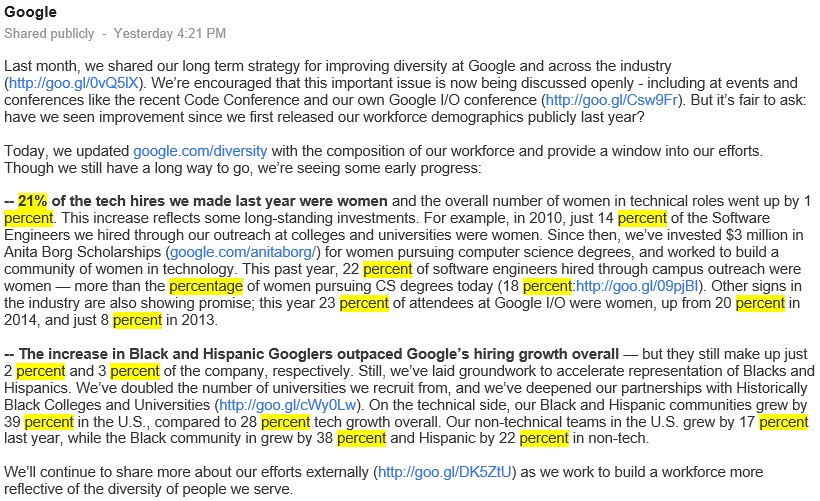
theodp writes: Among the books recommended by Bill Gates for beach reading this summer is How to Lie With Statistics, the published-in-1954-but-timely-as-ever introduction to the (mis)use of statistics. So, how can one lie with statistics? "Sometimes it is percentages that are given and raw figures that are missing," explains the book, "and this can be deceptive too." So, does this explain Google's just-released Diversity Report and the accompanying chock-full-o-percentages narrative (find-all-%-image), which boasts "the Black community in grew [sic] by 38 percent", while the less-impressive raw figures — e.g., the number of Google employees increased by 5,928, but the ranks of Black females only increased by 35 (less than 0.6% of the net increase) — are relegated to a PDF of its EEO-1 Report that's linked to in the fine-print footnotes? To be fair to Google, Microsoft, Twitter, Apple and Amazon didn't want people to see their EEO-1 numbers, either.
-
How Elon Musk's Growing Empire is Fueled By Government Subsidies
theodp writes: By the Los Angeles Times' reckoning, Elon Musk's Tesla Motors, SolarCity, and SpaceX together have benefited from an estimated $4.9 billion in government support. The figure compiled by The Times, explains reporter Jerry Hirsch, comprises a variety of government incentives, including grants, tax breaks, factory construction, discounted loans and environmental credits that Tesla can sell. It also includes tax credits and rebates to buyers of solar panels and electric cars. "He definitely goes where there is government money," said an equity research analyst. "Musk and his companies' investors enjoy most of the financial upside of the government support, while taxpayers shoulder the cost," Hirsch adds. "The payoff for the public would come in the form of major pollution reductions, but only if solar panels and electric cars break through as viable mass-market products. For now, both remain niche products for mostly well-heeled customers." And as Musk moves into a new industry — battery-based home energy storage — Hirsch notes Tesla has already secured a commitment of $126 million in California subsidies to companies developing energy storage technology.
-
First Ultraviolet Quantum Dots Shine In an LED
ckwu with word that South Korean researchers have created the first UV-emitting quantum dots, and employed them in the creation of a flexible LED. Their achievement is notable because no one has previously succeeded in making quantum dots capable of emitting light at wavelengths shorter than 400 nm, which defines the upper range of the UV spectrum. Writes ckwu: To get quantum dots that emit UV, the researchers figured out how make them with light-emitting cores smaller than 3 nm in diameter. They did it by coating a light-emitting cadmium zinc selenide nanoparticle with a zinc sulfide shell, which caused the core to shrink to 2.5 nm. The quantum dots give off true UV light, at 377 nm. An LED made with the quantum dots could illuminate the anticounterfeiting marks on a paper bill. The article names a few applications of the technology, besides, including water sterilization and industrial applications.
-
The Reason For Java's Staying Power: It's Easy To Read
jfruh writes: Java made its public debut twenty years ago today, and despite a sometimes bumpy history that features its parent company being absorbed by Oracle, it's still widely used. Mark Reinhold, chief architect for the Oracle's Java platform group, offers one explanation for its continuing popularity: it's easy for humans to understand it at a glance. "It is pretty easy to read Java code and figure out what it means. There aren't a lot of obscure gotchas in the language ... Most of the cost of maintaining any body of code over time is in maintenance, not in initial creation."
-
Ask Slashdot: Best Way To Solve a Unique Networking Issue?
New submitter petro-tech writes: I work as a service technician, maintaining and repairing gas pumps and POS equipment. In my day to day activities, one that consumes a ton of time and is relatively regular is the process of upgrading the software on pumps. This is done by connecting to the pump via direct ethernet from my laptop, then running a manufacturer-provided program that connects to the device and pushes the new software. Some sites have 8+ pumps with 2 devices in each, and at 20-30 minutes apiece this can be quite time consuming. Unfortunately the devices are not actually on a network, and as such cannot be updated remotely, also since they are not on a network, they are all configured with the same IP address. Additionally the software doesn't allow you to specify the adapter to use. I would like to be able to get to a site, connect a cable to each pump, and load them all at the same time. The only way I can figure to accomplish this with the software we've been provided is to do this: Get a 16-port powered USB hub, with a usb-ethernet adaptor in each port; Set up 16 VM's with extremely stripped down XP running on each, with only one USB-ethernet adaptor assigned to each VM; Set XP to boot the application for loading software as its shell; and load each device that way at the same time. Is there a better way to accomplish this? Have a question for Slashdot's readers? Take a look at other recent questions first to see if someone else has had a similar question. And if not, ask away! The more details and context you include, the more likely your question will be selected.