 Slashdot Mirror
Space Pictures From Near and Far
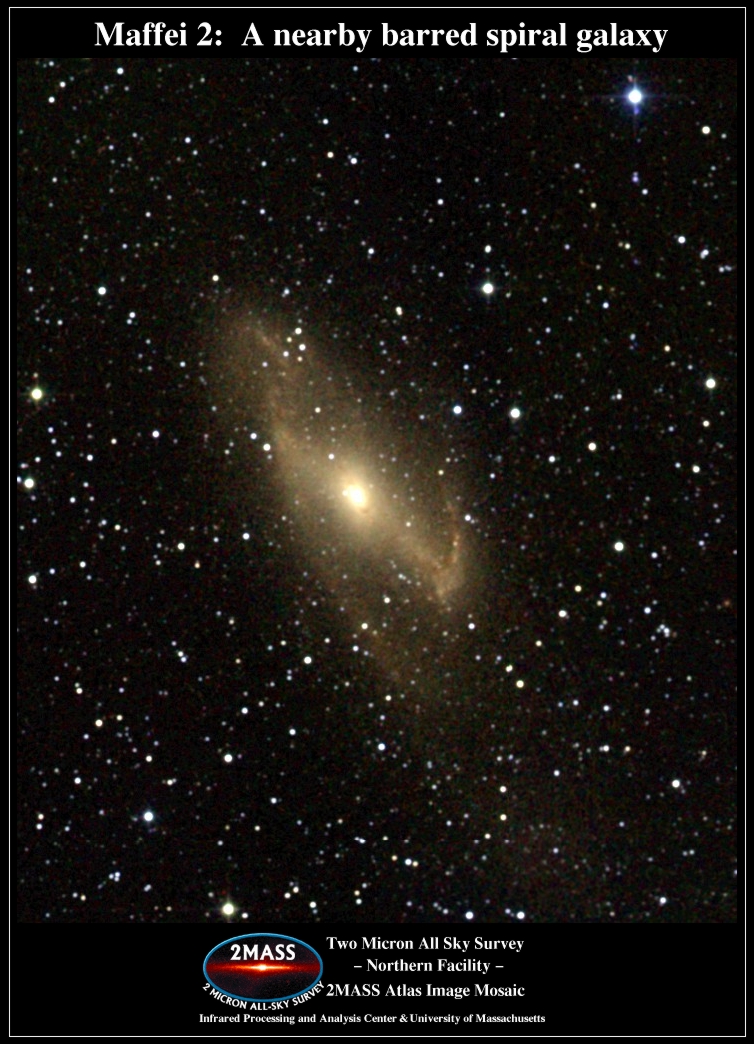
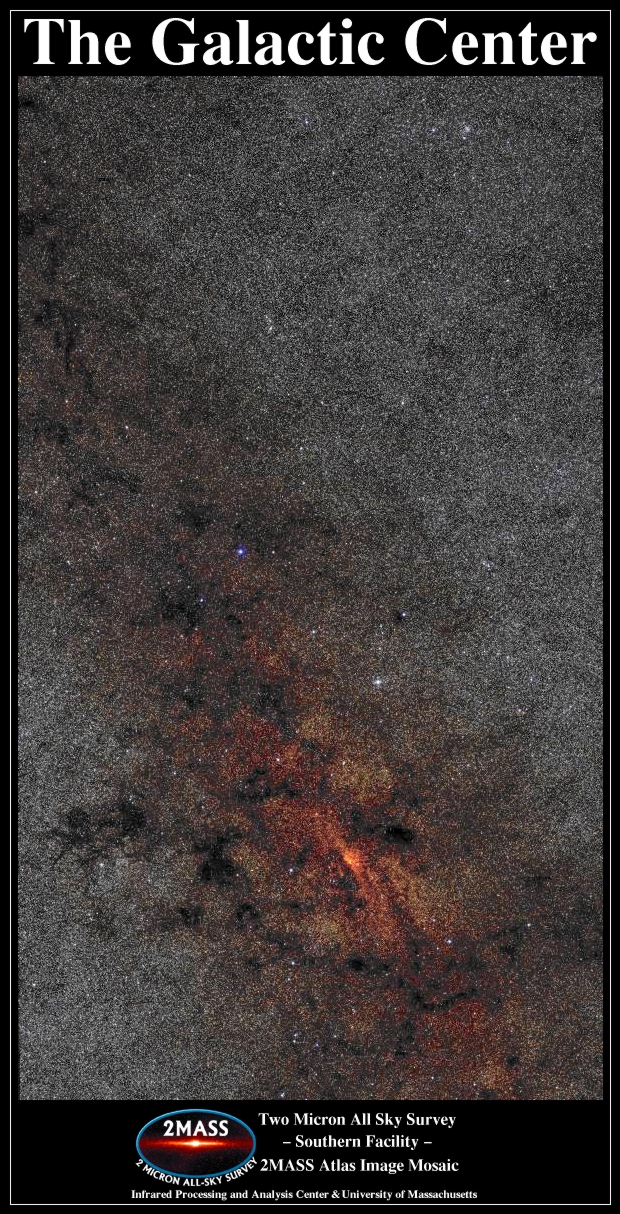
Buran writes: "The BBC News has a fine story about the how our galaxy looks from the outside according to the 2-Micron All-Sky Survey (2MASS). The article describes the shape of our galaxy (a barred spiral; all those books showing concept paintings of a regular spiral galaxy will be out of date now) and how the survey was done (near-infrared measurements of 500 million carbon stars). For the first time, we can see the center of our own Milky Way. All our worldly troubles seem so small..." That takes care of the big picture; Chris McKinstry has submitted news of much closer but just as exciting shots of Saturn -- read below for more on those.
mindpixel writes: "I was very excited when I saw this amazing shot of Saturn come up on the control room monitors of the VLT in November, and I'm even more excited that as of today the image is finally public. It is possibly the sharpest view of Saturn's ring system ever achieved from a ground-based observatory. All of us here at the observatory are quite proud of it, especially the NAOS-CONICA team."
Had the title been simply "Pictures From Near And Far", nobody would read it. But, the addition of "Space" makes it infinitely more attractive.
Try it. Space Ice Cream. Yum! Ice Cream. Boring. Space Frisbee! Exciting! Frisbee. Dull, lifeless. Space Herpes! Oh, wait...
- A.P.
"Remember when the U.S. had a drug problem, and then we declared a War On Drugs, and now you can't buy drugs anymore?"
To be honest, I was always a bit dissappointed that I wasn't living in a barred spiral. Turns out I am. Nifty. :)
I can't wait until Cassini gets within range of Saturn, it is definitly one of the most amazing things in the sky. Unfornatually it's largly been ignored by many high-power telescopes and space probes.
What NASA/ESA and all the other agencies in the world need to do is send out a swam of probes to *every* planet - a little science is better than no science!
Isn't micron symbolized by a "" ?
It would be 2ASS then... looks like something someone would say in an AOL chat room...
please flame me if I'm wrong.
For sale: One novelty T-shirt, displaying the (formerly correct) image of the Milky Way, and the words "You Are Here" with arrow. Lightly used. Almost clean.
Moving further out, apparently our Galaxy-cluster as viewed from the outside, looks kind of like a small handful of Swedish meatballs, wrapped in lavendar tissue paper and tied with a length of green and yellow ribbon.
Or so I'm told....
I jumped on the space bandwagon late, and it's really only been recently that I've developed an interest at all. So I'm in a unique position of learning basic facts that others take for granted, at an age where I can appreciate the grandeur. For instance, the fact that there are truly *billions and billions* of stars *just in our galaxy*. That had me reeling for a couple of days... I don't want to ramble, but *man* is space cool. And space icecream is cool, too, I guess :-)
Sorry to say it, but that picture of Saturn is just too perfect, it looks like a cheap computer rendition. Can we go back to the less sophisticated, grainy pictures? They were more exciting and seemed more "real".
At the AAS meeting a few weeks ago, a Chandra (X-Ray observatory) team produced this stunning mosiac of the Galactic Center.
It's amazing. Also, apparently the supposed massive black hole in our galaxy's center is 'off', so there's not a lot of emission from it, instead we see remnants of earlier activity (such as Sagittarius A).
A.
You know, if the United States Federal Government would get off it's duff, reform the tax system and be a little more responsable with where it spends money there would be the dollars for these things.
The EU won't foot the bill for a swarm of probes, so that leaves the US, Canada and Japan.
However, if they scaled up production of these things, the economy of scale would kick in and the overall price of these beasties would drop.
Right now, the probes are a one time knockoff and are as expensive as a Italian exotic sportscar is compared to a Lexus or Lincoln.
Whenever life gets you down, Mrs. Brown, And things seem hard or tough, [clunk] And people are stupid, obnoxious, or daft, And you feel that you've had quite enough, [boom]
[singing] Just remember that you're standing on a planet that's evolving And revolving at nine hundred miles an hour, That's orbiting at nineteen miles a second, so it's reckoned, A sun that is the source of all our power. The sun and you and me and all the stars that we can see Are moving at a million miles a day In an outer spiral arm, at forty thousand miles an hour, Of the galaxy we call the 'Milky Way'.
Our galaxy itself contains a hundred billion stars. It's a hundred thousand light years side to side. It bulges in the middle, sixteen thousand light years thick, But out by us, it's just three thousand light years wide. We're thirty thousand light years from galactic central point. We go 'round every two hundred million years, And our galaxy is only one of millions of billions In this amazing and expanding universe. [boom] [slurp]
The universe itself keeps on expanding and expanding In all of the directions it can whizz As fast as it can go, at the speed of light, you know, Twelve million miles a minute, and that's the fastest speed there is. So remember, when you're feeling very small and insecure, How amazingly unlikely is your birth, And pray that there's intelligent life somewhere up in space, 'Cause there's bugger all down here on Earth.
Your post actually is actually more culturally relevant than you might think. Gustave Courbet painted in 1866 a work entitled 'L'Origine du monde' (The origin of the world), which was a detailed painting of the nether parts of a human female. It was a private comission (some rich business guy wanted it), but raises the stakes on the old pornography or art question at a far earlier date than many might realize, besides the interesting commentary of the work's title. For the curious and over 18, you can view the painting at the Artchive here.
Oh the things you learn in art history class.
-Wombat
Take a look at that picture of the center of the galaxy again -- one of the biggest challenges to astronomy is how to catalogue every single object visible and create a rapidly searchable database. And that picture is not even 10% of the sky, in only one band! Astronomers are having to come up with new ways of loading, structuring, and searching multi-TB datasets to get incredible science out of the flood of data. The future of astronomy is in these multi-TB databases, in multiple wavelengths, which create the "National Virtual Observatory".
If you want to understand the science that these databases would make possible, imagine if your business had a searchable database of the entire population of the world, with parameters like age, height, weight, income, address, phone number, spending habits, and more, for every single person.
Have a look at this link for what some scientists think a virtual observatory will be capable of!
As is so often the case in journalism, this claim is wildly overselling things (and is not made in the BBC article.) I was using IRAS (infrared astronomy satellite) and various earthbound surveys (including the much earlier TMSS two micron all sky survey) around 1990, and have an IRAS poster from that era at home showing our galaxy (including the core.) Similarly, we have known for over a decade that our galaxy is a barred spiral.
Is this a case of the more overblown your submission, the more likely slashdot is to carry the story?
I'm not knocking the 2MASS survey - high quality all sky surveys like this lead to huge amounts of high quality science.
Quattuor res in hoc mundo sanctae sunt: libri, liberi, libertas et liberalitas.
I should have read more carefully - the BBC article *does* incorrectly claim this as a first: "Evident in the map, and seen directly for the first time, is the cigar-shaped bar..."
My apologies to the submitter of this story.
Also, I have checked and found it was COBE (cosmic background explorer) not IRAS that made my poster. Here it is. Notice how this too reveals the squarish, thicker towards the edges shape of the bulge indicating a bar seen obliquely.
Quattuor res in hoc mundo sanctae sunt: libri, liberi, libertas et liberalitas.
Why isn't there a big blind spot on the opposite side of the calactic center? Can the MASS see through the center, or are they just filling in what they assume is there?
Furthermore, can we see objects farther away on the opposite side of the galactic center? If not, how big is the blind spot?
http://www.ipac.caltech.edu/2mass/gallery/gc_movie .html
it's of the galactic center
pretty cool
"It is a greater offense to steal men's labor, than their clothes"
I'm sure it's been posted before, but I don't have the patience to look for it.
MMMMMM Milky Way. That is the first thing that I thought of when I read the article. I could sure go in for a candy bar.
And (okay now I'm getting deep) that's the problem with getting funding for space probes. My stomach is a lot more important to me than Uranus (or Pluto). Even if it costs next to nothing, I don't want to spend money on a probe when I could be spending money on making my life nicer.
Knowledge is all well in good, but there's no nugguty center.
Sweat
It breaks my pluginses, my precious!
Well I just happen to think that science, astronomy and the quest for knowledge is a better "pet interest" than building killing devices and using them on peasants in the third world while waving the "stars and stripes" so god damn close to your face that anyone who disagrees or dares to point out US hyprocrisy is part of the imaginary "Evil Axis".
I fart in your general direction!
* * Always question "the National Interest" - 9 times out of 10 it is a cover for evil
Nice picture of the galaxy... but was anyone else disappointed to find that the little red arrow with the words "You are here" was absent?
"Your superior intellect is no match for our puny weapons!"
Saturn is about 340 pixels wide in the high-resolution version of this picture. With an equatorial radius of 60268 km this translates into a pixel width of 177 km on the surface of Saturn.
The picture was taken from a distance 1209 million km, or 3215 times the surface-to-surface distance from the Earth to the Moon.
177 km divided by 3215 is 55 meters, and that is why you can't point this telescope at the moon and photograph the descent stage of a lunar lander. Actually the resolution could theoretically be a little better if the photograph was taken att shorter wavelengths, but still not good enough to catch man-made equipment on the moon.
Oops! 340 pixels is actually the diameter while 60268 km is the radius. So the pixel width turns out to be 354 km, and the corresponding resolution on the lunar surface would be 110 meters. Luckily, the conclusion is the same.
From memory, I think we are about SBab (i.e. about midway between an a and a b). It is a bit difficult to tell from inside, and so far as I know it is a subjective scale rather than quantitative. Basically it measures the ratio between bulge and disk size. Larger galaxies tend towards the 'a' end. We are in a quite large spiral galaxy.
Quattuor res in hoc mundo sanctae sunt: libri, liberi, libertas et liberalitas.