 Slashdot Mirror
Today's Solar Flare
An anonymous reader writes "X1-class solar flare today (13:30 Universal Time). Still the SOHO spacecraft offers some of the all-time greatest snapshots anywhere on the web. The flare's residual activity would be shown white and at around 9 o'clock position here. There are 3 major categories, each 10 times stronger than the next: X-class flares are big; they are major events that can trigger planet-wide radio blackouts and long-lasting radiation storms. M-class flares are medium-sized; they generally cause brief radio blackouts that affect Earth's polar regions. C-class flares are small with few noticeable consequences here on Earth. If it were headed towards Earth, arrival is usually 48-72 hrs later (this is not coming this way). Future Mars astronauts should take a lead umbrella because one radiation day on Mars is like living at 70,000 feet on Earth." Nature is pretty.
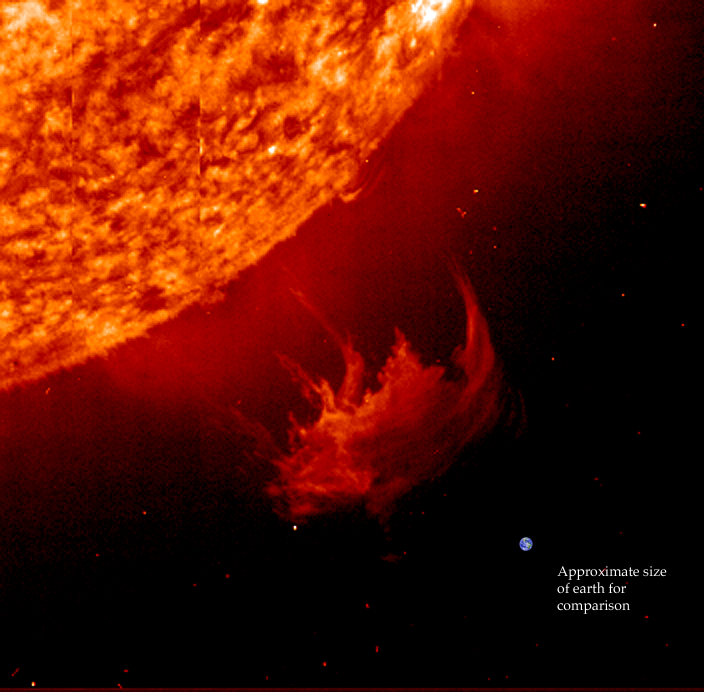
Fortunately, astronauts can find the protection they need indoors (from solar storms) ; shelter walls made of lightweight materials provide adequate shielding.
For those needing more on this, go find what you need here or, for something a little more cautious and "NASA" here.
Now only if we can get people to stop running about waving their arms and shouting "The Radiation! The Radiation!" we might get something productive done... Heh! No chance of that I guess, might as well join them...
*waves hands over head, runs about, starts screaming "The Radiation!" and giggling*
It seems to me that it probably could damage your binocs (exactly as you say). On the other hand, I used my binocs in the same fashion to view a solar eclipse, even when it was only about 20% eclipsed, and they still work fine. FWIW they are expensive 7x50 marine binoculars. They are gas-tight and filled with nitrogen.
I guess, since binocs transmit 9x% of the light, the power absorption is very low, once you get them adjusted so that the image is going through them. (But as you say, while you are adjusting, the image may briefly get projected on the edges somewhere, which can't be good.)
If you are worried about it, you could use something opaque like heavy paper to reduce the aperture of the objective. Or obtain some neutral density filters.
Another way to observe the sun is with a pinhole camera, although that is a bit more involved.
MM
--
By including this sig, the copyright holders of this work or collection unreservedly place it in the public domain.