 Slashdot Mirror
FSF Announces Corporate Patronage Program
Andy Tai writes "The Free Software Foundation has announced a 'Corporate Patronage Program' to allow companies to support the work of the FSF. The members already include IBM, HP, Ada Core Technologies and MySQL. Interested parties should contact Ravi Khanna."
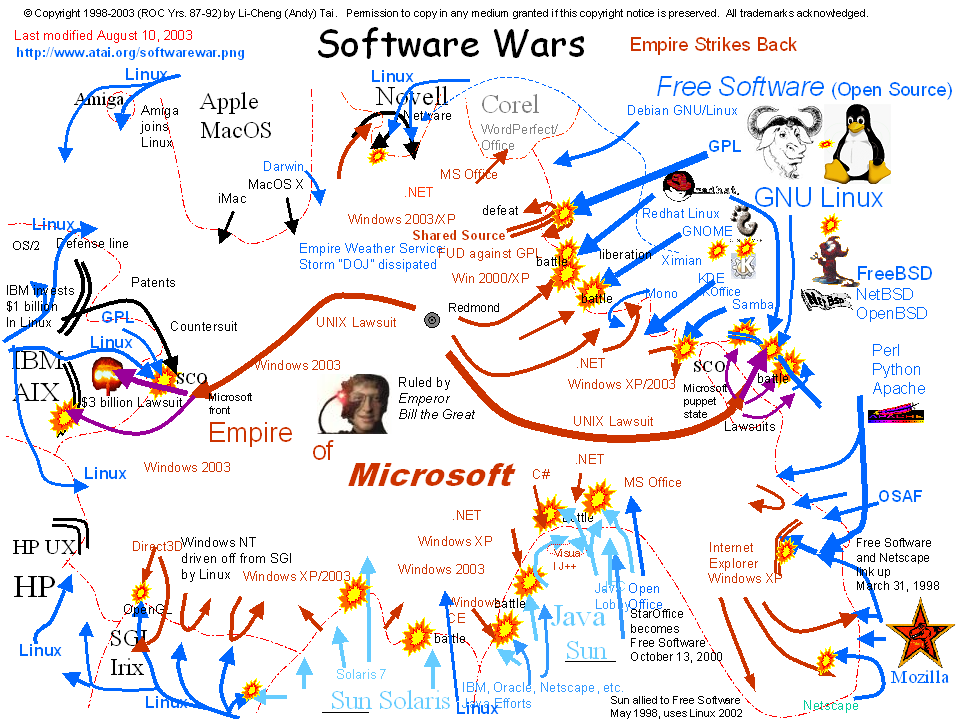
The FSF should at least offer to make the company's names on its Patron sponsor list linkable to the companys' websites. It is 2003 you know.
I hate having to go to Google to type in "OEone Corporation" to find out who the heck they are.
--LP
Here's hoping that both companies and individuals support it by the bucketload.
____________
Linux Hosting! $3 a Month! Cheap Web Site Hosting
This is a good thing. The FSF is getting corporations involved in free (libre) software. Goes to counteract all those nay-sayers who say "RMS and the FSF are communists!" No, they're not communists. Not even close. In fact, RMS and the FSF have repeatedly scolded licenses which are "like the GPL" but prevent corporations from using them on those terms.
social sciences can never use experience to verify their statemen
I think the reason is that, unlike 10 years ago, many companies are now in the business of writing free software. There's no reason for the FSF to take donations to do something that businesses such as Red Hat are already doing. The FSF is going where it's needed - providing legal support to ensure that existing free software remains free, and providing hosting services for volunteer-run projects.
Patent happy IBM is supporting a group attempting to get rid of software patents. IBM is cruising for a corporate identity crisis. Who will win? IBM's Hackers and marketers or IBM's lawyers?
I think the reason is that, unlike 10 years
/. to see what folks might have to say.
ago, many companies are now in the business of writing free software.
Not really. Not in the comprehensive way that was once the FSF agenda. Sure, companies doing development in fairly narrow (and not infrequently private or even proprietary) areas -- but no big R&D push comperable to the effort that FSF had going. Lot's of company-oriented projects that have the hearts and minds of volunteers, though.
(And isn't that last point at least unseemly?)
The FSF is going where it's needed - providing legal support to ensure that existing free
software remains free, and providing hosting
services for volunteer-run projects.
Some of what the FSF is doing (you left out advocacy) is very important. I don't disagree about that. That's why it's a delicate criticism -- I also have a lot of respect for the FSF.
I'm not even sure that the Right Thing is for the FSF to change here -- only to raise the issue on
-t
Free software stimulates the market, just not the software market :)
Seriously, the FSF originally set out to make it so that you could run a completely free system, and now you can. I do it; so do many others I know.
The FSF's task now is to make sure it remains possible -- i.e. no SSSCA, no DMCA'ed .doc format, sane or relatively impotent patents, and a legal environment in which free software feels like a safe choice to managers. When we started out, the biggest threat was actually needing something that only proprietary software offered, but that's not the big threat now.
Sure, more software needs to be written, but we are writing it. The FSF looks to secure our most vulnerable points.
P.S. Debian essentially is the long-promised GNU system. The FSF dropped out of administering it pretty early, and it uses Linux not Hurd, but it is basically the promised GNU system.
Sig:Why copyright isn't a fundamental human right
There really is very little software from the original FSF definition that isn't being written by the free software community that matters (for example I don't know if there is much development on "empire" but no one cares anymore). At this point the FSF serves a few roles which are important:
1) A legal advocacy organization
2) Giving direction on GPL related issues to the community
3) A place for authors to drop off code if they want someone to maintain it and they aren't interested anymore.
As for "complete GNU system" Stallman is of the opinion that Debian/Hurd would be a complete GNU system. So he obviously is happy enough with Debian even if they don't neccesarily agree with him on everything.
This is a good move -- hopefully many companies will catch on and the FSF will get sponsorship. But what worries my is that the FSF is an organization whose goals are not clearly stated. I, for one, am not sure what exactly FSF can and cannot do. I've spent some time looking for a charter, or a set of rules governing this organization and haven't found any on the FSF web site. All I found was talk and marketing.
I believe this should be particularly alarming to software authors who assign copyrights to the FSF. I would be rather wary of transferring rights to my work to an organization, unless I understood very clearly what the organization can can cannot do with them. Try to find that out from the FSF web site.
Yes, I have contacted the FSF about this. I was told that the documents were not put online because of lack of volunteer time.