 Slashdot Mirror
Water Basketball Robot
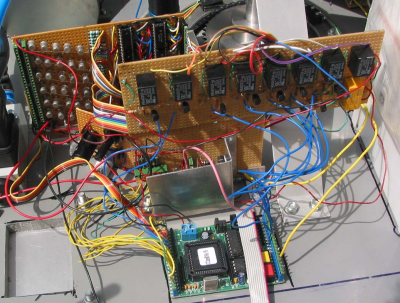
tisaak writes "Second-year Mechanical Engineering students of the ETH Zurich are required to participate in the so-called "Innovation Project". A subject is assigned each year and 12 teams battle it out to develop a complete product. This year's subject was "Sport and rehabilitation" and "Cleaning". One of the teams managed to build a floating, ball-throwing kind of robot. I think the whole idea is funny and the fact that it has a lot of cables and a processor in it should appeal to the Slashdot public :-) The electronics platform used is called C-Control and is used to control the sensors, the motor and the LCD-Display. The implementation of the game program is nice, considering it is written in a subset of BASIC."



That's incorrect:
John G. Kemeny and Thomas E. Kurtz invented BASIC in 1964 for use at Dartmouth College. They made it freely available to everyone who wanted to learn how to program computers. It soon became a world standard. -TrueBasic.com
You're probably thinking of this:
In 1973, Gates entered Harvard University as a freshman, where he lived down the hall from Steve Ballmer, now Microsoft's chief executive officer. While at Harvard, Gates developed a version of the programming language BASIC for the first microcomputer - the MITS Altair. -http://www.microsoft.com/billgates/bio.asp
Bored with karma, be a fan/freak
If you were looking for the lowest power microcontroller board available, this would be in the running. I guess it was inexpensive -- always a plus for student projects. (My first computer in 1979 could probably thrash this good, except in size.)
One line blog. I hear that they're called Twitters now.