 Slashdot Mirror
Gates: Microsoft IP Finds Its Way Into Free Software
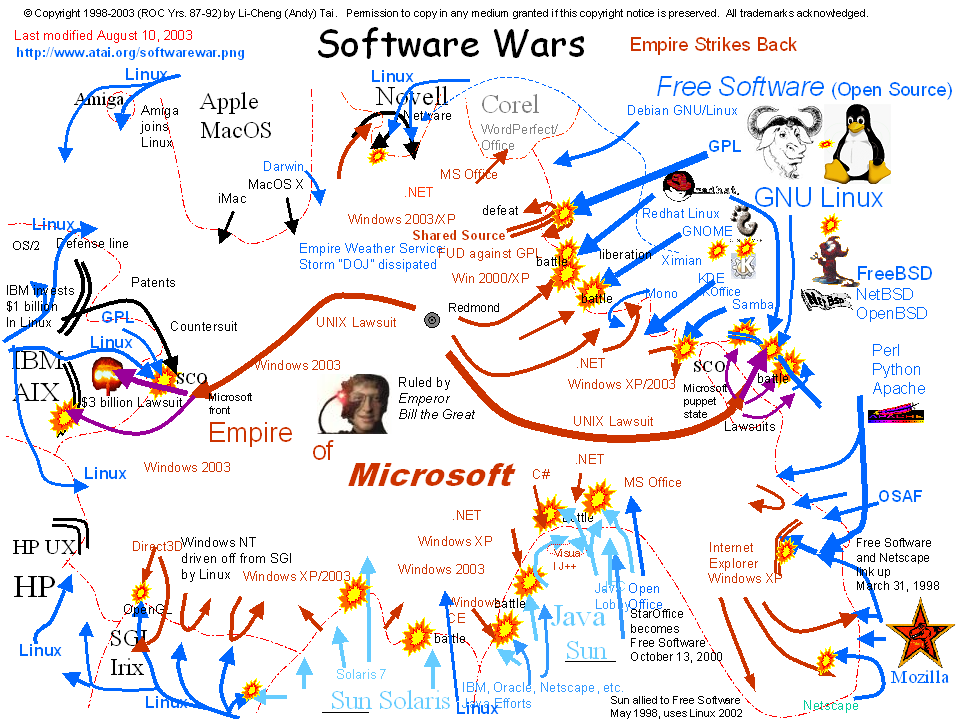
Andy Tai writes "While speaking to financial analysts and commenting on the SCO lawsuit, Bill Gates made the claim that Microsoft's IP is also included in Free/Open source software. Without being specific, he said "There's no question that in cloning activities, IP from many, many companies, including Microsoft, is being used in open-source software. When people clone things, that often becomes unavoidable." Considering Microsoft's claims of ownership over technologies like CIFS, does this mean Microsoft may also launch SCO-style attacks against Free Software/Open Source?"
BSD code is in there, in full compliance with the license.
Microsoft actaully does use GPL code as well in some of their unix interopability software. Again, believe it or not, they actually comply with the license.
With the pressure on Microsoft, I don't think they would risk getting caught stealing code. If such an accusation came up and had even the slightest whiff of legitimacy, I'd expect to see several MS developers fired immediately and MS offering a large settlement deal.
Actually... if you check out halloween 7, you will see that this was foreshadowed. Indeed, the brush up with SCO has every sign of being just an opening skirmish in a long battle. Note Eric Raymond's comment in the intro to Halloween 7 - "The risk that Microsoft will go on a patent-lawsuit rampage, designed more to scare potential open-source users than to actually shut down developers, is substantial. The language about "concrete actions" in relation to IPR has the same ominous feel that the talk of "de-commoditizing protocols" did in Halloween I and II." This is partly based on the following comment within the Halloween doc: "Linux patent violations/risk of being sued" struck a chord with US and Swedish respondents. Seventy-four percent (74%) of Americans and 82% of Swedes stated that the risk of being sued over Linux patent violations made them feel less favorable towards Linux. This was the only message that had a strong impact with any audience."
Also, copyright covers the right to make derivative works. So if there's an icon or other UI element that was a tweaked Windows element then that's technically copyright infringement. It's awefully hard to prove though (given the Apple v. MSFT precedent.
In short, Gates is right but it doesn't mean they'll start firing lawsuits against open source...They didn't previously sue their other competitors unlike how Sun/Oracle lobbied and/or sued MSFT.
If coca-cola brings out a new drink, i do a chemical analysis on it and duplicate it, then bring it out at half the price in a remarkably similar bottle, i'd get sued to death. I don't see why people think the software world should work differently.
Because free software cloning doesn't work that way. When someone write a clone of some Microsoft product, it is assumed that they don't disassemble the original and copy the code (the equivalent of your chemical analysis). The clone is a completely different piece of code with the same capabilities as the originals. Pepsi Cola similarly clean-room engineered their version of sugared water without analyzing the chemical composition of Coca Cola, and they're still around.
"A door is what a dog is perpetually on the wrong side of" - Ogden Nash
He's not claiming reverse engineering.
What he's claiming is very interesting for people that aren't familiar with the nastiness of big business, though. Sort of an eye-opener for me a few years back, and tech folks should be aware of this if they're interested in IP.
See, you know how most Free Software folks complain bitterly about (at least some) software patents, saying that it makes things really hard to operate? They aren't lying. Engineers working at big companies ran into the same problem *years* ago. You simply cannot build things in a world with this many tech patents. It's impossible. You'd have to check through huge numbers of patents to do anything.
So big business came up with a solution. They just cross-license *everything*. One company is free to use all of another company's (or organizations...for example, MIT and Microsoft cross-license) patents. Most tech companies with decent IP portfolios do this with their competitors. For example, Seagate, Western Digital, Maxtor, etc, all cross license each others' patents.
This seems, at first, counterproductive. After all, isn't the point of patents to give you a short-term edge over competitors, to encourage new development? Nope. Patents in a situation like this still provide one big benefit to their owners -- they maintain oligopolies. If a new hard drive manufacturer comes along and wants to make hard drives, they can't. Seagate, WD, etc own masses of IP, enough to keep the new vendor from entering the market.
This is why patents are pretty frusterating in the world of big business. Go work at a corporate research lab...any patents you come up with don't do your company any good against their competitors. They just keep anyone else from entering the arena.
Now, Gates is troubled enough by Linux to pull the patent oligopoly card out of his sleeve, which normally doesn't get played. MS cross-licenses with *huge* numbers of organizations. They own massive amounts of IP. And yes, it's almost certain that they have rights to a large number of patents that Linux does not have rights to.
Hell, last time Slashdot ran a contest asking for silly patents (a ways back, maybe a year ago), I searched for "computer". First ten hits contained the just-granted patent on the table-lookup optimization for computing CRC-32s. Now, *everyone* does this...modem manufacturers, lots of hardware vendors. Not doing it is stupid. And maybe this patent would have gotten challenged if the owner went after, say, 3com with it. But instead, it's almost certainly in a large patent portfolio somewhere, waiting around for a day when its owner feels threatened by a newcomer to the industry. Then it can pull out its portfolio and start beating folks up.
This is not a trivially fixable feature of the patent system. Most US corporate research (probably foreign as well...I'm just not that familiar with non-US legalities) depends upon the oligopoly benefits provided by patents.
And just throwing out the patent system has other problems. I'm not sure that, say, RSA encryption would *ever* have been developed without a patent system to provide encouragement.
The best thing to do, I think, would be to cap tech patents at seven years, so that companies have to keep frantically coming up with new tech. Wastes more on lawyers -- it costs a couple of thousand per patent, and more patents would have to be produced to compensate -- but that at least alleviates some of the effect.
May we never see th
I agree with most of your points but I doubt BG really made up his Basic by looking at the Dartmouth Basic source code. The source code for Dartmouth Basic is at dtss.org and IMHO it is very difficult to understand; about one comment every 300 lines and in assembler for a GE mainframe (these machines are alleged to have a very large and complex instruction set). Most of all Dartmouth Basic was a compiler, not an interpreter.
In March 1995, the 1st US Circuit Court of Appeals overturned the 1993 decision of Judge Keeton of Boston in Lotus' lawsuit against Borland. Lotus sued Borland for copyright infringement on Lotus 1-2-3. In its decision the appeals court determined that Lotus' menu structures, incorporated into Borland's Quatro Pro spreadsheet, are "an uncopyrightable method of operation".
~REZ~ #43301. Who'd fake being me anyway?