 Slashdot Mirror
Surviving Slashdotting with a Small Server
S.BartFarst writes "Our little departmental server has been slashdotted twice in the last year and survived! Implementation of a two-headed redundant hardware scheme using linux virtual server and backup and failover capabilities enhanced by the linux high-availability tools has produced a nifty low-cost solution. Gotta love those little white boxes!
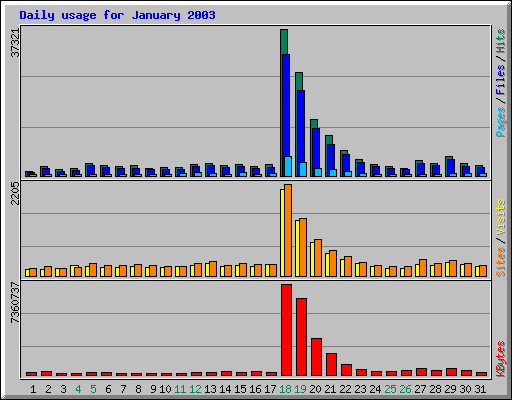
(also having a university-supplied BIG PIPE doesn't hurt). More interesting is the documentation of the apparent exponentially decaying attention span of slashdotters. Anybody else observed similar phenomena?"
Notice this comment was posted on a slow Sunday afternoon (EST). Very clever, because they know that /.'ers can't resist a challenge like that. Feel sorry for them on Monday morning though...
well there you go... having a massive amount of bandwidth will allow you to survive a slashdotting. In most cases of slashdotting, I dont think the server was the bottleneck... its no problem for a server to dish out static pages... its the bandwidth, especially for serving pictures or videos....
Or is it where the article is at any given time? Top of front page gives lots of hits. As it drifts down, the hits slow as fewer read; to the sidebar, fewer but still substantial hits; then off to the specialty pages such as Science or Games, then only a few will read.
Of course, the only test would be to repost the article and see if there's the same number of hits... Nah, slashdot would never go for duplicate stories.
Interesting how it peaks, drops off slowly then rises again a little before dropping off again. Maybe some 'behind the curve' slashdot readers?
You didn't get Slashdotted if the server was still operating normally. You just had some people from Slashdot visit.
May we never see th
Our little departmental server has been slashdotted twice in the last year and survived!
:-)
Oh, come on. Even my little old G3 iMac is capable of handling quite a load from Slashdot and this site is serving up graphics intensive stuff. What you need to prevent a good Slashdotting is bandwidth that universities provide. T3 backbone connections are a wonderful thing.
Go ahead click all you want.
Visit Jonesblog and say hello.
Most slashdottings come from limited bandwidth or php/perl/asp/mysql/ etc being unable to handle it. Most dynamic content could be static content. (Most slashdot pages are static caches).
On the stats link provided for a January slashdotting, the most bandwidth used in a day was a little under 7.4 GB. Assume that it was posted on /. at noon, so there were 12 hours to spread the big hit over: about 617 MB/hr. That's a little over 10 MB/Min, or 170 KB/sec. Even if we assume that the initial hit was double that, I can easily stream a 1000 KB/sec Divx movie over my 100 Mbps switched home LAN. The limiting factors here are the servers, routers and bandwidth to the Internet, not the local network connecting the servers.
That's it. I'm no longer part of Team Sanity.
Why is it surprising that it follows an exponential dropoff? The only interesting questions are the coefficients of exponential dropoff, not that it's exponential--I'd sit upright and take notice if it was a linear decrease.
Anything which follows a steady fractional diminishment will have a curve of y = ke**-ax, where k and a are constants. You see this basic equasion pop up all the time in physics, economics, statistics... etc. Why should server slashdotting be any different?