 Slashdot Mirror
Surviving Slashdotting with a Small Server
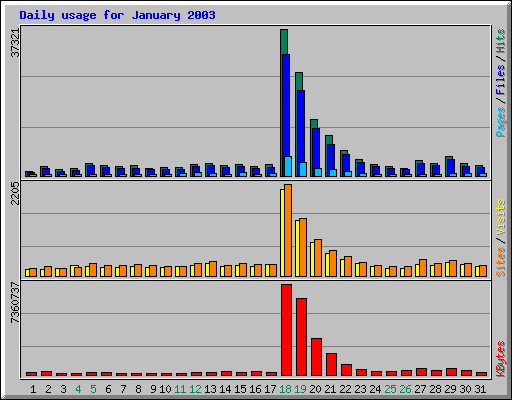
S.BartFarst writes "Our little departmental server has been slashdotted twice in the last year and survived! Implementation of a two-headed redundant hardware scheme using linux virtual server and backup and failover capabilities enhanced by the linux high-availability tools has produced a nifty low-cost solution. Gotta love those little white boxes!
(also having a university-supplied BIG PIPE doesn't hurt). More interesting is the documentation of the apparent exponentially decaying attention span of slashdotters. Anybody else observed similar phenomena?"
My server has been slashdotted a few times and I can tell you it's pretty simple to not get overloaded.
The first time I learned my lesson. The server was on a T1 line that was 2/3 full already, and slashdot linked to a page full of large photos. That'll kill your link pretty quickly. Low-budget solution: sign up for a burstable web hosting account somewhere and just put all your large images there.
Later when we got some actual office space for the business, I moved the main server up to a colo facility in fremont. All slahdottable content is hosted there on a fast server with a 100mbps ethernet link. Other oddball services that need their own machine are hosted from the other end of a point-to-point T1 line going directly back to the office from the colo.
So depending on your budget it's really not hard to set up your site to survive a slashdotting. If you don't have a lot of dough to spend but you want to run your own server for configurability/security reasons, just host the static stuff somewhere else. Or if you're serving enough to make it economical, get a colo account with a burstable link.
There's a widespread misconception here that slashdotting is caused by server overload. In reality this is almost never the case. It's caused by insufficient bandwith. This in turn may cause server overload because of too many slow clients being connected, but that is purely a secondary effect.
It simply stops serving images at anything but a really slow rate
What's the point? Either way you're slashdotted.
Besides, I think in the case of server overload (as opposed to network overload), throttling will only exacerbate the problem by increasing the number of slow clients you have to deal with. This is the #1 bottleneck in web servers, the more clients you have, the longer it takes to deal with each one of them. Losts of processes to switch between, long arrays in an out of select(), etc.
Also, when a user doesn't get a page in his browser, what does he do? He clicks the link again and again.... even more connections to handle.
Really the only way to cure an overloaded server is to drop incoming SYNs. Any other measure is just pouring gasoline on the fire.
Even though only a small percentage of Slashdot readers look at the comments, Slashdot's readership is so huge that the number of people reading the comments is still significant. It's not enough to kill a server, but I posted links to three images, around 80KB each, on my home server a few days ago fairly deep down in the discussion and got 3904 hits from it. It didn't kill my server (Pentium 133MHz, 64MB RAM, Debian 3.0, Apache 1.3.26, 3000/256 cable) and didn't result in any nasty letters from my ISP.
OT: It was interesting reading the logs. There are quite a few Linux users on here (but even more Windows users), and I saw lots of people using Mozilla, Opera, Safari, etc. Compare that to sites aimed at the average user where 95% of visitors are using IE or AOL and don't know that there's anything better out there.
It's an operating system, not a religion.