 Slashdot Mirror
Surviving Slashdotting with a Small Server
S.BartFarst writes "Our little departmental server has been slashdotted twice in the last year and survived! Implementation of a two-headed redundant hardware scheme using linux virtual server and backup and failover capabilities enhanced by the linux high-availability tools has produced a nifty low-cost solution. Gotta love those little white boxes!
(also having a university-supplied BIG PIPE doesn't hurt). More interesting is the documentation of the apparent exponentially decaying attention span of slashdotters. Anybody else observed similar phenomena?"
Surviving slashdot'ing with a small server
David P. Anderson
Department of Geological Sciences
Southern Methodist University
The science and technology news service at slashdot.org, self-described "news for nerds," has become a widely read and extremely popular website in the last few years. Enough so that it has introduced a new word into our vocabulary: to be "slashdotted." This is a phenomena in which a news item reported on slashdot.org generates sufficient attention to a particular website that thousands of news-hungry readers descend on that site en masse, creating temporary havoc for the system and often crashing the targeted server.
Our server, www.geology.smu.edu, has been slashdotted twice in the past year. The server has also been subjected to some large bursts of network activity focused around other news media attention, particularly surrounding the destruction of the Space Shuttle Columbia.
After a large surge of server accesses brought our system down in the fall of 2002, it was rebuilt as a two-headed Linux Virtual Server. At the same time provisions were made for system redundancy using the Linux High Availability utilities. In this configuration two machines share the load of a single virtual webserver, while performing out-of-band heartbeat signaling. This plus an automated backup system provides for a seamless failover capability. Each machine has its own independent 100 Mbit connection to the Gigabit SMU internet service, and each has its own Uninterruptible Power Supply (UPS). If either machine fails, the other automatically takes over it's resources to provide smoothly continuous, uninterrupted service. Similarly, one will automatically releases the other's resources when/if the other (failed) machine comes back online. This is a scalable architecture, though currently configured using only two machines.
www.geology.smu.edu
Our nominal access rate for the geology department web/ftp server has usually averaged around 4000 to 6000 hits per day, which corresponds to about 400 to 600 separate visits. With the media attention surrounding our infrasound work on the destruction of the Space Shuttle Columbia in February, we saw peaks as high as 42000 hits per day, corresponding to about 2700 separate visits. Figure 2 shows the daily statistics for February as generated from the Apache log files using the Webalizer utility.
Figure 2. Daily Usage for February 2003
The Columbia was destroyed on February 1st, and we published tentative time, location, and magnitude estimates on the evening of February 3rd. This was accompanied by a spike in web activity on the 4th and 5th, and sustained above-average accesses for the next week. On February 14th, Dr. Herrin held a press conference and presented his team's completed analysis, and that information was repeated in the national media over the next two weeks, producing the spike of activity surrounding the 21st.
Other months not shown here have seen similar peaks of activity, such as that surrounding the publication of our paper on the search for Strange Quark Matter at the Los Alamos National Laboratory archives, and the publication of some of our Planetary Imagery in the popular press and on display at the Smithsonian Museum in Washington D.C.
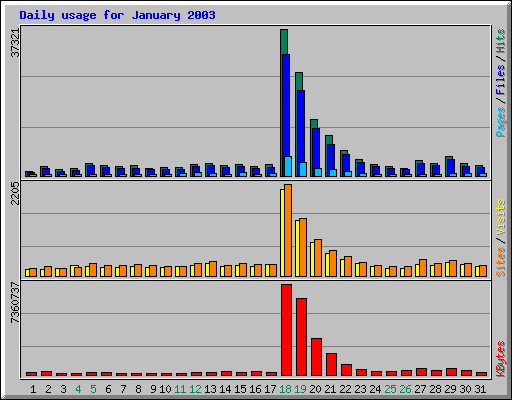
Figure 3. Daily Usage for Jaunary 2003
Compare and contrast the statistics for February 2003 with those for Jaunary 2003 in Figuire 3, when our website was first mentioned on slashdot.org. The seeming exponential decay of accesses is striking. The hourly usage statistics for 18th through the 20th of Jaunary show a simlar exponential-appearing curve. Notice the slight rebound around the 27th through the 29th, like the behavior of a damped sinusoid or a critically damped pendulum. We make no claims as to the significance of these data, other than to note in passing that the attention spans of slashdotters seem to follow an exponential or perhaps damped sinusoidal curve.
We were slashdotted a
It's the S-Prize. Soon John Carmack will be in on it and it'll get huge computer-media attention.
---
When I grow up, I want to be a kid again.
had to be said... sorry.
DT
Is this thing on? Hello?
Well they should probably set up web caching then shouldn't they?