 Slashdot Mirror
Halley's Comet Imaged As Transneptunian Object
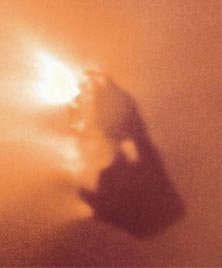
An anonymous reader writes "The European Space Observatory has imaged Halley's Comet at the farthest point (past Neptune) in which such a 10-kilometer diameter iceball has ever been observed. To image a comet as a raven-black object, without its bright dust tail (coma), is equivalent to seeing a lump of coal at the distance between the Earth's poles and to do so in the evening twilight. The last gasp seen from Halley's Comet was 1991, when a gigantic explosion happened, providing it with an expanding, extensive cloud of dust for several months. It is not known whether this event was caused by a collision with an unknown piece of rock or by internal processes (a last 'sigh' on the way out). Halley has an orbital period just over 76 years and will return in 2062."

It is not known whether this event was caused by a collision with an unknown piece of rock or by internal processes (a last 'sigh' on the way out).
If they were able to image it, it seems they knew where it was, by mapping where it was going. If it had collided with something, it's trajectory would have changed.
So does this give us new insight as to how comets die? And if they die, how are they still comets? How does the solar system replenish its comet supply?
Everything seemed to be going so nice
'till the end of all beings punched right through the ice
Almost 1000 years ago, Halley's Comet was overhead during the Battle of Hastings in the year 1066. That long ago, the comet was said to have virtually filled the sky it was so bright. It must have been perceived as a powerful omen.
They can pick out such a small dark object at that distance. Makes me hope that maybe one day the Star Trek scenes where Picard asks Data for range to object and then has it on screen in living colour at 50 million Kilometres may one day become a reality.
Do not try to read the dupe, thats impossible. Instead, only try to realize the truth
What truth?
There is no dupe
It's a remarkable achievement, and shows what can be done with Earth-based telescopes, but it seems to be more proof of concept than practical.
Panurge has posted for the last time. Thanks for the positive moderations.