 Slashdot Mirror
Heavy Metal Frost on Highlands of Venus?
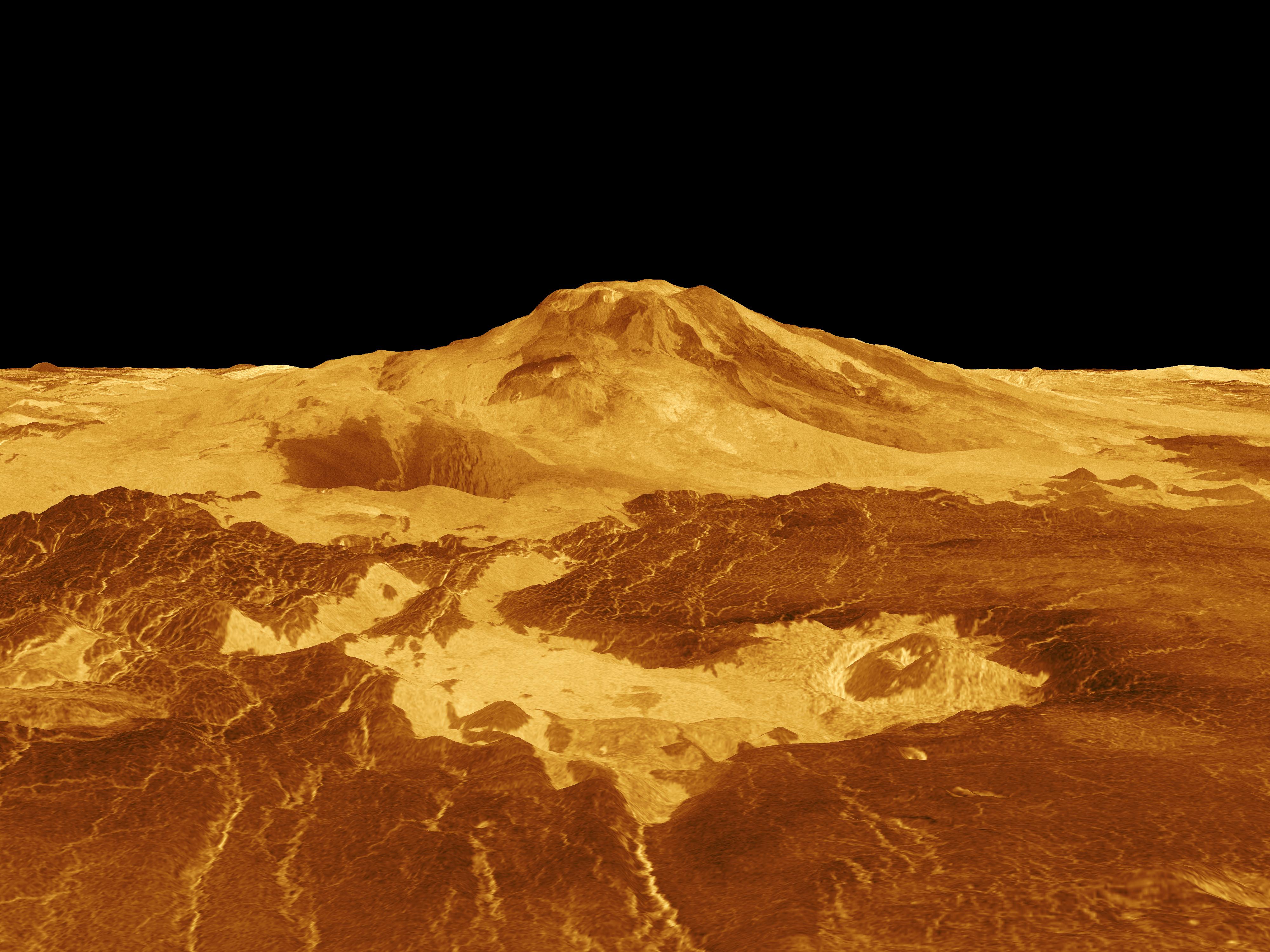
deglr6328 writes "The BBC is reporting that a paper published in the journal Icarus, suggests that the highlands of Venus are covered by a layer of Lead and Bismuth frost. The authors of the paper were looking for a way to explain the anomalous high reflectivity (and corresponding low emissivity) shown at high altitudes in synthetic aperture radar images sent back by the Magellan probe in the early 90's. The study concludes that Venus's lowlands are hot enough (~850F) to partially vaporize these metals into a mist which then condenses back out of the atmosphere to a solid on the surface of the cooler Venusian highlands."
Just a rough copy-and-paste. I'm not posting it AC because nobody trusts AC text reposts anymore. Too many troll text insertions (sometimes funny, sometimes just dumb). I've left out the footnotes and tables that don't format well -- if this piques your curiosity, download the original .pdf.
Heavy metal frost on Venus
Laura Schaefer and Bruce Fegley, Jr.
Planetary Chemistry Laboratory
Department of Earth & Planetary Sciences
Washington University
St. Louis, MO 63130-2302 USA
Submitted to Icarus
12 September 2003
Revised: 13 November 2003
Pages: 20
Tables: 2
Figures: 4
Proposed Running Head: Heavy metal frost on Venus
Editorial correspondence to:
Bruce Fegley, Jr.
Department of Earth and Planetary Sciences
Campus Box 1169
Washington University
St. Louis, MO 63130-4899
Phone: (314) 935-4852
Fax: (314) 935-4853
E-mail: bfegley@levee.wustl.edu
ABSTRACT
Chemical equilibrium calculations of volatile metal geochemistry on Venus show that
high dielectric constant compounds of lead and bismuth such as PbS (galena), Bi2S3
(bismuthite) or Pb-Bi sulfosalts condense in the Venusian highlands and may be
responsible for the low radar emissivities observed by Magellan and Pioneer Venus. Our
calculations also show that elemental tellurium is unstable on Venus? surface and will not
condense below 46.6 km. This is over 30 km higher than Maxwell Montes, the highest
point on Venus? surface. Elemental analyses of Venus? highlands surface by laser
induced breakdown spectroscopy (LIBS) and/or X-ray fluorescence (XRF) can verify the
identity of the heavy metal frost on Venus. The Pb-Pb age of Venus could be determined
by mass spectrometric measurements of the Pb207/Pb204 and Pb206/Pb204 isotopic ratios in
Pb-bearing frosts. All of these measurements are technologically feasible now.
Key Words: Venus, geochemistry, trace elements, Te, Pb, Bi, dielectric constant,
INTRODUCTION
Pioneer Venus and Magellan radar observations of Venus? surface reveal a
puzzling shift in radar properties at a planetary radius of ~6054 km (Pettengill et al. 1982,
1996, 1997, Ford & Pettengill 1983). Below this altitude and over most of Venus, the
radar properties are typical for anhydrous rocks, such as dry basalt. In contrast, higher
elevation regions have lower radar emissivity indicating the presence of semiconducting
minerals with high dielectric constants (Pettengill et al. 1996). A number of models have
been proposed to explain the unusual radar properties of the Venusian highlands. Among
these are: volumetric scattering from decimeter sized voids in surface rock (Pettengill &
Ford 1993), the presence of a low-loss soil layer (Tryka & Muhleman 1992), the loading
of surface rock with small conductors or dielectrics such as pyrite (Pettengill et al. 1982,
Ford & Pettengill 1983) or perovskite (Fegley et al. 1992), the presence of ferroelectric
minerals (Shepard et al. 1994), and the vapor phase deposition of high dielectric constant
metallic compounds (Brackett et al. 1995). However, Magellan bistatic radar
observations of the Maxwell Montes highlands (Pettengill et al. 1996) are best explained
by the metallic frost model (Pettengill et al. 1996, Brackett et al. 1995).
Brackett et al. (1995) proposed that the low emissivity minerals in the Venusian
highlands are metal halides or chalcogenides produced by volcanic outgassing. Halides
and/or chalcogenides of several volatile metals (e.g., Cu, As, Pb, Sb, Bi) occur around
terrestrial volcanic vents and fumaroles or are present in volcanic gases (Brackett et al.
1995). Although volcanic outgassing may occur anywhere on Venus? surface, the volatile
metals and their compounds only condense in the cooler Venusian highlands, which are
cold traps for the heavy metal frost.
Pettengill et al. (1996) suggested that the metalli
Stressed? Me? Of course not. Stress is what a rubber band feels before it breaks, silly.