 Slashdot Mirror
Konqueror Compiled For Mac OS X; KOffice Next
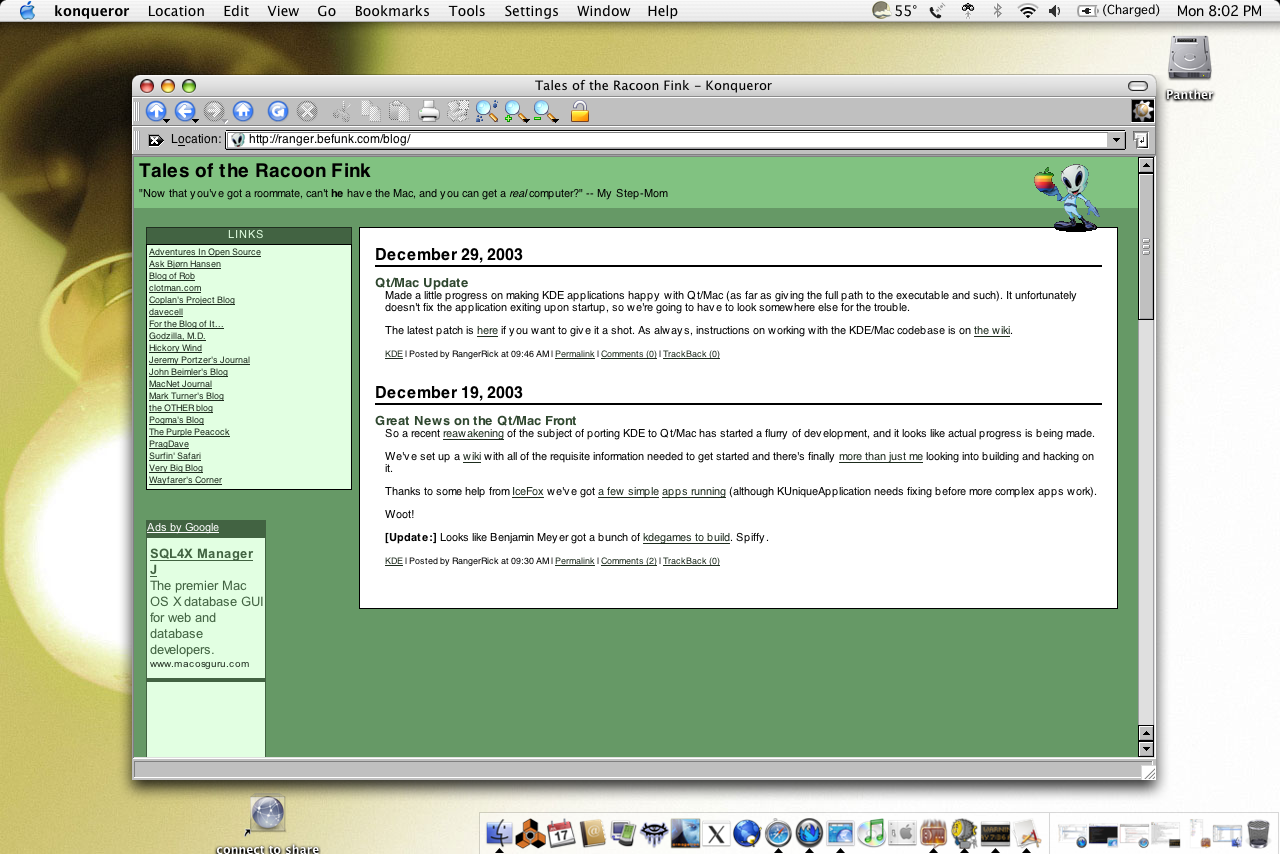
scishop writes "Benjamin Reed has just compiled Konqueror for Mac OS X after porting the KUniqueApplication class. A screenshot of the running program can be found here. According to Reed's blog, 'next up is KOffice.'"
while I agree that it is odd, there were a good number of other browsers for OSX
MSIE, Netscape/Mozilla, Safari, Camino, etc.
What a great idea!
That IS odd that they could not have ported
that to the Cygwin platform... I mean, X11
is available and all.
Wait, but isnt there already a port of KDE
to Cygwin?
This port doesn't use X11 at all. I have been on the maillist, and the stumbling block has been the X11 specific code(and a minor thing in QT-mac, reguarding extensions of shared libs). This is a real achievement, and rangerrick is to be greatly congratulated!
You should use AdiumX on your Mac.
As an example, I use gaim on FreeBSD because its tabbed interface is simply the best I've come across. I would love to use it instead of Trillian when I'm forced into using Windows. But the Windows port of gaim, which uses GTK+/Windows, works horribly. The GTK theme doesn't match my XP settings, widgets draw slowly and work clumsily (tooltips in particular seem to spontaneously appear and refuse to go away, even when the program is minimized!), and all in all it feels like a cheap Wal-Mart knockoff.
GTK+ widgets offer no benefits over standard Windows controls -- they draw slower, they don't match the environment, and Windows is just as themable as GTK is. Going back on-topic, this Qt/Mac port of Konqueror likewise eschews native widgets for the entirely out-of-place Qt look. All I can ask is Why? Wouldn't it be far easier for Qt/ and GTK/Windows or /Mac to simply wrap native widgets, rather than poorly ape them?
Loneliness is a power that we possess to give or take away forever
Can other browsers drag a file from a remote machine via ssh and drop it on another machine via ftp? Browse a digital camera? Connect to SMB shares? And of course, browse the Web - all at the same time, in different tabs and split screens?
No. Konqueror browses practically everything, not just the Web.
All that said, I do wonder if the kioslaves made it into this OS X version of Konqueror.
Yes, that's the whole point of what he did. You can already run KDE under X11 on OSX. (I've done it before). The thing that is special about this was that he actually *ported* it to OSX's Quartz windowing system.
There are no tiger attacks in my area and it's all because this rock I'm holding keeps the tigers away.
You're not misinformed, Safari does indeed use the KHTML engine. But the point of this appears to be to show the world that KDE apps can be ported to OSX in a manner that they won't require X11 (which a lot of the less-expert users shy away from). This means that these applications can be "first class" Mac applications.
I.e. someday soon, we may see grandmas everywhere running KOffice instead of shelling out hundreds for MS Office.
There are no tiger attacks in my area and it's all because this rock I'm holding keeps the tigers away.
Konqueror is more than a web-browser. Its other major use is as a file manager, among other things.
Evolution runs fine under Apple's X11, though a native port would be nice... it's a fine IMAP client in its own right, regardless of the Exchange features.
The big problem is getting those Exchange features - those are only available via the Exchange Connector for Evolution, which is a commercial product and is not available for OSX using X11. If there was a native port of Evolution then we'd still need a supported version of Connector, and would still have to pay for it.
For the same reason that Apple paid people to make contributions to the KHTML project.
OmniWeb may use the same underlying rendering and scripting engine that Safari uses but it is actually quite different than Safari. They are both great products but OmniWeb by far provides you with more functionality
About the only thing that Safari has over OmniWeb is tabbed browsing. OmniWeb has many more options than Safari such as regex filtering of content from sites, the ability to easily masquerade as any type of browser running on any type of operating system, autofilling of forms, tons of display options, the ability to set up shortcuts for the url input line ("google something" starts a Google search for something, "dict something" looks up something in dictionary.com, etc), and much more.
I'm not knocking Safari, it's a really nice, lean browser but its feature set is almost too lean. OmniWeb is kind of like a full-featured version of Safari.
Sapere aude!
If you don't like it, fuck off.
Safari has browser masquerading (enable the Debug menu), autofill, and such. There's no shortcuts, but I *believe* there's a third-party plugin that adds it (I'm not sure). There's no regex filtering, but PithHelmet is a third-party plugin that adds it.
Take a look at this...
:)
There are a few more screenshots, just go to the parent directory.. I hope it doesn't kill his server.
What time is it/will be over there? Check with my iPhone app!
For a GPL'ed SFTP/FTP program try out Cyberduck. It rocks :)
You said it yourself. Konqueror is more than just a web browser, it's also a file manager, with a lot of very nice features. While the port is primarily more of a proof of concept than anything, it does have advantages over Safari.
Learn to Play Go
Kopete is one of them, and AFAIK it is (or will be?) the official KDE IM client. It supports multiple protocols and is based on a plugin system.
And just in case you're wondering for its name, Copete is like we call here in Chile to the alcoholic beverages (like booze), and the main Kopete developer and author is chilean.
Regards!
Articulos para gente geek: Poleras, linux, libros y mas
A .war file is just an ordinary gzipped tar file with all the relevant files (graphics and style sheets) in it.
You are a little bit confused over this one. KHTML is the Konqueror/Safari html rendering engine, like what Gecko is to Mozilla/Galeon/Firebird.
Articulos para gente geek: Poleras, linux, libros y mas
The old Netscape code was dropped and Mozilla started it's life from stratch.
Mozilla is the most standards compliant browser in the world par none. It also has better CSS1/2 support than any other browser, including Konqueror.
How the hell are you using it when other people including myself have had more windows open and had it running longer (into weeks) without having to restart it.
*shrug*
Fugu is nice for SFTP, too. BSD'ed ;)
Timeo idiotikOS et dona ferentes
doesn't seem as fast as IE to load or as responsive on low-end hardware
The 'low-end hardware' bit I can understand, but traditionally, IE has cheated in two respects:
1. It plays dirty tricks, tries to foul up Netscape/Moz starts, and the Moz code has to go hunting in the Registry for all the booby traps and remove them first.
2. Windows loads most of the IE engine on startup. MS used to have a 'Preload' key in the Registry which could be turned off. If you turned it off, IE was slow as molasses to start. MS have removed the key now, and what I've heard, on XP Moz loads about as fast as IE. But that's only what I've heard.
I don't think the important achievement is in the fact that the we now have another browser on Mac OS X, because there is enough choice out there, nor is the additional feauture set of Konqueror important to me.
What IS important is that some people have figured out how to isolate KDE from X11, which sets a precedent for porting other KDE apps to Mac OS X. Programs such as KOffice or Kopete do seems worth the bother to me.
Reblet
Which had a modern file system first? Hint: in no case was it MacOS.
I think it depends what you mean by "modern". When Unix was created it used a very simple file system compared to most operating systems of the time because of the "everything is a stream of ascii text" metaphore. That is to get piping to work the database file systems which were common at the time were not used. "modern" file systems seem to be returning to the 70s filesystems and even on Unixes most applications don't create streams of ascii. MacOS had metadata which is more in the "modern" direction than windows.
Apple does give back to the OSS community. They contribute to the GNU project (gcc), to KDE (KHTML upgrades for WebKit have been ported back) and they even provide kernel-level things (the HFS+ filesystem driver for FreeBSD comes from Darwin). Why should they give anything to Linux? Linux is just a kernel, and has contributed nothing to Apple...
I am TheRaven on Soylent News
Bullshit. Finder crashes daily on me browsing my Samba network under 10.3 which is fully updates.
Did you think I made this up? There's a thread going on about Macs over at OSnews and many people are having the same problem I have. Just because you haven't experienced it doesn't mean it doesn't happen.
This guy is way out there