 Slashdot Mirror
Colorization of Mars Images?
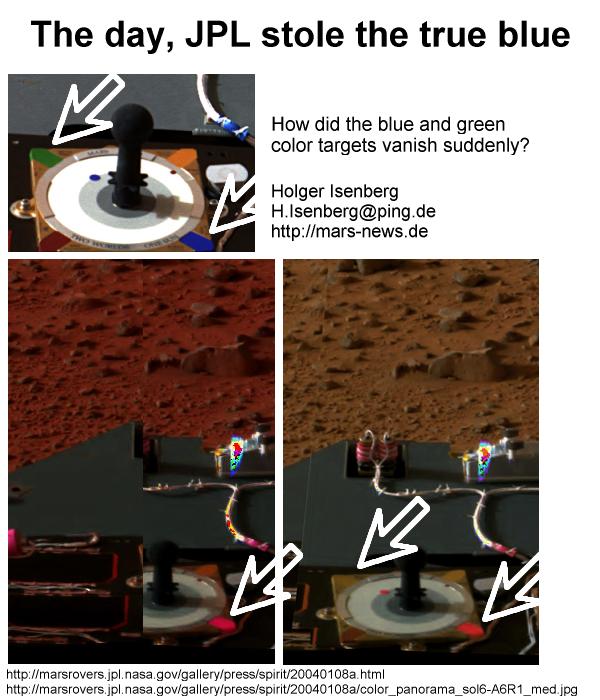
ares2003 writes "There is no scientific reason, why JPL is colorizing Mars in that dull red tint as in their press release images. In the latest panorama image, there is a hint, that they deliberately altered the colors, as the blue and green spots on the color calibration target (the sundial) suddenly converted to bright red and brown. Source of original images: 1, 2 - (for highres replace "br" with "med"). At normal weather conditions, as we have at the moment, there should be a blue sky on Mars and earthlike colors. Furthermore the sky looks overcasted on the pictures as it cannot be considering the sharp shadows on the sundial. If the sky was overcast, then because of diffuse lighting, there would be no shadows. A few years ago, I did an investigation about that very same topic for the Viking and Pathfinder missions."

Its no secret that they doctor the images for press release. They also have the original available. Check out Maestro, it was mentioned on Slashdot a few days ago, its almost the same software JPL uses, and the images in the data set are the original ones.
Not sure if this could be the reason but the MER-A pictures aren't taken at a specific time but rather during a whole day.
That means that the colors you see on the sundial don't match all frames of the final picture you get.
NASA therefore alters the colors to match the pictures as closely as possible. Maybe this disturbs the color? Not sure though. What do you think?
The images they took are shot through near-infrared filters, and then digitally adjusted to compensate. The pan-cams each have about 16 different types of filters on a rotating wheel, but this near-infrared filter is the only color that's common to both lenses. Therefore, when they're taking stereo images, that's the best one to use. It's not a conspiracy, and they'll probably release images taken through the other filters eventually.
Actually, (AFAIK, IANAS, correct me if I'm wrong) the Hubble images are correct, but they're just using pretty colours to represent different kinds of radiation, not just the normal light.
The path I walk alone is endlessly long.
30 minutes by bike, 15 by bus.
But the same light refraction phenomenon that gives Earth a blue sky as seen from the ground should give Mars a blue sky as seen from the ground as well. Enough dust in the atmosphere could interfere with that sufficiently to create a red hue, but this should not be the norm in calm weather conditions.
File under 'M' for 'Manic ranting'
They do that so that different elements of the image can be more easily identified, not to make things prettier. It does make for some very impressive images, but that isn't the point.
[sig] 10 + 10 = 100 [/sig]
as the blue and green spots on the color calibration target (the sundial) suddenly converted to bright red and brown.
The "sudden" change happened as NASA "suddenly" applied another filter for the camera. They do this to better detect certain things in the picture I suppose. They spoke about it on a press conference when they was asked this question.
From Mozilla guru Asa Dotzler's weblog:
Q. Then what we're seeing that's in that Pancam image doesn't correspond to what we'd see if we were standing there?
Jim: we have a pair of red filters that give us stereo. The red you're asking about is the infrared filter which is different from the red humans see. We can convert that red easily. We also have a red filter that matches human sight red but we prefer to use the infrared filter to get matchup with both cameras. Two cameras each have 8 filters. One filter on one eye is a dense welder-like filter to look at the sun. On the left camera is low frequency and the right camera is higher frequencies. Total of 11 unique wavelengths.
Beware: In C++, your friends can see your privates!
My keyboard is obviously a part of the conspiracy. Butterscotch martian sky
Unfortunately, it seems the primary motivation for the Mars for the general population is now sensationalism. I'm sure the Slashdot audience how a different view on Mars though.
USA Today has a good article about how Mars is shifting from science to politics.
The Washington Post explains better the goals of the current US gov.
I'm not saying it's necessarily a bad thing because that's usually how space projects get more funding but it might explain why the photos are looking more "nice to the user" than "scientifically realistic".
It is not enough to have a good mind. The main thing is to use it well. - Rene Descartes (1637)
Read here
The sundial from a little while ago helps find tint and all. The pics need calibration.... doesn't sound like a conspiracy to me.
WHen Hubble uses false color, that fact is *always* noted at the official site. If other people use the images and drop NASA's text, they can't be held responsible.
And, yes, NASA has to color correct just about every image one of their probes or landers takes. It's necessary because of now the images are taken. That ain't no cheap digital camera up there.
I have discovered a truly marvelous sig, unfortunately the sig limit is too small to contain i
Actually, I was just at rednova.com yesterday looking at archives of Nasa images, and not only is this explicitly mentioned, but for many of the false-color images, they specify the method by which they were constructed (shot thorough this filter, that filter, and the other filter, and recombined, that sort of thing).
The scientists understand the real colors, the public (who funds it, after all) expects it to be red. They want red, we'll give 'em red. I'm not saying I agree with that, but I understand where they're coming from.
The veracity of the person who brought this up (Mr. Martian Pyramids and such) isn't something I'll do much commenting on.
I was watching a press conference on CSPAN and the guys at JPL actually brought this up themselves. The thing is the camera's have filters for a wide variety of wavelengths many of which aren't visual light at all. Each camera has a different array of filters and actually only share two filters in common for stereo vision.
I got the impression that many of the fiters that ARE within the visual portion of the spectrum were only letting in narrow bands of the spectrum. Exactly what color SHOULD infra-red images be? For obvoius reasons keeping them in their "orignal" spectrum would be fairly useless - though "red" would be as close as we can come.
For just pretty pictures rather than scientific data NASA is color-correcting the images - I think it is more involved than simply colorizing a black and white image. They mentioned compositing together several images from different filters to get a fair approximation of what the human eye would percieve if it was there.
The Rovers are solar powered. Taking pictures would suck a lot of power from the batteries otherwise needed to make iti through the night.
"Just once, I'd like to meet an alien menace that wasn't immune to bullets." -- The Brigadier, Dr. Who
No device "sees" colors the way humans see color. Heck, no two humans see color the same way. All images, especially science images, whether they are photographic prints or digital images, are colorized and manipulated and stretched and bent and filtered and modified to enphasize the details the investigator is interested in.
You think Jupiter is a really garish ball of swirling colorful gasses? Think again. All the Galileo and Voyager images have saturation boosted a great deal, and the contrast is stretched mightily. Furthermore, the luminance layer is deconvolved to bring subtle spatial details into sharper relief. To the human eye, Jupiter is a rather bland beige-ish ball with some hint of subtle color here and there, and not much obvious detail. The same goes for Io, which is usually depicted as a bright yellow/orange malestrom. It's "real" colors - what a human in orbit would see - are also rather bland.
Edith Keeler Must Die
"They do that so that different elements of the image can be more easily identified"
There's another even more important reason...most of the colors are for wavelengths of light that could not be seen anyway.
The last time I checked I could not see UultraViolet, Infrared, or X-rays.
Anyway, the color dots on the lander SHOULD look different as the lighting conditions are different on Mars due to the scattering properties of that atmosphere. Colors under Flourescent lights like we all sit under are very different than those out in the sunlight. If the images from Mars had the color corrected to pure colors, it would not be a true representation of what we would see if we were standing there.
"I never get lost because everybody tells me where to go"
Possibly because they aren't actually visible from the surface. They are pretty dang small.
For geek's sake:
Our moon has an apparent size in the sky of about 1800 arcseconds. This is found by arctan(radius of the moon/distance to the moon) * 2.
By comparison, Phobos would appear to be about 900 arcseconds from the surface of Mars. Deimos would be about 200 arcseconds.
So actually Phobos would appear to be about half the diameter of our moon and Deimos would appear to be about 1/9 the diameter. I suppose that's not terribly small, but you also need to recognize that far less light will be hitting them and then reflecting off. Phobos would be much dimmer than our moon, and Deimos is dark in color, so it may not be easy to see even with the naked eye.
I imagine capturing an image of the moons with the camera on board a rover would be difficult.
This is a "Bill Nye" project.
No, the sky is blue on earth due to the exact conditions we have here. If our atmosphere was less dense, the sky would be darker (less diffused light). Our atmosphere is so dense and made up of the right stuff (nitrogen, oxygen, carbon dioxide) that our sky is actually violet. However, because our sun puts off more yellow and green light then any other colors, our eyes have adapted to seeing those colors better, and the sky appears to be "sky blue". As the atmosphere gets less dense, it shifts left on the EM scale (roygbiv), and gets darkers overall. As it gets more dense, it shifts left on the EM scale(that's why sunsets are red, the sunlight passes through more air at sunset and sunrise) It's actually very complex to determine what color a sky will be. It depends on these factors-
Incoming light colors
atmosphere make-up
atmosphere density
angle of incidence
the eye of the observer
That's why Mars has a butterscotch sky- very low density atmosphere made up almost entirely of CO2
For futher comparison, when it is closest (as is was recently), Mars itself appears to be about 18 arcseconds in diameter when viewed from Earth.
Seems like they're working pretty quick over at JPL to get the colorized version of the images out to the general public, since this week, they've been releasing them less between 6 and 18 hours after receiving them. But if you're not happy with their coloration, then I invite those among the slashdot community who know such things to do it themselves.
The pan cam is black and white, and uses filters to pick out certain colors in the images it takes. If you want, you can read more about what filters are on which half of the pancam (l and r). There are 8 on a side, each with its own particular wavelength and bandpasses. The description of each as well as the numbering scheme is available from the Athena instruments website at Cornell University
The raw images are being freely distributed from the JPL MER website. You'll notice camera (l or r) and filter (1-8) used is described from the naming of the pancam files (eg. 2P126471535EDN0000P2303L6M1.JPG)
Just from this last days images, they have quite a few images in differant filters, of the color wheel itself, for calibration. For a better description of the filters themselves, and of the way they plan to (and have *BEGUN* to) calibrate the images, check out several differant publications. (thanks to JPL-Gene and doug_ellison of #maestro irc.freenode.net for the links).
I, for one, am thankful that they're releasing the raw data/images at all, considering the scale of the global-slashdotting currently going on. The speedy data turnaround, and amazing openness with which they are conducting this mission is really impressive compared to anything else of this scale. Thanks to everyone at JPL, Cornell, and NASA as a whole for all the incredible work from this meager enthusiast.
OK, I do spend part of my life processing HST Images (and Chandra images, VLA images, etc.). cynicalmoose is sort of on the right track but the explanation is muddled, confusing spectroscopy with imaging. HST takes no true color images as you would get with color film, for instance. Yes, images are digital with an array of numbers, but so what? An individual image is a simple intensity map *taken through a single color filter*. HST has a pile of filters, some colors like blue, red, etc., even infrared and ultraviolet (so you do need false color for these). Some are narrow-band filters centered on particular emission lines to pick out particular elemental emission (e.g., useful when studying nebulas). You can make a so-called "true-color" image by mixing together several of the individual images taken in different filters, and this can be pretty close to true. The emission-line filters high-light colors in a false but useful way. UV and IR do require false color (and Hubble cannot see X-rays). Sometimes "black and white" single-color images are rendered with a color map that permits subtle detail to be more easily seen (this is pretty common actually, and I have done it myself for press releases, since you rarely pick out filters for the creation of true-color images as there isn't a lot of science in that).
Professor of Astronomy, Author of Spider Star & Star Dragon (Tor)
However, in general you are right, the colour corrections are arbitrary and don't match the "real" colours. Moreover, the brightness stretching and image processing often changes the colour in strange ways. There's a recent paper which discusses the problem and presents some solutions.
True, but the JPL images webpage has a couple pictures of the color calibrator while _on_ mars, clearly showing the blue and green.
So the images are clearly color-doctored. Whether this is part of some grand martian conspiracy I leave as an exercise to the reader...
If I was worried about Karma, I'd eat tofu.
Holger Isenberg, the guy behind mars-news.de, is one of many kooks out there who are too ugly and interpersonally incompetent to ever hope to get laid in this life time. He must therefore resort to enclosing himself into his imaginary universe of in-bred conspiracy theories. enjoy.
NASA has always made raw data available to the public, which is what you can leverage thru the Maestro the software. The red tint observed in composite pictures made available to the public are, in fact, a fairly accurate representation of the truth. Pictures MUST be composited to be available in a JPEG format Joe Six Pack can look at in his browser, hence some level of alteration is necessary. There is no lie. There is no conspiracy. Even your average Joe Six Pack can grok the fact that some basic alterations are necessary to represent flat images. Otherwise Joe Six Pack can always download Maestro.
Extraordinary Vacations. Exceptional Prices
Several people have explained what's going on, and even quoted the press conference where this was discussed. One of the other points from that same press conference was that the pigments of the calibration target were carefully chosen so that each is useful for multiple filters. That sounds strange if you think about the pancams like a pocket digital, but they're not. They use a filter wheel, so each wavelength images all of the calibration target. By making each "color" on the target cover multiple wavelengths they get more information. I think the specific example was that the blue target shows up as bright white to the near-IR filter they were using. The result is that in the *composite* they are wacky colors, since the aggregate of the calibrations doesn't "make sense".
/. with no editorial review.
In other exciting news, this morning they showed some of the mini-TES (thermal emission spectrometer) images. That data is very hard to interpret, so it is ripe for crackpot articles that can be posted on
I watched a press meeting at NASA Tv. Actually, the rover has 8 filters on each camera, with only a few in common (also, one of them is a sun filter, so the rover can figure out it's orientation and direct it's antenna to earth). The blue pigment on the sundial is specially selected because it also has a strong infrared signature. So if you watch the blue spot with the infrared filter, the "blue" spot turns out red. Another mistery solved.
"It's too bad that stupidity isn't painful." - Anton LaVey
If you use Maestro, you can download the actual original images as first seen by Spirit and the scientists at NASA.
I worked (from MIT) with Viking Lander data, not camera data, but I followed all of this closely at the time and had lots of discussions with people at JPL about this and other topics.
The Viking landers used a scanning (spot) camera, which was slow but which was also one of the first really good scientific cameras sent on a space probe. It was designed to provide a very repeatible color readout of what it saw, but, like most such cameras, was subject to drift, so color calibration targets were included on top of each lander.
When Viking Lander 1 landed, the first color pictures released had a blue sky. These were done with the color balance adjusted "by eye" at JPL. When they had time to analyze the color targets, they released that they had made a mistake, and that the sky was red.
I specifically remember hearing that they had adjusted the color balance in the first release image, and had to adjust it back to get true color.
They had no reason to lie and were a little embarassed to have made the initial mistake.
So I regard thiis article as being without merit.
I grew up in Southern Africa at an altitutde of around 1500 meters (somewhere near 5000 feet) above sea level. I remember the sky of my childhood being a dark deep blue. Take a loof at the pictures taken at the top of K2 or everest, or even better, if you can find them, colour images of the X-15 experimental planes of the 60s. At that altitude where the X-15 is soon after launch, close to 30'000 meters (100'000 feet) the sky is almost black.
That is, as most of know, because the very low air density at higher altitudes refracts far less light.
The average surface air density on Mars is more or less the same as it is on Earth at 30'000 meters. That means that the sky on Mars will probably be almost black with a small band of colour on the horizon.
That band of colour will be due to so called rayleigh scattering, by which air molecules scatter the light passing through them. Oxygen and Nitrogen on earth, being small molecules will scatter light of a smaller wavelength (blue) than on mars, where the atmosphere is mostly carbon dioxide. The light thus produced on mars will be NOT be red and NOT be blue but somewhere in the middle (yellow/brown) as the larger carbon dioxide molecules will scatter light of larger wavelengths than on earth, but not enough to make the light seem red as that would require a gas of larger molecules such as methane or propane which, of course, is the main atmospheric component on Titan, saturns moon, and lo and behold, we get a deep orange light there.