 Slashdot Mirror
Colorization of Mars Images?
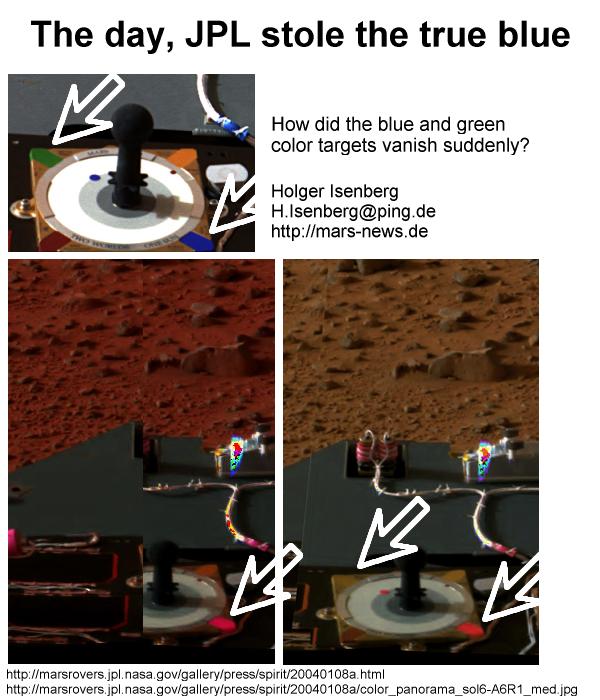
ares2003 writes "There is no scientific reason, why JPL is colorizing Mars in that dull red tint as in their press release images. In the latest panorama image, there is a hint, that they deliberately altered the colors, as the blue and green spots on the color calibration target (the sundial) suddenly converted to bright red and brown. Source of original images: 1, 2 - (for highres replace "br" with "med"). At normal weather conditions, as we have at the moment, there should be a blue sky on Mars and earthlike colors. Furthermore the sky looks overcasted on the pictures as it cannot be considering the sharp shadows on the sundial. If the sky was overcast, then because of diffuse lighting, there would be no shadows. A few years ago, I did an investigation about that very same topic for the Viking and Pathfinder missions."

..but releasing these images to the public is a public relations endeavor, not a scientific endeavor.
Catering to it is no better than being an advocate of the conspiracy theories in the first place.
File under 'M' for 'Manic ranting'
Why shouldn't NASA color-enhance images used for PUBLIC RELATIONS purposes? This isn't the data that scientists are going to use - it's advertising, designed to get them good PR and consequentally, more funding. Joe Sixpack doesn't care about science, but he does like shiny things. Scientists, and anyone else who really needs or wants it, can get the raw data.
Why is it that the proponents of "one nation under God" are so eager to get rid of "liberty and justice for all"?
This story should be pulled, it is wrong in too many places, and is just a bunch of conspiracy mumbo-jumbo. The pictures are slightly modded for color, but that's because it's a collage
As evidenced, here, the Martian sky is more yellow/butterscotch (they used the Viking landers American flag to balance the colors properly,pictures are on the website). The Martian sky doesn't really get "overcasted" as there is no moisture in the air to create clouds! There is dust, yes, but the atmosphere is so thin, the sunlight can still go through it. Ares2003 has a few loose screws-My guess is that the digital image of the craft itself was taken later in the martian day, and modifying the color of the photo was the only way to make it look like it "fit in". Mars should not have "earth-like" colors. Any glance through a moderately-powerful telescope will show that the "red planet" is, in fact, red in color (iron oxide dust). Those more yellow pictures of Mars floating around are actually not real photographs, but generated images from the Mars Orbiter Laser Altimeter data.
To see lots of pictures and some scientific conjecture and analysis, you can go here
USA Today has a good article [usatoday.com] about how Mars is shifting from science to politics.
Wait a minute. You're suggesting that missions to other celestial bodies might have... political or nationalistic overtones that often far dwarf the actual scientific value of the mission?
Um... do you know anything about the space race between the U.S. and Soviet Union?
OtakuBooty.com: Smart, funny, sexy nerds.
These plans are all very exciting folks, but our grandchildren are going to be paying the bill one day. It's time for the current administration to cut up the credit cards and start taking packed lunches instead of eating out, for a day of reckoning is coming and the American taxpayer is going to suffer badly. Entry into the third world awaits....
Drill baby drill - on Mars
Today's Sesame Street was brought to you by the number e.
Color is a figment of your brain's imagination. In some situations, a proper white balance will make the picture closely match what your brain perceives (else people would have green skin under fluorescent lighting). In other situations (like sunsets), a proper white balance makes the picture look completely different from what your brain perceives.
This issue came up with the pictures from the Viking landers. The first pictures sent back, before color calibration, had a blue sky. IIRC the color correction NASA did wasn't a pure white balance, but something to more closely reflect how the scene would look to your eyes (and brain) if you were there.
Note that in those photos they have 'greyed out' the portion of the photograph containing the atmosphere and surface of the planet.
--is not to be confused with user #672982 - Bame Flait
Go out and by some theatrical gel filters ("tough no green" or "tough 1/2 green" will do). Cut them into strips, roll them to make tubes and slide tubes over each of the fluorescent lights in a room. Now:
- Turn on the lights and leave the room for about 10 minutes.
- Look into the room and notice how everything looks pinkish in the room.
- Enter the room (everything still looks "wierd") and look at objects outside of the room (they look "normal").
- Wait 10 minutes and try the above step again.
You will notice that once you have become accustom to the light in the room that objects in the room sort of look "normal" (not quite though) and everything outside of the room looks pink.Now I ask you, in both cases you have a "pink" area and a "normal" area, so which area is showing true colors and what will your Canon PowerShot A60 show?
My point: color perception can be fooled quite easily and what you see as red may not be red or not what I see as red and certainly not necessarily the same tint or red the anyone/anything else sees it as. Ambient lighting conditions do have an effect on what color objects are precieved to be. This effect may not necessarily be the same for your eyes and a camera.
Merlin.
For those of you curious: the above experiment was done to some offices where I use to work as the persons working in them found the shifted light reduced eye strain.