Slashdot Mirror


Colorization of Mars Images?

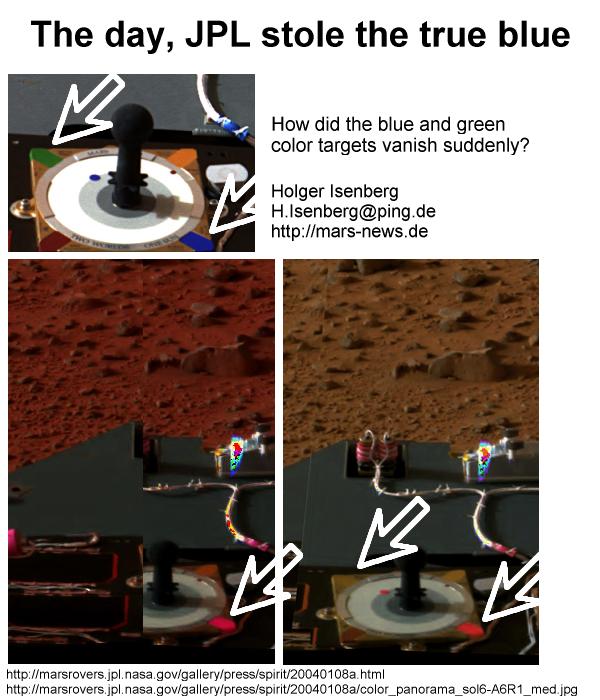
ares2003 writes "There is no scientific reason, why JPL is colorizing Mars in that dull red tint as in their press release images. In the latest panorama image, there is a hint, that they deliberately altered the colors, as the blue and green spots on the color calibration target (the sundial) suddenly converted to bright red and brown. Source of original images: 1, 2 - (for highres replace "br" with "med"). At normal weather conditions, as we have at the moment, there should be a blue sky on Mars and earthlike colors. Furthermore the sky looks overcasted on the pictures as it cannot be considering the sharp shadows on the sundial. If the sky was overcast, then because of diffuse lighting, there would be no shadows. A few years ago, I did an investigation about that very same topic for the Viking and Pathfinder missions."
9 of 784 comments (clear)

  1. There may be no scientific reason by Nevo · · Score: 5, Insightful

    ..but releasing these images to the public is a public relations endeavor, not a scientific endeavor.

  2. Re:It's quite simple really by mark-t · · Score: 4, Insightful
    Why the F*** would they care whether or not some conspiracy freaks choose to misinterpret the facts as a coverup?

    Catering to it is no better than being an advocate of the conspiracy theories in the first place.

  3. Re:Check the links, editors by Tassach · · Score: 5, Insightful

    Why shouldn't NASA color-enhance images used for PUBLIC RELATIONS purposes? This isn't the data that scientists are going to use - it's advertising, designed to get them good PR and consequentally, more funding. Joe Sixpack doesn't care about science, but he does like shiny things. Scientists, and anyone else who really needs or wants it, can get the raw data.

    --
    Why is it that the proponents of "one nation under God" are so eager to get rid of "liberty and justice for all"?
  4. The Martian Sky is butterscotch, not blue by UPAAntilles · · Score: 5, Insightful

    This story should be pulled, it is wrong in too many places, and is just a bunch of conspiracy mumbo-jumbo. The pictures are slightly modded for color, but that's because it's a collage

    As evidenced, here, the Martian sky is more yellow/butterscotch (they used the Viking landers American flag to balance the colors properly,pictures are on the website). The Martian sky doesn't really get "overcasted" as there is no moisture in the air to create clouds! There is dust, yes, but the atmosphere is so thin, the sunlight can still go through it. Ares2003 has a few loose screws-My guess is that the digital image of the craft itself was taken later in the martian day, and modifying the color of the photo was the only way to make it look like it "fit in". Mars should not have "earth-like" colors. Any glance through a moderately-powerful telescope will show that the "red planet" is, in fact, red in color (iron oxide dust). Those more yellow pictures of Mars floating around are actually not real photographs, but generated images from the Mars Orbiter Laser Altimeter data.

    To see lots of pictures and some scientific conjecture and analysis, you can go here

  5. Re:Mars has become a political agenda by John_Booty · · Score: 4, Insightful

    USA Today has a good article [usatoday.com] about how Mars is shifting from science to politics.

    Wait a minute. You're suggesting that missions to other celestial bodies might have... political or nationalistic overtones that often far dwarf the actual scientific value of the mission?

    Um... do you know anything about the space race between the U.S. and Soviet Union?

    --

    OtakuBooty.com: Smart, funny, sexy nerds.
  6. Feynman by sleepingsquirrel · · Score: 5, Insightful
    You might be interested in a little something by Richard Feynman
    I would like to add something that's not essential to the science, but something I kind of believe, which is that you should not fool the layman when you're talking as a scientist. I am not trying to tell you what to do about cheating on your wife, or fooling your girlfriend, or something like that, when you're not trying to be a scientist, but just trying to be an ordinary human being. We'll leave those problems up to you and your rabbi. I'm talking about a specific, extra type of integrity that is not lying, but bending over backwards to show how you're maybe wrong, that you ought to have when acting as a scientist. And this is our responsibility as scientists, certainly to other scientists, and I think to laymen. For example, I was a little surprised when I was talking to a friend who was going to go on the radio. He does work on cosmology and astronomy, and he wondered how he would explain what the applications of his work were. "Well," I said, "there aren't any." He said, "Yes, but then we won't get support for more research of this kind." I think that's kind of dishonest. If you're representing yourself as a scientist, then you should explain to the layman what you're doing-- and if they don't support you under those circumstances, then that's their decision.
    1. Re:Feynman by kfg · · Score: 5, Insightful

      The problem is that people aren't given proper training to understand the truthful answers you give them, even when you include such training in the explanation.

      All they hear is "I don't know."

      "Well Jeeeeezus. I thought you were supposed to be some kind of expert or something. If I wanted to be told 'I don't know' I could have asked my retard cousin Vinnie. I'm gonna go watch the FOX special on this. Those boys talk straight and tell me The Answer.

      The problem is fostered in our lower schools. They are taught "facts," and are given tests to determine if they have memorized those facts well enough to regurgitate them, i.e. give the "right" answer to the question. Even mathmatics is treated as simple arithmetic where you manipulate some numbers to come up with a predetermined correct outcome.

      All of this teaches science not just as facts, but as a field where things are simply either correct or incorrect. Knowledge as a collection of preapproved facts and for every question there as an answer.

      Whereas science, that is to say the real sort of science that Feynman is talking about, isn't about known true facts so much as it's about the limitations on our knowledge and why those limitations exist and what we might do to expand those limitations.

      If they haven't had the proper background, fairly early in life, when you explain these things to people as well as it's possible to explain them all the vast majority hear is:

      "I don't know."

      Then wander off muttering that the problem with scientists is that they refuse to give you straight answer, never suspecting that that's good science.

      After a decade or four of this even most scientist legitimately trying to exlain things properly get frustrated and devise a set of stock answers. When given these stock answers people respong "Whoooooa! Really? Hey, that's pretty neat" and walk away with a smile on their face. Perhaps a wee bit better educated on a facts basis but no wiser.

      It doesn't stop me from telling things as they are, but I've found over the years that the only real audience is children. They listen, they pay attention, they learn.

      And I hope they then grow up to hear more than "I don't know" when told the truth as we actually know it, especially if they get elected to congress.

      For that matter I hope they grow up to be scientists who tell the truth . . . and get elected to congress.

      KFG

  7. Re:Mosaic by Zordak · · Score: 4, Insightful
    It's not rocket science, after all...
    Which is exactly the problem. Never send a rocket scientist to do an artist's job.
    --

    Today's Sesame Street was brought to you by the number e.
  8. Re:Check the links, editors by WasteOfAmmo · · Score: 4, Insightful
    An experiment for you:

    Go out and by some theatrical gel filters ("tough no green" or "tough 1/2 green" will do). Cut them into strips, roll them to make tubes and slide tubes over each of the fluorescent lights in a room. Now:

    • Turn on the lights and leave the room for about 10 minutes.
    • Look into the room and notice how everything looks pinkish in the room.
    • Enter the room (everything still looks "wierd") and look at objects outside of the room (they look "normal").
    • Wait 10 minutes and try the above step again.
    You will notice that once you have become accustom to the light in the room that objects in the room sort of look "normal" (not quite though) and everything outside of the room looks pink.

    Now I ask you, in both cases you have a "pink" area and a "normal" area, so which area is showing true colors and what will your Canon PowerShot A60 show?

    My point: color perception can be fooled quite easily and what you see as red may not be red or not what I see as red and certainly not necessarily the same tint or red the anyone/anything else sees it as. Ambient lighting conditions do have an effect on what color objects are precieved to be. This effect may not necessarily be the same for your eyes and a camera.

    Merlin.

    For those of you curious: the above experiment was done to some offices where I use to work as the persons working in them found the shifted light reduced eye strain.