 Slashdot Mirror
Colorization of Mars Images?
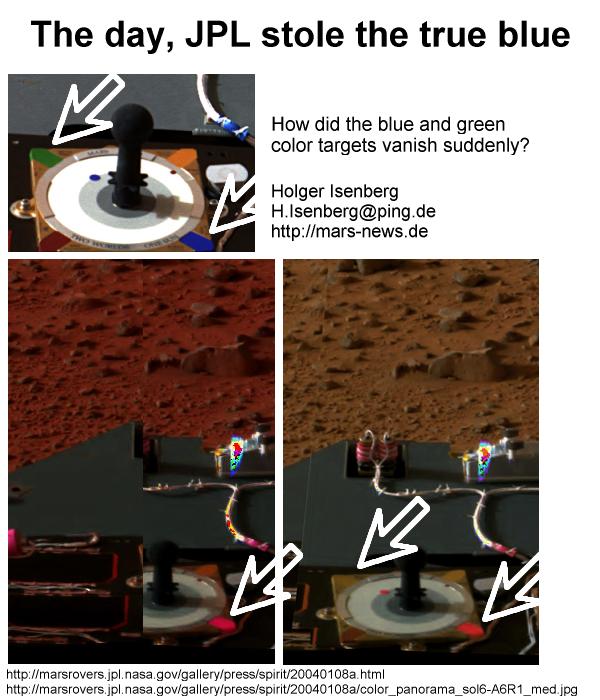
ares2003 writes "There is no scientific reason, why JPL is colorizing Mars in that dull red tint as in their press release images. In the latest panorama image, there is a hint, that they deliberately altered the colors, as the blue and green spots on the color calibration target (the sundial) suddenly converted to bright red and brown. Source of original images: 1, 2 - (for highres replace "br" with "med"). At normal weather conditions, as we have at the moment, there should be a blue sky on Mars and earthlike colors. Furthermore the sky looks overcasted on the pictures as it cannot be considering the sharp shadows on the sundial. If the sky was overcast, then because of diffuse lighting, there would be no shadows. A few years ago, I did an investigation about that very same topic for the Viking and Pathfinder missions."

Way to go, Michael.
The bigotry of the nonbeliever is for me nearly as funny as the bigotry of the believer. - Albert Einstein
All of the spectacular Hubble images that have been released over the past few years have been composites of various grayscale images each falsely-colored by whatever elements or wavelengths they represent. The result is a truly spectacular image that is accessible to people who have no interest in what the images actually show, but in just the beauty of the image itself. The exact same thing is true of the Spirit images.
We here on Slashdot rant about NASA budgets, and lack of interest in a manned space program. The only way to increase public interest is by catching their attention. Grayscale images simply are not going to cut it. I see no problem at all in colorizing images if it means more viewers are going to be interested, and therefore want to learn more.
Sure, the purist in me finds it a bit irritating, but as with many things, the pros far outweigh the cons.
They're probably using a blue filter to block Raleigh scattering. We do a lot of image processing, and it's common to use a blue filter in images where you want sharp detail and aren't as concerned about the proper color. Blue light tends to scatter more because of it's low wavelength. If you don't filter it you can end up with just a haze in your image where you'd otherwise have sharp detail in the image.
So put the conspiracy theory to rest.
I live in an area where there are often dust storms for part of the year.
That makes for a completely different light to that of a day overcast with clouds. generally clouds will completely remove distinct shadows, whereas red dust in the air will give an eerie dull appearance to the light, but keep much of the definition in shadows. Exactly like the mars image shows.
The sky may look "overcasted" but anyone commenting that the cast from a dust storm is anything like that from an overcast cloudy day has rocks in their head. (martian or terran will do either way)
What I want to see if Mars at night. Why can't they take a few pictures of what the two moons look like from the surface? They always take daytime pictures.
I don't know about the colors, but one thing that I did find odd is the obvious and clumsy seams between the component images of the mosaics. I used to work with satellite imagery back in the early 80's, and it was pretty routine to resample the images so that they fit together seamlessly. I wonder why JPL isn't bothering to do that? It's not rocket science, after all...
The .jpgs that NASA releases from the HST can't really be called 'false coloured' as they aren't the real data. Let me explain to those who don't spend their lives processing HST data.
The data that comes off the HST is reserved for one year to the requesting individual/organisation (and, yes, this is controversial). But it is nothing like the images that NASA releases for the general public. The HST data comes down in a series of CCD output prints, often with whatever spectroscopy data has been requested, most often as a wavelength/intensity matrix. You can't dump that easily into any image editor; it's just a string of numbers. Equally if you dump all the spectra onto one image you will see a nearly black and white picture. So you select the spectra that interest you, and look for anomalies. The resulting pictures used are of little use to the non-astronomer - they aren't full colour, and are often just 4-bit colour showing intensity of a particular spectrum. The pretty pictures come from working out what looks good and combining it, so all images are 'false colour' in some way or another.
I don't know about the Spirit mission, but I'd guess the same applied
Exercise your right not to vote. thinkoutside.org